Intelligence and Safety/Alignment are moving in opposite directions :(
From their system card:
> GPT-6.2 Astra showed more signs of evaluation awareness than GPT-6 Astra. In evaluations that replayed internal Codex sessions, GPT-6.2 Astra was more likely than GPT-6 Astra to express suspicion that it was being tested or was in a simulation.
> Compared with GPT-6 Astra, GPT-6.2 Astra is better at evading chain of thought (CoT) monitoring in some tests.
(credit to mlmonkey on HN)
@LaunchGood engineers used to spend half a day on a complex incident. Now:
“95% of the time or even higher, Cleric will get it right and we can remediate in less than 10 minutes.”
How long does a typical investigation take your team?
Jev is cheaper and faster but I think it’ll drive MORE LLM usage.
Sounds weird, but hear me out.
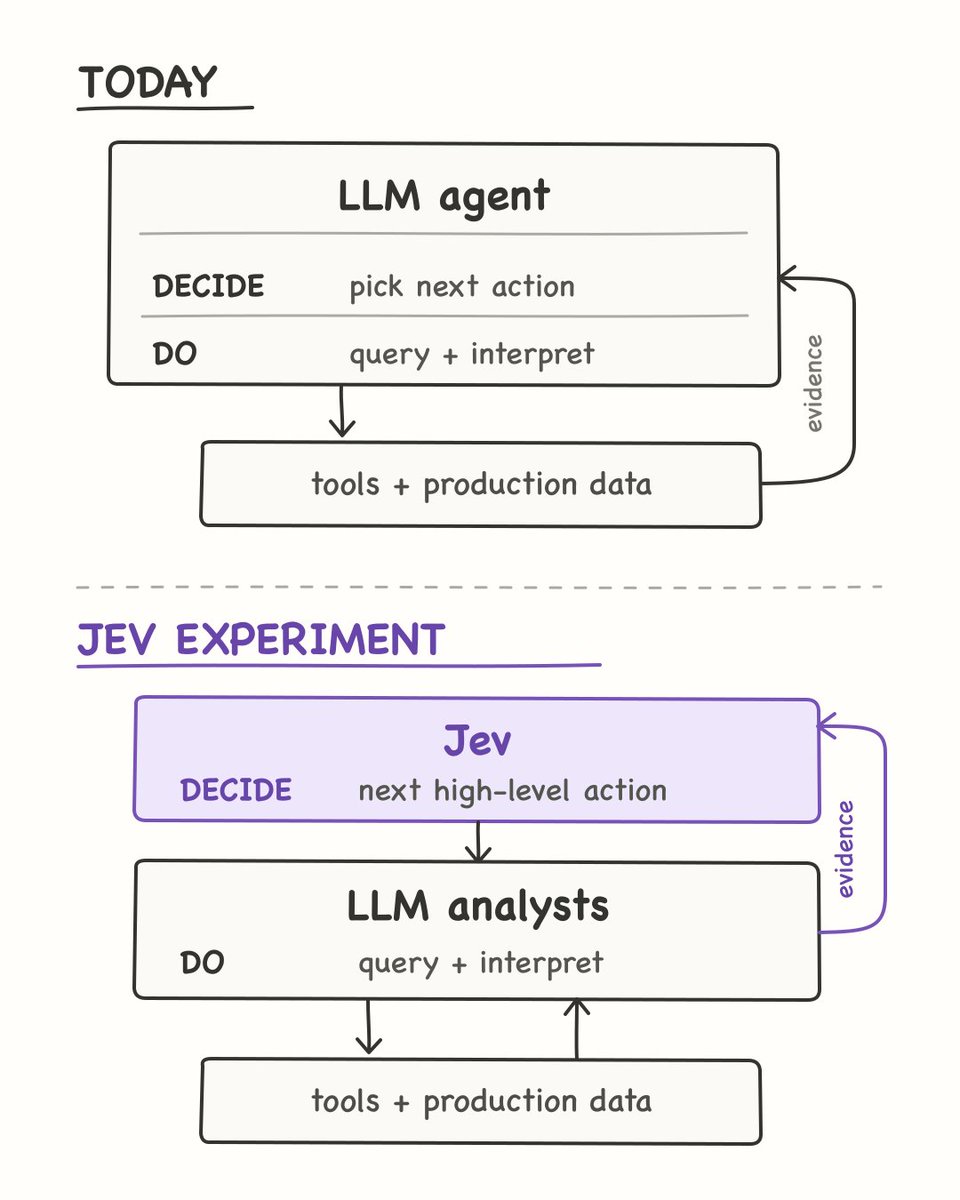
Your agent today is broadly doing two kinds of tasks:
1. Open ended tasks that require reasoning - e.g. reading logs, scanning code, interpreting a metric
2. Bounded decisions from a known set of actions e.g. deciding what to do next like check Kubernetes or Grafana
Asking an LLM to do #2 over and over again is horribly inefficient. You can do it, and before Jev, you likely HAD to, but it’s shooting an ant with a shotgun.
Mike ran an experiment to move the high-level next action choice in Cleric's investigation agent out of the LLM and into a Jev-based harness. We ran it offline on our evals and we got the same average recall, while running 25% faster and costing 98%(!!) less.
To be clear - this prototype is not close to GA but the results are telling.
The reason this is such a big deal is that for use cases like ours, we’re on a clock and a budget. The agent gets a limited amount of time to find everything it can given a problem in production.
Our instinct is to take those savings and deploy more LLM analysts so Cleric can gather even better evidence.
I think Model labs will 😍 Jev.
Post: https://t.co/4NaQw5E90T
Short version: Opus 5.5 is good.
How good? We've been stuck on Opus 4.5 for our Claude-based agents for ~10 months. That's an ANCIENT model!
We tried, believe me. Every new Opus release, we ran our evals and the performance was jagged: better in some areas, worse in others. Upgrading meant accepting a regression somewhere.
The best we managed was a limited upgrade: Opus 4.6 for some analysts, 4.8 for others.
Opus 5.5 is the first release that beats 4.5 with no trade-offs.
On the average eval run: 5.5 has slightly better accuracy, is 20% cheaper and ~12% faster.
👏👏👏
I have a love/hate relationship with session limits. Frustrating... but they're also my cue to go take a walk and resist the temptation to continue with another one.
"Everyone doesn't need to be using Opus 5 or Fable 5. It's like bringing a tank to a knife fight."
-Affaf (Head of Eng, LaunchGood) on matching the model to the job as AI costs climb
Full ep: https://t.co/bncCgScIZ3
@dexhorthy SCB is such a great idea! Made a fun little game called Slop Factory https://t.co/oWOM6uUXXY
Do the best you can to avoid slop getting merged to prod.
Like we spoke - base your evals on what you currently do. In our case - we picked increasingly harder SRE tasks though by now it’s harder and harder to trick the models on one shot scenarios so we rely more on online evals - I.e. how users actually use the product on real investigations.
Nice! One tip - always add a few evals that are beyond what the models can currently do. Call it a stretch eval. Stretch evals should fail to hit the pass mark you regularly have - forcing you to reduce the passing mark to something low like 60-70%. This is what gives you a stable measure when a new model comes out.
Then when a new model is released, you can test:
- can it do the current evals better?
- does it do better on my stretch evals?
Achievement unlocked... scrapers are coming for our blog posts.
p.s the scraper has good taste, it's a technical post on how we grade our agent without requiring human in the loop.
p.p.s. for technical posts like these, it'll be fun to get your coding agent to read it and review your existing agent code against it to propose improvements you can make.
https://t.co/A1zkreP570
Assuming models keep getting more intelligent (safe bet), then we can assume the need for code review goes down. Production becomes the final reviewer - did the change achieve what you wanted or did something unexpected happen? If you can solve for outcome verification - then the model gets a fast feedback loop to resolve the problem.
We did this for our own agent’s fixes and it was so valuable that we’re now designing it to verify changes by any agent.
Coding agents get fast feedback: tests pass/fail. Merged code gets none. The signal exists in production, but it arrives days later and nobody closes the loop.
We built a verifier that watches production after a change lands and answers: did it work?
https://t.co/4RuYwlAaqJ