More SF observations:
1. Seeing the word "inference" on billboards in SF still blows my mind. 99.9% of america has no idea what inference is and I wonder how many know what an agent is. Will Muse, Instinct, Dots etc will change that over the next 12 months?
2. You know who doesn't get enough credit? Manus. In March 2025 they shipped the blueprint for AI agents: every task gets its own computer in the cloud, you can watch it work, it writes a todo list and checks it off, and you walk away while it finishes. So much of what we use today runs on those ideas!
3. Your product now has to sell itself twice. First the agent has to pick it, then the human has to trust that pick enough to say yes.
4. I was talking to a guy who told me we should just destroy all the data centers. I think that sentiment is more common than people in SF realize. You can already see some of the big AI companies adjusting positioning their AI as something that helps people and gives them more time/cures for cancers etc.
5. AI is making people work 5x faster (at least), so for freelancers/agencies that charge per hour you're earning 5x less per unit of work. But your rate is the same? I think a lot of freelancers and agencies are about to have to rethink how they price.
6. Running a company now feels kinda dystopian sometimes, especially with a small team of a few humans and a lot of agents. Some days the Slack channel is mostly bots reporting to each other, and you're the only one in the room with a pulse.
7. Every product company is turning into a product studio. I see it firsthand as a co-founder of @meetLCA , which is basically a Labs as a Service company incubating new products for companies. (DM me if you want to work together in 2027).
8. Personal software is exploding. People at every company are building their own little tools for their own jobs. It's amazing for productivity and a nightmare for IT, because nobody knows what's running or who owns it.
9. Revenue per human is the new flex. Founders used to brag about headcount. Now they brag about how much they're doing with how few people.
11. More founders are using agents for customer research. Agents run the interviews, read every support ticket and summarize what people are begging for. Synthetic market research is the new thing.
12. Shipping technology that actually takes 3-6 months with unique partnerships that are hard to replicate. So, partnerships are sooo back!
13. Insane amount of young people (22 or younger) making absurds amounts of money. At least it feels that way. Never seen anything like that, even during mobile era.
14. Only 2% of the US is paying for AI products, but it feels like 110% SF is.
15. Advice for college grads used to be “follow your passion” and now it’s follow careers that are not document- driven, rules-bound and verifiable
16. Seeing the word inference on billboards in SF still blows my mind.
17. Agents paying for things feels futuristic. I think its coming, only a matter of time, but I’m wondering when it becomes mainstream. 2027?
18. Lots of talk about proactive agents being the next phase of personal agents. Right now you ask your agent to do something. In 2027, it’s all going to be about noticing things (context/memory) and acting first. "Your flight got delayed, I already rebooked you."
19. The quote "what the smartest people do on the weekend is what everyone else will do during the week in 10 years." by Chris Dixon. It feels like that length of time isnt 10 years anymore, its 12 months.
20. This is the most asymmetric window I've ever seen in business.
My DMs are open. Respond to the most interesting ones.
Loved my trip to SF. Until next time. Maybe NYC next?
Thank you for everything.
I'm rooting for you.
We are releasing Ultramarine 1 Flash, a frontier-class model built for knowledge work. It is open-source and achieves similar performance to Fable 5, while being 60x cheaper.
It was post-trained by a team of 5 for ~$300k all-in. Available on API now, with weights releasing in 2 weeks.
I spent 48 hours in SF hanging out with billionaires, data labs and AI founders and execs running $1B to $100B companies.
My observations:
1. Sooo MANY stories of data brokers making like $2M a WEEK selling company data to labs. I can't tell if it's the beginning or a bubble, and I kept wondering which niches are left. Digging into it actively.
2. At dinner, someone asked the table, "If a new model drops next month, does your company get better or worse?" HALF the table went quiet! I think that's the best question to ask about any AI startup right now.
3. The bar people talk about now is hitting $1B in revenue in 12 months (I guess that's the new unicorn?). What I didn't hear much about is retention. AI revenue can come in fast and leave fast, and I think we're going to see a lot of stories of AI companies with huge revenue and terrible retention.
4. It's pretty clear we're living through the reinvention of the computer. The model is the CPU, the harness is the operating system, and skills and plugins are the apps. Thinking about it that way makes it easier to see where the whitespace is.
5. We're maybe 12 months from an agent that can watch you work for a week and then do your job without any instructions. The screen recording plus agent memory plus local model combination makes this possible right now.
6. Agent harnesses feel like the new GPT wrappers, in a good way, especially vertical ones. The best teams I talked to treat the model as swappable. One founder walked me through routing different models to different jobs: one for taste and visuals, a cheaper one for the everyday stuff, another for text.
They use prompts they can move across models over fine-tuning, and A/B test the output on what users actually do with it: do they edit it, export it, share it? A vertical harness is basically four things: the connectors for that industry's data, evals written by people who know the work, rules for what the agent can and can't touch, and a clean screen for a human to review. The model is maybe 20% of it.
7. There's a lot of reverse engineering going on/cloning going on more than I've ever seen. People are decompiling software and rebuilding it with agents, and someone showed a suite of like 10 apps that are worth $5B+ each all that he cloned open source. Me and everyone are still thinking through what it means when software gets this easy to copy.
8. My guess is the value moves to data. If the software can be rebuilt quickly, what's worth paying for in a legacy SaaS company is the years of customer data and workflows inside it. Some SaaS companies are secretly data companies.
Gets me thinking about how do you truly value data for this saas companies? Like if we were buying these dying saas companies at 2x ARR before (as example), maybe there is a better metric. Idk, just thinking out loud here.
9. It feels like a good chunk of legacy software won't make it to the agentic era, especially anything built around people clicking through a lot of screens.
10. Every company I talked to wants to pipe its internal data into one place and expose it to agents through MCP. Then they look at the data and realize it's a mess: five versions of the same customer, old Slack channels, PDFs nobody can search. Cleaning that up feels like a big consulting opportunity!
11. A lot of founders are building the basic building blocks for agents: APIs, data layers and tools. Some of the companies I saw barely have a UI because the main user is an agent. I really believe the startups that build primitives to this agentic era will do extremely well. Building blocks is the best way to think about it.
12. Labs can get plenty of training data, but it's harder to get real examples of agents failing inside companies. Whoever has those logs has something valuable.
13. Someone running a big consumer company told me the next fight is over memory. The model that remembers the most about you wins, and the smartest model matters less than people think.
14. Physical AI came up a lot. Astra I think was the first model that got people into AI can actually do CAD, and I think a lot of people are thinking what does vibe manufacturing really look like. The line I keep thinking about came from a robotics founder: the hardest problems in AI are deployment problems now, not research problems. Their robots work on their own, call a human when they get stuck, and every one of those calls becomes training data.
15. Cybersecurity companies are having a moment and are actually cool companies to build now, especially the ones that clean up after a breach. Every agent with access to your systems is a new door into your company, and a lot of those doors were left open.
16. Some startups are worth more dead than alive now. A shutdown company with 5 years of Slack, email and code can get paid for licensing all of it. I wouldn't be surprised if founders start factoring that into when they shut down.
17. People are starting to talk about monetizing the agent web. It feels really early, but when the most popular user of the internet is an agent, what startups should you be building?
18. I think agent insurance is coming. Once an agent makes an expensive mistake, insurers will want audits before they cover anyone.
19. Several people said the hire they want most is someone with taste who can write evals. The models are getting good at generating ideas, so the hard part is judging which ones are good.
20. New trend I observed: startup raises VC, uses venture dollars to become a creator, startup fails, founder falls back on being a full-time creator and incubates other products bootstrapped.
21. Getting SIGNIFICANT distribution is HARD right now. Founders are sponsoring buses, buying billboards like crazy and throwing parties with famous DJs to get noticed. Kinda feels dotcom era in that sense.
Attention is what's scarce! The growth guy going viral sharing his UGC strategy from Wispr Flow is a good example. It's the sauce everyone wants, and I truly believe there are probably only 50 people on the planet who know how to scale these types of businesses efficiently in this era.
Always good to get that dose of SF. I felt sooo lucky to have such an incredible trip during such an incredible time in building businesses. Surreal in so many ways.
Happy to be home and locked in.
Until next time!
"The best engineers in an AI world won't just ship features, they'll own outcomes.
They'll understand customers, influence product adoption, and work across engineering, sales, marketing, and enablement to drive results.
The engineers who thrive will be the ones who think like founders, not just builders." @matanSF
Do you agree and does no one see that everyone should about what it will take to be a top engineer in 5 years @lennysan@sjwhitmore@jasonyuan@zan2434@rsms
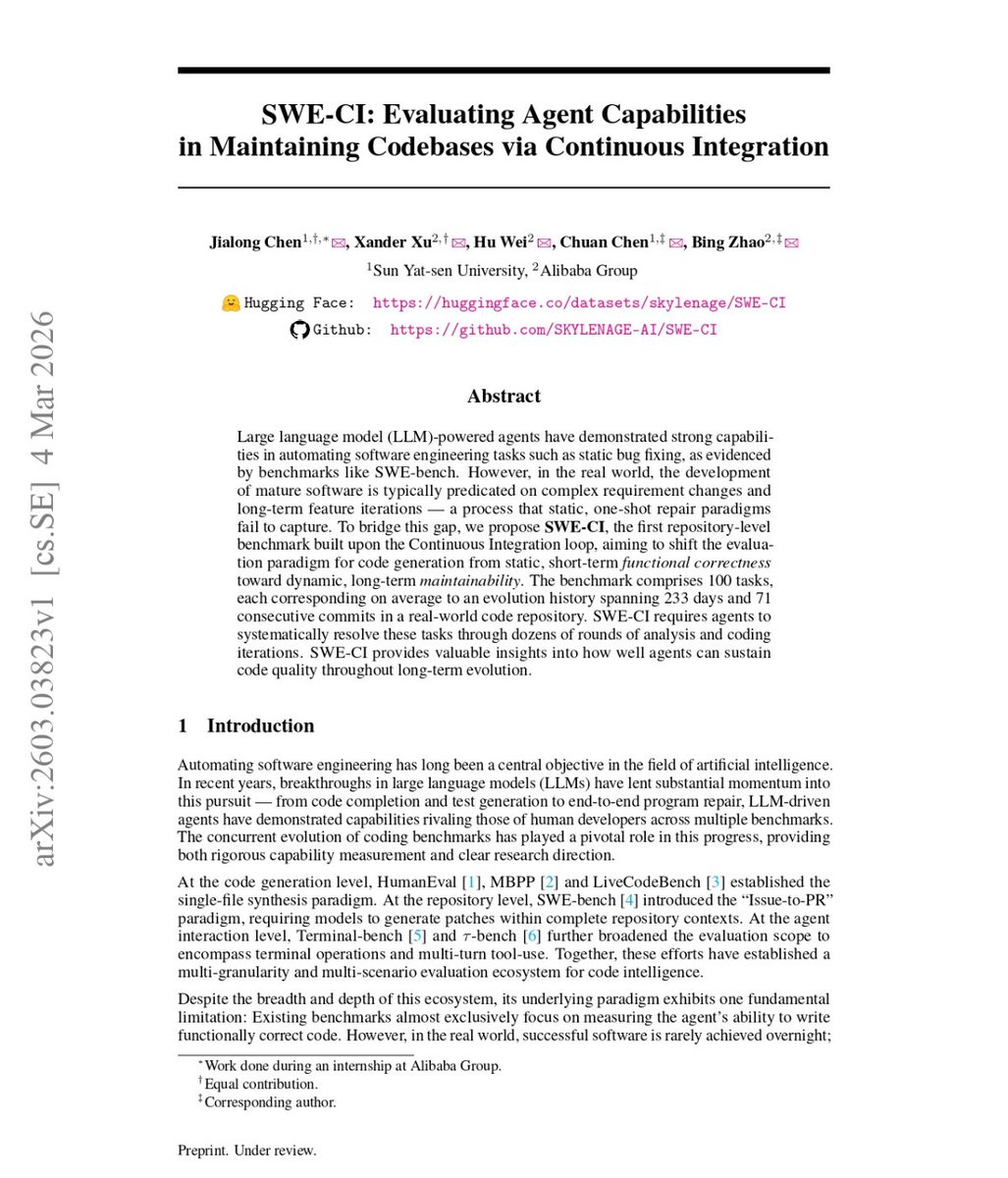
🤯BREAKING: Alibaba just proved that AI Coding isn't taking your job, it's just writing the legacy code that will keep you employed fixing it for the next decade. 🤣
Passing a coding test once is easy. Maintaining that code for 8 months without it exploding? Apparently, it’s nearly impossible for AI.
Alibaba tested 18 AI agents on 100 real codebases over 233-day cycles. They didn't just look for "quick fixes"—they looked for long-term survival.
The results were a bloodbath:
75% of models broke previously working code during maintenance.
Only Claude Opus 4.5/4.6 maintained a >50% zero-regression rate.
Every other model accumulated technical debt that compounded until the codebase collapsed.
We’ve been using "snapshot" benchmarks like HumanEval that only ask "Does it work right now?"
The new SWE-CI benchmark asks: "Does it still work after 8 months of evolution?"
Most AI agents are "Quick-Fix Artists." They write brittle code that passes tests today but becomes a maintenance nightmare tomorrow. They aren't building software; they're building a house of cards.
The narrative just got honest: Most models can write code. Almost none can maintain it.
this is fucking ridiculous lol - anthropic just killed a $50B industry with a single feature (again):
- companies pay $50K a year to scan their code for vulnerabilities.
- anthropics Code Review does it for you in minutes for a fraction of the cost.
- deploys multiple agents to hunt for bugs in your code. internal results show its amazing (84% hit rate on 1000+ line code base)
for comparison: anthropic cost = $15-25 PER review, trad competitor cost = $99+
complete fucking no brainer. watch the appsec stocks react to this one
Karpathy just mass-produced the most expensive part of ML research for free.
The bottleneck in neural network development has always been researcher iteration speed. A senior ML engineer costs $400K-$800K/year, runs maybe 3-5 meaningful experiments per day, and spends 80% of their time on the exact loop Karpathy just automated: tweak, train, evaluate, repeat.
This agent ran 276 experiments in a few days. Found bugs in QKnorm, missing regularization, wrong AdamW betas, and overly conservative attention patterns. These are the kinds of things a PhD student finds over months of staring at training curves. The agent found them while Karpathy slept.
The math gets worse. Tobi Lutke cloned the approach for Shopify’s query expansion model, went to bed, and woke up to a 0.8B parameter model that outperformed his previous 1.6B model. 37 experiments in 8 hours. A smaller model beating a larger one because the agent had more at-bats optimizing it than a human team would get in a week.
This tells you something about how frontier labs will allocate headcount over the next 18 months. The “run experiments and iterate” function of ML research is about to get compressed by 10-50x. What remains is the part agents can’t do yet: choosing what problems to work on, designing the evaluation metrics, and writing the program.md that tells the agent how to think.
Karpathy’s own framing is revealing. He said humans “optionally contribute on the edges.” That word, optionally, should make every ML researcher who defines their value as “I tune models” extremely uncomfortable.
The 630 lines of code in this repo fit inside a single LLM context window. That’s by design. The constraint that unlocks autonomous research isn’t intelligence or compute. It’s keeping the codebase small enough that the agent can hold the entire system in working memory. Every company with a training pipeline longer than 630 lines just got a reason to refactor.
@charliejhills@heygurisingh Thanks @charliejhills But this is running qwen locally instead of claude, right? Even that works for agentic coding, but checking since my understanding is claude is not open source.
FYI the CME is violating its own "rules"
There are supposed to be "circuit breakers" with the first tripped at 10%.
Here we are WAAaaaAy past that moment, and the CME is 'letting it rip.' Which they wouldn't do if things were going the other way, of course. #rigged#shameful.
Stop leaving your corporate credit card on a park bench. 💳
If your AI wrapper uses Fat Client Architecture, your API keys are basically public property.
Here’s how to use the "Vibe Coding" shortcut without getting burned: https://t.co/FWcHhobCl8
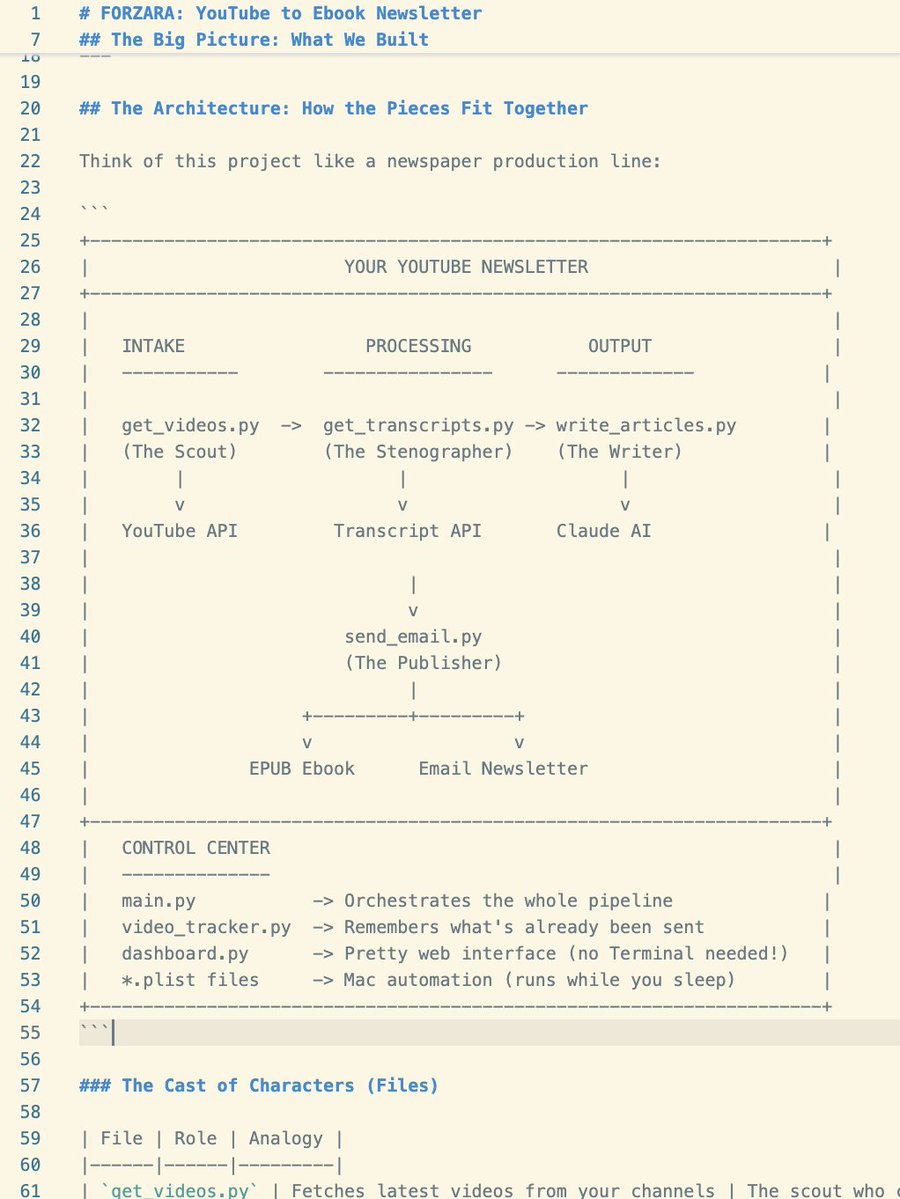
Add this paragraph to the https://t.co/CGO09Sihd0 file to turn Claude Code into Claude Teacher. Every project is a lesson to become more technical.
"For every project, write a detailed FOR[yourname].md file that explains the whole project in plain language.
Explain the technical architecture, the structure of the codebase and how the various parts are connected, the technologies used, why we made these technical decisions, and lessons I can learn from it (this should include the bugs we ran into and how we fixed them, potential pitfalls and how to avoid them in the future, new technologies used, how good engineers think and work, best practices, etc).
It should be very engaging to read; don't make it sound like boring technical documentation/textbook. Where appropriate, use analogies and anecdotes to make it more understandable and memorable."
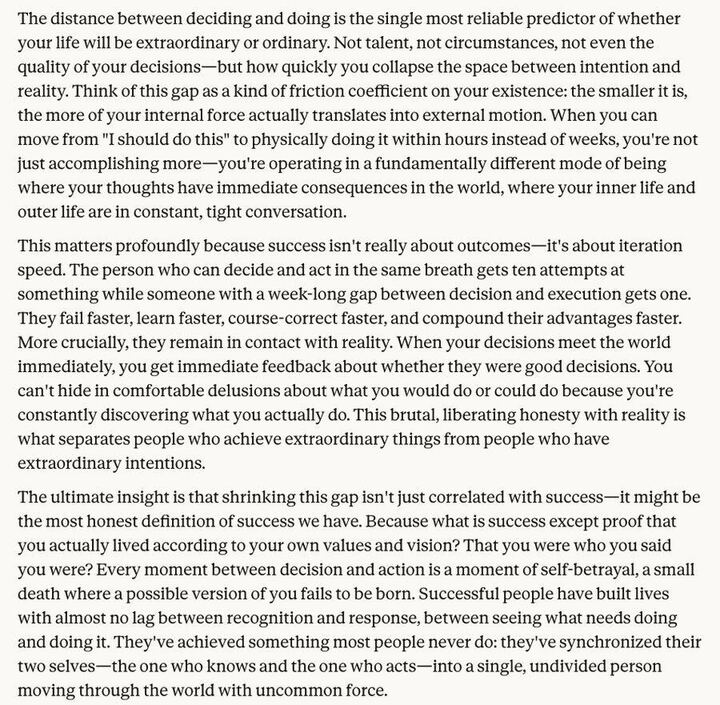
“The distance between deciding and doing is the single most reliable predictor of whether your life will be extraordinary or ordinary.”
These three paragraphs will change your life: