We recently brought together researchers from across academia, national labs, healthcare, and policy for the Open Source AI for Science Summit to explore how open models from Meta, such as Muse Glimmer, SAM, DINO v3, TRIBE v2 and UMA, are driving real-world advancements.
A couple highlights:
→ Medical Research: The University of Pittsburgh presented an assistive-robotics system built on DINOv3 and SAM 3. The team plans to demonstrate a robot that can help a person eat and is experimenting with letting users give instructions in their own words.
→ Chemistry: With the University of Chicago, we showed how UMA can simulate entire enzymes, atom by atom, potentially helping scientists understand how they work and engineer better ones for medicine, sustainability and energy.
Read the full recap: https://t.co/kBWzmv3JZm
So, we tested Qwen 4 Max on MaxxBench. Yeah... you should probably just use DeepSeek for coding.
In other news, Muse Ember is actually stupidly fast, really cheap, and pretty good! If you're going to use DeepSeek, you should probably just use Muse Ember.
Created a "benchmark benchmark": a frequency distribution of which benchmarks were reported by the frontier labs in 2026: https://t.co/GswjxqWz1c
Some observations:
- HLE, SWE-Bench Pro, DeepSWE, and Terminal-Bench saw universal adoption
- Scale AI is behind two of those four (SWE-Bench Pro, HLE w/ CAIS), plus MCP-Atlas (#9 benchmark)
- Of the frontier labs, OpenAI is the most prolific benchmark producer (SWE-bench Verified, BrowseComp, GDPval); people don't seem to mind evaluating on a benchmark made by a competitor
- Anthropic has just one on the chart (BioMysteryBench) that basically nobody uses 🤔
- In academia, strong showings from Princeton (SWE-bench, CharXiv), Stanford (Terminal-Bench), Berkeley (CyberGym, Agents' Last Exam), and NYU (GPQA)
- DeepSWE saw incredible adoption, from first appearing in June to all 12 labs reporting it
- Labs cycled through four versions of Terminal-Bench (2.0 → 4.0) in a single year
We launched Muse Ember, our smallest and most efficient model. It is designed for the work agents repeat all day like tool calls, coding subtasks, routing, extraction and long document parsing. It delivers more intelligence per dollar than Claude Haiku or GPT Luna.
Read our research blog https://t.co/1orndIWIpW and try it on our API.
Releasing Muse Ember today -- our smallest model that delivers higher intelligence per dollar than others in its class. Built for token-heavy work that agents repeat all day: tool calls, coding subtasks, routing, extraction, and long document parsing. Available today on the Meta Model API and in Muse Code.
One reason I am sanguine about the technological singularity is that I have seen it coming for over 50 years. In 1975, when I was 17, I wrote:
"Before man can most effectively aid his problem solving machinery, he must first understand it. At present, his understanding is very poor. However, when the breakthrough in understanding the brain occurs, improvement will come very fast and in an exponential increase. Once man has created an intelligence greater than his own, that intelligence should be able to create an intelligence greater than itself, as man whose intelligence is less than its was able to create its intelligence. Thus, the level of intelligence will shoot up with incredible rapidity, probably within the space of years. Within a few years of a breakthrough, which may occur any time now, man will either have been left behind by a superior intelligence of his own making, which he can no longer understand, or he will have become that intelligence and will no longer be like anything imaginable today."
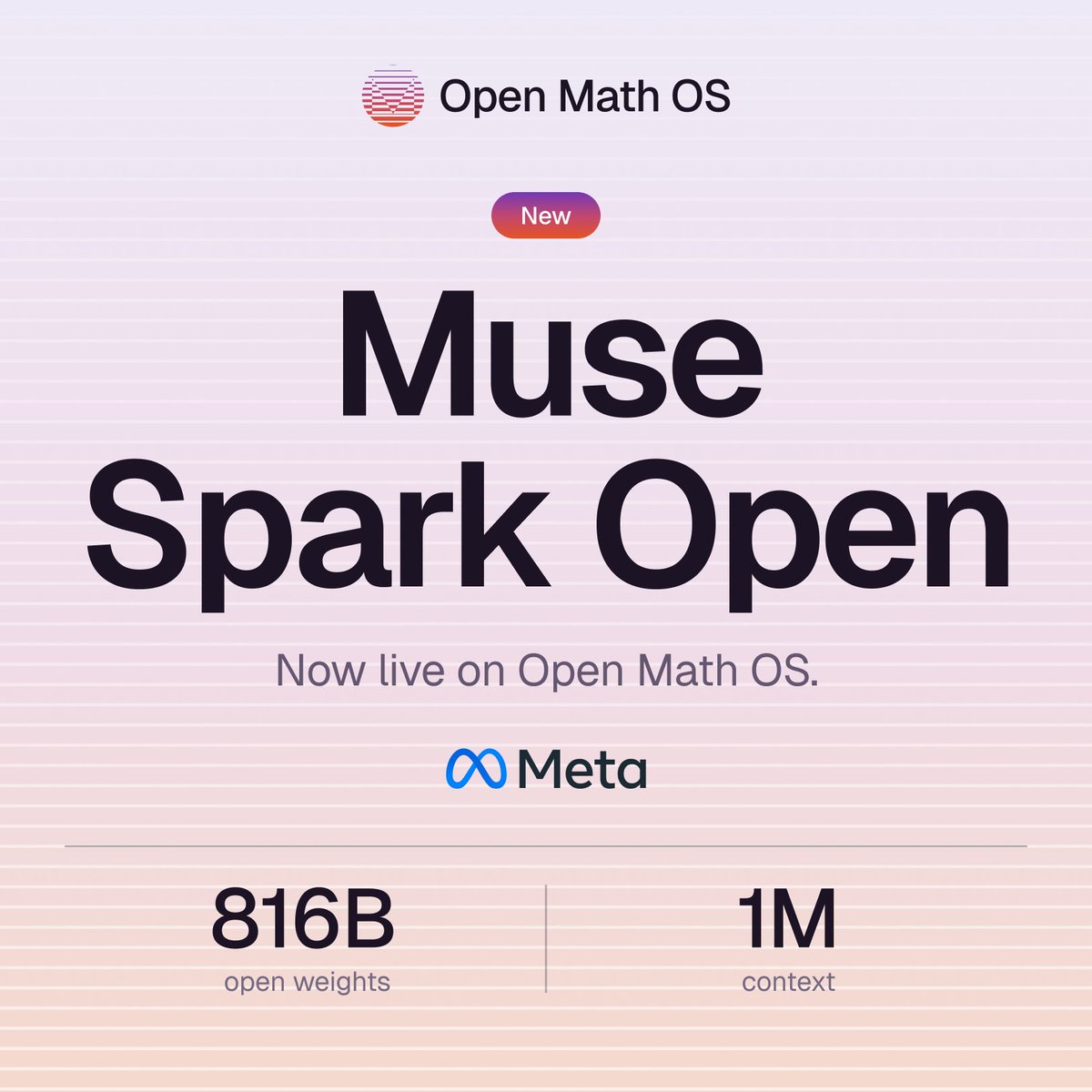
New on Open Math OS: Muse Spark Open by @AIatMeta
816B total parameters (42B active). 1M context window. Available now to all approved teams.
Apply for Open Math OS now:
https://t.co/aRvrbmiy3h
Today we're announcing support for university research at @Caltech, @OhioStateMed, @LSU, @IndianaUniv, and @UTHealthHouston to help advance breakthroughs across science and medicine.
As part of the support for university researchers, we’ll provide access to our latest Muse models, including Muse Wonder and Muse Spark; open weight models like Muse Glimmer and Muse Spark Open; computer vision models such as SAM, V-JEPA, and DINO; as well as SeamlessM4T, our multilingual communication model.
We’re excited to support these five universities as they use our models to accelerate the important work they’re doing.
Read more on our research blog: https://t.co/1E55HDKbTS