NYSE is going on-chain.
And $LINK is the quiet backbone.
The New York Stock Exchange just announced a blockchain-based platform for tokenized securities:
• 24/7 trading
• Instant on-chain settlement (no T+2)
• Fractional shares
• Stablecoin funding
• Multi-chain by design
Wall Street is adopting crypto rails.
Now here’s the part that matters 👇
“Chainlink is already embedded in this future.”
ICE (NYSE’s parent) already partners with Chainlink
to bring institutional-grade market data on-chain.
That means:
• Trusted price feeds for tokenized equities
• Corporate actions handled on-chain
• Chain-agnostic settlement without fragmentation
• Cross-chain interoperability via CCIP
• Compliance-friendly infrastructure institutions trust
NYSE stays blockchain-neutral.
Chainlink connects everything.
This isn’t speculation.
This is the same playbook used by SWIFT, DTCC, UBS, Citi.
Tokenization isn’t coming.
It’s being built.
Chainlink is everywhere.
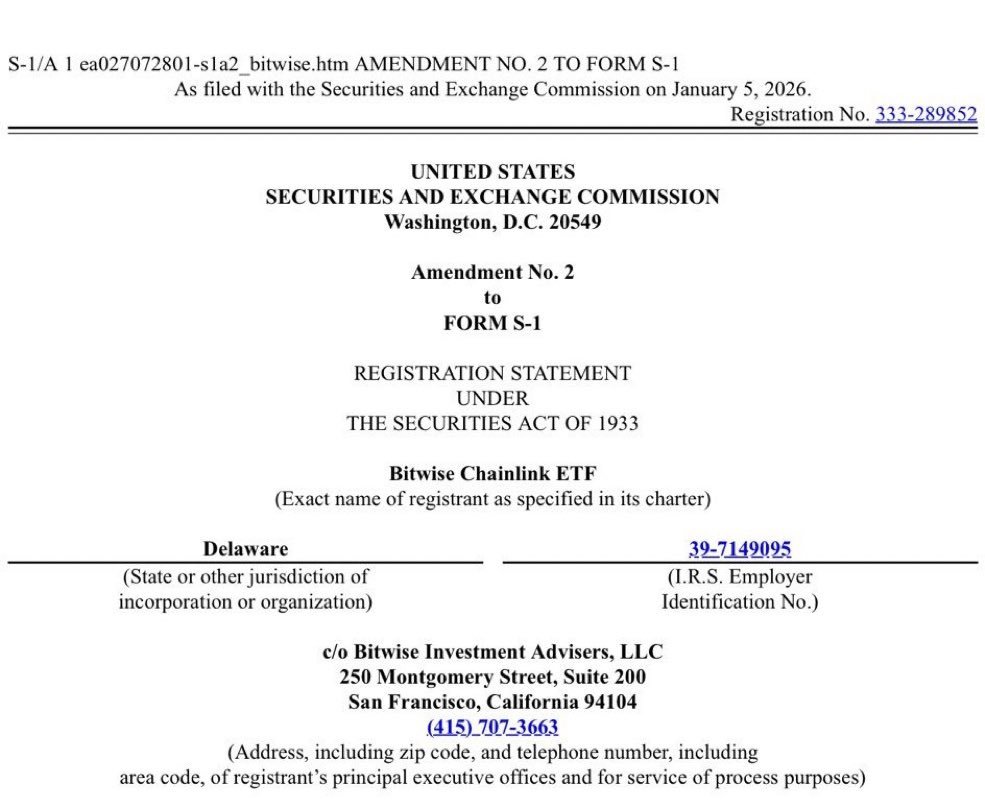
✅SEC APPROVES BITWISE SPOT CHAINLINK ETF
The U.S. SEC has approved Bitwise’s spot Chainlink ETF for listing on NYSE, marking Chainlink’s first direct entry into U.S. equity markets.
The ETF is expected to launch this week, offering a 0% management fee for the first 3 months
🔥 LATEST: Coinbase has chosen Chainlink’s CCIP as the exclusive bridge for all Coinbase Wrapped Assets, enabling secure cross-chain transfers and broader expansion.
Excited to see that being the most secure cross chain technology across DeFi and TradFi is attractive to top technical teams who do deep diligence and security review.
I also think that being able to provide real reliability for a bridge during cloud outages like AWS, while other bridging systems go down for extended time periods, is a large advantage when being considered by highly technical teams that want high uptime/reliable systems.
I personally feel that all the security and reliability work that was put into CCIP is starting to pay off, which feels very familiar from when Chainlink was chosen to power the top DeFi and TradFi systems with the most secure and reliable data. I think the consistent security and reliability properties of Chainlink will continue to make the choice of top teams and institutions in our industry.
Yes, we are early with RWAs outside stablecoins being in the ~$20Bn range, but it is also inevitable that institutional tokenization across a connected set of chains and existing systems takes hold and reinvents the entire financial system. It is inevitable and will happen slowly and then all at once, just like the internet.
BNB CHAIN INTEGRATES CHAINLINK DATA STANDARD TO BRING U.S. ECONOMIC DATA ONCHAIN
- @BNBChain, one of the largest blockchain ecosystems with a broad global user and developer base, has adopted the @Chainlink data standard to make the U.S. Department of Commerce data available onchain.
- This development introduces official economic information into the blockchain space, marking a new phase for data transparency and practical application in decentralized finance (DeFi) and prediction markets.
Key Details:
- The data, sourced directly from the Bureau of Economic Analysis, includes key macroeconomic indicators such as Gross Domestic Product (GDP), the Personal Consumption Expenditures (PCE) Price Index, and Real Final Sales to Private Domestic Purchasers.
- These indicators are now being transmitted through Chainlink Price Feeds to BNB Chain, ensuring that accurate and verifiable government data can be used within blockchain-based systems.
- The integration allows developers to build new classes of blockchain applications that rely on verified economic data.
- These may include digital assets linked to macroeconomic performance, prediction markets informed by official U.S. economic figures, and perpetual futures markets benchmarked to data released by the Bureau of Economic Analysis.
- It also offers opportunities for DeFi protocols to improve risk management practices by referencing actual economic conditions rather than speculative or unverified inputs.
- The inclusion of real-world data onchain is expected to help align blockchain operations with measurable economic indicators, reducing discrepancies between decentralized financial systems and the traditional economy.
- The use of Chainlink’s data standard within BNB Chain provides a unified structure for transmitting external information to blockchain applications, enabling consistent, tamper-resistant access to public data sources.
[Image obtained from X]
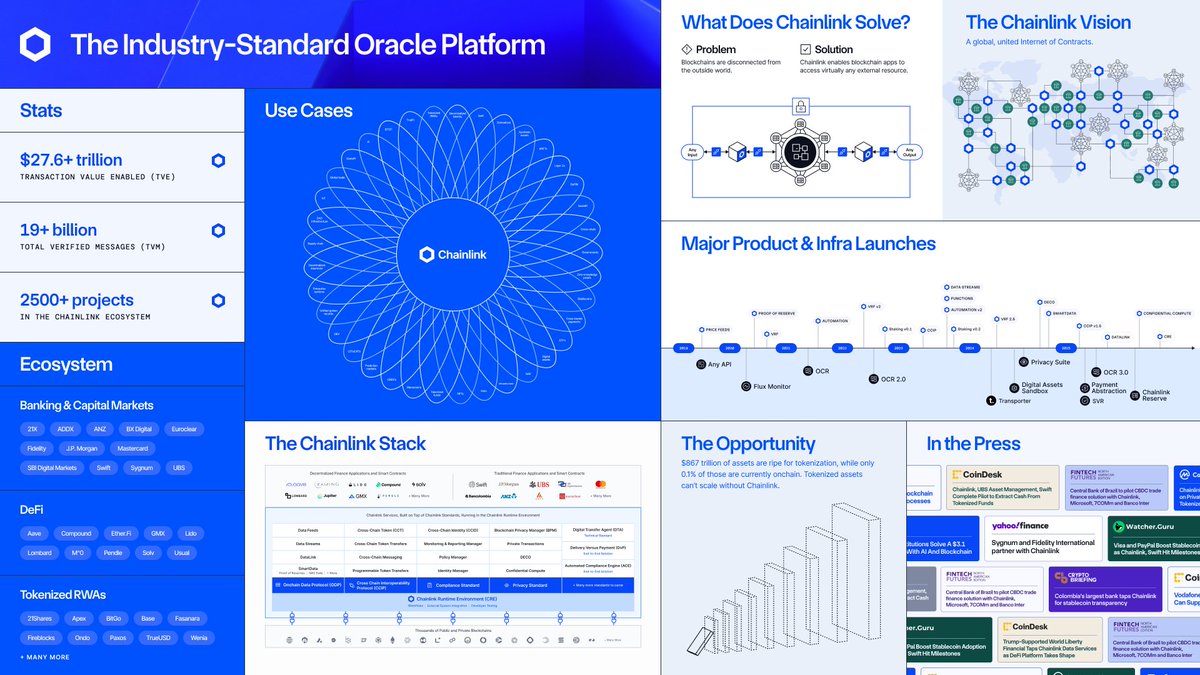
On this date 8 years ago, the Chainlink whitepaper was released to the world.
Since 2017, Chainlink has evolved from just an idea to becoming the industry-standard oracle platform enabling tens of trillions in transaction value and securing nearly $100B for the vast majority of DeFi markets.
Up next?
Bringing the whole world onchain.
RESERVE UPDATE
Today, the Chainlink Reserve has accumulated 43,937.57 LINK.
As of September 4th, the Chainlink Reserve holds a total of 237,014.07 LINK.
https://t.co/BJYimLa2Fv
The Chainlink Reserve is designed to support the long-term growth and sustainability of the Chainlink Network by accumulating LINK using offchain revenue from large enterprises adopting Chainlink and onchain revenue from service usage.
⬡ Chainlink Adoption Update ⬡
This week, there were 8 integrations of the Chainlink standard across 6 services and 4 different chains: Arbitrum, Base, Ethereum, and Polygon.
New integrations include @aave, @AlloyX_Limited, @BasisOS, @DemetherDeFi, and @orange_web3.
Explore the complete Chainlink ecosystem: https://t.co/LDZpTVhx1i
WLFI, the native governance token of @worldlibertyfi, is now officially transferable cross-chain, secured by Chainlink CCIP with day-1 support.
World Liberty Financial adopted the Cross-Chain Token (CCT) standard to increase the utility and accessibility of WLFI by unlocking secure transfers across Ethereum, Solana, and BNB Chain via CCIP.
WLFI and USD1 holders can bridge their tokens today using CCIP at https://t.co/NZo4r3pj3e or via @transporter_io at https://t.co/X4bA4bHfwd.
Through its partnership with Chainlink, World Liberty Financial is reinforcing its position at the forefront of blockchain innovation as it continues to play a critical role in advancing the convergence of traditional finance and DeFi.
We’re excited to work with the U.S. Department of Commerce to bring key government economic data onto @arbitrum, @avax, @base, @botanix, @ethereum, @LineaBuild, @Mantle_Official, @Optimism, @SonicLabs, and @zksync.
Chainlink is the only oracle platform bringing all 6 of these official government macroeconomic data points onchain:
• Real GDP — Level
• Real GDP — Percent change (Annual rate)
• PCE Price Index — Level
• PCE Price Index — Percent Change (Annual Rate)
• Real Final Sales to Private Domestic Purchasers — Level
• Real Final Sales to Private Domestic Purchasers — Percent Change (Annual rate)
RESERVE UPDATE
Today, the Chainlink Reserve has accumulated 41,105.84 LINK.
As of August 21st, the Chainlink Reserve holds a total of 150,770.02 LINK.
https://t.co/BJYimLa2Fv
The Chainlink Reserve is designed to support the long-term growth and sustainability of the Chainlink Network by accumulating LINK using offchain revenue from large enterprises adopting Chainlink and onchain revenue from service usage.
THE CHAINLINK ENDGAME
The updated Chainlink vision is here.
What started as a data solution is now an extensive platform of essential services for integrating the world into the onchain economy ⬇️
https://t.co/HlnmFeiEWY
What TCP/IP did for the Internet and the Java Runtime Environment (JRE) did for online development, Chainlink is doing for blockchains and onchain apps.
In the early days of the Internet, scaling required more than innovation—it required unification and seamless orchestration.
TCP/IP and the JRE emerged, bringing coherence to a fragmented digital world and abstracting away complexity so developers could focus on building.
Blockchains are at the same turning point.
With more chains and even more financial institutions and real-world assets moving onchain, the main challenge now is building apps that efficiently orchestrate across blockchains and existing systems.
Advanced blockchain apps now involve multiple types of data, cross-chain interoperability, compliance policies, integration with legacy systems, and much more.
Building these next-gen apps is nearly impossible to do in-house and overly complex if you have to rely on a growing list of vendors, who each only solve a small portion of the application’s overall requirements.
Chainlink changes that.
Chainlink is not just a price feed. It’s a unified oracle platform that underpins critical standards, services, and end-to-end solutions needed to unlock advanced blockchain applications:
• Data oracles for publishing mission-critical data onchain
• Interoperability oracles for moving data and value cross-chain
• Compliance and privacy oracles for meeting regulatory and internal business requirements
• Legacy system integration for seamless connecting between onchain and offchain systems
• Verifiable orchestration and compute to power entire applications in a decentralized manner
Like Java and TCP/IP before it, Chainlink unifies blockchains and abstracts away complexity, empowering developers and institutions to build and power the entire lifecycle of onchain use cases via a single, secure platform.
Now, enterprises can efficiently build onchain apps that mirror the sophistication of traditional finance yet benefit from the transparency, security, and composability of blockchains and Chainlink technology.
Chainlink is how the world integrates into the onchain economy.




![BSCNews's tweet photo. BNB CHAIN INTEGRATES CHAINLINK DATA STANDARD TO BRING U.S. ECONOMIC DATA ONCHAIN
- @BNBChain, one of the largest blockchain ecosystems with a broad global user and developer base, has adopted the @Chainlink data standard to make the U.S. Department of Commerce data available onchain.
- This development introduces official economic information into the blockchain space, marking a new phase for data transparency and practical application in decentralized finance (DeFi) and prediction markets.
Key Details:
- The data, sourced directly from the Bureau of Economic Analysis, includes key macroeconomic indicators such as Gross Domestic Product (GDP), the Personal Consumption Expenditures (PCE) Price Index, and Real Final Sales to Private Domestic Purchasers.
- These indicators are now being transmitted through Chainlink Price Feeds to BNB Chain, ensuring that accurate and verifiable government data can be used within blockchain-based systems.
- The integration allows developers to build new classes of blockchain applications that rely on verified economic data.
- These may include digital assets linked to macroeconomic performance, prediction markets informed by official U.S. economic figures, and perpetual futures markets benchmarked to data released by the Bureau of Economic Analysis.
- It also offers opportunities for DeFi protocols to improve risk management practices by referencing actual economic conditions rather than speculative or unverified inputs.
- The inclusion of real-world data onchain is expected to help align blockchain operations with measurable economic indicators, reducing discrepancies between decentralized financial systems and the traditional economy.
- The use of Chainlink’s data standard within BNB Chain provides a unified structure for transmitting external information to blockchain applications, enabling consistent, tamper-resistant access to public data sources.
[Image obtained from X]](https://pbs.twimg.com/media/G2lBHLfaAAAyX4p.png)





![BSCNews's tweet photo. BNB CHAIN INTEGRATES CHAINLINK DATA STANDARD TO BRING U.S. ECONOMIC DATA ONCHAIN
- @BNBChain, one of the largest blockchain ecosystems with a broad global user and developer base, has adopted the @Chainlink data standard to make the U.S. Department of Commerce data available onchain.
- This development introduces official economic information into the blockchain space, marking a new phase for data transparency and practical application in decentralized finance (DeFi) and prediction markets.
Key Details:
- The data, sourced directly from the Bureau of Economic Analysis, includes key macroeconomic indicators such as Gross Domestic Product (GDP), the Personal Consumption Expenditures (PCE) Price Index, and Real Final Sales to Private Domestic Purchasers.
- These indicators are now being transmitted through Chainlink Price Feeds to BNB Chain, ensuring that accurate and verifiable government data can be used within blockchain-based systems.
- The integration allows developers to build new classes of blockchain applications that rely on verified economic data.
- These may include digital assets linked to macroeconomic performance, prediction markets informed by official U.S. economic figures, and perpetual futures markets benchmarked to data released by the Bureau of Economic Analysis.
- It also offers opportunities for DeFi protocols to improve risk management practices by referencing actual economic conditions rather than speculative or unverified inputs.
- The inclusion of real-world data onchain is expected to help align blockchain operations with measurable economic indicators, reducing discrepancies between decentralized financial systems and the traditional economy.
- The use of Chainlink’s data standard within BNB Chain provides a unified structure for transmitting external information to blockchain applications, enabling consistent, tamper-resistant access to public data sources.
[Image obtained from X]](https://pbs.twimg.com/media/G2lBHTKbUAAnVkM.png)


