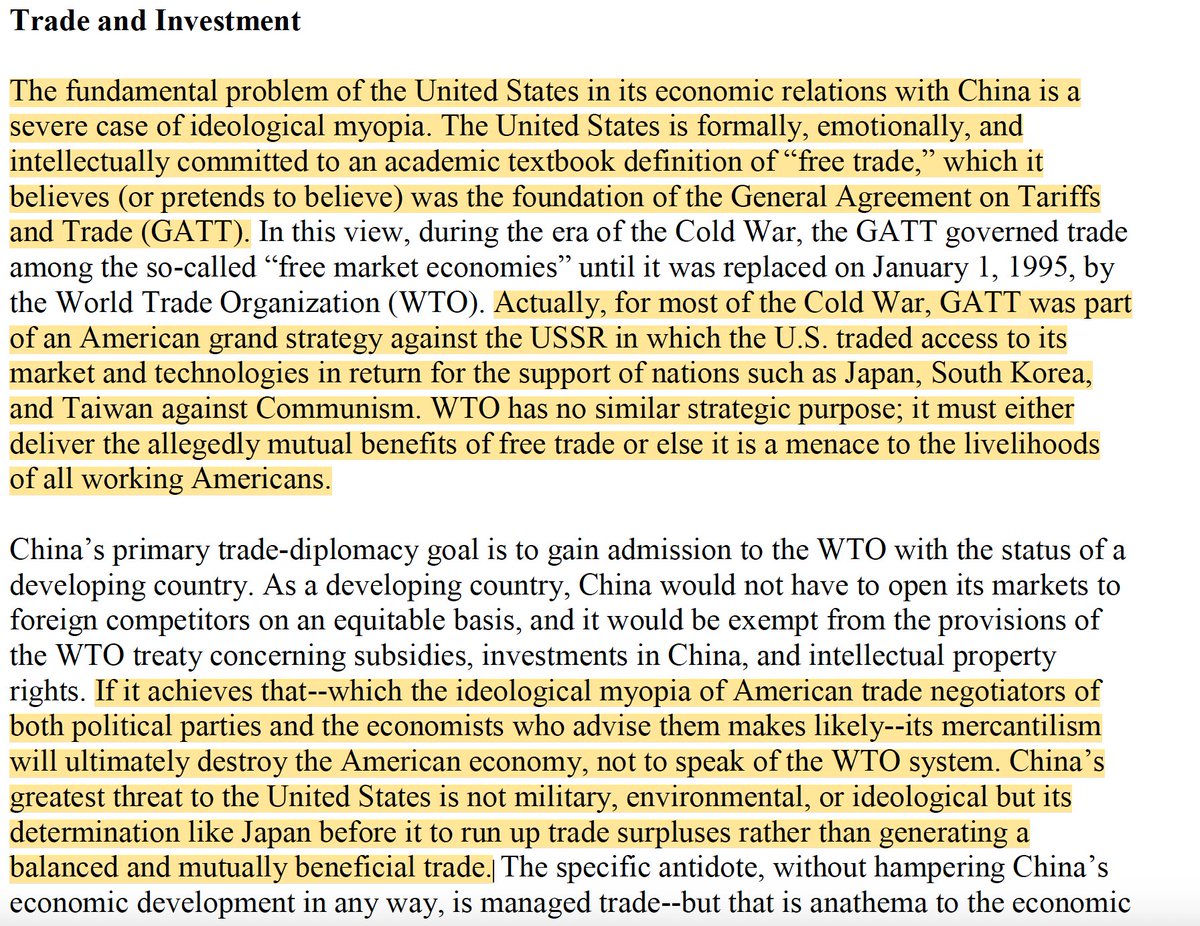
1/I stumbled upon this 1996 article by Chalmers Johnson, (an Asia expert & author of the excellent 1982 book on the history of MITI). Some passages really struck me, and still come across as relevant today. @michaelxpettis@Brad_Setser - in case you don't know it already:
2/ The author clearly assumes China is looking to replicate the Japanese model, and even goes so far as predicting the magnitude of the potential impact on US trade balance down the line (and seems he is not far off?)
I recently read this book by @michaelxpettis and highly recommend it for those interested in EM sovereign debt. IMHO It really deserves a 2nd edition, incl: 1) What has changed, or not, in the countries since (BZ, MX...) 2) what parallels, if any, for recent African borrowers?
2/2
In my 2001 book, I argued that one of the reasons developing economies had gotten into so much trouble financially was the tendency to take on "inverted" debt structures rather than hedged debt structures. Hedged structures (e.g. borrowing long-term in domestic currency, or with equity kickers) typically result in debt-servicing costs that are higher when times are good, and lower when times are bad.
Inverted structures (e.g. borrowing in foreign currencies, or very short term) do the opposite: when conditions improve, inverted borrowing results in lower-than-otherwise debt-servicing costs, but when conditions get worse, debt-servicing costs can explode.
Developing countries are already very volatile, especially to the extent they rely on commodity production, and so they should structure their balance sheets to minimize volatility, but there is always the temptation to gamble on inverted structures and hope for the best. Sometimes this works out well, but its cumulative effect is to raise overall volatility, increase the probability of default and, consequently, to raise overall financing costs for the country and its businesses.
Total return swaps can be highly inverted. As long as conditions improve for Nigeria, there will be no additional debt-servicing costs associated with the swaps, but if conditions deteriorate to the point that the value of Nigerian local-currency bonds declines, or the naira depreciates, Nairobi will be forced to come up with collateral payments at just the time it can least afford it.
I agree. There is a hidden assumption, especially among economists, that most countries have broadly the same financial systems and institutional set-ups that we study in the US, so that a policy that has one effect in the US must have the same effect elsewhere. Albert Hirschman warned insistently against that kind of thinking.
@michaelxpettis Thank you for sharing as always @michaelxpettis - this excessive reliance on supply chain financing (effectively debt) and the consequences of the unwind when regulations change also reminds me of the Agrokor default in Croatia. You may want to look into it, it’s well documented
Back in 1973 OPEC accounted for just over half of ALL global oil production.
Its share was already down to a third in 2025 (thanks largely to the US shale revolution).
Now, the UAE's departure will take it below 30% for the first time in history.
A seismic moment...
Major railway development for Turkey, which potentially opens very large horizons indeed, and will hopefully benefit the whole region as well. Congratulations @memetsimsek and @WorldBankGroup@bjerde_anna
Happy to have signed this landmark agreement alongside @bjerde_anna and the @WorldBank team.
INRAIL is more than an ordinary railway connection.
📍 Bridging the Bosphorus: Unlocking one of the Middle Corridor’s most critical bottlenecks.
📈 Rail capacity: 3M → 50M tons/year
💰 $8.1bn project: 83% IFI-financed
🏆 3rd largest project in World Bank history
👷 414,000 better-paying jobs
This signing is a clear statement of mutual trust in Türkiye’s development journey & in our partnership.
A sincere thanks to the technical teams on all sides for their outstanding work.
Together, we are not just financing a railway, we are building a more connected world. 🇹🇷 🌍
Happy to have signed this landmark agreement alongside @bjerde_anna and the @WorldBank team.
INRAIL is more than an ordinary railway connection.
📍 Bridging the Bosphorus: Unlocking one of the Middle Corridor’s most critical bottlenecks.
📈 Rail capacity: 3M → 50M tons/year
💰 $8.1bn project: 83% IFI-financed
🏆 3rd largest project in World Bank history
👷 414,000 better-paying jobs
This signing is a clear statement of mutual trust in Türkiye’s development journey & in our partnership.
A sincere thanks to the technical teams on all sides for their outstanding work.
Together, we are not just financing a railway, we are building a more connected world. 🇹🇷 🌍
For any agenda on industrial policy
A necessary starting point is Ha-Joon Chang's 𝘒𝘪𝘤𝘬𝘪𝘯𝘨 𝘈𝘸𝘢𝘺 𝘵𝘩𝘦 𝘓𝘢𝘥𝘥𝘦𝘳 (2002), which reveals that the West became rich not through neoliberalism, but through industrial polices and trade protectionism
Importantly, he published this book *before* industrial policy became fashion. A lonely but prescient voice.
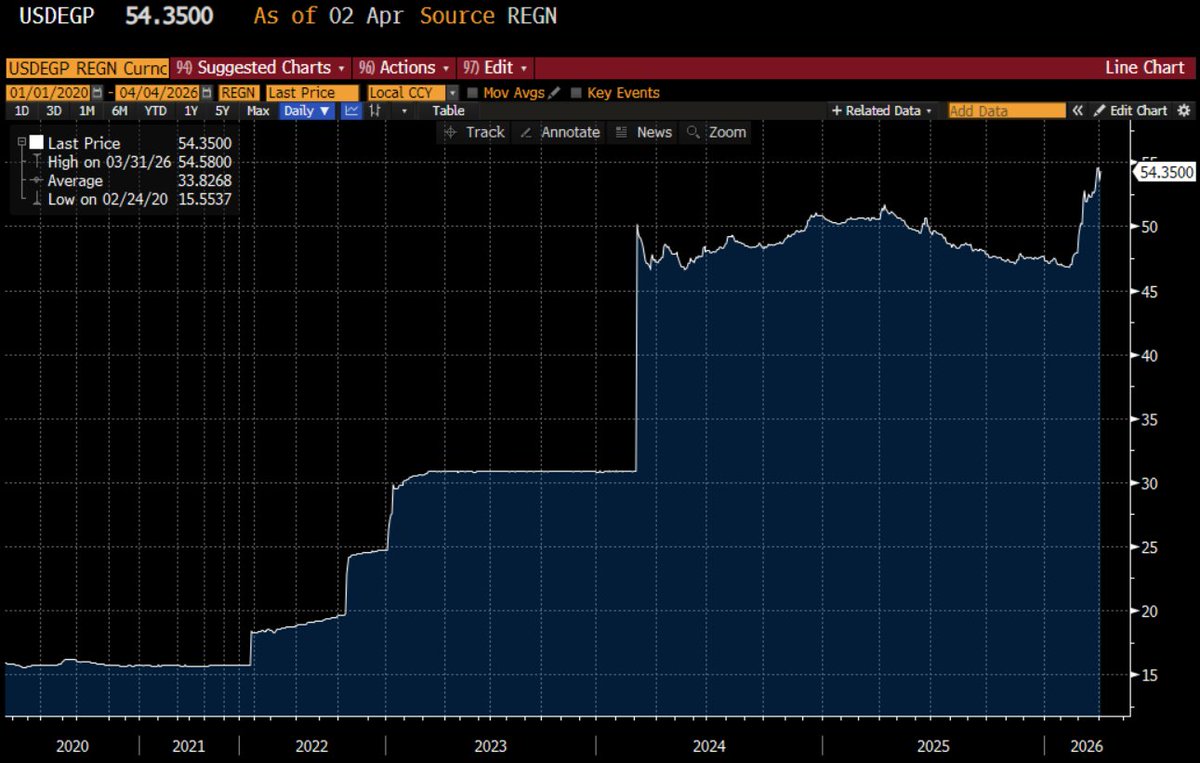
In 2022, as oil and grain prices rose, Egypt resisted depreciation and a series of explosive devaluations followed. This time around, Egypt's government has learned the lesson and is allowing the Pound to fall freely. It deserves a lot of credit for that.
https://t.co/4UnVt9MB13
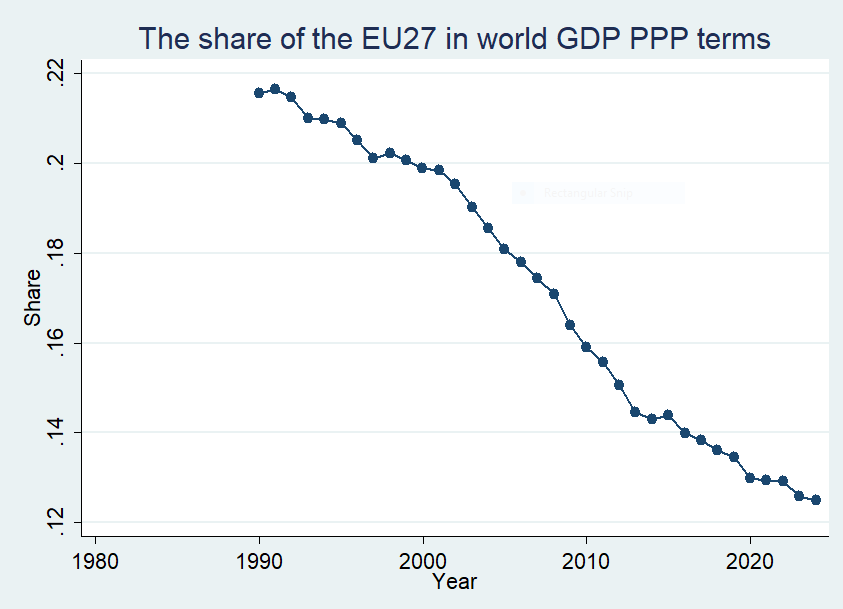
I was curious: here is the share of the current 27 European Union members in global GDP (in purchasing power terms) since 1990.
(China's current share is just short of 20%, US around 16%)
Source: World Bank World Development Indicators 2025
@robin_j_brooks@CarlosRamirezF Thank you for the analysis as always @robin_j_brooks. On the point re: the small elite capturing all the gains, is there any data that evidences this? Or just a hunch based on your read? As this is a problem that could apply to many countries so would be useful to track this.
@Laelia_Ve Merci @Laelia_Ve - rarement je vous vois commenter sur des classiques de science fiction. Je serais curieux d'avoir votre avis sur les livres qui vous plaisent dans ce genre, et les raisons pour lesquelles vous les aimez?
@robin_j_brooks Thank you for clarifying @robin_j_brooks your point is much more clearly expressed here. And indeed you are right about the figure, so for all the Chinese prowess in RE I fully agree we need to keep the stark reality of their coal usage in mind.
A good reminder of the fluidity of the definition of Western Europe, or even Europe. For those interested in the topic, I highly recommend « the myth of continents » by Martin Lewis and Karen Wigen
@robin_j_brooks@vincenzosciarr3 3/ elephant in the room from
a carbon emission pov - will all the RE/EV push finally result in an absolute reduction in coal use. The jury is out here. But at least seems to plateau awhile electricity production ramps up. And electrification opens possibilities of reductions.
@robin_j_brooks@vincenzosciarr3 2/ self sufficiency: major driver for China of course. Domestic Coal + Hydro + dominance over RE and EV supply chains has increased China’s autonomy