When you come from behind.
When losing seems inevitable.
When you Rise from a fall.
Winning is even sweeter….
(And I made my contribution: Stuck to my tradition stubbornly & didn’t watch!)
💪🏽💪🏽💪🏽🇮🇳
Steve was an incredible leader, innovator, and friend whose world-changing ideas moved all of us forward.
Celebrating his remarkable life and legacy today, on his birthday.
Michael Carrick has this team BELIEVING. 🇾🇪
To go into the Emirates and take 3 points after that late Merino equalizer ?
Mentality: ELITE
Matheus Cunha is that guy 💎
The North London fortress has been breached!
#MUFC#GGMU#ARSMUN
Experience the launch from the rocket’s perspective.
Watch the on-board camera visuals from #LVM3M6 capturing the journey of BlueBird Block-2 from liftoff to spacecraft injection.
For More information Visit:
https://t.co/cDGOk9dnUB
#LVM3M6#BlueBirdBlock2#ISRO#NSIL
The Promotion and Regulation of Online Gaming Bill, 2025 passed by the Parliament.
The Bill takes a balanced approach – promoting what’s good, prohibiting what’s harmful for middle-class and youth.
Here’s a quick explainer 👇🧵
AI= Sachin Tendulkar
Indian IT= Parthiv Patel
Point is you can't compare the two.
Indian IT and AI are two different beasts. There is a reason why most AI work happens outside India:-
To build LLMs you require basically 5 things:
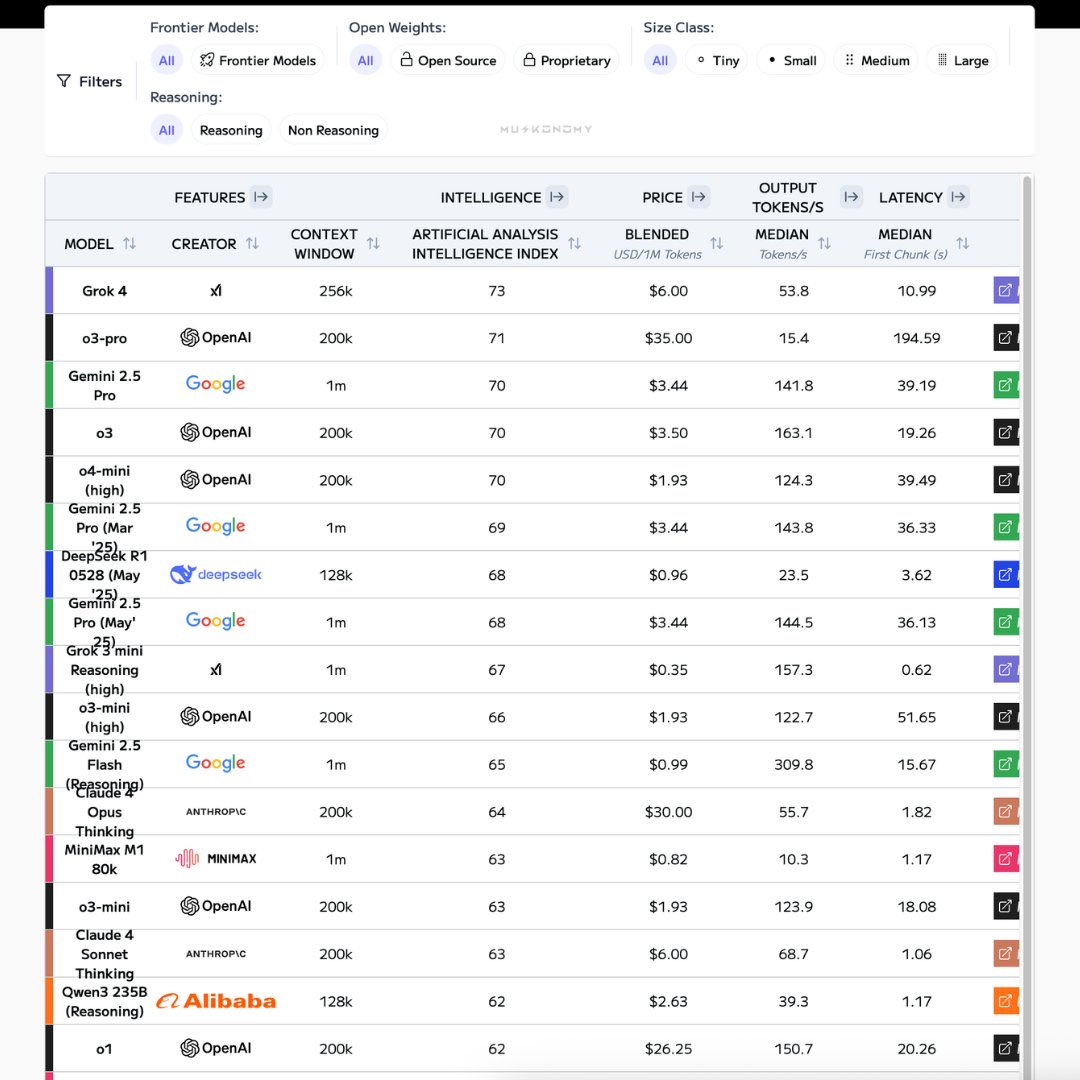
1) What vision you chase? eg. Grok-4 is being built to solve edge cases. It is likely to be #1 player as we move from "general compute" to "specific compute". In India, IT do not even do general compute.
They are backend service providers. Calling Indian IT as AI players or (expect them to become AI players) is like comparing Sachin with Pathiv Patel.
There is a reason why Indian IT will not build in AI much.
2) Collaborative ecosystem: Grok-4 is trained on H-200 NVIDIA Chips. These are easily accessible to them.
There is also a clear migration path from H200 to Blackwell chips. Gork/Musk can plan for 5 years on this vision.
Add to this: Ecosystem partnerships (eg. Apple partnering with Perplexity or Grok maybe). This solves distribution + hardware problems.
What would Indian IT invest in?
3) A test market that pays: for LLMs (eg Perplexity), it charges $20 to $2000 per month. People in India won't pay that kind of money
If there is no market, why would a company put money?
4) Low cost energy: AI requires massive energy. Companies that will win the compute would own two things: (a) massive distribution (b) lowest computation cost/throughput.
Every AI firm on earth is optimizing for (b)
In India, Energy infra is now being owned by private players. Bottomline: our energy will be very expensive.
So we have fucked up our AI even before it began.
5) Stable and competitive regulation: AI is an advancement race. Right now Open AI, Gemini, Grok all are trying to outcompete.
Same competition applies to any "layer" on AI.
- Eg: Joby vs Archer
- Cloudflare vs AWS
- I can go on and on.
Company X grows because there is a challenger Y.
So firms innovate.
India is a regulation market. We build and promote cronies.
Expecting IT firms to "invest" in such an environment is like expecting Parthiv Patel to make 100 international centuries like Sachin.
Today we launched a new product called ChatGPT Agent.
Agent represents a new level of capability for AI systems and can accomplish some remarkable, complex tasks for you using its own computer. It combines the spirit of Deep Research and Operator, but is more powerful than that may sound—it can think for a long time, use some tools, think some more, take some actions, think some more, etc. For example, we showed a demo in our launch of preparing for a friend’s wedding: buying an outfit, booking travel, choosing a gift, etc. We also showed an example of analyzing data and creating a presentation for work.
Although the utility is significant, so are the potential risks.
We have built a lot of safeguards and warnings into it, and broader mitigations than we’ve ever developed before from robust training to system safeguards to user controls, but we can’t anticipate everything. In the spirit of iterative deployment, we are going to warn users heavily and give users freedom to take actions carefully if they want to.
I would explain this to my own family as cutting edge and experimental; a chance to try the future, but not something I’d yet use for high-stakes uses or with a lot of personal information until we have a chance to study and improve it in the wild.
We don’t know exactly what the impacts are going to be, but bad actors may try to “trick” users’ AI agents into giving private information they shouldn’t and take actions they shouldn’t, in ways we can’t predict. We recommend giving agents the minimum access required to complete a task to reduce privacy and security risks.
For example, I can give Agent access to my calendar to find a time that works for a group dinner. But I don’t need to give it any access if I’m just asking it to buy me some clothes.
There is more risk in tasks like “Look at my emails that came in overnight and do whatever you need to do to address them, don’t ask any follow up questions”. This could lead to untrusted content from a malicious email tricking the model into leaking your data.
We think it’s important to begin learning from contact with reality, and that people adopt these tools carefully and slowly as we better quantify and mitigate the potential risks involved. As with other new levels of capability, society, the technology, and the risk mitigation strategy will need to co-evolve.
Welcome to India, @elonmusk and @Tesla.
One of the world’s largest EV opportunities just got more exciting.
Competition drives innovation, and there’s plenty of road ahead.
Looking forward to seeing you at the charging station.