Traditional market research systems are outdated, tedious, and cannot scale while the demand from businesses is increasing. @metaformsai is changing this by helping research agencies become AI-first.
Excited to join the mission w @arjunsme & @ofcAkshat🤝.
https://t.co/Eq0rp52maj
If you're NOT in Bangalore and working on the public good on any of our favorite problem areas, come to Bangerlore
We at @_lagrangepoint will help with flights and accommodation, and help you meet fellow practitioners. Just DM me!
- urban quality of life / civic tech
- food toxicity
- deep tech talent
If you know someone that fits, send them my way, and I will gift you some really nice socks
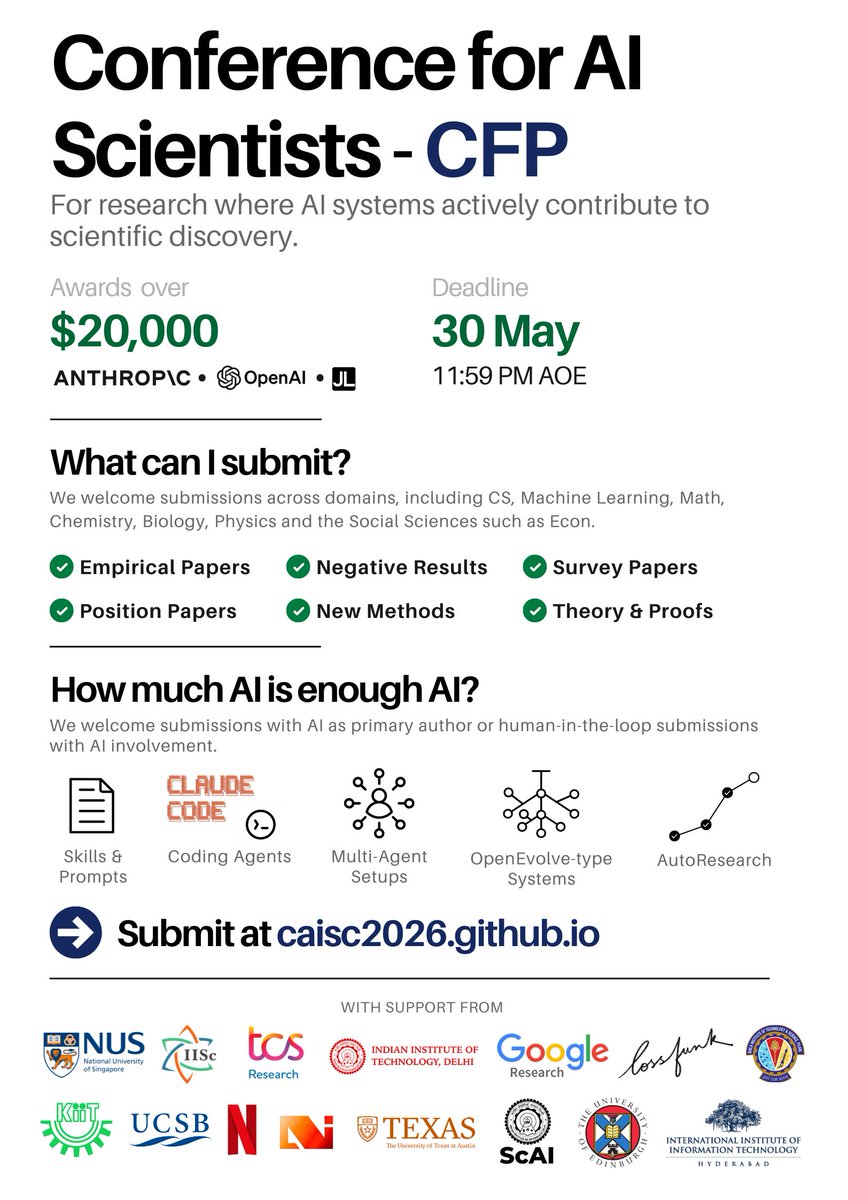
⏰ 3 days left until the deadline for the Conference for AI Scientists (CAISc) 2026.
With awards incl. model and compute credits over $20,000, this is a great chance to get feedback on ongoing research.
Our ask - use an LLM or AI system in some part of your research workflow.
built this in the last 4 weeks or so. it's a full fledged market research delivery ops simulator with operations, finance, demand-gen, and HR modeled in. wanted a good way to teach operational concepts + simulate what agents do to an operational chain
https://t.co/98lvlhjngq
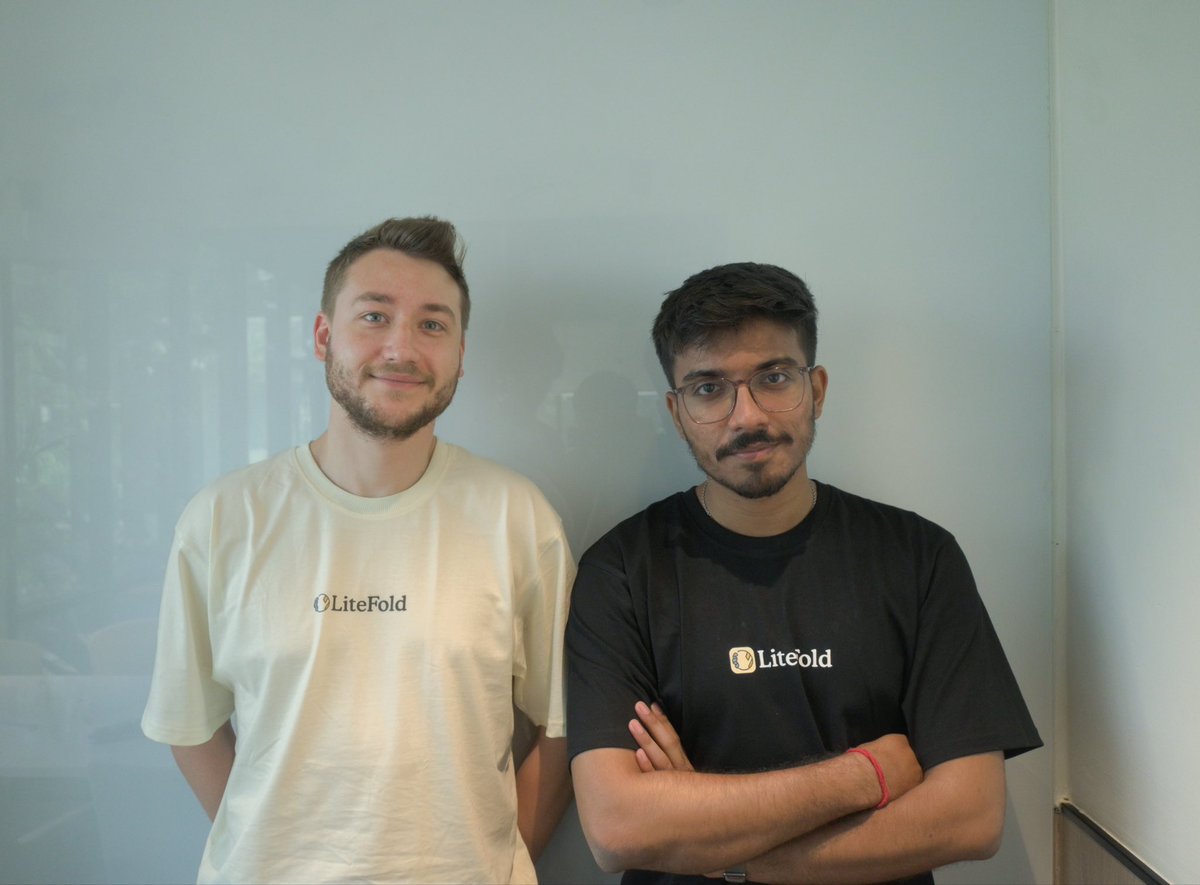
LiteFold just got featured in @YourStoryCo
It’s been 8 months since Cory and I officially started @try_litefold.
We began by building better interfaces and workflows for computational biology, followed by Rosalind, our AI Co-Scientist for therapeutic design.
Now we’re gradually moving toward developing our own in-house scientific and AI research focused on next-generation therapeutic models and research environments and partnerships.
Still very early. Really cant wait to share whats coming.
Story link in the comments
Excited to release the Ultimate guide to RL environments!
Definitions of RL environments differ wildly in the LLM era, so we spent the last month building several RL environments across 6 different frameworks, domains and complexities to map out which are easiest to build with and which can be scaled to 1000s.
Introducing RL Commons.
An open research initiative for the reinforcement learning era.
Shared compute. Open benchmarks. Collaborative work.
Founding phase Project Aster is now open.
Frontier LLMs can do a lot—but can they write good flashcards?
Turns out: not yet! @andy_matuschak and I created an eval for flashcard generation and found surprisingly poor results.
Worse, newer models aren’t helping: GPT 5.4 performs worse than 5.2, Opus 4.7 worse than 4.6.
@asvs_kartheek ahh, this is a thin in-house harness
nothing fancy, just wanted some tools to be run on the users browser/extension and some reliability via model fallbacks, end user in the loop etc
./skills files are just directed graphs. took our skills hitting 300k+ tokens and agents consistently missing discovery and latency issues. so
1. depth should be inverse of frequency. stuff needed every run → 1 hop from root. niche edge case → 3 hops deep is fine.
@asvs_kartheek like a git undo: revert(steps: int, message: str)
as this tool call is not specific to undoing skill file reads, whenever agent attempts something and fails like search_replace on artifacts it can decide to revert
this mattered when models were like just 150k usable contexts.
3. but every hop is a file read and every file read costs context window. wrong file = wasted tokens. graph structure is literally inference cost optimization.
we added a tool call that undoes a file read and redacts it from context before compaction hits