velo:native
This is the definitive on-chain proof that the "shakeout" is complete and the supply is structurally locked.
@wideopentruth did forensic work that most people only talk about. Let's break down what this data actually means for the thesis.
$VELO's breakout target at $1.6534 continues to go unchanged here and prices look to be nearing a smaller breakout which can spark a key move towards!
Technical setup shows >200X potential.
$VELO may be one of the most misunderstood infrastructure plays in crypto.
Most people still think crypto is about charts, memecoins and speculation.
But behind the scenes, an entirely new payment architecture may already be taking shape.
And surprisingly, many of the puzzle pieces appear to connect around VELO, Lightnet, XRPL, EVOLVE and even projects like mBridge.
BRICS Pay documents and recent interviews describe a future financial system built around multilateral netting, national currency settlement, blockchain accounting, stablecoin bridges, OTC fiat gateways and interoperable payment rails.
This is not about replacing the dollar with a single coin.
It is about rebuilding the infrastructure of global commerce.
One statement from the BRICS Pay CEO stood out in particular:
USDT may serve as a temporary bridge, but over time the system will likely require regulated regional stablecoins from jurisdictions such as Hong Kong or the UAE, potentially even asset-backed alternatives like tokenized gold.
That distinction matters more than most people realize.
Since the implementation of MiCA in Europe and the tightening of stablecoin regulation globally, the market has increasingly split into two categories:
regulated institutional-grade digital assets and unregulated liquidity bridges.
This is precisely where VELO’s positioning becomes interesting.
For years, @veloprotocol has quietly built infrastructure around PayFi settlement, fiat gateways, OTC liquidity, merchant payment systems, loyalty tools and interoperable cross-border transfers.
The similarities are difficult to ignore.
And this is where $USDV becomes critical.
USDV is not simply another stablecoin. It acts as the system-native settlement asset within the Velo ecosystem and is backed through exposure to BlackRock’s USD Institutional Digital Liquidity Fund, BUIDL, tokenized via @Securitize
That changes the entire conversation.
If USDT is merely a temporary liquidity bridge, the obvious question becomes:
what comes next?
VELO’s answer may already exist in the form of a regulated, yield-bearing stablecoin infrastructure connected to tokenized US Treasury exposure.
And unlike unregulated stablecoin bridges, USDV is backed by an investment in BlackRock’s USD Institutional Digital Liquidity Fund, BUIDL, tokenized via Securitize.
At the same time, Velo has also explored additional V-Stablecoins linked to regional fiat currencies, reinforcing the idea of a multilayered settlement architecture built around interoperable regional liquidity rather than a single dominant asset.
In other words, while USDT solves short-term liquidity, USDV points toward the next phase of institutional PayFi settlement backed by real-world assets and on-chain yield generation.
Then things become even more interesting with Lightnet.
Velo & @lightnetgroup was co-founded by Chatchaval Jiaravanon, a member of the family behind
@CPGroup_Live, one of Asia’s most influential conglomerates with deep historical business ties throughout China.
And this matters because cross-border payment systems are never built on technology alone.
They require regulatory trust, banking relationships, liquidity corridors, licensing frameworks and geopolitical access.
That is precisely why Lightnet’s positioning in Hong Kong is so significant.
Hong Kong is increasingly emerging as the regulated digital asset sandbox for Asia and potentially even a controlled gateway into broader Chinese financial experimentation.
Through partnerships such as WeLab and its pursuit of Money Service Operator licensing, Lightnet has positioned itself near one of the most important future payment corridors connecting ASEAN, Hong Kong and China.
But another critical piece is often overlooked:
mBridge.
mBridge is the BIS-backed multi-CBDC initiative involving the central banks of China, Hong Kong, Thailand and the UAE.
And interestingly, its core focus revolves around the exact same concepts:
$VELO may be one of the most misunderstood infrastructure plays in crypto.
Most people still think crypto is about charts, memecoins and speculation.
But behind the scenes, an entirely new payment architecture may already be taking shape.
And surprisingly, many of the puzzle pieces appear to connect around VELO, Lightnet, XRPL, EVOLVE and even projects like mBridge.
BRICS Pay documents and recent interviews describe a future financial system built around multilateral netting, national currency settlement, blockchain accounting, stablecoin bridges, OTC fiat gateways and interoperable payment rails.
This is not about replacing the dollar with a single coin.
It is about rebuilding the infrastructure of global commerce.
One statement from the BRICS Pay CEO stood out in particular:
USDT may serve as a temporary bridge, but over time the system will likely require regulated regional stablecoins from jurisdictions such as Hong Kong or the UAE, potentially even asset-backed alternatives like tokenized gold.
That distinction matters more than most people realize.
Since the implementation of MiCA in Europe and the tightening of stablecoin regulation globally, the market has increasingly split into two categories:
regulated institutional-grade digital assets and unregulated liquidity bridges.
This is precisely where VELO’s positioning becomes interesting.
For years, @veloprotocol has quietly built infrastructure around PayFi settlement, fiat gateways, OTC liquidity, merchant payment systems, loyalty tools and interoperable cross-border transfers.
The similarities are difficult to ignore.
And this is where $USDV becomes critical.
USDV is not simply another stablecoin. It acts as the system-native settlement asset within the Velo ecosystem and is backed through exposure to BlackRock’s USD Institutional Digital Liquidity Fund, BUIDL, tokenized via @Securitize
That changes the entire conversation.
If USDT is merely a temporary liquidity bridge, the obvious question becomes:
what comes next?
VELO’s answer may already exist in the form of a regulated, yield-bearing stablecoin infrastructure connected to tokenized US Treasury exposure.
And unlike unregulated stablecoin bridges, USDV is backed by an investment in BlackRock’s USD Institutional Digital Liquidity Fund, BUIDL, tokenized via Securitize.
At the same time, Velo has also explored additional V-Stablecoins linked to regional fiat currencies, reinforcing the idea of a multilayered settlement architecture built around interoperable regional liquidity rather than a single dominant asset.
In other words, while USDT solves short-term liquidity, USDV points toward the next phase of institutional PayFi settlement backed by real-world assets and on-chain yield generation.
Then things become even more interesting with Lightnet.
Velo & @lightnetgroup was co-founded by Chatchaval Jiaravanon, a member of the family behind
@CPGroup_Live, one of Asia’s most influential conglomerates with deep historical business ties throughout China.
And this matters because cross-border payment systems are never built on technology alone.
They require regulatory trust, banking relationships, liquidity corridors, licensing frameworks and geopolitical access.
That is precisely why Lightnet’s positioning in Hong Kong is so significant.
Hong Kong is increasingly emerging as the regulated digital asset sandbox for Asia and potentially even a controlled gateway into broader Chinese financial experimentation.
Through partnerships such as WeLab and its pursuit of Money Service Operator licensing, Lightnet has positioned itself near one of the most important future payment corridors connecting ASEAN, Hong Kong and China.
But another critical piece is often overlooked:
mBridge.
mBridge is the BIS-backed multi-CBDC initiative involving the central banks of China, Hong Kong, Thailand and the UAE.
And interestingly, its core focus revolves around the exact same concepts:
Most people are looking at $VELO all wrong 👀
Everybody watches the chart.
Up = genius 🚀
Down = panic 😨
But what if the real story is what is getting built while nobody is paying attention?
I think the biggest thing people are missing with $VELO is distribution 🌏💳
Not hype.
Real payments.
Cross-border money movement.
Remittance.
Merchant systems.
And here is the part hardly anyone knows when they are purely speculating or trading coins at random...
$VELO may be priced like a memecoin right now but no memecoin I've ever known of has had ties through its ecosystem like Lightnet, a real payments/remittance company connected to Southeast Asia finance networks.
That matters.
Why?
Because if real payment rails grow, utility grows.
A spec market can distract people from what matters.
Price goes down and people get scared.
Price goes sideways and people get bored.
Meanwhile utility can still be growing under the surface 👀 ...these historical bottoms I believe will be generational wealth territory to #DCA into.
Makes me think about Jeff Bezos and Amazon.
Amazon crashed from around $113 to about $6.
Everybody thought it was over.
But Bezos said:
"The stock is not the company. The company is not the stock."
The price got crushed.
The business kept getting stronger.
That stuck with me.
Price is not the full story.
Have a reason for owning something.
Have a thesis.
Watch adoption. Watch partnerships. Watch utility.
And more importantly when the lemming market speculators talk shit... lean in a bit deeper and you'll discovery, like always, the ones who bark the loudest usually know the least.
Most people chase candles... their thesis is simply and only that... 📈
I am watching what gets quietly built.
If you hold $VELO, know WHY you hold it.
#VELO #Crypto #PayFi #RWA #Altcoins #Web3 #NFA
• Lightnet + ASEAN settlement network: https://t.co/hzTDG9H4LR
Velo’s new whitepaper is live.
https://t.co/WXlrRsdKAi
This isn’t just an update—it’s a shift in how payments, liquidity, and capital come together.
Introducing a compliant, crypto-native FX liquidity, treasury network for global settlement.
Here’s what’s changed 👇 1/3
[ $VELO ]
Weeks ago, weekly candle turned out to be a rejection from this macro RSI diagonal and we made a slightly lower low. With great reactions after we've now confirmed:
- a double bullish divergence,
- RSI breakout after 1y of misery.
Welcome to a HTF reversal and a new macro wave in front that should well exceed current local top at $0,039
$VELO l @veloprotocol
Just saw this post and my gut instantly told me...
This is HUGE! 🚀
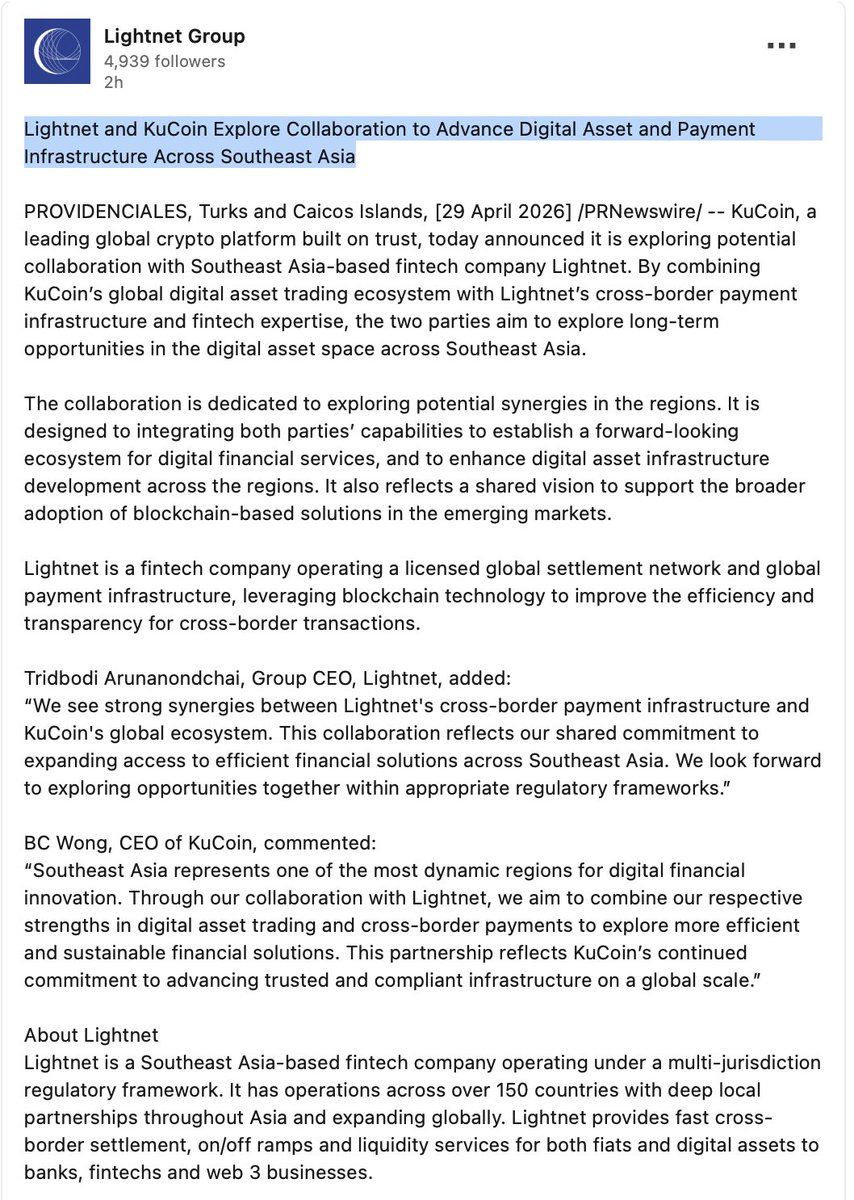
LIGHTNET (Southeast Asia fintech with Licensed Global Payments & Blockchain Rails) is exploring a major collab with @kucoincom (40M+ user crypto exchange).
They want to connect crypto trading liquidity with real-world cross-border payments across SEA (South East Asia!)
Lightnet Group CEO Tridbodi Arunanondchai (BEAM) said:
“We see strong synergies between Lightnet's cross-border payment infrastructure and KuCoin's global ecosystem. This collaboration reflects our shared commitment to expanding access to efficient financial solutions across Southeast Asia. We look forward to exploring opportunities together within appropriate regulatory frameworks.”
---------------------------------
Why this matters for $VELO ??
---------------------------------
LIGHTNET is powered by $VELO
$VELO is the key collateral & bridge asset behind their settlements & stablecoins.
This = more real transaction volume → higher demand for $VELO → stronger utility, liquidity & adoption in SEA remittances/fintech.
Exactly the real-world use case $VELO was built for!
Long-term bullish for the project, token & holders 🚀🚀
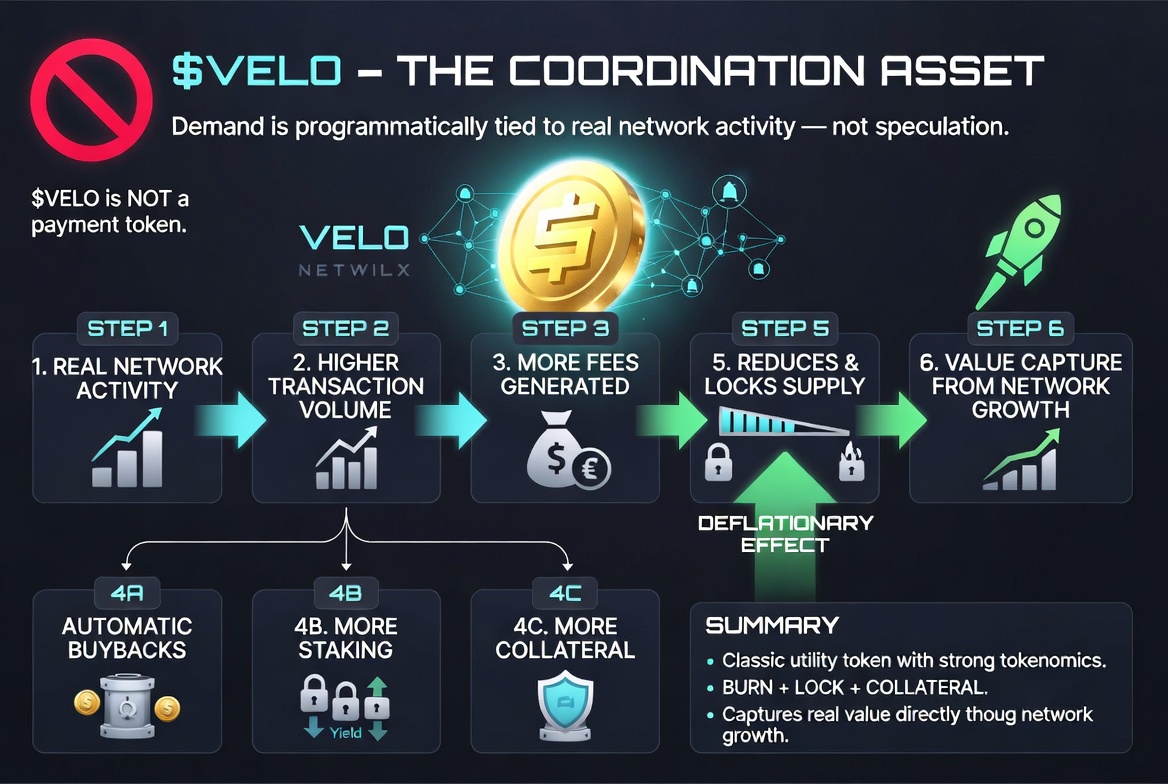
$VELO l @veloprotocol is not a payment token.
$VELO is "A Utility Token" with strong tokenomics (burn + lock + collateral) designed to capture real value directly from network growth.
It is the coordination asset that holds the entire VELO NETWORK 🪐 together.
Its demand is programmatically tied to real network activity, not speculation.
Higher Transaction Volume ➡️ More Fees ➡️ Automatic Buybacks ⬆️ More Staking ⬆️ More Collateral 📈
This actively reduces and locks supply, creating "A Deflationary Effect" 🔥
Most people still look at $VELO as just another crypto token.
But @veloprotocol is positioning itself as something much bigger:
a full-stack financial infrastructure layer for Asia.
Global payments remain inefficient.
For users, cross-border payments can take 2–5 days, move through several intermediaries and still fail.
For institutions, large amounts of capital remain locked in pre-funded accounts just to enable settlement.
That is exactly the problem Velo is trying to solve.
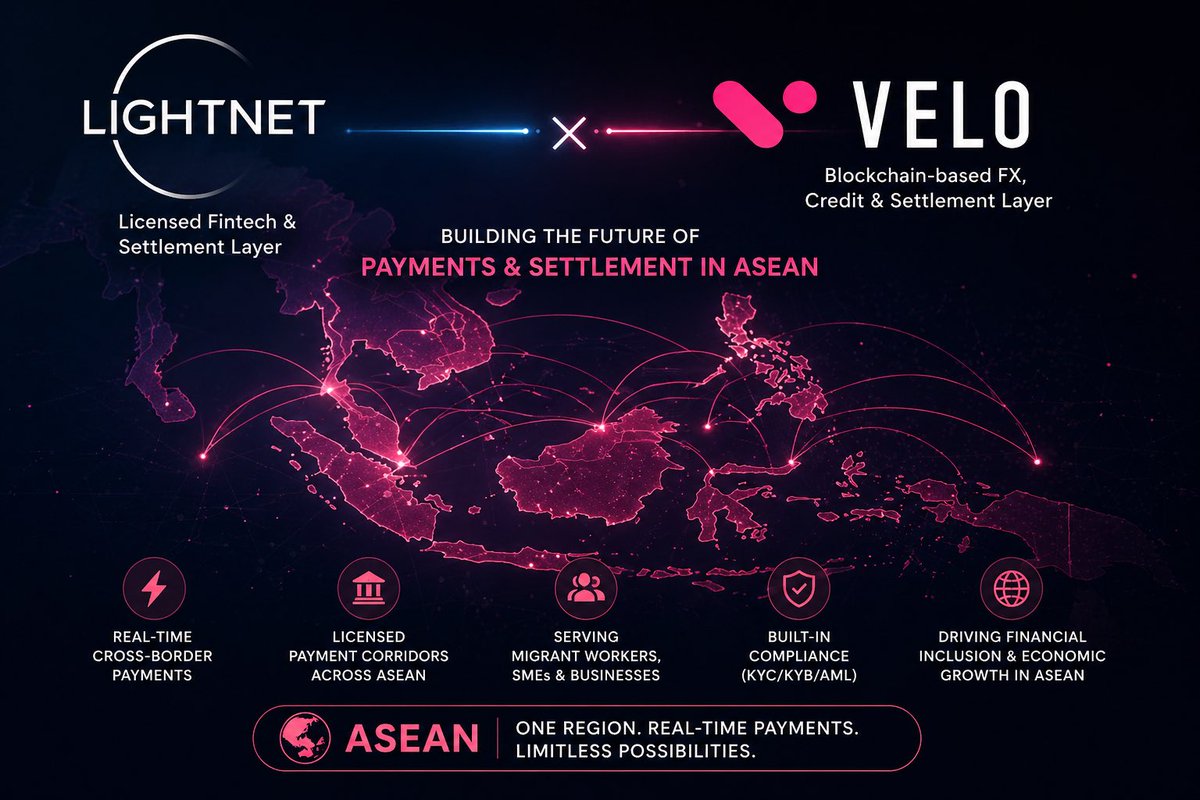
Velo Protocol and @lightnetgroup are not building a simple payment app.
They are aiming to establish a blockchain-native settlement network for the ASEAN region.
That distinction matters.
ASEAN needs regulated payment rails, fiat access, liquidity, compliance and real-time settlement.
This is where Velo and Lightnet are trying to position themselves.
Lightnet uses Velo as the technical backbone for real-time cross-border payments.
The goal is to create a faster and more efficient alternative to legacy correspondent banking and SWIFT-based settlement flows.
The focus is clear:
Southeast Asia’s remittance market.
A market worth over $150B annually, serving migrant workers, underbanked communities, SMEs and cross-border businesses.
For users, the current system is often slow, expensive and fragmented.
For institutions, settlement still depends on intermediaries, pre-funded accounts and capital sitting idle just to move money across borders.
Velo describes its system across four layers:
Compliance → licensed fiat rails in ASEAN
Infrastructure → chain-agnostic execution
Capital → aggregated CeFi + DeFi liquidity
Treasury → yield on idle capital
This is an attempt to build financial rails.
Through Lightnet, Velo has access to licensed payment corridors across ASEAN, bank and merchant integrations, fiat-to-crypto on/off-ramps and built-in compliance.
That matters.
Because the hardest part in payments is not only the blockchain.
It is distribution, licenses, liquidity and real-world access.
This is where Velo becomes interesting.
$VELO is described as the coordination asset of the network.
Demand is driven by transaction fees, liquidity staking and collateral for institutional settlement.
More usage → more volume → tighter token loop.
And now the focus is shifting.
From infrastructure → real usage.
Coming next:
• Orbit Plus is already live in 15 countries worldwide as a gateway into the Velo ecosystem.
Additional features and integrations are still being rolled out, marking the shift from infrastructure to real-world application.
• Crypto debit cards
• Direct off-ramps to bank accounts
• RWA access
• Cross-chain swaps
• Merchant payments
This is where the thesis becomes simple:
If Velo can scale real usage, the token is no longer only a speculative asset.
It becomes part of the payment, credit and settlement engine.
That is why the Velo + Lightnet connection matters.
Lightnet brings the licensed fintech and settlement layer.
Velo brings the blockchain-based FX, credit and settlement layer.
Together, they are targeting one of the hardest problems in finance:
moving money across borders faster, cheaper and with compliance built in.
If Velo becomes fully integrated into Lightnet’s licensed B2B settlement system, it could serve as the FX, credit and settlement core behind a new payment layer for Asia.
That is the core thesis.
• Payments.
• Settlement.
• Liquidity.
• Compliance.
• Fiat access.
• Adoption.
Most people are still looking for the next narrative.
But the real value may be in the rails.
That is where infrastructure is being built.
Pay attention to Velo.




![Osemka8's tweet photo. [ $VELO ]
Weeks ago, weekly candle turned out to be a rejection from this macro RSI diagonal and we made a slightly lower low. With great reactions after we've now confirmed:
- a double bullish divergence,
- RSI breakout after 1y of misery.
Welcome to a HTF reversal and a new macro wave in front that should well exceed current local top at $0,039](https://pbs.twimg.com/media/HHoAR-DWkAUPrcU.jpg)