Founder & CEO, SWIRL AI. Enterprise AI search without moving your data. Knowledge authority for Claude, Copilot, Harvey. Don't move the data. Move the query.
Team SWIRL is delighted to announce the release of SWIRL Community 4.5!!
This version includes:
* Support for executing RAG with most LLMs and optional LLM instructions
* New MCP server for easy integration with Claude or any MCP client
* New Galaxy UI featuring search history & the return of dark mode
* New admin console featuring bulk editing support for SearchProviders, built-in activity analytics, log viewer, JSON paste support and more!
* Revised source selector now groups sources by tag and shows the tag selected instead of listing the underlying sources
* Updated re-ranking model improves precision and reduces response time
* Improved error handling, especially during AI insight generation
For full details, see the link in the comments... congratulations @SWIRL_SEARCH for this milestone release!!
Gordon Ramsay would be an extraordinary agentic coding lead!
Think about it.
His secret isn't talent. Every kitchen has talented chefs. His secret is that before anyone touches a pan, the standards are absolute, documented, and non-negotiable. The mise en place. The brigade system. The recipes. Every cook knows: you do not freelance in Gordon Ramsay's kitchen.
Deviate? He finds out. Immediately. Loudly.
"An inline panel?! We use MODALS in this kitchen! GET OUT!"
This is exactly what your AI coding agent needs.
Because here's the thing about agents: they are incredibly talented chefs who will happily cook whatever they feel like if you don't tell them otherwise. Leave them unsupervised across three sessions and you come back to a codebase with three different UI paradigms, two new dependency patterns, and a data model that made sense to nobody but the agent that invented it at 2am.
Gordon doesn't leave chefs unsupervised. And he puts the standards in writing. Every service. Every shift.
That's your prompt.
Every task prompt needs three things:
→ What to build
→ The actual context (code, specs, contracts)
→ The standards: use existing patterns, ask before introducing anything new, no freelancing
The last one is the Gordon Ramsay clause. It goes in every prompt. Not just the first one.
Because the agent doesn't remember the last session. But Gordon would never let that be an excuse.
"I don't CARE that it was a new context window. This is RAW."
Be Gordon. Write the standards down. Put them in every prompt.
Your codebase will thank you... hopefully, without screaming.
Ever seen this?
Process 'ForkPoolWorker-7' pid:32839 exited with 'signal 11 (SIGSEGV)'
billiard.exceptions.WorkerLostError:
Worker exited prematurely: signal 11 (SIGSEGV) Job: 0.
On a mac, you've hit one of the classic fork-after-init traps.
Here's what's going on and how to actually fix it...
The engineer who built Claude Code just dropped a 28-minute video on how to write prompts that actually work
I've seen $300 courses that don't cover what he shows in the first 10 minutes
CLAUDE.md files, memory shortcuts, parallel sessions, prompting patterns
all in one video and completely free works whether you're a developer, a beginner, or someone who's been using Claude for months.
Anthropic shipped Claude Opus 4.8 last week.
For lawyers, two numbers matter.
First: it set the highest recorded score on the Legal Agent Benchmark.
Translation - Opus 4.8 is now the strongest publicly available model for legal agent tasks. That benchmark measures end-to-end agent performance on real legal work.
Second: it is the first model to break 10% on the all-pass standard.
Translation - even the best model on the market fails 90 percent of full legal agent tasks. The ceiling is rising. The floor is still low.
That second number is the one most legal-AI vendors will not mention.
Both numbers are true at the same time. The capability is real. The verification gap is also real.
What this means for solo and small-firm lawyers in practice:
→ Your existing agent stack just got better, automatically, if you are running on the API. Opus 4.8 is a drop-in upgrade.
→ The coding and drafting agents your firm uses are now 4x less likely to let flaws slip through unflagged. That is a real reliability improvement.
→ Fast mode is 2.5x quicker. Latency on real-time workflows drops meaningfully.
→ Pricing held - $5 per million input tokens, $25 per million output. With 90 percent savings on cached prompts, the unit cost of running a configured agent is meaningfully lower than Opus 4.7.
Now the honest part.
A model that fails 9 out of 10 full legal agent tasks is not a model you let run unsupervised on client work. It is a model you build verification protocols around.
The lawyers who win this upgrade cycle are the ones who already have the verification layer in place - the citation checker, the human approval gates, the audit log.
The lawyers who lose are the ones who hear "highest legal benchmark ever" and skip the verification step.
The model got better.
The discipline did not.
THE RULE OF THREE
Never let an AI agent try to fix the same bug more than three times.
Attempt one is useful. Attempt two is plausible. Attempt three tells you something.
Attempt four is where the agent renames three variables, invents a caching problem, and starts “cleaning up the tests.”
No.
After the third miss, stop the loop. Document what happened. Summarize the current state. Capture the exact error, files touched, theories tested, and what changed.
Then critique the work. What did we assume? What did we miss? What did the agent confidently make worse?
Then start a new task with clean context.
Agents are great. But after three failed tries, you don’t have a coding assistant.
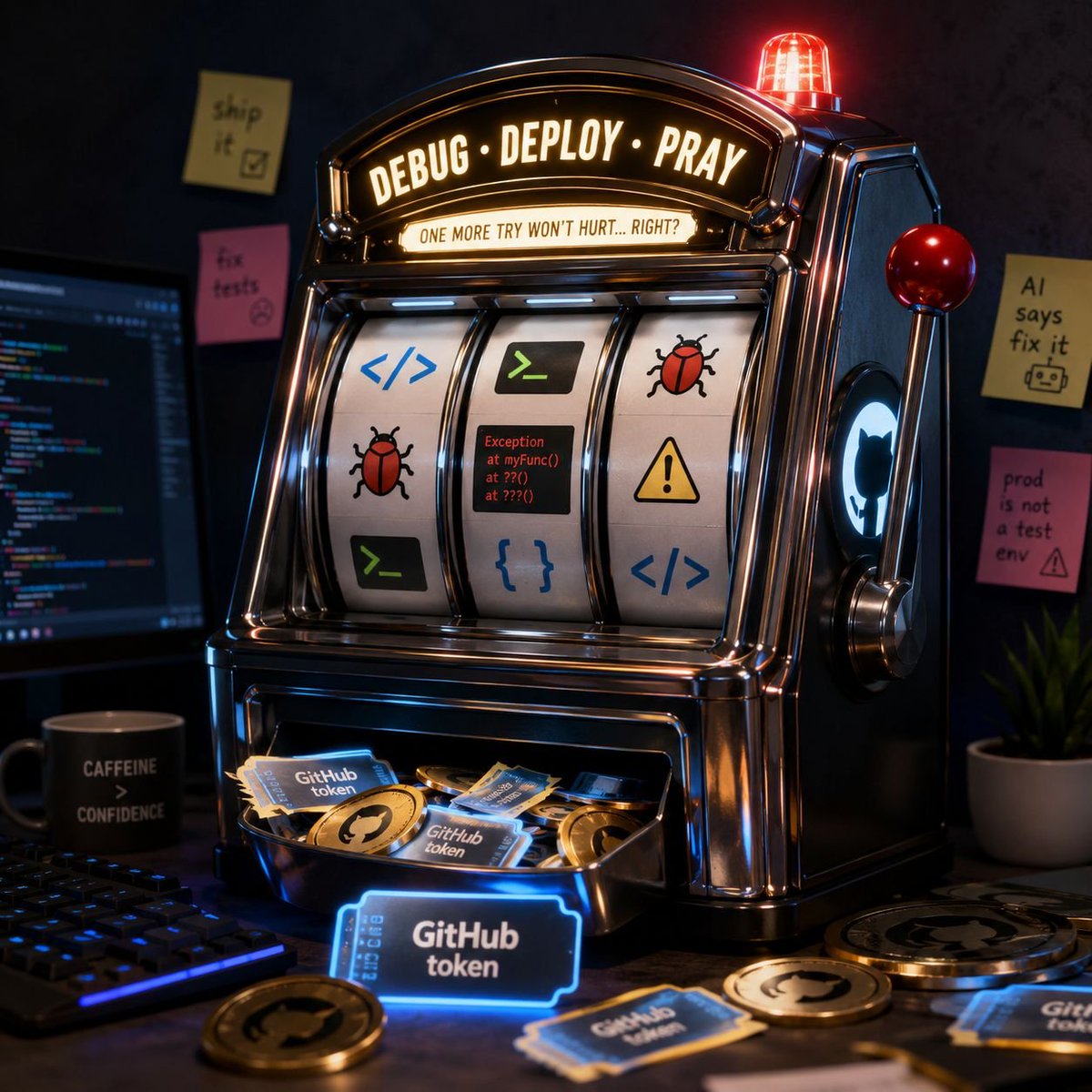
You have a slot machine with a GitHub token!
Claude: capable of coding in parallel at the speed of light
Also Claude: fails 5x trying to access the search box on a web page, because it doesn't realize it has to dismiss the cookie warning
The part that actually points forward
Here's what I keep coming back to, and it's the reason this matters beyond two horror fans nerding out.
The Backrooms is the first major studio horror feature grown entirely from an open, collaborative internet mythos. It started as a single unsettling photo on an imageboard. A community built the canon on a public wiki, with no author and no permission required to contribute.
A teenager with free tools picked up the shared world and made nine minutes of YouTube that the rest of us then watched 79 million times. A24 came to him!
The pipeline ran backwards from every studio's playbook.
I want to be precise, because precision is the whole point: this isn't open source in the license sense. The mythos was crowdsourced, the YouTube films are free to watch but copyrighted, and the feature is a fully proprietary A24 production. What's new isn't the licensing, it's the creation model. Open, collaborative, community-built canon as the seedbed for a commercial work, with attribution and ownership sorting themselves out later.
That's a great direction.
The same logic that produced this film is the logic idea that value isn't in hoarding the source, it's in what a community builds when the door is open and anyone can no-clip into the world and add a room.
The Backrooms is proof the model works in culture, not just code.
Open the door.
See what comes back through the hum.
End of 🧵
The Hum Between Worlds: Why David Lynch Would Have Loved the Backrooms
I've been a fan of liminal horror for what seems like an eternity... A hallway that goes too far, a room that shouldn't exist, the wrongness of a space built for people and emptied of them. Fluorescent buzz. Damp carpet. The feeling that you've stepped one inch sideways out of reality and the door behind you is ... gone.
So I was psyched to learn that Kane Parsons, the 20-year-old who turned a 4chan creepypasta into a viral YouTube series and now an A24 feature, essentially grew up inside Twin Peaks!!
He's said as much: it was ambient in his house, in his bones, before he could even articulate why. He's also refreshingly honest that he hasn't finished the whole run and intends to. That's the right kind of influence. Not homage you can point to, but a frequency you absorbed young and now transmit without trying.
And the critics heard it without being told. Variety's Owen Gleiberman said Parsons shares "early David Lynch's love of industrial cosmic sound design" and Lynch's fixation on the mysteries of electricity. Others have called the film's final stretch heavily indebted to Twin Peaks. When the inheritance shows up in reviews from people who weren't looking for it, you know it's real.
🧵
The bridge moment
If you want the single frame where the two creations touch, it's in The Return, Part 17.
Cooper takes his old Room 315 key, walks Cole and Diane down into the furnace room of the Great Northern, and stops at a door that has been emitting a low hum all season ... a sound that's been bleeding through the walls of the show for weeks. He tells them not to follow. He passes through.
That is a no-clip. Lynch shot it in 2017, but it is the most Backrooms-like moment in his filmography: a man using an ordinary key to step through an ordinary door in the basement of a hotel and arriving somewhere reality forgot to finish. On the other side is MIKE, then Jeffries, then the instruction to go find Judy across the threshold of another dimension ... a crossing that doesn't resolve until Part 18, in a different motel, a different town, a woman who may or may not be Laura Palmer. The hum that's been haunting the Great Northern all season was the sound of the other place. Parsons spent a whole feature building a world out of that exact hum.
Lynch passed away in January 2025. He never saw this film. But "would have loved it" feels too weak; he'd have recognized it.
It's built on his frequency.
🧵
@TiredBambooLaw It’s going to help small businesses more than it hurts them. Small businesses are constantly getting screwed over by larger ones who can handle the legal fees. AI gives SMBs the tools to fight back. It also gives them the ability to perfect themselves better from the onset
The NBA will have to contend with Wemby for the next decade plus...he can control a game like no other...but who had Luke Kornet with the Play of the Game ?