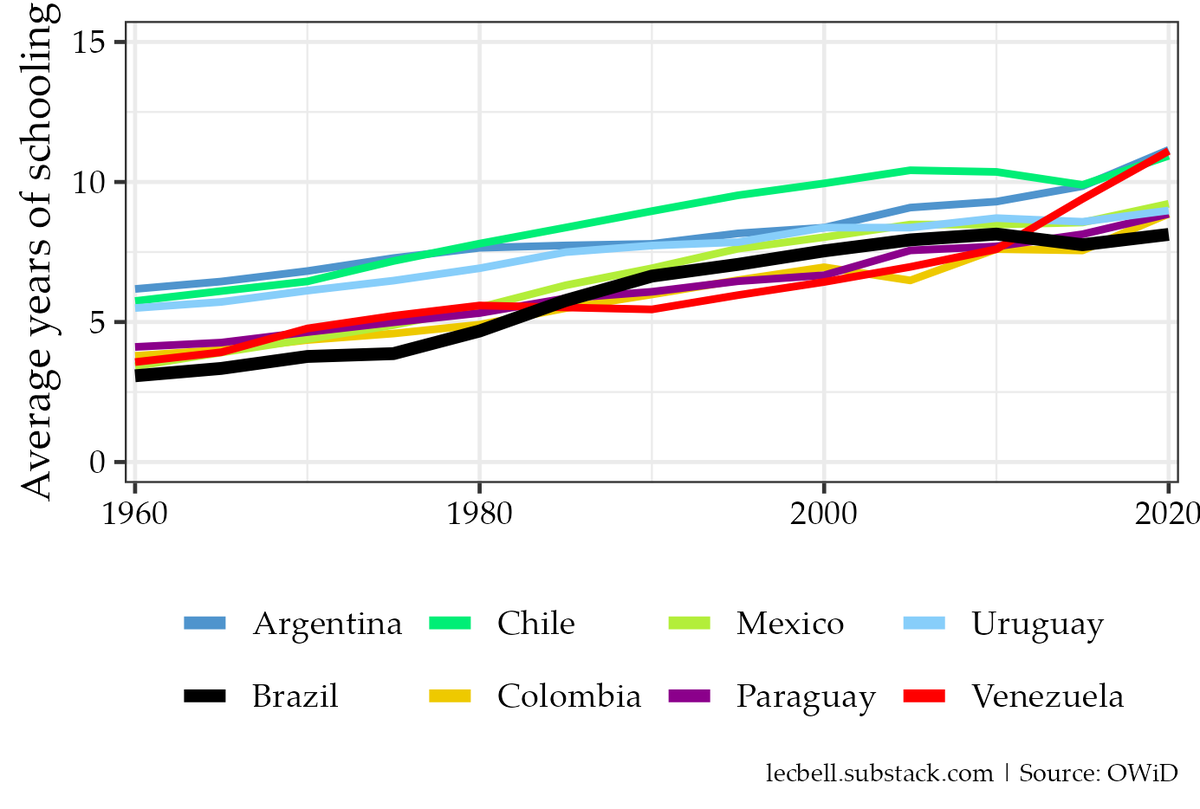
The world is getting better, more prosperous and we are living helthier, longer lives. Brazil is part of the world and it is getting better, too: but at lower rate than the world in general and the developing countries in particular.
The world is getting better, more prosperous and we are living helthier, longer lives. Brazil is part of the world and it is getting better, too: but at lower rate than the world in general and the developing countries in particular.
I'd say there is a third problem:
3) the society itself will change, because young people are more risk-taking, and innovation ofter arises from a bunch of young people; thus society will be more risk-averse and less innovative.
This transformation can lead to stagnation.
The problem with the collapse of fertility is not so much economic, I think we'll figure that out, but 1) fiscal because we need people to pay for state-provided services for old people and 2) the fact that many communities in rural areas and small towns will be wiped out.
The first problem is widely discussed, but I think most people don't know about the second one. If the population of small towns and surrounding villages falls too quickly, we'll have to write off a lot of infrastructure and make large investments to build new ones elsewhere just as aging will already squeeze budgets.
@alt_ccc@souljagoyteller our elites were trying to "naturally end" slavery: a specific law fred all slaves over 60, while another law fred all recent-born slaves: therefore slavery would naturally go away when the then current adult slaves reach 60
@Kracudo_ E provavelmente as pessoas comuns da mesma área onde você cresceu vivem hoje uma vida bem melhor do que quando você era criança. Obviamente não é o paraíso, mas bem melhor do que naquela época.
It perhaps makes some sense in retrospect, but our imperial government was trying to end slavery (our Emperor, D. Pedro II, was personally an abolitionist), while various players were just trying to sustain slavery as the British Empire was dealing with ways to end slave trade.
But we were a very poor and undeveloped (even unpopulated) country with limited resources, low prestige, and not a feasible way to interfere in American affairs.
That said, certainly some Brazilian very rich people back then, slave owners, could sympathize with the Confederacy cause. Although here, the military coup that ended the monarchy was openly abolitionist, therefore it's possible that confederate cause wasn't popular among Brazilian powerful people in the late 19th century, I guess.
@tilynkat@ftpavani minha vizinha teve bebê e fez festa de MESVERSÁRIO até ela fazer 2 anos... cada uma mais requintada do que as festas que ela mesmo tinha (quando tinha) de aniversário, hahahaha
@tilynkat@ftpavani bem isso
e era 1 (ou 1/2) cento de salgados, 1 (ou 1/2) cento de docinhos, nem meia dúzia de refrigerantes e é isso
(e essa seria uma festa das boas, ainda)
I'll drop a quick exploration each week on how Brazil is lagging behind, starting with GDP and education.
Next week we'll get sanitation, HDI, and Human Capital Index.
Along the weeks we'll explore international trade, economic complexity, TFP, corruption and violence.
@ftpavani E olha que este número é pequeno hoje... temos uns 213M brasileiros, e uns 50M vínculos na RAIS... de CLT, devem ser uns 30M-40M (e olhe lá).
Por baixo, metade das pessoas que trabalham não tem vinculo formal: e isso hoje. No passado era ainda mais raro ter vínculo formal.
@glauber_doc Esse povo não vai pra escola, pra faculdade? Não namora?
Porque professores bons em cursos exigentes são muito críticos. Namoradas às vezes são muito críticas, especialmente em "certos dias".
Nunca praticam artes marciais? O pessoal lá também é muito crítico.
@izzynobre Numa avenida perto de casa, o limite é 60km/h, e eu nunca tive coragem de chegar a 50km/h lá, de tão ruim que é o pavimento. Pessoal ignora o radar e às vezes passa acima de 100km/h lá...
Fora o tanto de lombada e buraco, e buraco no topo das lombadas...
@elivieira Todo mundo erra, até os homossexuais, hahahaha
Gosto muito de uma daquelas frases de efeito do Hitchens: "homossexualidade não é só uma prática sexual, mas uma forma de amar".