You are allowed to feel lucky to be British. People seem to forget this.
The accent that somehow gets you served first abroad. Countryside that looks like it was painted by someone quietly showing off. A proper pub at the end of a wet walk. The shipping forecast read out every night to a nation that is, for the most part, not at sea.
But there is one blessing that never makes the list, and it never makes the list because the people compiling the list have spent a decade being told it is a problem to be managed rather than a gift to be counted.
British livestock farming.
Start with welfare. Britain sits near the very top of the global table for animal welfare law, level with Sweden and Austria, and ahead of every other major economy on earth. No country scores full marks, but nobody scores higher than we do. The animal that becomes your Sunday roast was made insensible before it knew a single thing was wrong, on a holding you could trace by the number printed on the label. There are corners of the world where none of that is true. We are not one of them.
Then the self-sufficiency, which is the part the net zero crowd would prefer you never sat down and worked out.
Britain is over 100% self-sufficient in lamb. We grow more than we eat and sell the surplus abroad. We are around 80% self-sufficient in beef, and very nearly self-sufficient in the milk in your tea. Now look at fresh vegetables, where we manage barely half of what we get through, the lowest figure since records began. The most resilient, most homegrown, least import-dependent food this entire country produces is the exact food we are being lectured to give up.
Sit with that one. It does not get any less strange the longer you stare at it.
And none of it is luck of the draw. It is the land itself. Britain was built, by rain and rock and ten thousand years of weather, to grow grass and very little else across most of its surface. You cannot put wheat on a Welsh hillside or a Cumbrian fell. You can put a cow on it, or a sheep, and stand back, and in return some of the most marginal farmland in Europe quietly turns out some of the finest red meat and dairy on the planet. The climate that ruins your barbecue is the same climate that grows the grass that feeds the herd that feeds you.
So here is the bit they leave out of the documentary.
You live in a country with the highest welfare standards, the shortest supply chains, the most suitable land, and a thousand-year head start, and you are being asked to feel guilty about eating the produce of all of it while you wait for an avocado to be flown in from a drained valley in Mexico.
So don't feel guilty. Feel lucky, and then go and put your money where your good fortune already is.
Eat British.
Eduardo was sheared in May.
He stood, as he stands every May, with the patience of a camelid who has done this nine times. He hummed once. The glossary lists it as "acknowledgement of necessary inconvenience." He did not move. He did not flinch.
His fleece weighed three point eight kilograms. The fibre measured 22 microns. Sheep's wool from a typical British breed sits between 28 and 36.
Eduardo's wool is finer than cashmere. No lanolin, so no chemical scouring. Hollow-cored, so it traps more warmth per gram than the wool of any sheep on this island. It does not pill. It does not itch. It sheds water in a way that synthetic fibre engineers have spent forty years trying, and failing, to replicate.
The vegan alternative is acrylic.
Acrylic is petroleum. Polyacrylonitrile, derived from crude oil, polymerised in a chemical plant using a hydrogen cyanide catalyst, dyed in processes that have, on more than one occasion, made the news.
An acrylic jumper sheds approximately 730,000 microplastic fibres per wash. Into the rivers, the seas, the food chain, the placentas of unborn children, the lungs of the rest of us.
Eduardo's jumper sheds nothing. At the end of its life, it goes back to the soil. The acrylic jumper goes to landfill for two thousand years.
Now. The suffering question.
Eduardo was, for eleven minutes, mildly inconvenienced. He stood still. He tolerated the sound of clippers he has heard nine times before. He was handled by a shearer whose hands he recognises by smell.
Afterwards, he was lighter, cooler, and visibly relieved. He hummed twice in the register the glossary lists as "satisfaction with current arrangement," walked to the geometric centre of the field, and kushed.
If he had not been sheared, the fleece would have grown through summer and caused him to overheat. By autumn it would have felted against his skin, harbouring parasites.
The shearing is not the suffering.
The shearing is the relief.
The fleece is in Powys. Eduardo is humming. The summer is properly underway.
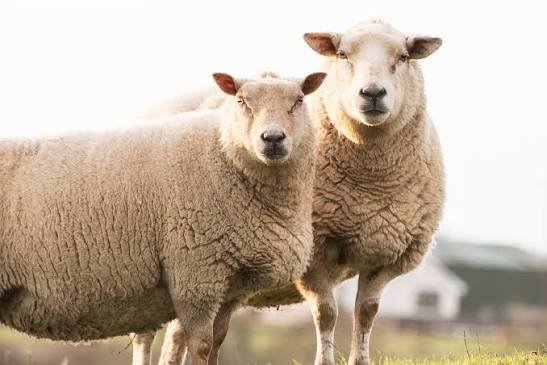
There are two Texel ewes that share Keith's field in summer.
They are not Keith's ewes. They are not part of any active breeding plan. They are two retired ewes that the farmer's wife took on from a flock dispersal in 2023, and that have been living on the bottom pasture of Dave's farm because the bottom pasture is, after Keith has worked it, in better condition for grazing than it has been in any of the previous tenancies the farm has known.
The ewes' names are Pat and Margaret.
Keith's relationship with Pat and Margaret is the following.
He ignores them.
Specifically, he ignores them in the way that a goat ignores sheep, which is not the way that, for example, a sheep ignores another sheep, or that a horse ignores a sheep, or that any other animal on this farm ignores any other animal. Keith's ignoring is structural. It is not absent-minded. He is aware of where Pat and Margaret are at all times. He simply does not allow this awareness to influence his behaviour.
Pat and Margaret are also aware of where Keith is at all times.
They have, however, learned to follow Keith.
Not closely. Not in any way that Keith has acknowledged. But when Keith opens a gate, Pat and Margaret are, on average, through it within four minutes. When Keith identifies a section of bramble that is going to be addressed, Pat and Margaret are nearby within ten. When Keith is on the barn roof, Pat and Margaret are usually in the shade of the barn, looking up at him with the specific patient expression of two old sheep who have decided that whatever the goat is doing is, on balance, probably worth being near.
Dave has noticed.
Dave has not mentioned it to Keith, because Keith would deny it.
Dave has also noticed that Pat and Margaret have, in their last two years on this farm, lambed at a rate that the previous flock-keeper would have considered impossible for ewes their age, eaten weeds they had not previously touched, and produced fleece that the local mill paid more for than any of their previous fleeces.
The ewes have got better.
The ewes have got better because they have been doing what the goat does.
The goat does not know they have been doing what the goat does.
This is, in agricultural terms, a mixed grazing system.
It is one of the oldest systems known to British farming. Cattle, sheep, and goats together, sharing pasture, each handling the vegetation the others won't touch, parasites broken up by interspecies grazing, the field improving over years rather than declining over months.
The system was lost when farms specialised after the war.
Dave did not set out to recreate it.
Dave bought a goat for the knotweed.
The system has reassembled itself.
Pat and Margaret are at the gate.
Keith is on the roof.
The pasture is the best it has ever been.
Many of us did. That's a fact. It really, truly happened.
Yes. It is true that the young today do not have a connection to even recent, living memory cultural stuff from the past the way we did.
Modern stoicism has been captured by men who wake up at 4:30am to post about waking up at 4:30am.
Cold plunges. Journalling prompts. A quote from Marcus Aurelius over a photo of someone's gym bag. The philosophy of slaves and emperors, repackaged as a productivity system for people who want to feel disciplined without examining what they're being disciplined for.
Epictetus didn't write the dichotomy of control so you could use it to stay emotionally regulated during a sales call.
Marcus Aurelius didn't spend twelve years on campaign writing private notes to himself so you could put "Stoic" in your bio next to a lightning bolt emoji.
The Stoics were trying to solve a specific problem: how do you live well when almost nothing is in your control? Not how do you optimise. Not how do you perform wellness to an audience. How do you actually hold it together when the world is doing what the world does, which is whatever it wants, regardless of your morning routine.
Gerald has never read Meditations.
Gerald doesn't need to.
Gerald woke up at 6am in horizontal November rain and grazed because the field needed grazing in November the same as it does in June. Nobody was watching. Nobody logged it. No cold plunge. No post. No proof of concept.
He improved the south corner for four years and has never once required the south corner to acknowledge the improvement.
He lay down at noon on Friday in the same spot he has always lain down, not because it's a habit he's building, not because the routine serves his goals, but because it's noon on Friday and that's what the field calls for and Gerald has no argument with the field.
The vet came for the annual check. Gerald stood completely still and looked at the field the whole time. Cortisol: normal. Her assessment, privately, to the farmer: "He's either the most contented animal I've seen or he's transcended caring either way."
That is the philosophy. Correctly applied. By a bull who has never journalled about it.
The modern hustle-stoicism gets it backwards. It says: use the philosophy to become more productive, more resilient, more competitive. As though Epictetus was describing a performance strategy rather than a way to stop performing.
Gerald has never performed anything.
Gerald has grazed, improved the land beneath him, left the field better than he found it, and not once required an audience to confirm that this was worthwhile.
The south corner has seven wildflower species.
Gerald didn't post about any of them.
That's the whole lesson.
The Amish have been producing raw milk, on the same family farms, from the same breeds of cow, for approximately three hundred years.
No artificial insemination. No hormones. No industrial feed. No antibiotic prophylaxis. The cows eat grass in summer and hay in winter. The milk is in your hand within hours of leaving the cow.
Amish children, by the epidemiological research of the University of Chicago and Johns Hopkins, have substantially lower rates of asthma, eczema, food allergies, and autoimmune disease than the broader American population.
Raw milk is illegal to sell across state lines. It is illegal to sell retail in most states. The FDA has raided Amish dairies in Pennsylvania and Wisconsin, armed, seized the milk, destroyed equipment, and prosecuted the farmers.
The enforcement is presented as consumer protection.
The raw milk the FDA is protecting Americans from has a lower documented illness rate than the spinach aisle at any given American supermarket, which has produced multiple national E. coli outbreaks in the last twenty years with no armed federal raids on spinach farms.
A community of religious traditionalists, farming by hand, producing food the way Americans produced food for three hundred years, is being criminalised for continuing to do so.
The consumer is being protected from the option of buying food her great-grandmother considered normal.
The most subversive dietary act in 2026:
Eat fatty meat until you are full.
Stop eating when you are full.
Do not eat again until you are actually hungry.
No app.
No macro split.
No eating window.
No meal prep.
No plan.
The food industry invests enormous resources in engineering food that provides calories without completing the satiety sequence. That keeps you hungry after eating. That causes you to eat again before your body has finished using what it already has.
Fatty animal food does the opposite.
It completes the sequence.
It tells the brain the meal is over.
It is, from the perspective of the snack industry, profoundly inconvenient.
Eat until done.
Stop.
The hunger does not come back for a surprisingly long time.
Mutton was the meat of Britain for 800 years.
A British sheep, at full adulthood, has grazed for two or three years on British grass, weathered several winters, raised lambs, and developed the deep, slightly gamey, mineral-dense meat that the British diet was built around. Mutton fed the medieval monasteries. Mutton fed the Industrial Revolution. Mutton was the Sunday joint of approximately every Yorkshire working-class family until the First World War.
In the 1890s, refrigerated steamships began arriving from New Zealand and Australia carrying cheap frozen lamb. The British butcher discovered that lamb was easier to sell. Younger meat. Milder flavour. Faster cooking. Less consumer education required.
By 1970, mutton had almost disappeared from the British butcher's window. The sheep that used to produce it were now being slaughtered at six months instead of two years, because the economics of lamb beat the economics of mutton on every spreadsheet except the one measuring nutritional density.
Mutton contains roughly double the iron of lamb. Higher conjugated linoleic acid. Higher creatine. Higher carnosine. Its fat profile concentrates the fat-soluble vitamins A and K2 at levels that lamb simply has not had the time to accumulate.
King Charles III, before he was king, ran a Mutton Renaissance campaign for fifteen years. He got some London restaurants interested. A few specialist butchers took it up. Farmers with older sheep found an occasional market.
The supermarkets did not follow.
There is now a generation of British adults who have never tasted mutton and who, if served it, would reject it as "too strong."
Sheep is not a mild meat.
We only get to taste the version that is slaughtered before it becomes itself.
There is a Welsh dish you have almost certainly never heard of, and it fed a hill nation for six hundred years.
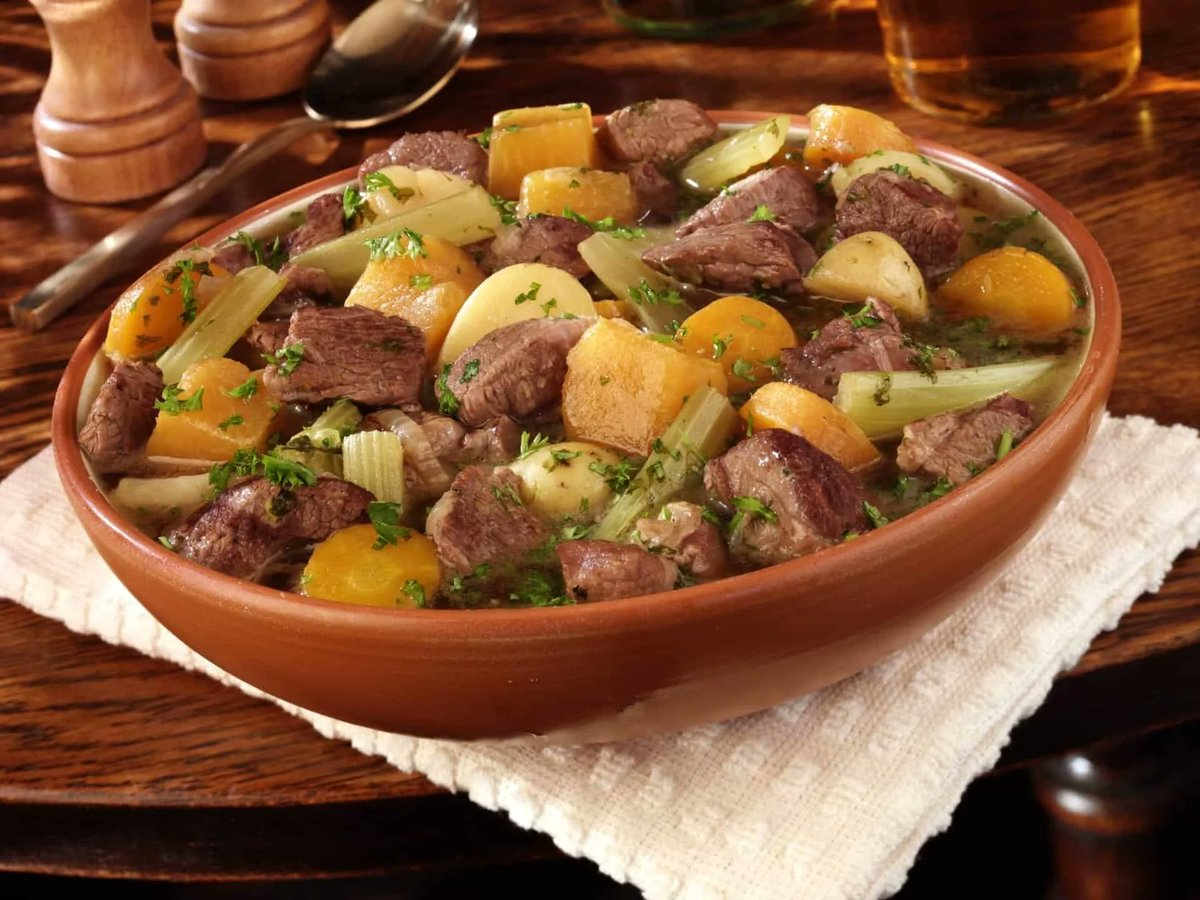
It is called cawl. Pronounced, approximately, "cowl." Chunks of mutton, leek, swede, parsnip, potato, and carrot simmered for hours in a single pot until the meat falls off the bone and the broth turns the colour of amber. That is the whole dish. That is also one of the most nutritionally complete meals in the British peasant tradition.
It is eaten as two courses from one pot. The broth first, ladled into a bowl and drunk almost like a tea, tasting of the marrow and the leeks and the slow kindness of long cooking. The meat and vegetables second, fished out with a slotted spoon, piled onto a plate, and eaten with a hunk of bread and a wedge of Caerphilly cheese on the side.
A Welsh hill farmer in 1880 ate cawl three or four times a week. The mutton came from the family's own sheep, culled at five or six years old, the fat yellow with Welsh grass. The leeks and the root vegetables came from the garden behind the farmhouse. The bread was baked that morning in the kitchen range. The cheese was made from the household cow two valleys over.
One bowl delivered, in a single sitting, substantial complete protein, collagen dissolved from the bones, fat-soluble vitamins rendered out of the marrow, and the minerals leached from the meat and vegetables over four hours of slow heat. All from a single cut of mutton shank that fed the family for three days.
A 2024 survey of Welsh adults found that approximately 40% had never eaten cawl. A further 30% had eaten it only at a tourist restaurant, served as a heritage novelty in a ceramic bowl with a sprig of thyme on top.
Every peasant cuisine on earth independently arrived at this formula. Scotch broth in the Highlands. Mutton broth in the Borders. Pot-au-feu across the Channel. Bollito misto in Piedmont. Cocido in Castile. The same idea, solved by every hungry population in Europe, independently: take the toughest cut of the cheapest animal, simmer it for half a day with whatever roots are in the cellar, serve it twice from the same pot, feed everyone.
This is traditional wisdom. It is what your great-grandmothers knew without having to be taught. The formula is not a recipe so much as a principle: tough cut, long time, root vegetables, two courses from one pot. It works in every kitchen on earth because it was developed by every kitchen on earth, in parallel, by people who had to feed families on what the land gave them.
The knowledge is not difficult. The ingredients are still sitting on the butcher's slab and the greengrocer's shelf. The pot is, probably, already in the cupboard.
The only part that has gone missing is the grandmother who used to tell you how to start it.
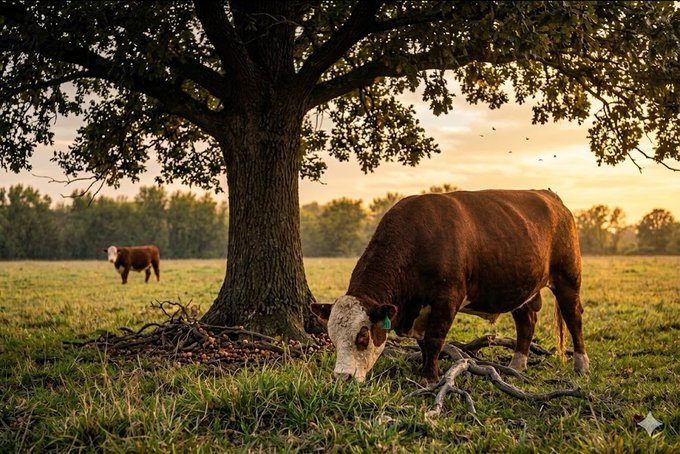
You walk past a field. There is a bull in it. That is what you see. A bull. In a field.
Have a closer look.
The grass under his hooves is deeper-rooted than it looks. Two, three feet down in places, because his grazing has been stimulating root growth for the six years he has been in this field. Those roots are pulling atmospheric carbon into the soil at a rate the climate modellers would weep over if they ever thought to measure it.
The soil itself is alive. A single teaspoon from beneath Gerald contains more microorganisms than there are humans on earth. Bacteria. Fungi. Protozoa. Nematodes. A functioning microbial civilisation built by his manure, year after year, pat after pat, feeding a soil structure that holds rainwater like a sponge.
The earthworms are working. Roughly 400 per square metre under a well-grazed pasture, which is approximately ten times the count in the arable field two hedges over. They are aerating the soil, cycling nutrients, and feeding the badger who patrols the field at night.
The dung beetles are on duty. Up to a hundred species compete for a fresh cowpat in a British summer. They bury it. They break it down. They aerate the ground as they go. Without them the pasture would stop functioning within a year.
The cowpat itself, fresh, supports roughly 300 species of invertebrate in its first week of existence. Flies. Beetles. Wasps. Parasitic nematodes. A small, smelly ecosystem the size of a dinner plate, which Gerald produces ten to fifteen times a day.
The hedgerow around his field is dense because Gerald keeps eating the shoots that try to grow outwards. It supports, in turn, around 2100 species of invertebrate, bird and wildflower. The skylark is nesting in it. The wren is hunting it. The hedgehog is using it as a corridor to the next field.
The yellowhammer is on the gate. The pipit is on the wall. The swifts are working the air above Gerald's head, because the flies around him are what they eat. The barn owl quarters the field at dusk, because the short-grazed grass lets her see the voles.
The wildflowers along his field boundary number, at last count, 31 species. Tormentil. Eyebright. Bird's-foot trefoil. Self-heal. Red clover. The wildflowers support the bees. The bees support the pollination of the next farm's orchard. The orchard supports the apples being pressed in the village.
A horseshoe bat was recorded feeding over the field last August. First record in the parish in thirty years.
The soil beneath Gerald has gained approximately 1.5 tonnes of carbon per hectare per year since he arrived. His field alone has offset the annual emissions of about forty British households.
Gerald does not know any of this.
Gerald is eating grass.
He has been eating grass, continuously, for four years, on the same 12-acre field, and in that time he has supported more biodiversity, more carbon sequestration, and more ecological complexity than most conservation projects with a salaried team and a press office.
He has done it for free. He requires only rain and grass. He has asked for nothing.
People are trying to cancel Gerald for this.
Some corners of the internet have started calling lamb land salmon.
Hear them out.
Omega-3s, CLA, zinc, B12, iron, selenium, complete protein. From an animal that spent its life on a fell in Cumbria eating grass, without a manufactured pellet anywhere in the picture.
The CLA is the headline. Conjugated linoleic acid, higher in pasture-raised lamb than almost anything else on the shelf. You cannot synthesise it. You cannot extract it from a plant. The lamb makes it in its rumen from the grass, and then you eat the lamb. That is the entire supply chain.
The zinc bioavailability is higher than beef. Meaningfully higher than the zinc in pumpkin seeds, which queues behind phytates and arrives at a fraction of what the label claims.
The Texel ewe on the north fell did all of this on grass and rain, at four hundred metres, without supplements or certification or anyone's feeding programme.
One of the most nutrient-dense meats on earth. Somehow the one you forgot to put in the basket.
Put it in the basket.
Dave's log. Day four of Margot's second visit.
7:04am - Keith came down from the barn roof in three minutes and twelve seconds. Previous record: three minutes forty. Dave timed it. Dave has been timing it.
7:07am - Keith walked to the yard gate. He opened it. Stood back. Waited. Margot walked through. They went to the east ditch together. Dave stood at the kitchen window and watched this happen and felt something he does not have a column for.
9:00am - Knotweed. Working the north section. Dave watched from the track. They were working toward each other from opposite ends. They met in the middle. There was a pause. They both ate the last clump. Dave is not going to write about the pause in the log. Dave is thinking about the pause.
11:30am - Keith showed Margot the barn roof access route again. Not because she didn't know it. She climbed it in under a minute on Tuesday. Dave thinks Keith showed her again anyway. Dave is not sure why he thinks this. Dave has added a column called 'Observations' and then immediately felt foolish about it and crossed it out.
1:00pm - They stood at the corner post together for eight minutes. Margot pressed her ear to the wire. Keith pressed his ear to the wire. They both stepped back at the same time.
Dave rang his cousin.
Dave: I think something is happening.
Cousin: With the knotweed?
Dave: With Keith.
Cousin: ...
Dave: I watched them work the east ditch this morning and there was a moment when
Cousin: Dave.
Dave: I know.
Cousin: They're goats.
Dave: I know that.
Cousin: Keith opens every gate on your farm.
Dave: He opened it and then stood back and waited.
Cousin: ...
Cousin: I'll bring her back in May.
Dave's log, evening: 'Day four. Knotweed at 4%. Corner post assessment: ongoing. Keith came down in 3:12. New record.'
Dave did not write the other thing.
Dave is watching the barn roof from the kitchen window.
Keith is up there.
Keith is looking toward Dave's cousin's farm.
Dave has made tea.
Dave is not going to say anything.
Nobody has ever given a full-throated sales pitch for a tin of sardines. That is a market gap.
Allow me.
The tin is food-grade steel, lined, sealed, oxygen removed. The environment inside is more controlled than most restaurant kitchens you have eaten in happily and without incident.
No preservatives. Canning is heat and the absence of oxygen. Just the fish, suspended exactly as they were the day the boat came in.
The omega-3s survive it. Studies comparing fresh to tinned show no meaningful difference in EPA and DHA. The fish was caught, canned within hours, and the fatty acids went nowhere.
The bones are edible. They have been sitting in olive oil long enough to become soft, and they are the calcium delivery mechanism the sardine built for itself. You eat them. That is the intended use.
What the tin actually contains: EPA and DHA in immediately usable form. Selenium, iodine, B12, CoQ10, vitamin D, calcium, complete protein with every essential amino acid.
Your protein shake has twenty-three ingredients. The sardine grew its own nutrition in the North Atlantic and asked for nothing.
A food humans have eaten since before written history now apparently requires a defence.
Buy the tin.
Sailing yesterday. Today scrubbed the yacht stem to stern. Then I passed out from exhaustion.
Woke up sore but feeling fantastic. Walked down the dock and saw way too many derelict vessels.
Please, for the love of the Republic, cancel your gym membership and get a real hobby. Something that adds value to your community. Buy a broken house, a broken yacht, go build a deck or clear a tree off your land or clear a trail or dig out a pond.
I don't want to look at your chiseled bodies. I do want to gawk and star at the victorian you restored or wood ketch that now has a glistening teak deck.
Our communities are uglier now then when I was a kid because you spend all your time, sweat and money on your bodies instead of using your bodies to build beautiful things.
Yes you are healthy but you can only stare at a mirror so long. If you build or restore something beautiful you'll have a healthy body, healthy mind, healthy soul and can admire your work for decades.
Taxing non-income-producing property is wrong. Homeowners should not be forced to work to pay "rent" to the government for the privilege of living in their own homes. Property taxes should only be levied on income-producing property, as the income provides a means to pay the tax.
In his strongest condemnation yet of the Trump-Vance war against Iran, Pope Leo XIV said today:
“We are surrounded by a delusion of omnipotence that’s becoming increasingly unpredictable and aggressive.”
“We are met by threats instead of invitations to come together.
“Those who pray don’t threaten death. Death enslaves those who have turned their backs on God and turned themselves and their own power into a mute, blind, and deaf idol.
“They demand the whole world bends their knee. Enough of the idolatry of self and money! Enough of the display of power! Enough of war!
“True strength is shown in serving life!”