The mainstream view of "elite" universities goes something like this: you get accepted into an "elite" university, placing you into a socio-economic stratum that provides the network and access to opportunity that will lead to "success." As academic achievement faded in importance, admissions has become a farce of parlaying "interest" in ever creative and nonsensical ways.
"A new report from a committee of Yale professors takes a different view. The purpose of the university, it says quite simply, is 'to preserve, create and share knowledge.' The method is academic excellence. To the extent that universities are supposed to serve democracy, it’s by becoming considerably more meritocratic." https://t.co/rdUZthwASR
Ukrainian military view: "The use of unmanned ground vehicles in attacks is less about cutting-edge technology and more about instruction in adapting existing systems." Perhaps we spend too much time worshipping at the altar of exquisite systems at the expense of creativity and expediency? https://t.co/ax5ADxnt8W
"Ukraine’s counter-drone technology, initially cobbled together from off-the-shelf consumer goods and video game gear, now rivals conventional air defense systems but at a fraction of the cost, military analysts say." https://t.co/e702l6H4fB
"What began as a modest workplace amenity for public servants has metastasized into a taxpayer-funded citadel of privilege."
Commentary: https://t.co/GZ54TBzeKy
Relevant to present day, Qian Xuesen was deported by the US back to China, where he led development of the Dongfeng ballistic missile and the Chinese space program.
This is so ridiculously wrong, I'm not sure where to start.
At no point in its thousand years long history has China invaded Japan, not once. Japan has however invaded China at least 3 times, most recently of course during World War Two.
China does have some disputed territory with Japan, specifically the Diaoyu Islands (Senkaku Islands), which were part of China until 1895 when Japan annexed them together with Taiwan. These are very small uninhabited islands so it's utterly ridiculous to claim that China "thinks that most of Japan belongs to them".
There's also the question of Okinawa, formerly the Ryukyu Kingdom, annexed by Japan in 1879. To this day there's a strong independence movement on these islands and many inhabitants descend from China (the Ryukyu Kingdom was a tributary state of the Ming and Qing dynasty) but China has never claimed the territory, either historically or today.
China doesn't believe that Korea - North or South - is its territory. Same as Japan, at no point ever in its history has China invaded Korea. It has however defended Korea several times against invasions, be it from Japan during the Ming Dynasty or from the U.S. during the Korean war (which famously led to the creation of North Korea which, contrary to popular belief, is very much NOT a vassal state of China).
China doesn't believe that the Philippines is its territory. They have a dispute over some islands in the South China Sea, most notably the Spratly islands which are claimed not only by China and the Philippines but also, in whole or part, by virtually all the other countries around the South China Sea. Very much worth mentioning: the Philippines' claim over the islands is much more recent than China's and most other claimants' (the Philippines starting claiming the islands in 1972 when China's formal claim dates back since even before the creation of the PRC in 1946).
As for Taiwan, yes, the PRC claims Taiwan and literally all the countries in the world - including the United States - agree under the One-China Policy that Taiwan is part of China (although not part of the PRC). Heck even Taiwan itself officially agrees that it is part of China - its official name is the Republic of China and some 95% of their population are Han Chinese. If you go to the national museum in Taipei, you'll find the world's largest collection of Chinese art and artifacts, brought over by the Kuomintang when they retreated to the island, and the museum claims to embody 5,000 years of Chinese civilization. The reality is that the root of the dispute over Taiwan isn't about territory - it's about which government is the legitimate ruler of China, a civil war that never officially ended. To frame this as some sort of expansionist land grab completely misses the historical context.
All in all, if one studies China's history within its region, it's probably one of the least aggressive great powers in history. Despite being the dominant power in East Asia for most of recorded history, China historically preferred diplomatic influence over territorial conquest. Even during periods of maximum strength, China focused on trade and diplomatic relations rather than colonization or territorial acquisition. You just need to look at the facts: China hasn't fired a single bullet on foreign grounds in over 45 years. Which other country can claim the same in today's world? The list is awfully short.
It's absolutely insane to frame China as this sort of bloodthirsty warmongering power, especially when you're American... And it's even more disgusting to do so when you're yourself literally a weapons manufacturer, as is Palmer Luckey.
Extraordinary language from the Singapore Minister of Defense, when Singapore had always been very U.S.-friendly:
"[The US's] image has changed from liberator to great disruptor to a landlord seeking rent."
Src: https://t.co/sjykCf2Ujc
Perfect illustration that U.S. tech leaders have dangerously lost the plot. Not only does Karp not seem to understand the first thing about geopolitics, he doesn't even understand what made the U.S. successful.
He claims that:
- The only way for the U.S. to be safe is for their adversaries to "wake up scared and go to bed scared"
- The U.S. should do collective punishment, threatening not just adversaries but their "friends, cousins, mistresses, and whoever was involved."
- The U.S. "cannot have parity" with adversaries because "our adversaries do not have our moral compunction. If it's even, they will take advantage of our niceness, kindness."
- International institutions such as the UN are "discriminatory against anything good"
In short, this is imperial hubris at its most deluded and hypocritical. Karp simultaneously claims American moral superiority while advocating deeply immoral tactics like collective punishment, making everyone else live in fear and rejecting any checks on its power. It's a worldview that mistakes bullying for leadership and domination for security. And which, by the way, betrays America's own historical lessons as a former British colony...
And, most importantly: it's dead wrong - the world absolutely doesn't work this way. Rule by fear has a long and very well documented history of failure. Empires that rely on fear and domination always sow the seeds of their own demise because fear always generates resistance and resentment.
This is by the way exactly what's happening now, as explained by none other than Former National Security Advisor Zbigniew Brzezinski in his book "The Grand Chessboard", in which he wrote that the most dangerous scenario for the U.S. would be an "alliance of the aggrieved": "The most dangerous scenario would be a grand coalition of China, Russia, and perhaps Iran, an 'antihegemonic' coalition united not by ideology but by complementary grievances."
That's what rule through fear and intimidation gets you: it unlocks the "most dangerous scenario" for the U.S. because, guess what, turns out people don't particularly enjoy being bullied and threatened... They tend to band together against the bully, regardless of their differences.
What made America truly successful wasn't its ability to frighten others - it was its ability (largely lost today) to build. The Marshall Plan, international institutions, cultural exchange, industrial might, technological innovation - these were the real sources of American power.
How did the U.S. "win" the cold war? Let's turn to another actually smart American statesman, George Kennan, the architect of the U.S. cold war strategy. Key to his strategy was, in his words, proving that the U.S. was "coping successfully with the problems of its internal life and with the responsibilities of a world power".
This meant creating a society and an international order that inspired admiration rather than fear, one that nations would be inspired by rather than be coerced into. This is precisely why Gorbachev, for better or worse, ultimately pushed for reform - he recognized the clear success of the American economic and technological model compared to Soviet stagnation. He was convinced by U.S. achievements, not intimidated by threats.
Most tellingly, this tech CEO seems completely disconnected from today's tech reality. His claim that the U.S. is "the only one with a real tech scene" is peak delusion - China has now overtaken the U.S. in innovation and scientific discoveries according to almost all credible rankings.
All in all Karp's "make them afraid" rhetoric reveals a profound insecurity - a tacit admission that America can no longer compete on the basis of positive achievements. When he dismisses international institutions and advocates for rule by fear, he's essentially admitting that America can no longer lead by example or build constructive alternatives. All that's left is the threat of force.
It also reveals something about the current state of American tech leadership. When tech CEOs start sounding like Cold War hawks, advocating for global domination through fear rather than innovation through building, it suggests they've run out of ideas. They're no longer confident in their ability to compete on the merit of their products and solutions.
To conclude, Karp's worldview isn't just dead wrong - it represents everything that's gone awry with American leadership: the abandonment of building for bullying, of influence for intimidation, of power for control, the triumph of worst instincts over thoughtful judgment.
When America elevates leaders like Karp who preach fear over building, we're not witnessing the restoration of American greatness as many of the comments below claim - we're watching its erosion in real time. A nation that can only threaten rather than inspire has already lost its claim to leadership.
After decades of coasting on a post cold war peace, the bill is coming due…
“The US Navy oiler USNS Big Horn ran aground yesterday and partially flooded off the coast of Oman, leaving the Abraham Lincoln Carrier Strike Group without its primary fuel source.”
“Compounding the problem is the fact that the Big Horn is the only oiler the Navy has in the Middle East. One shipowner told gCaptain that the Navy is scrambling to find a commercial oil tanker to take its place and deliver jet fuel to the USS Abraham Lincoln.”
https://t.co/x0SA944stf
🇺🇸JEFFREY SACHS:
"I read a great book by John Mearsheimer, and in it, he described—I'll quote him, though he can speak for himself afterwards.
He said that regional hegemons don't threaten each other. Why? Because we have a big ocean in between.
I deeply believe that China is not a threat to the United States, and I deeply believe the only threat to the United States, period, in the world, given the oceans, given our size, and given the military, is nuclear war.
I deeply believe we're close to nuclear war because we have a mindset that leads us in that direction.
We have a mindset that everything is a challenge for survival, and that escalation is therefore always the right approach.
In my view, a little prudence could save the whole planet.
So, why I don't like Ukraine? Because I don’t see any reason in the world for NATO to be on Russia’s border with Ukraine.
As I said, I was Gorbachev’s adviser and Yeltsin’s adviser, and they wanted peace and cooperation.
But no matter what they wanted, they did not want the U.S. military on their border.
If we continued to push, as we did, we would eventually get to war.
John explained that better than anyone.
We're now at war, and even this morning there is further escalation. Blinken has said, 'Well, if the Iranians give these missiles, then we will give missiles to hit deep into Russia.'
This is a recipe for disaster.
Then, last week, Bill Burns, the CIA director, said an absurdity he knows isn’t true—but CIA directors never tell the truth; if they do, they lose their job.
He said, 'Don't worry about nuclear war, don't worry about saber rattling.'
My advice to you is: worry a lot about nuclear war.
So, be prudent. You don't have to put the U.S. military on Russia's border.
And my advice to Russia and to Mexico (I’m going to Mexico tomorrow, and I’ll give them a piece of advice):
'Don’t let China or Russia build a military base on the Rio Grande.'
Not a good idea for Mexico, not a good idea for Ukraine, not a good idea for Russia, not a good idea for China, and not a good idea for the United States.
We need to stay a little bit away from each other so that we don't have a nuclear war.
By the way, I recommend another good book, Annie Jacobsen’s Nuclear War: A Scenario.
It takes two hours to read. The world ends in two hours in the book, and it’s a very persuasive guide that one nuke can ruin your whole day, as they say.
My strong advice on this, therefore, is to recognize that China, first of all, is not a threat to U.S. security—big oceans, big nuclear deterrent, and so forth.
Second, we don't have to be in China's face.
What do I mean by that?
We don't have to provoke World War III over Taiwan.
It's a long, complicated issue, but it would be the stupidest imaginable thing for my grandchildren to die for.
I resent it every day when we play that game.
We have three agreements with China that say we're going to stay out of that, and we should.
Then China would have no reason for war either.
Regarding China and economics, let me reiterate—because I was asked yesterday, and there was some surprise—was it good to let China into the WTO?
I said, of course! It enriched all of you, by the way.
It enriched me, it enriched this country, it enriched the world, including China.
That's normal.
Economics is not a zero-sum game. We all agree on that.
I believe that security doesn't have to be a zero-sum game either.
We can stay a little bit away from each other.
China does not spend its time bemoaning America being a Western Hemisphere hegemon.
They don't.
That's not their greatest interest—bringing down American power in the Western Hemisphere."
"Farley... thrashed the EV around Changan’s sprawling test track in central China... Afterward the executives sat silently, stunned at the progress Changan had made. “Jim, this is nothing like before,” Lawler told Farley after the drive. “These guys are ahead of us.”
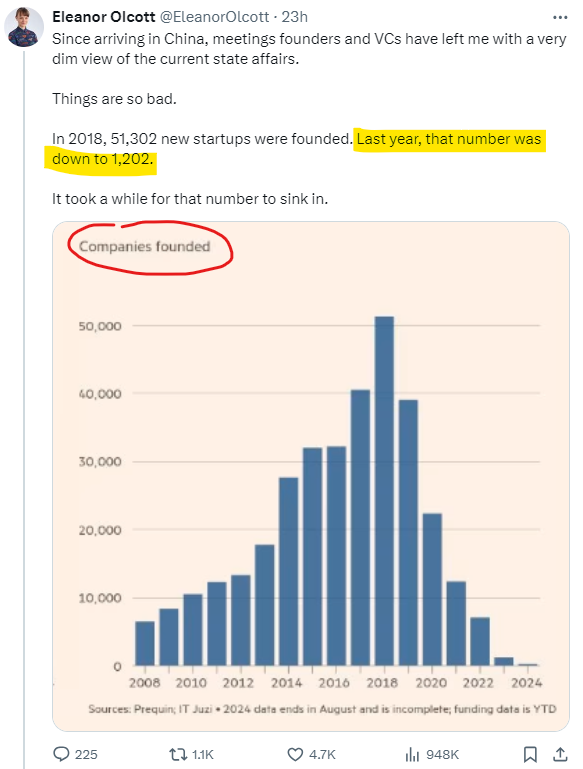
I'm sorry to be insisting on that one, but it is so illustrative of how insanely wrong the Western press can be on China, even allegedly prestigious business newspaper like the Financial Times.
This one is literally incredible.
So the @FT published an article yesterday by Beijing-based @EleanorOlcott that claims that only 1,202 companies in total were founded in China in 2023. Not 1,202 thousand companies, no... just 1,202 companies, in the whole of China. The claim is that out of 1,4 billion people, in an economy that grew 5.2% last year, only 1,202 people (the equivalent of the population in an average building in China) created a business.
When asked to precise what she meant by "companies founded", the journalist replied that it was indeed just that: "companies that have gone through proper paperwork to register as a company". So we're sure that's what she meant.
Of course the article went viral, you've likely already seen the graph being shared on Twitter... And most people, depressingly, didn't even bother to question the claims. I myself commented under the article (https://t.co/Db4lpEwkfu), telling the journalist her numbers were simply impossible, and was accused of the usual absolutely dimwitted insults: I am a "wumao", "paid by the CCP", bla bla bla...
But her numbers ARE impossible. Anyone with an ounce of common sense can see that. And the journalist herself, if she'd reflected a tiny bit could see it too. For instance, how many new independent restaurants has she seen pop up in Beijing last year? My guess is hundreds of them, at the very least. Well each of those is a company created under her definition since to open an independent restaurant in China you have to open a business, file paperwork, go through a health inspection, etc. Extrapolate this to the whole of China and you have thousands and thousands of new businesses created in the restaurant industry alone.
Or she could have asked herself the question: how many business were created in the US last year (the answer is 5.5 million: https://t.co/VfSpllDHnG) and given that China grew at more than twice the rate of the US, and has over 4 times the population, does it make sense that 5,000 times (!!!) less businesses would have been created in China than in the US in 2023? Obviously no, it doesn't make any sense.
Or she could have checked official Chinese statistics that show that, actually, 32.73 million new businesses were created in China in 2023 (https://t.co/3BCr2gHFru), an insane 30,000 times more than what she claims!!! Which by the way roughly corresponds to the US number of 5.5 million if one accounts for the fact we're speaking about a country of 4 times the population with an economy growing at twice the speed...
Some people will say: "wait a minute 32.73M new companies would mean one of out 44 people in China created a business in 2023, that doesn't pass the sniff test". But yes it does, because we know that the vast majority of these new businesses (72% to be exact: https://t.co/rwlVqmmtwl) are "individually owned businesses", i.e. sole proprietorships. In China (as in the US) to be self-employed as say a Didi driver (the equivalent of Uber) or a Meituan delivery driver - all the so-called "gig economy" workers - you need to register yourself as self-employed via an "individually owned business".
And even if one discards those "individually owned businesses" as not "real businesses", that leaves us with 10.1M businesses created in China in 2023, 8,400 times more than the 1,202 claimed in the FT article...
And it's not only about the journalist herself. She has editors, supervisors. Did no-one along the chain stop to think: "wait a minute, we're about to print that only 1,202 businesses were created in China in 2023, that sounds insanely low, maybe we should double check that number"?
I'm not sure what's the conclusion here besides reiterating my oft-repeated complaint that Western media get China completely wrong, and aren't even bothering to use basic common sense to question themselves.
"It makes the United States one of the reasons international law remains weak, since a “rules-based” order that exempts the United States and its allies fundamentally undermines the concept of international law." https://t.co/NNcg7Nfq42
Reasons to be Bullish on America:
1. Elon Musk
2. The American brand
3. Ozempic
4. The highest concentration of high-end human capital in the world
5. Artificial intelligence
6. Remains the premiere location for the ambitious to immigrate to
7. Silicon Valley & Venture Capital
8. The English language
9. Regional hegemon
10. A history of reinventing itself and adaptation
11. Culture of celebrating entrepreneurship
12. The Millenial Generation
13. Every US military intervention through 1991
14. Some of the greatest companies in the world
15. Chemical, Car, Plane, and Agricultural supply chains
16. Net food exporter
17. University and private education
18. Above average existing transportation infrastructure
19. The Mississippi, the Great Lakes, and two oceans
20. Abundant cheap land
21. Natural beauty
22. It's a nuclear power
23. Coming Boomer retirement
Reasons to be Bearish on America:
23. Obesity
24. Drug use
25. Homelessness
26. Legal marijuana
27. Overly financialized economy
28. Reserve currency makes exports uncompetitive
29. Healthcare system is a disaster
30. Declining life expectancies
31. Overuse of pharma
32. Gen Z
33. Suicide rate and depression
34. Can't build infrastructure quickly or cheaply
35. Unresolved long-term consequences of slavery
36. Inflation and government debt levels
37. US corporations accustomed to US hegemony
38. Excessive illegal immigration
39. Legal immigration system is a mess
40. General declining competence
41. Increasingly powerful culture of (self-)censorship
42. Excessive regulatory capture
43. Americans can't do math
44. Poor labor efficiency outside of innovative fields
45. Two long undefended border
46. Mexico and Canada both have serious problems
47. Declining fertility in middle & lower-upper class
48. Bipolarization
49. No consensus view on US culture or religion
50. US prison system
51. Every US military intervention since 1991
52. China + Russia alliance
53. Gerontocracy
54. Issues that are so controversial that I am afraid to write them here
55. Non-university public education
56. Declining military recruiting
57. Falling patriotism
58. Income inequality
59. Demographic differences between young & old generations
60. Assets concentrated in hands of old generation
61. Excessive legal complexity
62. A growing culture of extraction over contribution
63. Crime
Double-edged (Bullish & Bearish) Reasons to be Bullish on America:
64. Bitcoin
65. Federalism (ability of states to make their own laws)
66. USD reserve currency
67. Hollywood
68. Immense resource wealth
69. Trump
70. Huge inventory of guns
71. Democracy
72. "Brahminization" of US corporations & government
73. Diversity
74. Ignorance of other countries
In summary:
A lot of strengths and a lot of problems. Most of them are solvable, but some have been nagging for decades.
Not a good sign that this feels like a risky post, but, it has to be said.
We can't solve what we cannot discuss.