It’s draining to read most blogs in cyber these days.
Bugs found and code created with the help of AI are still impressive, yet a majority of the time the story and personal touches are gone.
In my opinion the best papers are by people who look at VR and SWE as an art form.
I would say side projects are the best hiring signals. Just because someone can use AI to assist with development, does not mean the design is good. Often, it’s easy to tell if the person truly understands what they built from reading their code/design.
People with a passion for the industry, who put hard effort into their projects will stand out more than ever.
@rtroar I’ve seen similar results, if you actually know what good c++ design and implementation looks like you can setup md docs to help the agent.
Obviously, it’s not going to be great 100% of the time, but it does enough of a decent job to be a useful tool.
Introducing Project Glasswing: an urgent initiative to help secure the world’s most critical software.
It’s powered by our newest frontier model, Claude Mythos Preview, which can find software vulnerabilities better than all but the most skilled humans.
https://t.co/NQ7IfEtYk7
@ZackKorman Neither. They can’t beat the amount of rich data that an EDR like Crowdstrike has, I could see Anthropic or OpenAI acquiring an EDR company though.
When learning a codebase internals with AI, you may lose invaluable insight that the journey of learning on your own gives you. Learning A leads you nowhere, but along the way it forces you through B, C, and D, and that detour ends up being where the real insight comes from.
@daaximus Skill atrophy is definitely a real threat. The problem is that the expectations for delivery of tasks keeps getting shorter. The more we use the tool the more reliant we become.
A pretty deadly snowball if you ask me.
I built the first AI that earns its existence, self-improves, and replicates without a human
wrote about the technology that finally gives AI write access to the world, The Automaton, and the new web for exponential sovereign AIs
WEB 4.0: The birth of superintelligent life
Peter Steinberger is joining OpenAI to drive the next generation of personal agents. He is a genius with a lot of amazing ideas about the future of very smart agents interacting with each other to do very useful things for people. We expect this will quickly become core to our product offerings.
OpenClaw will live in a foundation as an open source project that OpenAI will continue to support. The future is going to be extremely multi-agent and it's important to us to support open source as part of that.
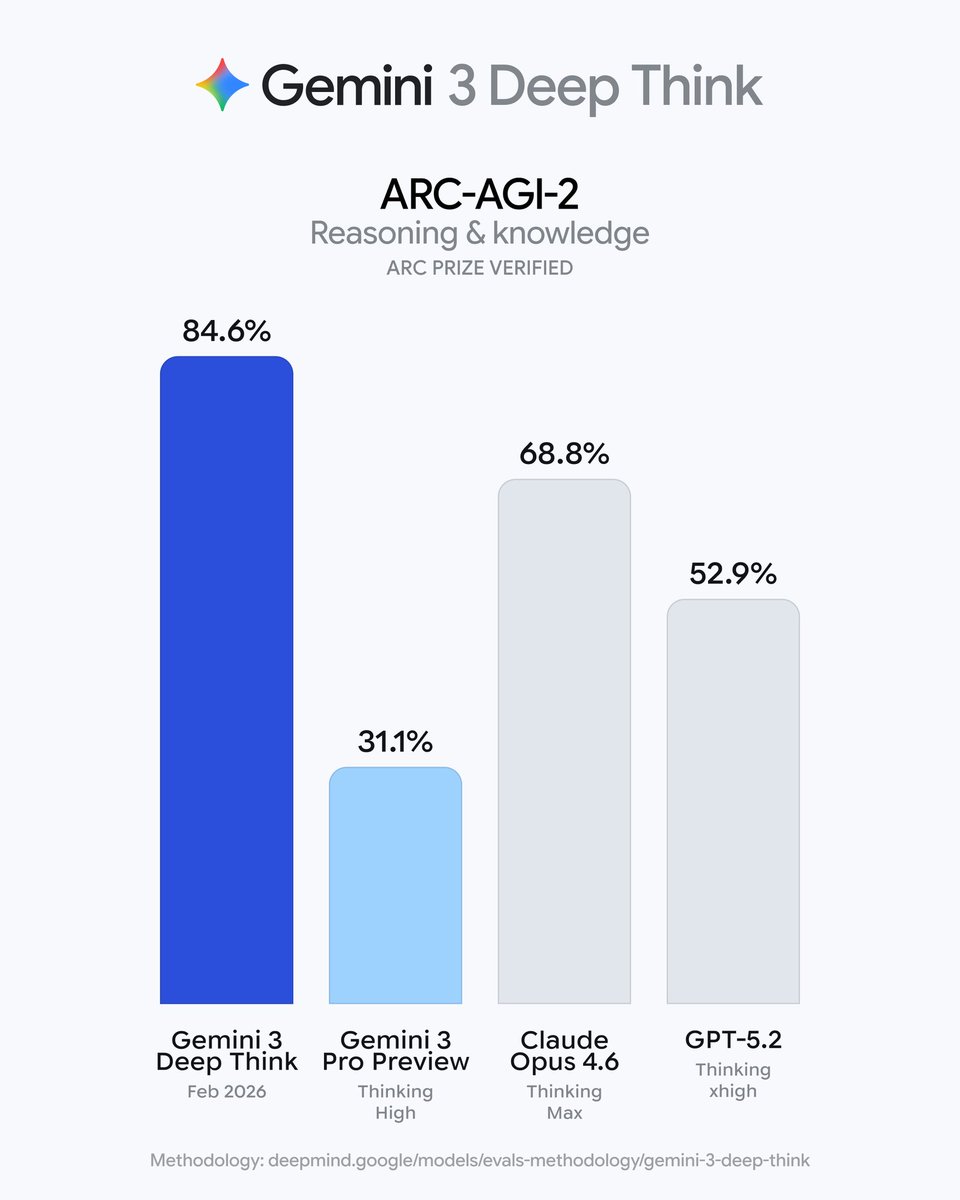
Lots of folks spread false narratives about how ARC-1 was created in response to LLMs, or how ARC-2 was only created because ARC-1 was saturated. Setting the record straight:
1. ARC-1 was designed 2017-2019 and released in 2019 (pre LLMs).
2. The coming of ARC-2 was announced in May 2022 (pre ChatGPT).
3. By mid-2024, there was still essentially no progress on ARC-1.
4. All progress on ARC-1 & ARC-2 came from a new paradigm, test-time adaptation models, starting in late 2024 and ramping up through 2025.
5. Progress happened specifically *because* research moved away from what ARC was intended to challenge (static DL), toward what ARC was intended to encourage (test-time adaptation). ARC was meant to steer AI research towards fluid intelligence, and it is only by implementing fluid intelligence that it could be solved.
6. To this day, base LLMs (no test-time adaptation) *still* perform abysmally low on ARC despite a 50,000x scaleup since 2020, which confirms what we predicted about this paradigm not being capable of fluid intelligence and therefore not being capable of solving ARC.
7. ARC-3 was announced in February 2025, back when ARC-2 was completely unsaturated. ARC-3 is not in response to ARC-2 getting saturated.
8. We never claimed solving ARC would be proof of having achieved AGI; all the way back to 2021-2022 and every single year since we made it very explicit that it would NOT be proof of AGI. ARC is a research tool that was intended to steer AI research towards fluid intelligence, which it did.