Every hour a GPU sits idle is an hour you can’t sell later.
Spot markets can put that capacity to work, but the allocation has to match the job: chip, memory, region and network all matter.
Availability changes quickly and is scattered across nodes. Moving data takes time.
The hard part is making sure the promised machines are available when needed and ready to run the customer’s workload.
Third-party inference providers are going to war.
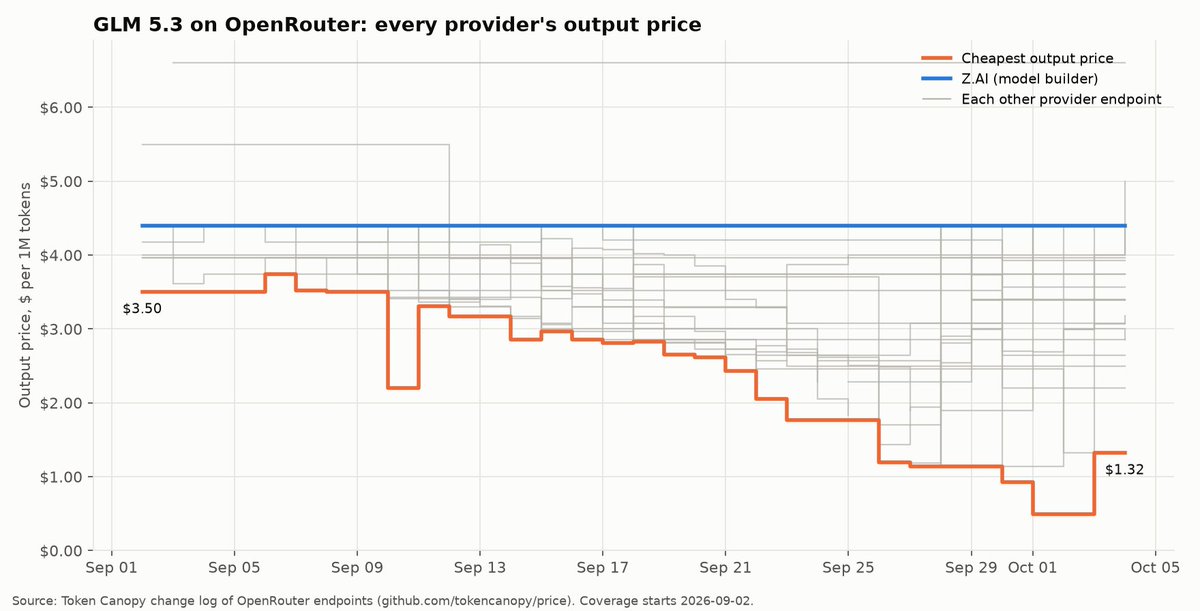
https://t.co/qi8NMYJsTI opened GLM 5.3's weights on Aug 28. Five weeks later, 32 hosts are serving it on OpenRouter and the price floor has collapsed.
Output price fell 89% at the extreme, from $4.40 (https://t.co/qi8NMYJsTI) to $0.49. Cheapest today is $1.32, still 70% under list.
Open-weight labs are already reacting.
https://t.co/qi8NMYJsTI moved GLM 5.3 itself off MIT.
Alibaba shipped Qwen3.7-Max API-only with no weights.
MiniMax changed its license to block commercial use without written authorization.
One thing stays constant: someone has to own the hardware. Today that's whoever can finance it, which means a handful of giants.
The GPU underneath is the primitive that lasts.
That's why we're building a GPU vault. Own a share of a real GPU node, get paid from the rent it earns.
Depositing into a Silicon Exchange vault provides financing to real GPU infrastructure. Each deposit mints shares representing user's ownership of the GPU. Once the GPU starts to generate revenue, profit is split based on the amount of shares a user holds.
We built on Tempo so deposits and payouts settle in under a second, with fees paid in stablecoins - no separate gas token needed. Using Open USD (OUSD) brings those same flows into Stripe’s payments ecosystem, connecting fiat funding, wallets, and onchain settlement through Stripe, Privy, and Bridge.
To rent a GPU cluster, AI startups often have to prepay ~30% of the contract before a single GPU is live.
Why? Neoclouds borrow to buy the hardware, and lenders don't trust young startups to keep paying. So the startup carries the risk upfront, paid for with VC money meant to build the company.
Silicon Exchange funds GPU nodes from a new source: contributors who own a share of the hardware and get paid monthly from the profit it generates.
A popular argument right now is that AI demand is slowing down.
The evidence is usually a chart of falling token prices, some showing as much as a 50% decrease in the last few months. But a token price tracks what people pay per token, not how many tokens they use.
Much of the drop is people moving to cheaper, faster models.
If you want to know whether demand is slowing, look at what it costs to rent the GPUs that make those tokens. If demand was stalling, that would be falling too. It isn't. B200 rental prices are up about 70% since last November.
But cheaper tokens usually mean more tokens. The compute behind them is the part that's scarce and it will only become more valuable.
There’s a weird problem with financing GPUs.
The companies that need flexible compute are the hardest ones to build compute for.
A B300 node costs more than $600K, so GPU operators usually finance the hardware. But lenders prefer GPUs backed by long-term rental contracts, where larger customers and longer contracts get cheaper financing.
So operators have an incentive to ask AI companies for two- or three-year commitments.
But startups are exactly the customers that can’t predict their compute needs that far ahead.
We realized you can remove this constraint by changing who finances the GPUs.
Instead of one lender financing the hardware, Silicon Exchange pools capital from many investors and buys the GPUs outright. The hardware earns money by being rented to compute customers.
Without a lender requiring a multi-year rental contract, the GPUs can be offered on more flexible terms.
We’re starting with one B300 node.
Introducing Silicon Exchange.
A new way to finance the infrastructure behind AI.
Own a piece of real GPU infrastructure. We handle deployment and hosting, while compute customers put the hardware to work.
Explore our first GPU vault at https://t.co/aqX2CArI3g