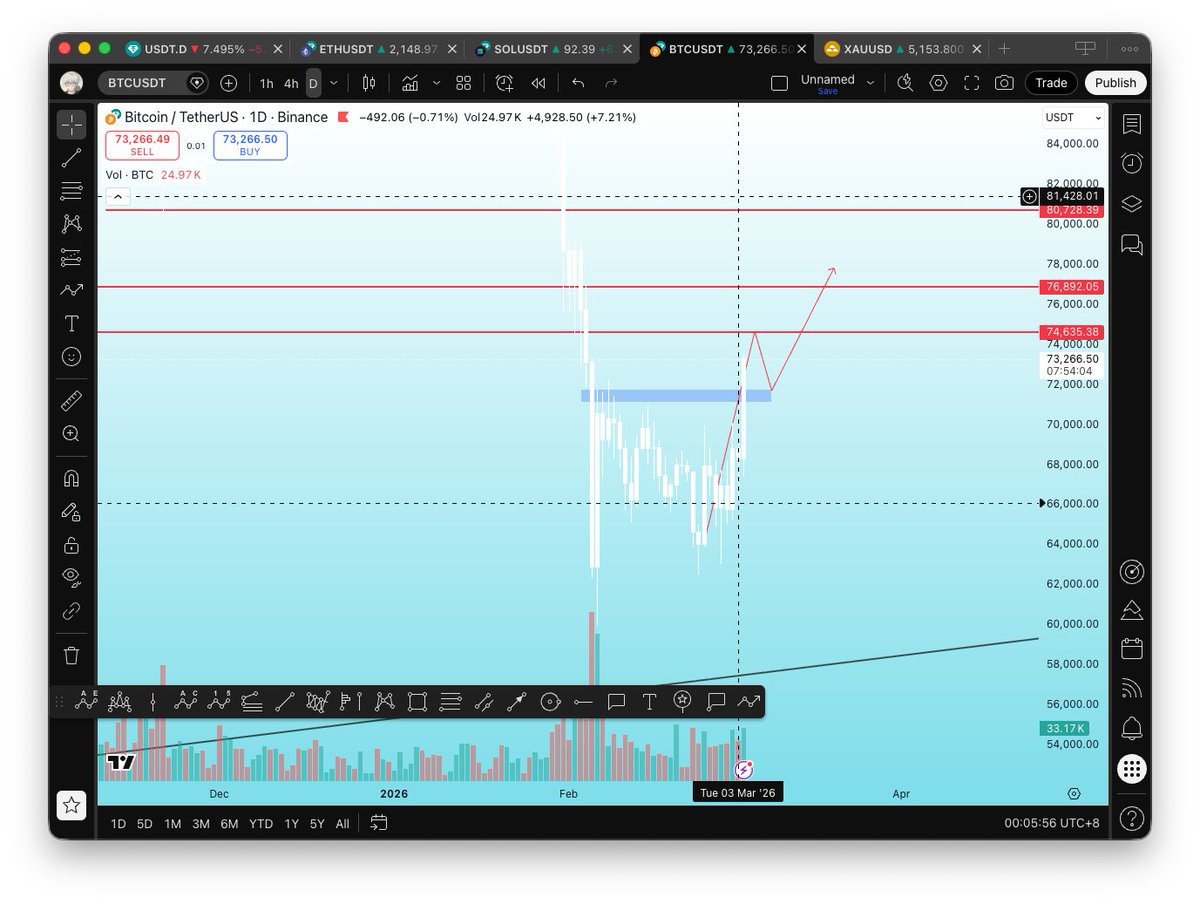
USDT.D has broken downward out of a contracting triangle. If this breakout holds, it can be seen as a right-side trend confirmation signal: risk assets are breaking out of consolidation and preparing for a one-way rally. Countdown to a major surge. 🚀
Let’s stop framing the discussion around rigid “Web X” definitions.
There’s a popular linear evolution narrative in the market: Web1 → Web2 → Web3 → Web4…
I strongly reject this way of thinking.
The core assumption behind this linear theory is that the internet evolves based on what it previously was, building forward from its past forms. I believe this assumption is fundamentally flawed.
My view is different: evolution is the product of problems.
At every stage, the internet evolved because the market was facing a major, unavoidable problem. The problem comes first; the internet’s form is merely the solution. What we later call a new “Web narrative” is just a retrospective description of that solution.
Looking back, we can infer the core problems of past stages by examining product forms:
- Early internet focused on information access.
- The algorithm era emerged to solve efficiency in information matching.
But today, without a god’s-eye view, we can’t reverse-engineer the answer so easily.
So the real question is: what is the current “major problem”?
This must be our starting point.
We should not begin by defining “Web4” and then looking for use cases to fit it. That’s designing the hammer before finding the nail—completely backwards.
As for Web4:
- I do acknowledge the demand for AI-native assets and payments.
- I recognize the direction of AI + PayFi.
However, I remain skeptical about the definition of “Web4” itself.
Before naming a new era, we should first understand the problem. Only then might a more accurate narrative emerge.
Secondly, I do not agree that Conway (and the application paths it implies) is necessarily the correct solution.
Even if the Web4 premise were valid, Conway may not be the optimal answer under that premise. There could be better approaches.
Product narratives must ultimately solve real problems and create real value. Without that, no narrative is sustainable.
I’ll end with a few very practical questions that both builders and investors must answer in front of the market:
1. Before discussing Web4, have we clearly identified today’s “major problem”?
2. From a market perspective, why should AI be granted more authority or sovereignty? Before this is validated by the market, there must at least be a compelling logic.
3. Even if holds and AI truly needs some form of sovereignty, can blockchain actually solve AI sovereignty?
How? Why must it be blockchain? Why wouldn’t other alternatives work?
These are the real prerequisite questions.
A few thoughts on Web 4.0 that I keep coming back to.
Everyone’s talking about AI boosting productivity. Sure, that’s real. But that’s just the first half. When supply explodes, demand has to catch up eventually. The next move for AI isn’t producing more — it’s becoming the consumer itself. This shift is coming faster than most people think.
Which raises an interesting question: how does a machine spend money? It has no ID, can’t open a bank account, KYC simply doesn’t apply to it. The traditional financial system was built for humans — machines are structurally excluded. So crypto isn’t “one option” for Web 4.0. It’s the only way out. This isn’t crypto faith. It’s just logic.
But I think people are underestimating how deep the demand for blockchain goes beyond payments. The bigger battlefield is context. Right now every AI product treats user data as a moat. The result? Your memory, preferences, and history are scattered across dozens of products, and none of them can actually use it well. That’s collective waste.
The more rational model: user context belongs to the user, stored somewhere decentralized, granted to different agents on demand. Better for users, better for the whole ecosystem. Whoever controls context wins — but first, context has to go back to the user.
The way I see it, Web 4.0 comes down to three things: AI agents as the new demand layer, crypto as the base infrastructure for the machine economy, and decentralized context as the new data paradigm. Put those three together and you have the actual next internet.
I built the first AI that earns its existence, self-improves, and replicates without a human
wrote about the technology that finally gives AI write access to the world, The Automaton, and the new web for exponential sovereign AIs
WEB 4.0: The birth of superintelligent life