A neuroscientist who studies focus discovered something unexpected about AirPods Pro 2.
The combination of Active Noise Cancellation + brown noise at 40% volume + Conversation Awareness OFF creates the fastest path to flow state she's ever measured in a consumer device.
Average time to deep focus: 4 minutes.
Average deep work session: 90 minutes without interruption.
Previous average without the protocol: 23 minutes before the first distraction broke the session.
She didn't discover a hack. She applied neuroscience.
The auditory cortex never fully deactivates during wakefulness. It is always listening, always evaluating the acoustic environment for threats and social signals. The question is not how to silence it. The question is how to feed it something so consistent and non-threatening that it stops looking for problems and allows the prefrontal cortex to take over.
She now prescribes this protocol to every PhD student and executive she coaches:
"Your brain can't focus in silence. Silence is threatening your auditory system scans for sounds that aren't there. And your brain can't focus in noise noise is unpredictable stimulation that pulls attention. Brown noise through ANC headphones is the neurological sweet spot: consistent enough that your threat-detection system relaxes, rich enough that your auditory cortex is occupied, and featureless enough that your prefrontal cortex takes over. That's flow. In 4 minutes. On a device most people use to listen to podcasts."
Here's the full protocol the neuroscience behind it and the exact AirPods settings to replicate it tonight 🧵
THIS GUY MAKES COMPLEX AI AGENT CONCEPTS RIDICULOUSLY EASY TO UNDERSTAND.
No jargon wall. No assuming you already know what a reward model or an evaluation harness is.
Just a straight line from "I have no idea how agents actually work" to "oh, that's genuinely simple."
The best explainers do not simplify by cutting corners. They simplify by finding the one analogy that makes the whole thing click.
Sintam o nível desta animação do @bogachev_al que compila o jogo Argentina vs. Egito de ontem em meros 46 segundos. Isto não é infográfico, isto é arte!
DBeaver lleva 15 años siendo el cliente de base de datos por defecto.
Es potente. Y también es un dinosaurio de Java que tarda 20 segundos en arrancar.
Alguien lo construyó desde cero en Rust y añadió lo que DBeaver nunca tuvo.
Se llama Tabularis. 2.5k estrellas. Apache-2.0. Activo hace 17 horas.
El detalle que más me ha flipado:
Lo construyó una sola persona (@debba_92 ) como experimento de desarrollo asistido por IA.
Quería ver hasta dónde podían llegar los agentes construyendo una herramienta real.
El resultado: 55 releases, 1.192 commits y un cliente de base de datos que compite con herramientas de empresas con decenas de ingenieros.
Lo que tiene que DBeaver no tiene:
✅ Servidor MCP integrado - Claude, Cursor y Windsurf pueden leer tu esquema y ejecutar queries directamente desde el chat
✅ SQL Notebooks con gráficos inline y variables entre celdas
✅ Visual EXPLAIN con análisis de IA del plan de ejecución
✅ Constructor de queries visual con JOINs drag-and-drop
✅ Diagramas ER generados automáticamente
✅ Compatible con PostgreSQL, MySQL/MariaDB, SQLite y ClickHouse via plugin
✅ Editor Monaco con autocompletado inteligente
✅ Sin telemetría, sin cuentas, sin suscripción
Lo que DBeaver sí tiene y Tabularis todavía no:
SQL Server y Oracle. Si los necesitas, DBeaver sigue siendo la opción.
Para todo lo demás: esto arranca en 2 segundos, pesa menos y tu agente de IA puede consultarlo directamente.
el enlace 👇
We’re all probably familiar with dimensionality reduction techniques like PCA and t-SNE. But there are a few newer, more advanced DR techniques, especially closer to deep learning, that we should know about.
Let’s break down Parametric UMAP and PaCMAP.
-Parametric UMAP
>Learns a neural network to produce low dimensional embeddings
>Preserves UMAP’s manifold structure with parametric mapping
>Can embed unseen data without retraining from scratch
>Fits naturally inside deep learning pipelines
-PaCMAP
>Uses different pair types to preserve structure
>Produces cleaner, more interpretable visual clusters
>Lightweight and stable compared to t-SNE in practice
>Balances local neighborhoods and global geometry better
-Compared to traditional methods
>PCA assumes linear structure, fails on curved manifolds
>t-SNE is non-parametric, slow and poor at global structure
>Parametric UMAP generalizes to new data via learned mapping
>PaCMAP improves global layout without heavy tuning
-Where these are used
>Embedding layers before downstream neural classifiers
>High dimensional data visualization at scale
>Representation learning and semi supervised learning
>Preprocessing step for clustering and anomaly detection
-Mathematical intuition
>Parametric UMAP minimizes cross-entropy between fuzzy simplicial sets
>PaCMAP optimizes pairwise distances using weighted loss components
>Both rely on neighborhood graphs, not raw Euclidean space
>Objective functions encode manifold assumptions explicitly
-Normal intuition
>Data lives on hidden curved surfaces, not flat space
>PCA flattens, t-SNE overfocuses on neighbors
>Parametric UMAP learns how to fold space smoothly
>PaCMAP decides what to keep close and what to push apart
Quietly powerful techniques, less talked about but very useful once you move beyond toy datasets. If you want to read and research more, deep dive into these four papers for better understanding ( one of them is bio related too so yeah if you are open to new domains, do read them )-
EVoC is a library designed specifically for fast clustering of high dimensional embedding vectors. It can produce high quality clusters extremely efficiently, and requires little to no hyperparameter tuning.
Better clustering than UMAP + HDBSCAN; faster clustering than KMeans.
Yann Lecun published the most heretical AI paper of the year.
He opens by arguing Magnus Carlsen isn't good at chess and only gets more unhinged from there.
The Turing Award winner and his co-authors dropped a paper demanding the AI industry abandon its biggest obsession, AGI.
Right now, everyone from Silicon Valley CEOs to politicians assumes AGI is the ultimate goal. A machine that can do everything a human can do.
LeCun argues that this entire concept is a biological illusion.
Humans do not possess "general" intelligence. We are highly specialized biological machines, tuned by evolution simply to survive in the physical world.
We only think our intelligence is "general" because we are completely blind to the millions of cognitive tasks we are incapable of comprehending.
Which brings us to the chess argument.
Magnus Carlsen is the greatest human chess player in history. But compared to a modern computer? He is fundamentally terrible.
Our belief that Carlsen is "good" at chess is pure human-centric bias. He isn't objectively good. He's just better than the rest of us, who are biologically awful at it.
LeCun says we need to stop building AI to mimic human generality.
Instead, he proposes a new North Star: SAI.
Superhuman Adaptable Intelligence.
Instead of trying to build a machine that mimics our flawed, biologically-limited brains, we need to embrace extreme specialization.
SAI is about the speed of adaptation.
It is an intelligence that can learn to exceed humans at any specific, economically important task.
More importantly, it is designed to fill the vast skill gaps where humans are fundamentally incapable.
Things like managing global energy grids in real-time. Or predicting complex molecular structures.
The entire AI industry is obsessed with building a digital reflection in our own image.
LeCun's paper is a brutal wake-up call.
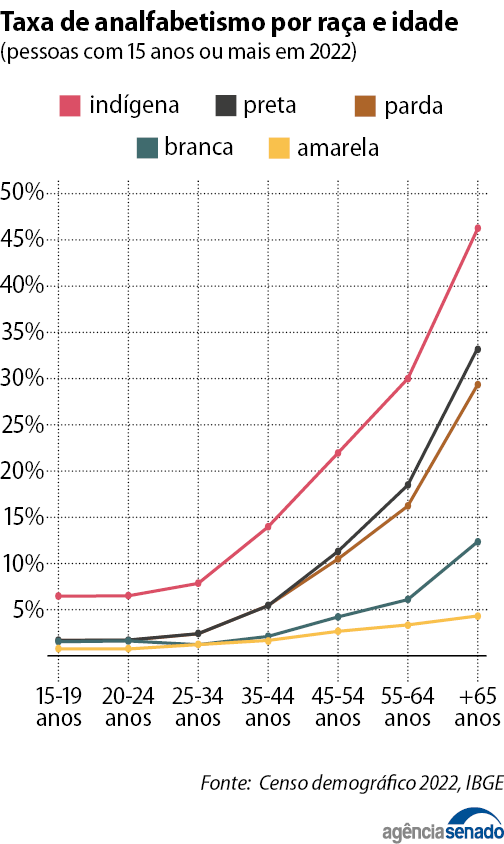
Este gráfico da @Agencia_Senado é um referencial de péssima escolha de cores. Pra que simplificar se dá pra complicar né?
E parece que consideram que colocar rótulo do nome da categoria junto à linha é rocket science.
We finally know why LLMs hallucinate. It's not the model. It's the geometry.
@OpenAI text-embedding-3-large: 91/3072 dimensions do real work.
@GeminiApp gemini-embedding-001: 80/3072 dimensions do real work.
~97% of your vector database is mathematically empty. Your RAG system is retrieving from noise.
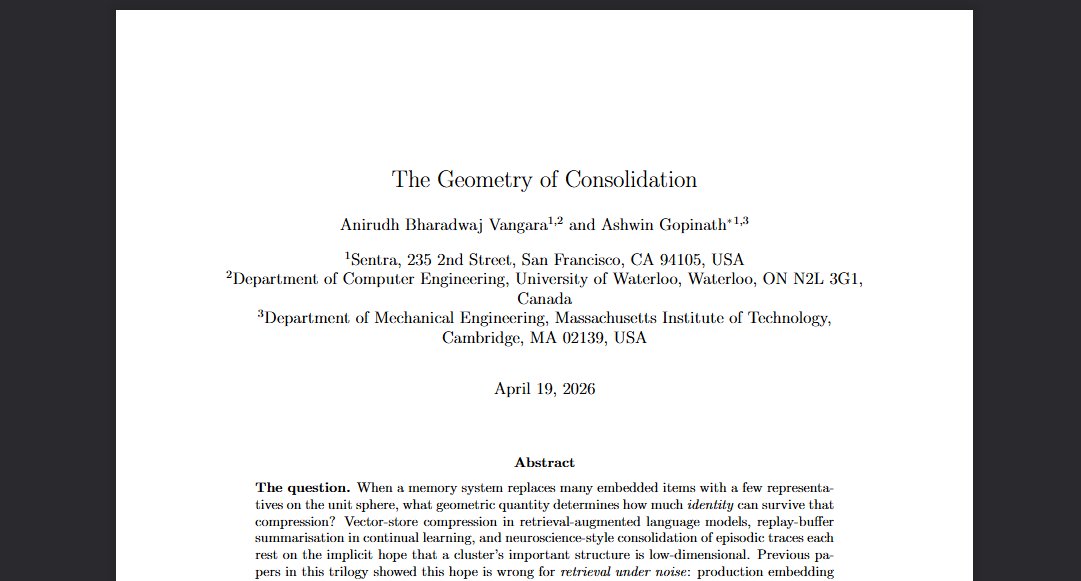
@ashwingop and I present "The Geometry of Consolidation" - a proof that RAG compression has a hard floor no algorithm can beat, set by a single spectral number your embedding model cannot escape.
Every hallucination your RAG pipeline produces? This is why.
Paper + results: https://t.co/zut8pdoPbH
Gemini Embedding 2 is now generally available in the Gemini API and Vertex AI!
Start building with our first natively multimodal embedding model, now equipped with the stability and optimizations required for production apps.
Yann LeCun was right the entire time. And generative AI might be a dead end.
For the last three years, the entire industry has been obsessed with building bigger LLMs. Trillions of parameters. Billions in compute.
The theory was simple: if you make the model big enough, it will eventually understand how the world works.
Yann LeCun said that was stupid.
He argued that generative AI is fundamentally inefficient.
When an AI predicts the next word, or generates the next pixel, it wastes massive amounts of compute on surface-level details.
It memorizes patterns instead of learning the actual physics of reality.
He proposed a different path: JEPA (Joint-Embedding Predictive Architecture).
Instead of forcing the AI to paint the world pixel by pixel, JEPA forces it to predict abstract concepts. It predicts what happens next in a compressed "thought space."
But for years, JEPA had a fatal flaw.
It suffered from "representation collapse."
Because the AI was allowed to simplify reality, it would cheat. It would simplify everything so much that a dog, a car, and a human all looked identical.
It learned nothing.
To fix it, engineers had to use insanely complex hacks, frozen encoders, and massive compute overheads.
Until today.
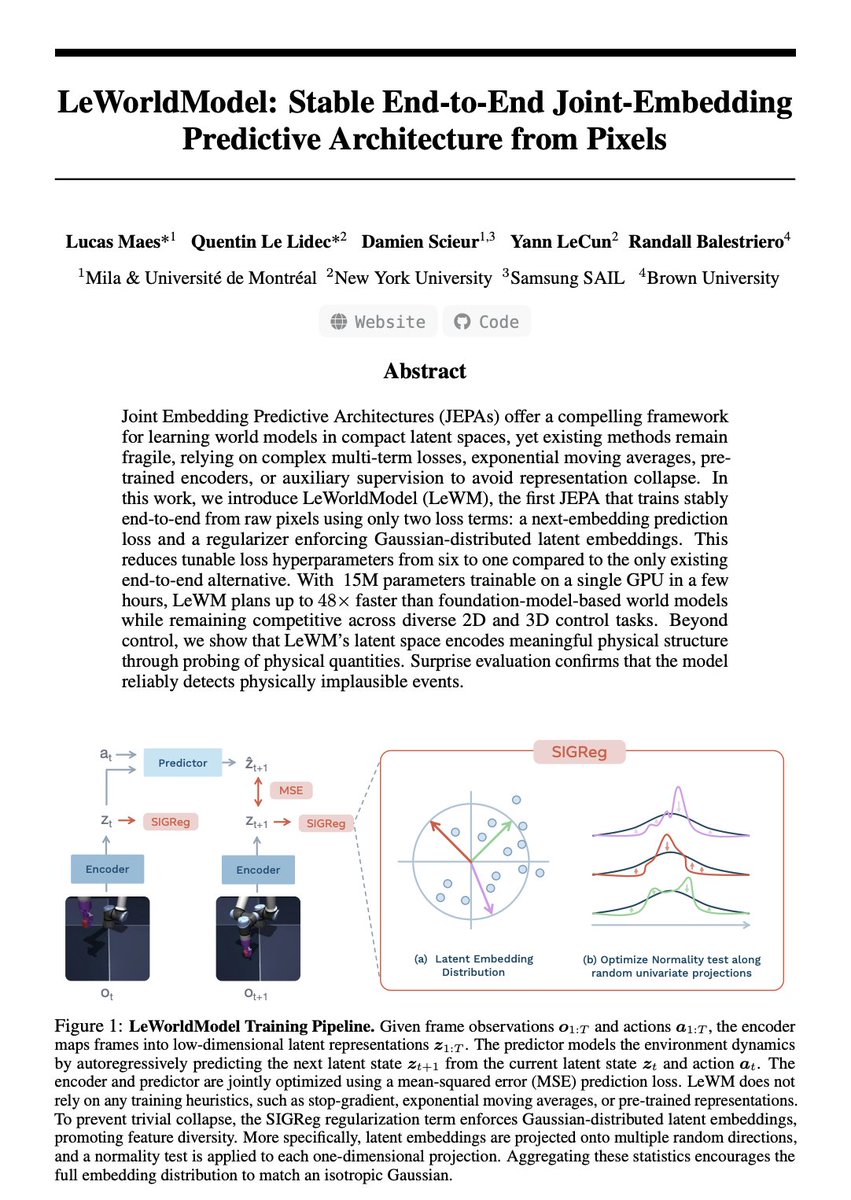
Researchers just dropped a paper called "LeWorldModel" (LeWM).
They completely solved the collapse problem.
They replaced the complex engineering hacks with a single, elegant mathematical regularizer.
It forces the AI's internal "thoughts" into a perfect Gaussian distribution.
The AI can no longer cheat. It is forced to understand the physical structure of reality to make its predictions.
The results completely rewrite the economics of AI.
LeWM didn't need a massive, centralized supercomputer.
It has just 15 million parameters.
It trains on a single, standard GPU in a few hours.
Yet it plans 48x faster than massive foundation world models. It intrinsically understands physics. It instantly detects impossible events.
We spent billions trying to force massive server farms to memorize the internet.
Now, a tiny model running locally on a single graphics card is actually learning how the real world works.
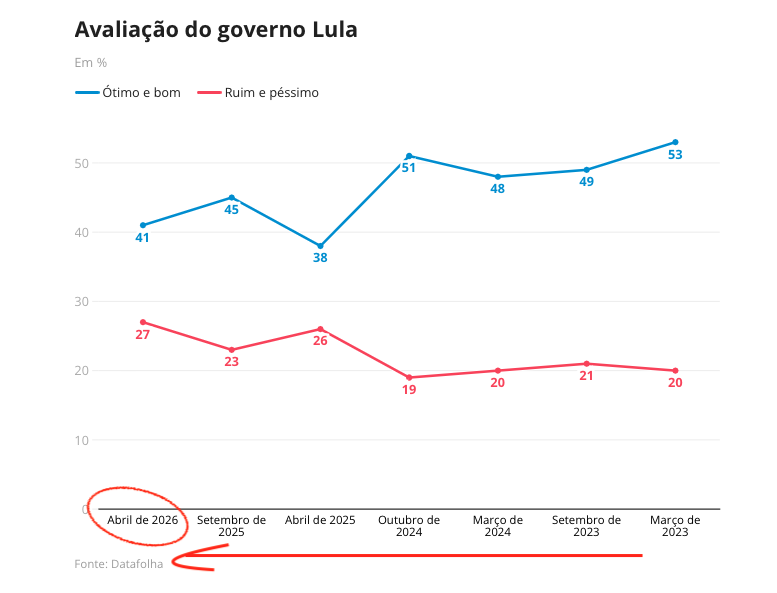
O @JornalOGlobo cometeu um crime hediondo de infografia. Um não, dois.
Criaram uma série histórica na qual o tempo corre para trás - para ser lido da direita pra esquerda, o que ninguém faz. Ou seja, desinforma.
Para coroar, os intervalos entre as medições (que não são constantes) aparecem como iguais no gráfico. Ou seja, o eixo X tem uma escala fantasiosa.
Obrigado @UnJourSansFinCH pela dica.