"Spending on PIP is already due to hit £47 billion in 5 years. This review will make the problem even worse.
The review has refused to even look at how to address the rising cost of PIP. Even this low bar they have failed to meet. The review identified lots of reforms that are individually the right thing to do for disabled people, but collectively will cost a lot of money, without making corresponding savings"
- Matt Ryder, researcher at the Adam Smith Institute, in response to the Timms review.
Ahead of Sir Stephen Timms' review into UK disability benefits tomorrow, here is the electoral maths complicating any overhaul: in most Labour and Conservative seats in England and Wales, personal independence payment (Pip) claimants outnumber the MP’s majority.
The state pension, the largest line item on the welfare bill, is even harder to touch: pensioners outnumber MPs' majorities in almost every seat.
Is meaningful welfare reform even possible in Britain? Me for the @FT: https://t.co/P8xQrz9Ch7
Meanwhile.
Shrewd Treasury economists have probably suggested this, as deposits will rise owing to new tenancies being charged at a higher rate, but this will have more of a deleterious effect on the wider sector.
The ASI reacts to the Milburn report released today
Silvia Andreoletti, Head of Communications, said:
“At a time when 3 in 4 constituencies spend more in welfare than receive in tax from workers, the reforms proposed today are nowhere near enough. The savings wouldn’t actually begin for three years, but during that time welfare spending will have increased by nearly £100 billion a year. The £14 billion savings over 10 years promised by the report pale in comparison to the ballooning costs.
Reversing the National Insurance increase imposed by Labour last year is a positive step, but it must be rolled out to every market and age group to really reduce costs for employers.
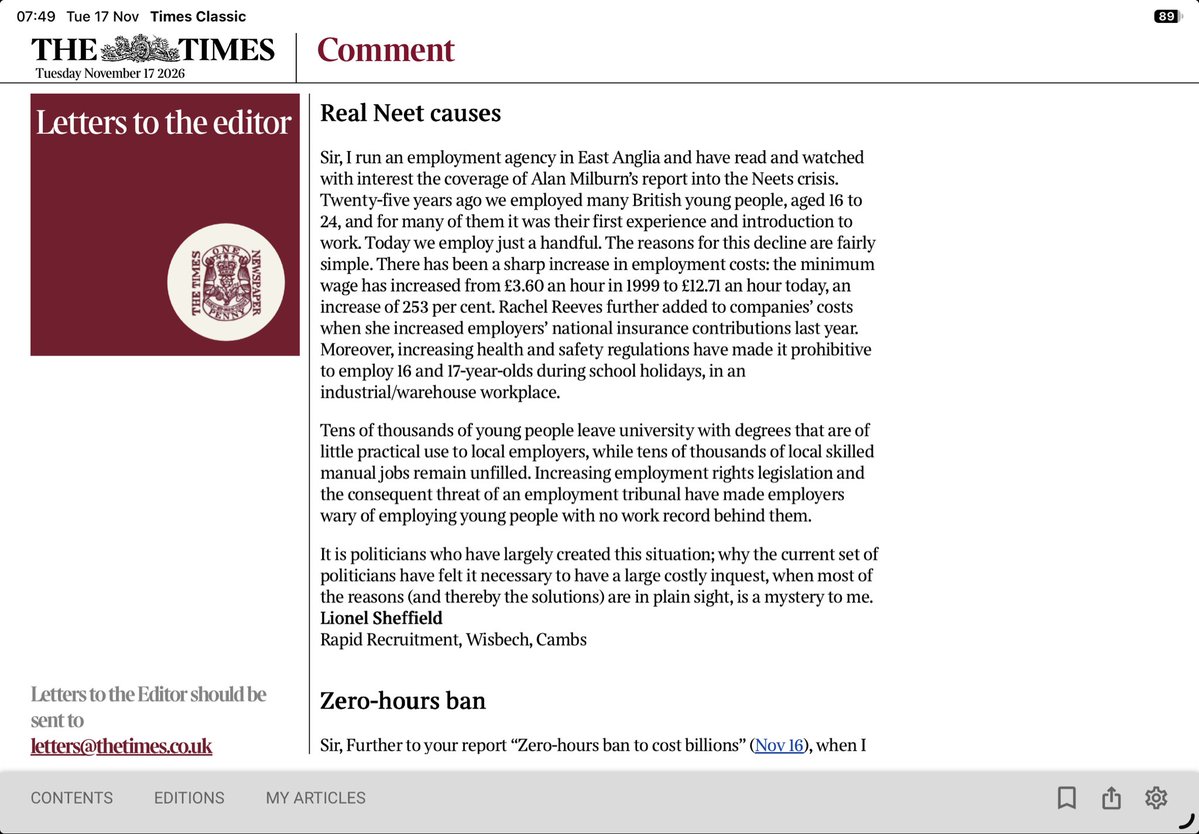
The report also didn’t touch on the other major hurdle stopping employers from hiring young people: the minimum wage increases. Time and time again, businesses owners have said rising employment costs are stopping them taking a chance on young people. Instead of giving thousand-pound subsidies at the taxpayer’s expense, the Government should reform the minimum wage and let the market do the rest.
The rising spending is pushing the national debt up to unsustainable levels; at this pace, the UK will owe more than three times the nation’s annual economic output by 2075, a higher debt-to GDP-ratio than Venezuela. What the next generation deserves is not subsidised jobs paid for by the Government; it is a future free from an impossible debt burden - which is becoming a distant reality.”
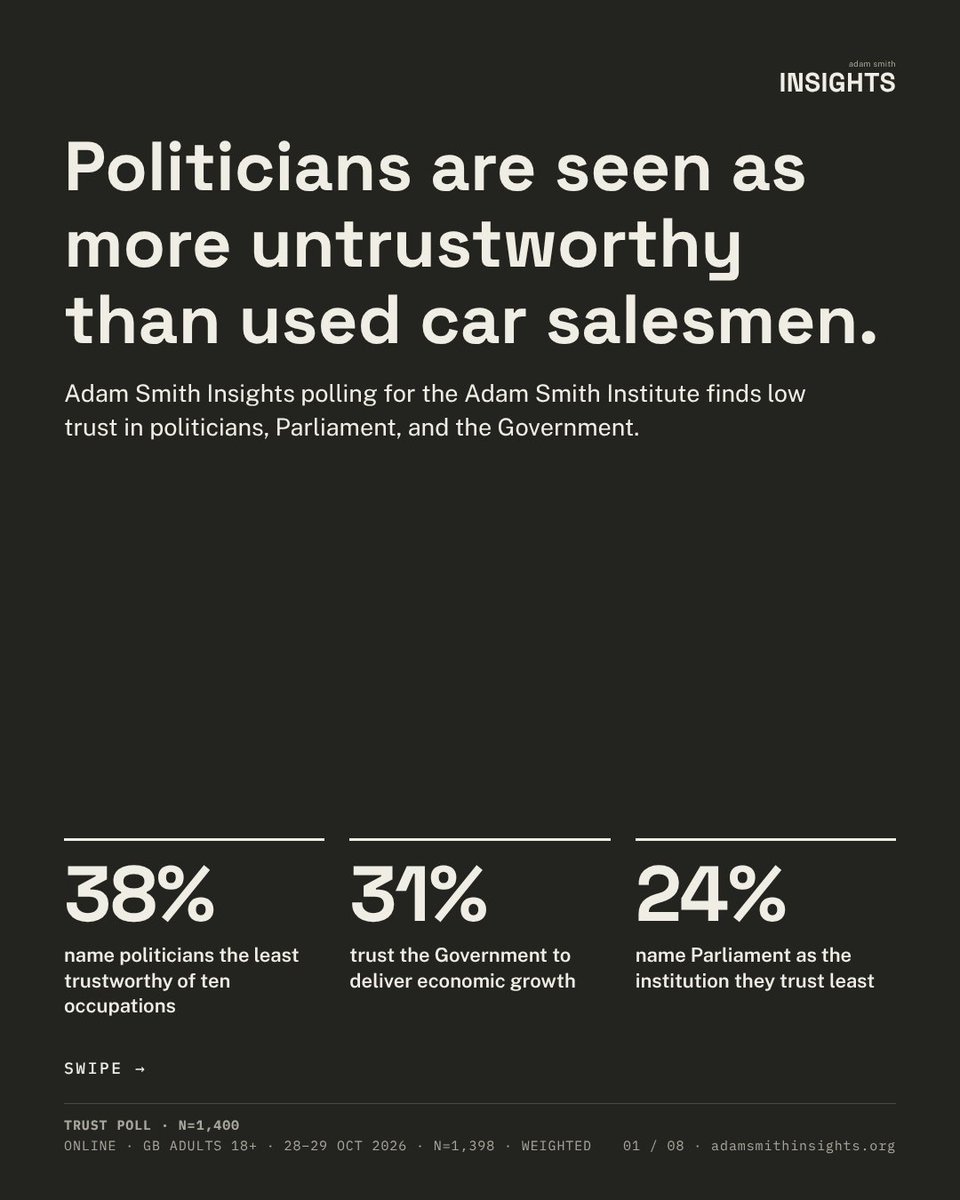
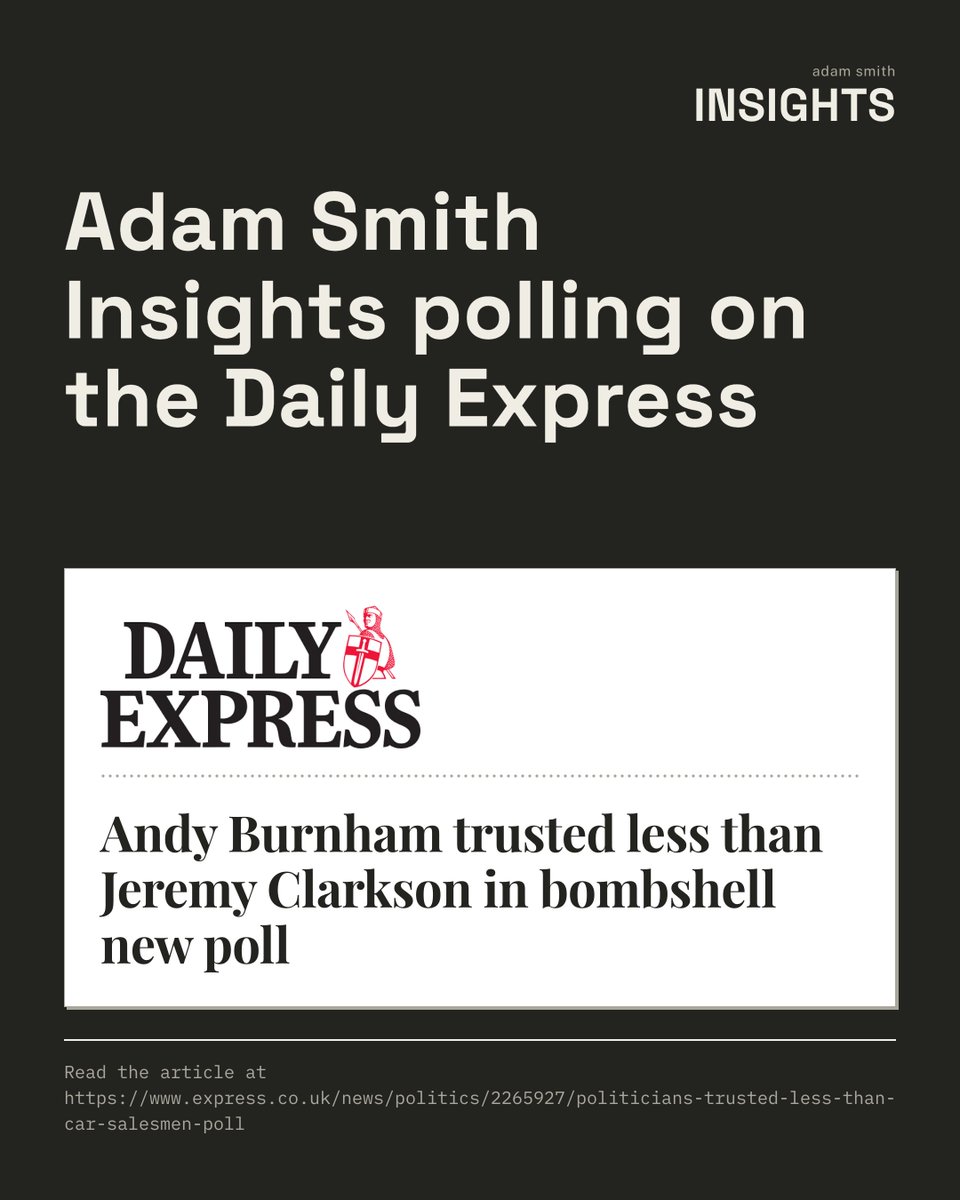
The @Daily_Express covered the newest Adam Smith Insights poll on trust in politicians this weekend. Read the piece at the link below:
https://t.co/MUG3ombp7t
More than three times as many Britons distrust Andy Burnham as distrust John Cleese.
30% rate the Prime Minister untrustworthy, compared with just 9% for the comedian.
A striking gap between Westminster and the world of entertainment. 👇
We're hiring a Development Manager to lead the ASI's fundraising and donor engagement!
£32k–£38k plus commission or bonus, based in Westminster, full or part time. Applications are reviewed on a rolling basis, so apply soon. 👇
📣 Applications for the ASI’s 2027–28 gap year programme are open!
Interested in politics, economics and free markets? Spend your gap year working with us in Westminster.
We’re offering a paid role for someone aged 18–20, with opportunities to contribute to research, write blog posts and help run events—all before starting university or your career.
We consider applications as they arrive, so apply early. 👇
As a British citizen there’s an implicit social contract.
You pay in when you can - but anyone can fall on hard times. There should be a safety net.
But our social contract has limits.
Our welfare state cannot support everyone who comes to Britain.
Migrants come here believing we will give them money, free healthcare and a house.
That has to change.
We will stop giving benefits and social housing to foreign nationals with indefinite or limited leave to remain.
As well as the savings, that will free up 230,000 social homes for British people.
We cannot be a cash machine for the world.
Labour-held Chelsea and Fulham and Liberal Democrat Richmond Park are the two seats in England with the lowest welfare dependency, spending under 27p in welfare per £1 of income tax and National Insurance their workers pay in. Birmingham Perry Barr, the most welfare-dependent seat, is held by an Independent and spends £4.41 in welfare per £1 of tax paid by its workers.
Explore the ASI's new Welfare Sustainability Tracker at https://t.co/KLoJA2IjFS
The welfare system was born as a safety net - a way to ensure pensioners and vulnerable people weren’t left behind.
But when we’re spending nearly £6,000 a head in welfare, eating up everything workers pay in tax and then some, something is very wrong.
The British welfare system is going bust: England and Wales spend £5,773 in welfare per adult, but only receives £4,528 per adult in income tax and National Insurance contributions.
This creates a deficit of £1,245 per adult, which is fuelling the biggest welfare crisis the country has ever seen and pushing the National Debt up to eye-watering amounts.
The latest growth figures are welcome, but over a fifth of that growth came from a single industry.
GDP rose 0.7% in Q3. Computer programming and consultancy contributed 0.15 percentage points.
Meanwhile, construction shrank 0.7% and private housebuilding fell 4.7%.
Britain’s AI boom needs physical foundations: data centres, energy infrastructure and homes for workers. It cannot be sustained if those things cannot be built.
With AI helping to drive economic growth, these constraints should concern every policymaker, and strengthen the case for planning reform.
Not one of Wales's 32 constituencies collects more in income tax and National Insurance than it spends on welfare. Across Wales, welfare spending is nearly double what workers pay in, a gap of £3,062 per adult. That is worse than every English region except the North East.
Explore more in the ASI's Welfare Sustainability Tracker. 👇
75% of constituencies in England and Wales spend more on welfare than their workers pay in income tax and National Insurance. London and the South East are the only regions that are net contributors; the North East is the most welfare-dependent region in England.
Explore the ASI's new Welfare Sustainability Tracker at https://t.co/KLoJA2IjFS
Constituencies with the highest welfare spending per adult in England and Wales tend to have younger populations, more children, higher rates of disability, and greater concentrations of social housing than England as a whole; low-welfare constituencies have fewer children, fewer people with disabilities, and far more people with university degrees than average.
Explore the ASI's new Welfare Sustainability Tracker at https://t.co/KLoJA2IjFS
ZERO constituencies in Birmingham are fiscally solvent. That compares to 47 in London.
It is an uncomfortable fact, but Britain’s welfare state depends on high earners in London and the South East footing the bill for the rest of the country.
See the @ASI Welfare Sustainability Tracker. 👇