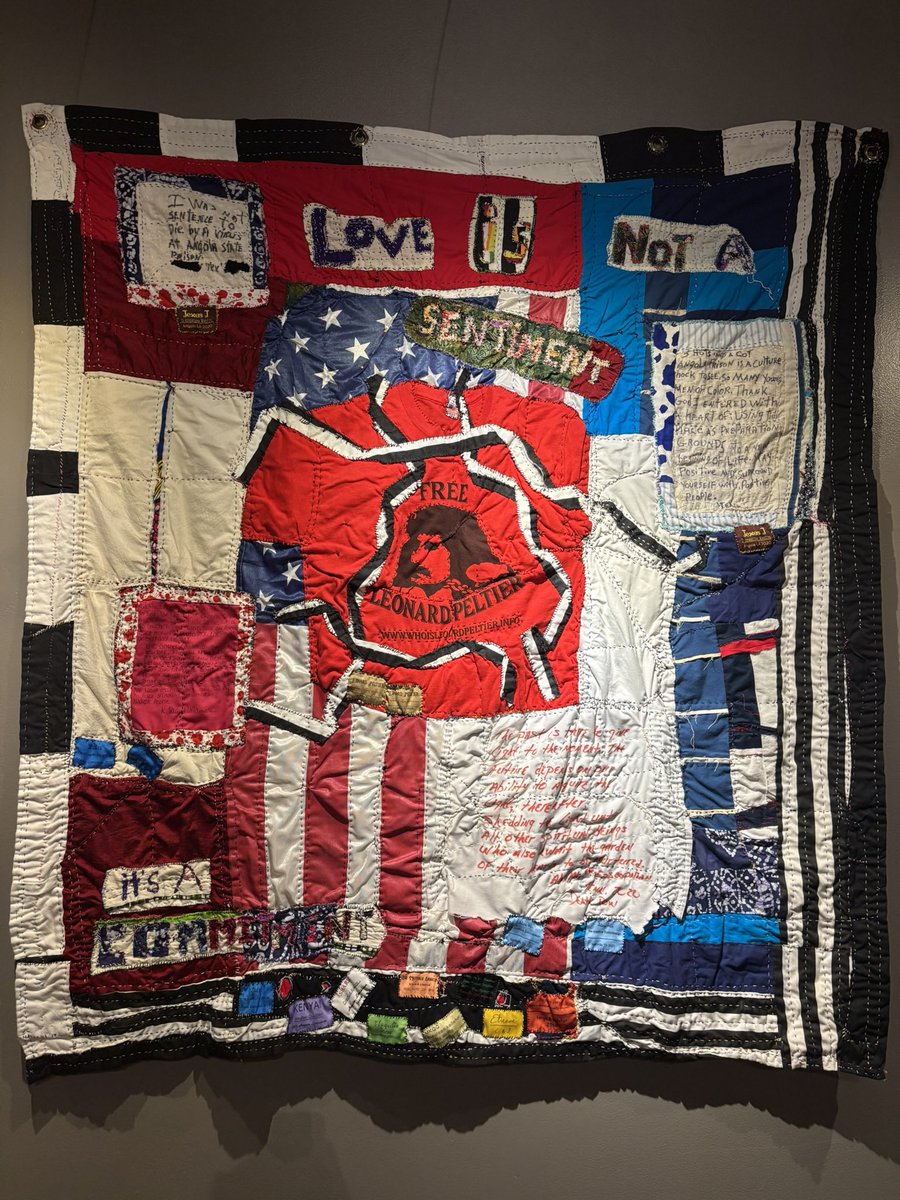
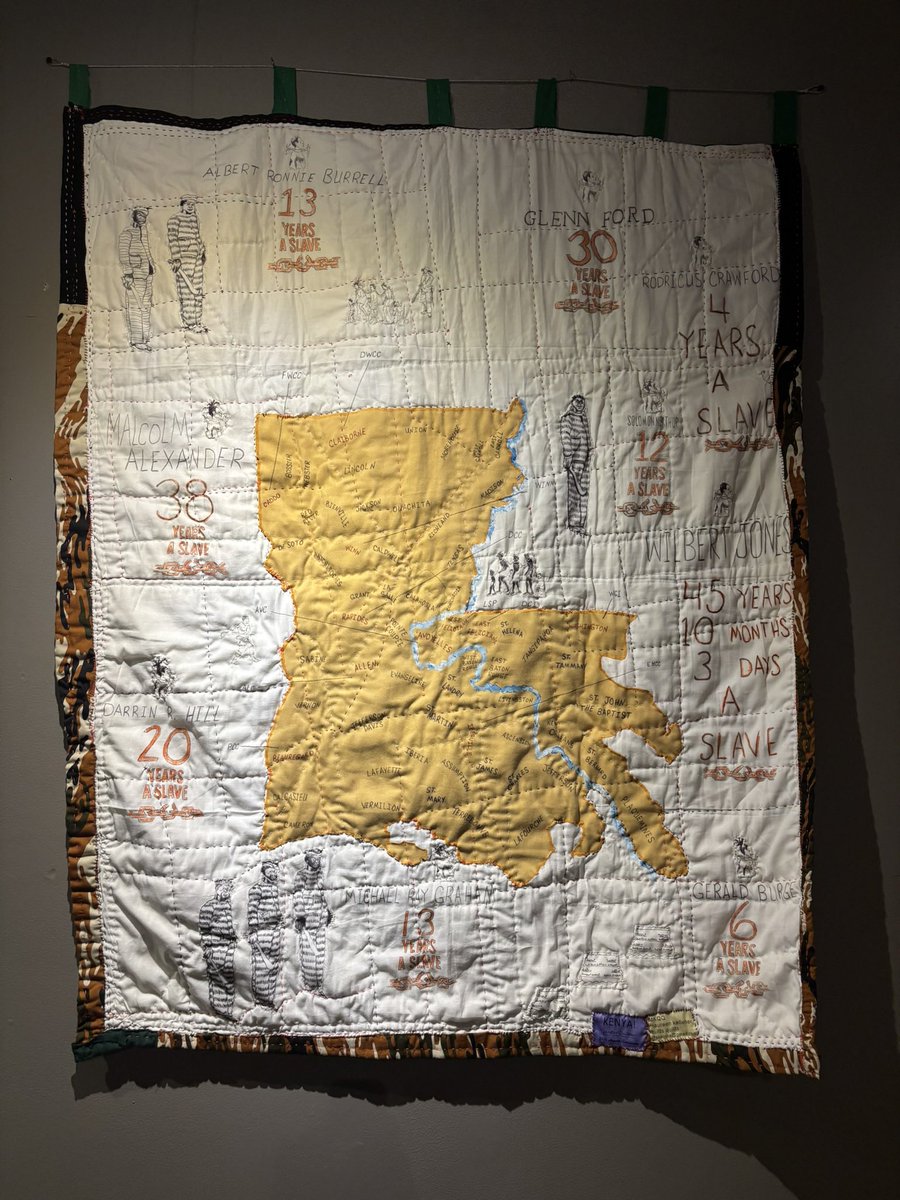
Saw these cool quilts yesterday. Inmates at Angola started a prisoner-run hospice program for those with life sentences. They started selling quilts to support it, which became an artistic outlet. Leonard Peltier and Mumia took part when the program spread to other prisons.
This war is the most significant one of our times. It will decisively determine the terms of engagement of the west with the global south - from the covert imperialism of the rules based order to outright imperialism. Iran fights for us all. Like it or not. Accept it or not.
The Nobel Committee has decided to make the case for Trump’s war on Venezuela, giving its “Peace Prize” to Maria Corina Machado, a US govt-funded regime change activist who’s helped lead failed military coups, violent street riots, and has likely promised her country’s oil and mineral wealth to a consortium of MAGA aligned billionaires in exchange for financing her political arsonism. This icon of peace has even appealed to Benjamin Netanyahu to help her lead a military invasion of Venezuela.
Maria Corina Machado is a marionette for Marco Rubio, a creation of the CIA-sponsored Gusano Industrial Complex that has brought violent terror and siege to any Latin American country defying the Washington Consensus of privatization and austerity, and a would-be Pinochet in a skirt.
Machado has spent years lobbying for US and EU starvation sanctions on her own country, resulting in waves of migration to the US, fueling the nativist resentment that gave rise to Trump. When Trump shipped Venezuelan migrants to a torture camp in El Salvador this year, Machado predictably sided with Trump, the main sponsor of her putchist career, over her countrymen.
Giving the Nobel to Machado is a green light for regime change war on Venezuela, and then Cuba. But the decision is consistent with the Committee’s role as a soft power instrument of Western empire. Just recall its award to Obama at the beginning of his first term, granting him infinite legitimacy in advance of his destruction of Libya, escalation of wars in Iraq and Afghanistan, and facilitation of Gaza’s decimation. Given that nothing has happened in Machado’s career without the support and guidance of Washington, the Committee’s decision must be seen as the result of another Western op - a coup in Oslo to pave the way for one in Caracas.
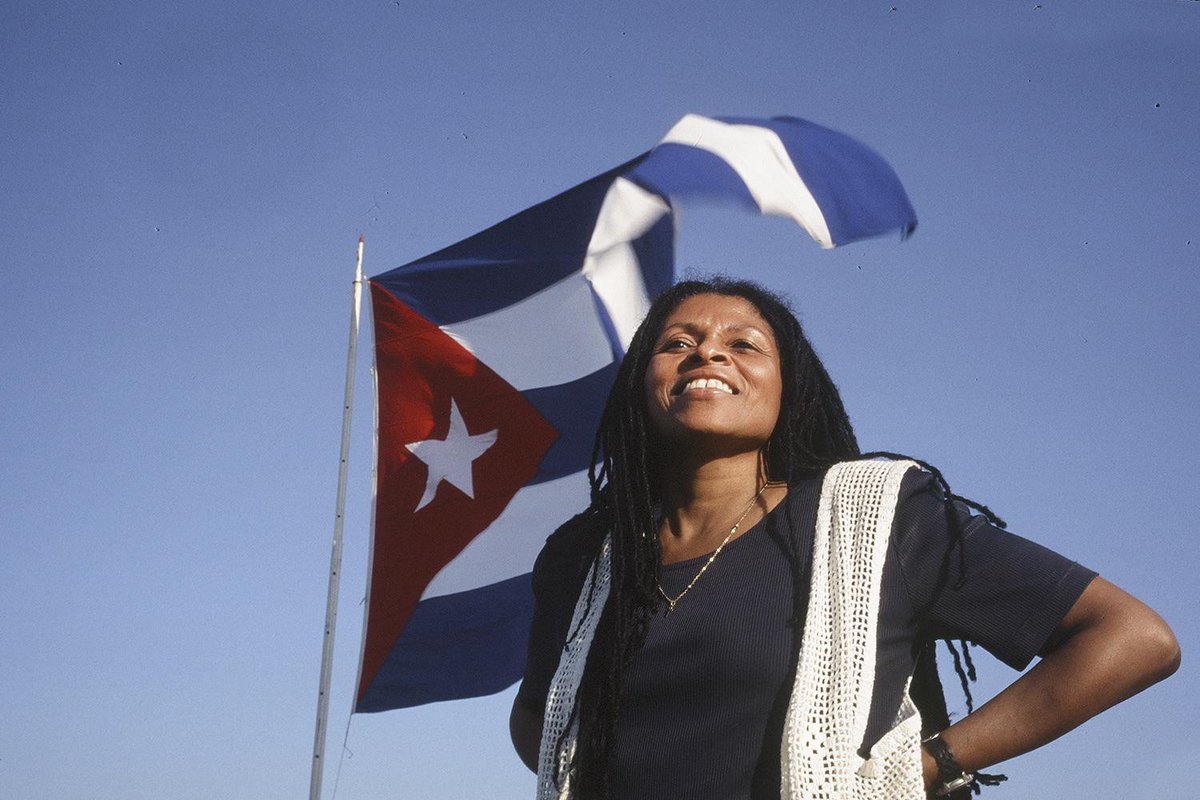
Assata Shakur Speaks from Exile: Excerpts from an Interview by Sociologist Christian Parenti (Cuba, 1997)
Parenti: How did you arrive in Cuba?
Assata Shakur: Well, I couldn’t, you know, just write a letter and say, “Dear Fidel, I’d like to come to your country.” So I had to hoof it–come and wait for the Cubans to respond. Luckily, they had some idea who I was, they’d seen some of the briefs and U.N. petitions from when I was a political prisoner. So they were somewhat familiar with my case and they gave me the status of being a political refugee. That means I am here in exile as a political person.
Parenti: How did you feel when you got here?
Shakur: I was really overwhelmed. Even though I considered myself a socialist, I had these insane, silly notions about Cuba. I mean, I grew up in the 1950s when little kids were hiding under their desks, because “the communists were coming.” So even though I was very supportive of the revolution, I expected everyone to go around in green fatigues looking like Fidel, speaking in a very stereotypical way, “the revolution must continue, Companero. Let us triumph, Comrade.” When I got here people were just people, doing what they had where I came from. It’s a country with a strong sense of community. Unlike the U.S., folks aren’t so isolated. People are really into other people. Also, I didn’t know there were all these black people here and that there was this whole Afro-Cuban culture. My image of Cuba was Che Guevara and Fidel Castro. I hadn’t heard of Antonio Maceo (a hero of the Cuban war of independence) and other Africans who had played a role in Cuban history.The lack of brand names and consumerism also really hit me. You go into a store and there would be a bag of “rice.” It undermined what I had taken for granted in the absurd zone where people are like, “Hey, I only eat uncle so and so’s brand of rice.”
Parenti: So, how were you greeted by the Cuban state?
Shakur: They’ve treated me very well. It was different from what I expected; I thought they might be pushy. But they were more interested in what I wanted to do, in my projects. I told them that the most important things were to unite with my daughter and to write a book. They said, “What do you need to do that?” They were also interested in my vision of the struggle of African people in the United States. I was so impressed by that. Because I grew up–so to speak–in the movement dealing with white leftists who were very bossy and wanted to tell us what to do and thought they knew everything. The Cuban attitude was one of solidarity with respect. It was a profound lesson in cooperation.
Parenti: Did they introduce you to people or guide you around for a while?
Shakur: They gave me a dictionary, an apartment, took me to some historical places, and then I was pretty much on my own. My daughter came down, after prolonged harassment and being denied a passport, and she became my number one priority. We discovered Cuban schools together, we did the sixth grade together, explored parks, and the beach.
Parenti: She was taken from you at birth, right?
Shakur: Yeah. It’s not like Cuba where you get to breast feed in prison and where they work closely with the family. Some mothers in the U.S. never get to see their newborns. I was with my daughter for a week before they sent me back to prison. That was one of the most difficult periods of my life, that separation. It’s only been recently that I’ve been able to talk about it. I had to just block it out, otherwise I think I might have gone insane. In 1979, when I escaped, she was only five years old.
Parenti: You came to Cuba how soon after?
Shakur: Five years later, in 1984.
New research published by the Lancet finds that economic sanctions imposed by the USA and EU are associated with more than 500,000 deaths per year since 1970, five times more than deaths by war. https://t.co/PnqmgMwwZW
"Do not be afraid, I am a colonel of the Soviet army and a Jew. We have come to liberate you."
80 years ago today, the Red Army liberated Auschwitz. In the passage below, two Russian soldiers describe the heartwrenching moment in which the prisoners — "living skeletons" — greeted their arrival.
Over a million people were systematically destroyed in the camp. First their humanity was torn from them; then their lives. "[O]ur language," Auschwitz survivor Primo Levi wrote, "lacks words to express this offence, the demolition of a man... [N]o human condition is more miserable than this, nor could it conceivably be so."
This year, ahead of the anniversary, the EU parliament adopted a resolution banning Soviet symbols. Russia was barred from attending the commemorations, with the Holocaust museum saying that its "presence would be cynical". Meanwhile, the authors of our generation's holocaust in Gaza were not only invited, but offered immunity from arrest by the Polish government, despite the warrants issued by the International Criminal Court.
In this way, Europe rewrites its history. It weaponises Holocaust remembrance to provide cover for the same kind of colonial logic that produced Nazism. And it erases the legacy of those who most forcefully resisted it. The implication could not be clearer: until we dismantle the material basis of fascism and colonialism, "remembrance" will remain a pernicious rhetorical device.
To remember, I turn again to Primo Levi, who saw dignity in the Soviet resistance to German aggression, and in that dignity the reason for its ultimate victory:
"And yet, under their slovenly and anarchical appearance, it was easy to see in them, in each of those rough and open faces, the good soldiers of the Red Army, the valiant men of the old and new Russia, gentle in peace and fierce in war, strong from an inner discipline born from concord, from reciprocal love and from love of their country; a stronger discipline, because it came from the spirit, than the mechanical and servile discipline of the Germans. It was easy to understand, living among them, why this former discipline, and not the latter, had finally triumphed.”
These words could very well have been written about the Palestinian resistance today.
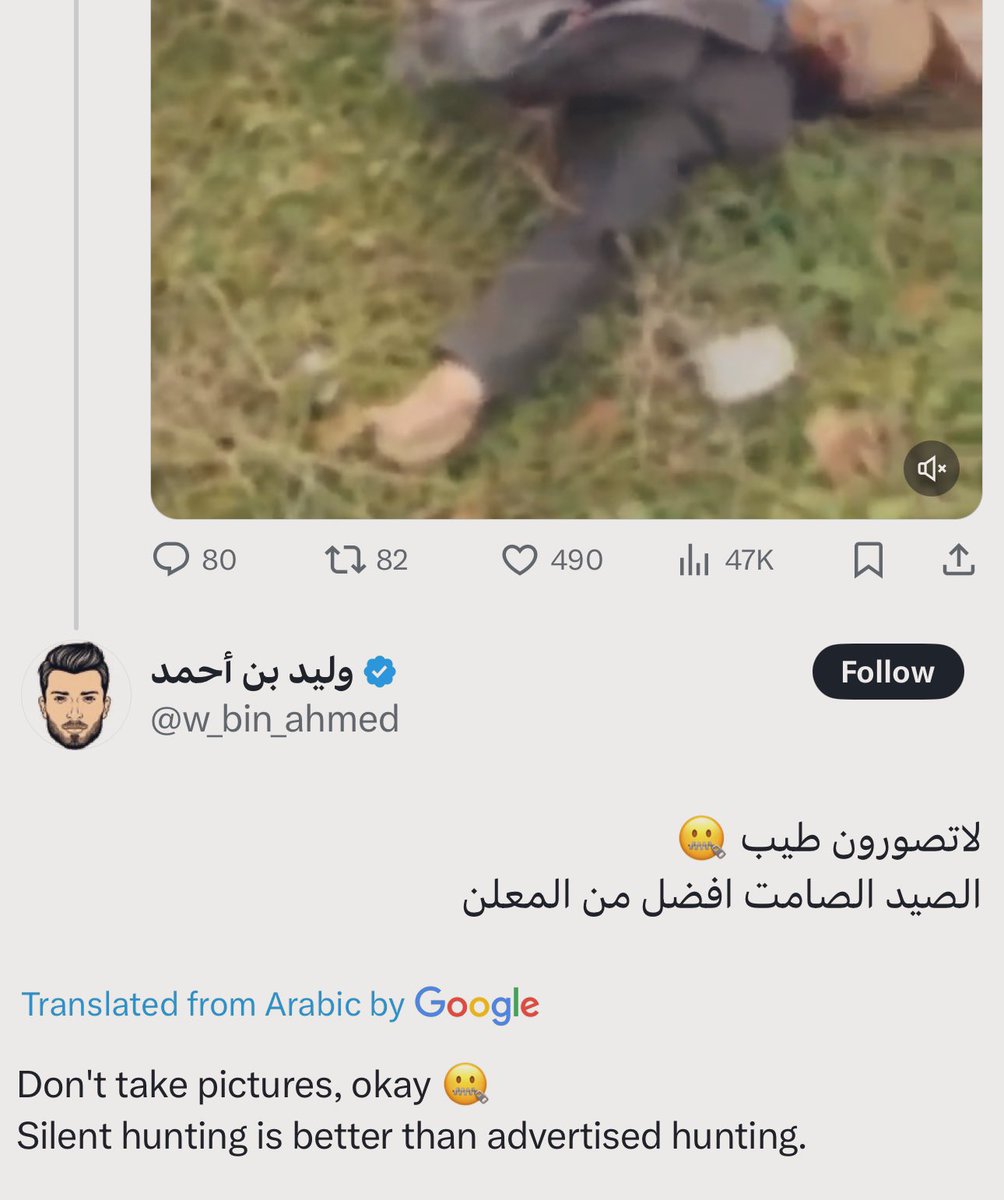
Mass executions of Syrian civilians are taking place in Syria. The videos are horrific. Alawite Syrians are attempting to fight back and Christian Syrians are calling for an armed resistance. While the pro-Julani crowd are calling for “silent killing” without cameras
The problem with liberalism is that it rests on a fundamental contradiction that cannot be resolved. It will always fail, it will always collapse, and this explains everything about our current moment.
Liberals try to hold two commitments at once: on the one hand, they are firmly committed to capitalism; on the other, they express support for principles like human rights, democracy, equality, freedom of speech, environment and the rule of law. This duality is the core of liberalism.
But there's a problem. Capital accumulation requires cheapening labour and nature. This eventually comes into direct conflict with principles like rights and equality. And whenever this conflict appears, the liberal ruling class sides with capital, abandons their lofty principles, and throws workers and nature under the bus. Every. Single. Time.
This results in flagrant displays of hypocrisy. They run on nice-sounding platforms but end up either betraying their promises or actively working against their stated values. They'll slash public services, bail out banks, imprison journalists, beat up students, expand fracking, coup democratically elected leaders in the global South, bomb liberation movements, fund a genocide - they'll even trash international law itself - anything that's needed to maintain the conditions for capital accumulation.
At most, they may try to negotiate mediocre compromises, a few social policies here and there - some abortion rights, a tiny increase in the minimum wage - but nothing that might pose any serious threat to capital accumulation. Thus the soul-crushing slowness of liberal incrementalism. Ultimately they are unwilling to take any of the obvious steps that would actually resolve our urgent social and ecological crises.
This is why nobody trusts liberal politicians. This is why they come across as so fantastically insincere, and even sneering. This is why they feel so spineless and *empty*.
The center cannot hold. Liberalism will always collapse, inevitably handing power to fascists, and this is not acceptable. There is only one way to overcome this deadly impasse, and that is to mobilize a socialist alternative. A political movement that can unite the working-classes, overcome capitalism, deliver real economic democracy, and enable us to achieve rapid progress toward social and ecological goals.
This isn't an exaggeration.
She's literally saying that she understands why people don't want to support a genocide, but that she DOES support the genocide, and if you want minimally decent domestic policy, you're going to have to support the genocide too.
Israel is destroying residential buildings in Beirut in the middle of the day, unashamed, and unrestrained. From Gaza to Beirut, this is the world Western leaders have decided we now live in – impunity without consequences, brutality without justice.
Cuba’s electrical grid collapsed. Food and medicine spoiled. Surgeries cancelled. Biden followed Trump and lists Cuba as a terrorist nation. Financial transactions impossible. They even killed Cuba’s tourist industry. War without firing a shot.
Mao to PLO delegation in 1965:
”Israel and Taiwan are bases of operation for Imperialism in Asia. They created Israel for the Arabs and Taiwan for us. They both have the same objective”
Yahya Sinwar was fired on by a tank, hit with a missile that severed his hand, then a drone and finally had to be sniped to be killed. His death symbolizes the technological advantages Israel has against an indomitable Palestinian spirit limited only by flesh & blood.
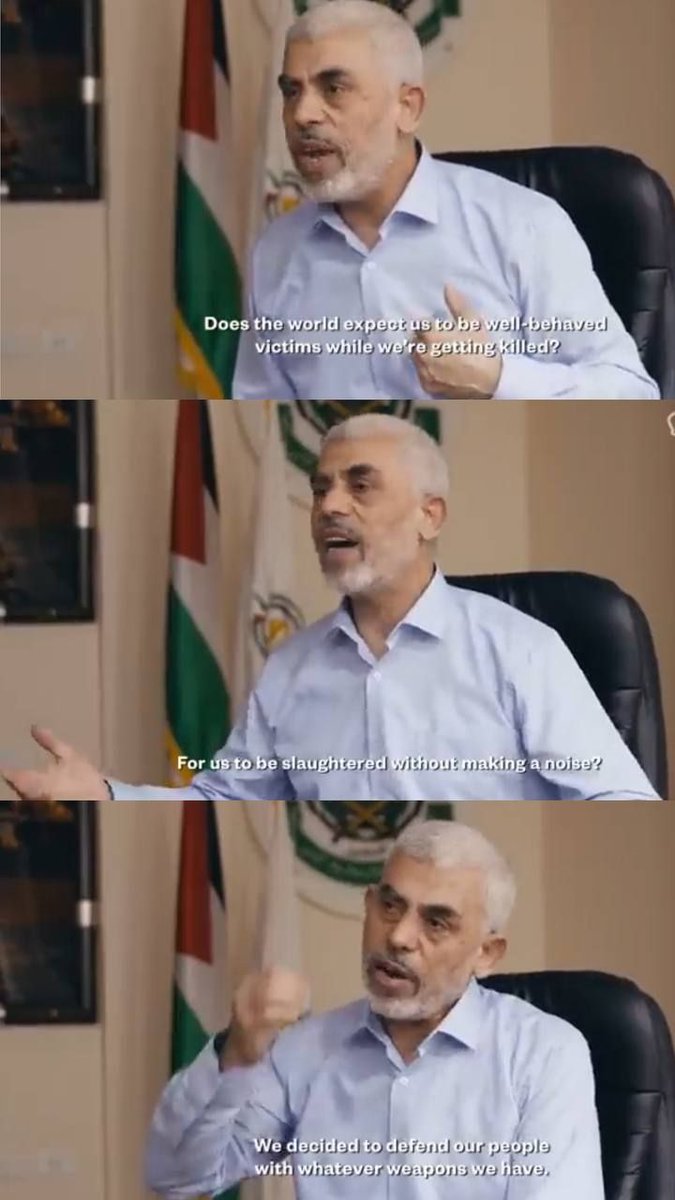
“Does the world expect us to be well-behaved victims while we are getting killed? For us to be slaughtered without making a noise?”
— Hamas leader Yahya Sinwar.







![pawelwargan's tweet photo. "Do not be afraid, I am a colonel of the Soviet army and a Jew. We have come to liberate you."
80 years ago today, the Red Army liberated Auschwitz. In the passage below, two Russian soldiers describe the heartwrenching moment in which the prisoners — "living skeletons" — greeted their arrival.
Over a million people were systematically destroyed in the camp. First their humanity was torn from them; then their lives. "[O]ur language," Auschwitz survivor Primo Levi wrote, "lacks words to express this offence, the demolition of a man... [N]o human condition is more miserable than this, nor could it conceivably be so."
This year, ahead of the anniversary, the EU parliament adopted a resolution banning Soviet symbols. Russia was barred from attending the commemorations, with the Holocaust museum saying that its "presence would be cynical". Meanwhile, the authors of our generation's holocaust in Gaza were not only invited, but offered immunity from arrest by the Polish government, despite the warrants issued by the International Criminal Court.
In this way, Europe rewrites its history. It weaponises Holocaust remembrance to provide cover for the same kind of colonial logic that produced Nazism. And it erases the legacy of those who most forcefully resisted it. The implication could not be clearer: until we dismantle the material basis of fascism and colonialism, "remembrance" will remain a pernicious rhetorical device.
To remember, I turn again to Primo Levi, who saw dignity in the Soviet resistance to German aggression, and in that dignity the reason for its ultimate victory:
"And yet, under their slovenly and anarchical appearance, it was easy to see in them, in each of those rough and open faces, the good soldiers of the Red Army, the valiant men of the old and new Russia, gentle in peace and fierce in war, strong from an inner discipline born from concord, from reciprocal love and from love of their country; a stronger discipline, because it came from the spirit, than the mechanical and servile discipline of the Germans. It was easy to understand, living among them, why this former discipline, and not the latter, had finally triumphed.”
These words could very well have been written about the Palestinian resistance today.](https://pbs.twimg.com/media/GiSETVhWEAAzaXL.png)