As an Indian woman from Muslim heritage, I write this rebuttal with the clarity and directness that comes from living the reality @Ilhan only tweets about from afar. Ilhan Omar’s claim that India has reached the “eighth stage of genocide” against Muslims is not analysis. It is reckless, fact-free propaganda that insults every one of us who actually live here, work here, raise families here, and exercise our rights every single day.
If there were even the beginning of genocide, our population would not have exploded. In 1951, Muslims were about 9.8% of India. By 2011, we were 14.2%. Today we are estimated around 14.5–15%, heading toward 18% by 2050 according to Pew projections. From roughly 35 million in 1951 to over 200 million now. Absolute numbers have multiplied nearly six-fold while the country’s overall population grew far slower in percentage terms. Genocide does not produce the world’s largest Muslim-minority population that keeps growing faster than the national average for decades. It produces mass graves and fleeing refugees. We have neither.
We vote in every election in the world’s largest democracy. We contest seats, win them, become MPs, ministers, judges, IAS officers, doctors, engineers, and business leaders. Three Presidents of India have been Muslim. We serve in the armed forces and police. We own businesses, run hospitals, produce films, and dominate segments of entertainment and sports. This is not the signature of a community facing extermination.
We are thriving and prospering — with real data and real lives. Yes, like every large community, we have internal challenges — lower average literacy and educational enrollment in some metrics, pockets of poverty, and the need for better skilling. But the narrative of uniform victimhood is a lie told by people who have never walked through a Muslim-dominated area in Mumbai, Hyderabad, Lucknow, or Kerala and seen the middle class, the professionals, the entrepreneurs, and the young women studying medicine and engineering.
Prominent Indian Muslims — from business (Wipro’s Azim Premji built one of India’s largest companies), to cinema (generations of stars and directors), to sports, academia, and medicine — show what is possible when talent meets opportunity in a free society. Millions of ordinary Muslim families have moved from villages to cities, from informal work to formal jobs, from one generation of limited schooling to the next pursuing professional degrees. That is prosperity in motion, not persecution.
We enjoy specific rights and accommodations that Hindus as a group do not. This is the part Omar and her echo chamber never mention. Indian Muslims operate under a parallel personal law system for marriage, divorce, inheritance, and maintenance rooted in Sharia. Hindus do not.
After independence, Hindu personal law was comprehensively reformed and codified into a uniform framework (Hindu Marriage Act, Hindu Succession Act, etc.). Muslims retained the right to follow their own religious laws — including provisions for polygamy (up to four wives) and differential inheritance rules that the Hindu majority surrendered decades ago.
We also have constitutional minority protections under Articles 29 and 30 that allow us to establish and administer our own educational institutions with significant autonomy — rights the Hindu majority does not claim as a group because it is not classified as a minority. The Waqf Act gives Muslim institutions unique control over vast religious and charitable properties in a manner unparalleled for any other community.
In short: the Indian state has gone out of its way, through personal laws and minority safeguards, to preserve and accommodate Muslim religious and cultural identity in ways it has not extended equivalently to the Hindu majority. These are not “equal rights” in every narrow sense — they are deliberate accommodations that give us more space to live according to our traditions than the majority community receives under the same Constitution.
As a woman from Muslim heritage in India, I have the full protection of the Indian Constitution plus the framework of personal law. The criminalization of instant triple talaq in 2019 removed a specific vulnerability that existed under uncodified practice. I can study, work, vote, travel, criticize the government, wear what I choose (or not), and practice my faith openly — all while living in a country where my community’s population share has steadily risen for 75 years.
@Ilhan Omar’s “eighth stage of genocide” rhetoric is not solidarity. It is the lazy export of American culture-war talking points onto a country and a people she does not understand. It erases the agency of 200+ million Indian Muslims who are neither cowering nor waiting for rescue from Washington. It cheapens the word “genocide” while real atrocities happen elsewhere.
Stop peddling foreign fantasies about our lives. We are here. We are visible. We are voting. We are building. And we reject your narrative with the facts of our own existence. That is the view from inside — not from a podium in the United States.
This is exactly the point I keep making.
We Indians are the only people on earth who take a few bad apples and turn it into a verdict on our entire country.
Someone behaves badly in public, and within seconds it becomes "Indians have no civic sense, we give India a bad name."
We do not even wait for the world to judge us. We rush to do it ourselves, loudly.
So let me hold up the same mirror to the rest of the world.
Just two weeks ago, PSG won the Champions League. This was their second title in a row, beating Arsenal on penalties. A back to back European crown, one of the biggest things that can happen to a football club.
So how did Paris, one of the most cultured cities on the planet, celebrate?
They set cars on fire. They vandalised and looted shops. They lit fires in the streets. A group even tried to storm a police station.
Across France, 890 people were arrested in one night. More than 200 were injured. A young man died after crashing his bike into concrete barriers during the chaos.
France had to put 8,000 police on the streets just to manage a party.
And this was not even the worst of it. When PSG won their first title the year before, two people died, 264 cars were burned, and a police officer was hit in the face by fireworks and put into an induced coma.
Now ask yourself one simple question.
Did anyone write "the French have no civic sense"? Did anyone say France should be ashamed, that the French give their country a bad name?
No. Their own President tweeted "a new star is shining over Paris." The whole thing got filed under passion. Under joy. Under boys being boys.
Take another one. In February 2025, Philadelphia won the Super Bowl. Their fans ripped traffic light poles clean out of the ground and carried them down the road. They set fires in the street. They climbed on dump trucks. They threw bottles at police. Dozens were arrested. And at the playoff celebration just weeks before that, an 18 year old fell off a lamp post and died, and that same night there were shootings, a stabbing, and a car that drove straight into the crowd.
This is one of the richest cities in the richest country in the world.
And again, nobody said "Americans are uncivilised." Nobody said America should hang its head.
It was reported as a wild, passionate, beautiful night. Everyone moved on.
When a Western crowd burns cars, tears down public property, and people actually die, the world calls it energy, love, raw emotion.
When an Indian does something far smaller, the world, and worse, we ourselves, call it proof that a billion people have no manners and no culture.
I am not saying bad behaviour is fine. It is selfish, it is annoying, and you should call it out, firmly. Bad behaviour is bad behaviour, in Delhi, in Paris, in Philadelphia.
But the rule has to be the same for everyone. If burning cars and storming a police station in Paris is just passion, then a small bit of celebration in Vietnam is, at absolute worst, a small bit of inconvenience. It is not evidence that our civilisation has failed.
Other countries guard their self image fiercely.
A French fan burns a car and still calls his people the most cultured in Europe. An American tears down a traffic pole and still walks around certain he is from the greatest country on the planet.
And then we find one bad clip and use it to confirm a sad little story we have somehow been taught to believe about ourselves.
So the next time you see one Indian behaving badly and feel that urge to say "this is why we are a third world country," stop.
We do not need the world to look down on us.
She was rejected 15 times, dismissed as unruly, and largely written out of the conversation. Then the science proved she was right — and changed everything we thought we knew about life itself.
In 1966, a twenty-eight-year-old biologist named Lynn Margulis sat down and wrote a paper that contradicted one of the most fundamental assumptions in all of science.
She was not a tenured professor. She was not working at a prestigious research institution. She was a young mother of two, recently divorced, completing her PhD while raising her sons largely on her own. The scientific establishment had no particular category for her and no particular interest in what she was proposing.
She proposed it anyway.
Her idea was this: that the story of evolution told through competition and conquest was incomplete. That somewhere in the deep history of life on Earth — billions of years ago, long before anything with a spine had appeared — something had happened that was not a battle but a merger. Two separate organisms, each unable to survive alone, had come together and become something neither could have been independently.
The mitochondria in every one of your cells — the structures that convert food into energy, the engine that powers every thought you are having right now — were once free-living bacteria. They did not evolve gradually inside cells. They moved in. They formed a partnership so deep and so permanent that over billions of years they became indistinguishable from the cell itself.
She called the theory endosymbiosis. She called the process symbiogenesis. What she was really saying was that cooperation, not just competition, was one of the engines of evolution — that life's greatest leaps forward had sometimes come not from one organism defeating another, but from two organisms becoming one.
Fifteen scientific journals rejected the paper before it was published in 1967.
Fifteen.
To understand what she was working against, you need to understand the scientific culture of the 1960s. Neo-Darwinism — the synthesis of Darwin's evolution with Mendelian genetics — was the reigning framework, and it was defended with the particular intensity of a field that had recently achieved hard-won consensus. The idea that a bacterium had simply moved inside another cell and stayed there, permanently, was considered not just wrong but somewhat absurd. Evolution happened through random mutation and natural selection, slowly, over generations. Not through dramatic mergers. Not through cooperation.
The reviewers who rejected her paper used words like speculative and insufficiently rigorous. One described the idea as the sort of thing that was interesting to think about but impossible to prove.
She was also described, more than once, as unruly.
It was the specific word that followed women who challenged scientific consensus — not wrong, not misguided, but unruly, as though the problem were her manner rather than her method.
She had been exceptional from the beginning in ways that made people uncomfortable. Born Lynn Petra Alexander in Chicago on March 5, 1938, she entered the University of Chicago at sixteen — intellectually restless, reading at a level that outpaced her coursework, drawn to the questions at the edges of what science had settled. At nineteen she married a young astronomer named Carl Sagan, who would go on to become one of the most famous scientists of the twentieth century. She would later say, without particular bitterness, that during their marriage she was primarily considered someone's wife rather than someone in her own right.
They divorced in 1964. She raised their sons — including Dorion Sagan, who would become her longtime collaborator — while completing her doctorate in genetics from the University of California, Berkeley. She did the work that would change biology while managing the entire domestic architecture of a life that offered her very little structural support.
When molecular biology caught up with her theory in the 1970s — when DNA sequencing technology became sophisticated enough to actually test what she had proposed — the results were unambiguous. Mitochondria contained their own DNA. That DNA was bacterial. The evidence was not suggestive. It was definitive.
The fifteen journals that had rejected her paper were now looking at proof.
The scientific establishment did what establishments eventually do when reality forces their hand — it incorporated her theory, celebrated it as a cornerstone of modern evolutionary biology, and credited her in terms that ranged from gracious to slightly grudging depending on who was doing the crediting. E.O. Wilson, the legendary sociobiologist, called her the most successful synthetic thinker in modern biology. Richard Dawkins — who disagreed with her on multiple other scientific questions — praised her sheer courage in holding to the endosymbiotic theory through years of institutional resistance until the evidence made denial impossible.
Science magazine, the most prestigious journal in American science, called her science's unruly earth mother.
They still couldn't let go of the word.
She was elected to the National Academy of Sciences in 1983. She received the National Medal of Science in 1999 from President Clinton — the highest scientific honor the United States government bestows. She collaborated with British scientist James Lovelock on the Gaia hypothesis — the provocative and still-debated theory that Earth itself, its atmosphere and oceans and living systems, functions as a single self-regulating organism maintaining the conditions necessary for life. It was another idea that the mainstream received with raised eyebrows, and another idea that has proven more durable than its critics expected.
She wrote books with her son Dorion that translated complex scientific concepts for general readers — believing that science belonged to everyone and that the story of life was too extraordinary to be locked inside academic journals. She co-founded a publishing imprint. She taught at the University of Massachusetts Amherst for decades and trained a generation of scientists who carried her framework into fields she never lived to see it reach.
She died on November 22, 2011, from a hemorrhagic stroke. She was seventy-three years old.
What she left behind was a redrawn map of life itself.
Every complex cell on Earth — every cell in your body, every cell in every plant, every cell in every animal that has ever lived — is a collaboration. It contains within it the descendants of bacteria that chose, billions of years ago, to stop competing and start cooperating. The boundary between self and other is not where we thought it was. It never was.
Lynn Margulis saw that when almost no one else did.
Fifteen journals said no.
The universe had been saying yes for two billion years.
In the early 1700s, a tiny, cash-strapped theological school called the Collegiate School of Connecticut was on the verge of financial collapse. It desperately needed money to construct its very 1st permanent building in New Haven.
The school's trustees reached out to a wealthy London merchant named Elihu Yale. Yale had spent nearly 30 yrs working for the East India Company at Fort St. George in Madras (now Chennai) looting India & eventually rising to become the Governor-President of the settlement.
While in India, Elihu Yale amassed an immense personal fortune through private trading: specifically in Golconda diamonds, high-grade textiles & spices & by participating in the Indian Ocean slave trade. He was eventually ousted from his post by the East India Company for rampant illegal profiteering & corruption.
In 1718, responding to the school's plea for help, Elihu Yale sent a massive cargo shipment from London to Boston. The shipment did not contain cash. It contained:
- 9 large bundles of exotic Indian textiles (including fine muslins, calicos & silks from Madras).
- 417 books.
- A portrait of King George I.
The school sold the Indian textiles & goods in Boston for the staggering sum of £800, which at the time, was enough money to completely fund the construction of their brand-new wooden college building. In pure gratitude for this South Asian windfall, the trustees officially renamed the entire institution Yale College.
Yale University would literally not exist w/o India. Its very name, its 1st major building & its foundational survival were directly paid for by wealth extracted from India.
Why was Imran Khan arrested and put in jail? Now very clear.
Asim Munir and Joe Biden's America conspired to get Imran Khan out of the way. Because the former Pakistan cricket captain made the biggest mistake to run foreign policy independently without approval of ISI and Pakistan military.
Not many are talking about it, but this is one of the most underrated things India is shipping right now and every Indian must know what this is all about.
Let me explain;
The system is called DIGIPIN and the username layer sitting on top is called DHRUVA. Built by the Department of Posts in partnership with IIT Hyderabad and ISRO's National Remote Sensing Centre.
Officially launched on May 27, 2025.
Here's how it works.
DIGIPIN divides all of India into 4 metre by 4 metre squares. Every single square gets a unique 10-character code like 829-4G7-PMJ8. That's down to the level of your front door, your shop counter, your hospital entrance, your village home, even a fishing boat in territorial waters. The entire country is now a digital grid.
But remembering a 10-character alphanumeric code is hard. So DHRUVA sits on top of it. You convert your DIGIPIN into a simple readable handle like rajesh@dhruva. The handle stays with you for life. If you move houses, only the underlying DIGIPIN updates. Your handle doesn't change.
Exactly like UPI replaced 16-digit bank account numbers with simple handles. malay@ybl instead of remembering an account number.
But why is our government building this?
Today roughly 20-25% of Indian addresses are unstructured. Slums, tribal areas, unplanned colonies, rural homes without proper street names.
An average Indian spends 8-12 extra minutes on an average in finding an address in India versus 2-3 in the West.
Ambulances reach late because nobody can describe the lane. Banks reject mortgages because they can't verify the property location. Insurance claims get delayed because addresses don't match across documents. Quick commerce loses crores in failed deliveries every day.
DIGIPIN solves all of this with one open-source standard.
The full source code and documentation are on GitHub. Any government department, private company, or startup can integrate it for free.
This is exactly the India Stack playbook. Aadhaar (identity), UPI (payments), ULPIN (land), DigiLocker (documents), and now DIGIPIN (address) are all open public infrastructure that private companies build on top of.
Of course developed countries already use a version of this. But India is building the best of the lot.
> UK uses postcodes plus house numbers. Works because they have structured street planning from the 1800s. We don't.
> Dubai built Makani numbers. 10-digit codes tied to building entrances. Government-only, not open.
> Japan uses block-based addressing that relies on physical signage and local familiarity.
India just built the best version of all of these.
Open-source, geo-coded, privacy-first, with a human-readable layer that even a non-tech grandparent can use. And it's free to integrate.
Once this gets rolled out, the government expects that;
> Ambulance response times improve by 40-60% in unplanned areas.
> KYC verification becomes instant. No more manual address proof.
> Rural credit unlocks. Banks can verify property and ownership in seconds for loans.
> Disaster response improves. Floods, fires, earthquakes. Rescue teams know exact homes to reach.
> Insurance pricing becomes location-precise. Same building, ground floor versus third floor, different flood risk, different premium.
> E-commerce delivery accuracy goes from approximate to exact. Failed deliveries drop sharply.
> Privacy too gets better. You share your DHRUVA handle, not your physical address. The delivery agent gets the GPS coordinates without seeing your full address. Less data exposed, less misuse.
Boring infrastructure rarely gets any hype. Everyone laughed at UPI for the first two years. Now it processes 16 billion transactions a month and seven countries have adopted it.
DIGIPIN will be the same story. In 5 years we'll wonder how we ever functioned without it. In 10 years it'll be quietly running underneath every delivery, every emergency call, every loan approval in India.
An 80-year-old man, Dhaniram Mittal, reportedly pulled off one of the wildest scams ever.
• Created fake govt & car documents • Sold 1000+ stolen cars using fake papers
But then he went next level…
He allegedly sent a fake government letter to a Haryana judge, forcing him on a 2-month “holiday”
Then…
Dhaniram himself sat in the judge’s seat as a fake judge and granted bail/orders for 2000+ criminals.
Real life is crazier than movies 🤐
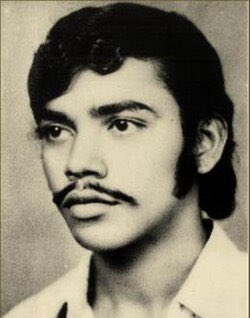
His name was Rajan.
He was a final year engineering student at the Regional Engineering College in Calicut, Kerala. His father, T V Eachara Varier, was a Hindi professor at the Government Arts and Science College in the same city.
On the morning of March 1 1976 the police came to the college campus and took Rajan away.
India was under Emergency. Civil liberties were suspended. Courts had effectively turned away.
His father found out the next day from the college principal.
He went to every police station in the district. No one admitted to having his son.
He met the Home Minister of Kerala, K Karunakaran, directly.
He sent petitions to the Home Secretary of the Government of Kerala three times. Not a single reply or acknowledgement came.
He wrote to the President of India and the Home Minister of the central government, with copies to every Member of Parliament from Kerala.
Nothing.
What Eachara Varier did not know at the time was that his son had been taken to an illegal police interrogation camp at Kakkayam.
He was tortured.
A practice called uruttal was used, where a heavy wooden log is rolled over the body of the victim.
Rajan died from his injuries. His body was disposed of by the police and was never found.
When the Emergency ended in 1977 Eachara Varier filed a habeas corpus petition in the Kerala High Court.
It was the first such petition filed in Kerala after the Emergency.
He did it without legal training, without political backing, without money.
He had spent everything searching for his son.
The court case slowly unravelled the truth.
It forced K Karunakaran to resign as Chief Minister of Kerala in 1978 when the adverse judgment came.
Rajan’s mother became mentally unstable from the grief. She died in 2000 still not knowing where her son was.
Eachara Varier wrote his memoir, Memories of a Father, which won the Kerala Sahitya Akademi Award in 2004.
In its final lines he wrote, “I don’t close the door. Let the rain lash inside and drench me. Let at least my invisible son know that his father never shut the door.”
He died on April 13 2006. He never found his son’s body.
Rajan was picked up from his college campus on a March morning in 1976. He was never seen again.
Repost this. Some stories must not be allowed to disappear.
If a showroom has only Fiat & Ambassador, will it ever showcase a Ferrari? What if imports of Tesla & Ferrari are banned?
Here's my hypothesis for why our stock market got over inflated. The roots of it lie in RBI's decision to deny higher overseas limit to MFs in 2022. Capital is like water, it must be free to find its level. Huge amounts of capital entered the market in 2022-24 and sloshed around in the same 500 domestic stocks. It provided a lucrative exit to promoters, FIIs & anyone who was already invested in them. Remember 50% of MF investors entered the market after 2021.
They say India is a capital starved country & so we need to hoard it. Yet we trade at huge premiums to other emerging markets even now at 20 PE. Retail capital has become a giant subsidy to promoters & asset managers. It has nowhere else to go!
Our financial services sector is like a showroom with only a few cars & so it keeps selling them. It knows there are better cars, but cannot stock them. So keep buying it yells, keep buying...for the long term...
Now you will say we make really good cars (stocks) and yes we do. But they cannot always be the best & at all prices. Indian investors & MFs must be allowed to look at all the showrooms in the world and make a free choice. If they still choose India, that's great.
@JewsFightBack Don't get confused between Jonathan Netanyahu, nick name 'Yoni', the real hero of Entebbe mission and the elder brother of Bibi ~ Benjamin Netanyahu.
In 458 BC, Rome was on the brink of collapse.
An invading army had trapped the Roman consul and his legion in a mountain pass. Panic spread through the city. The Senate did the only thing they could think of:
They sent messengers to find a 60-year-old farmer plowing his field.
His name was Lucius Quinctius Cincinnatus. He had once been a senator, then lost his fortune paying his son's bail. Now he worked his own four-acre plot just to feed his family.
When the Senate's envoys arrived, they found him sweating behind a plow. They asked him to put on his toga so they could deliver an official message.
The message: Rome was making him dictator. Absolute power. Total command of the army. No checks. No oversight. No term limit.
He accepted.
Within 16 days, Cincinnatus had raised an army, marched out, surrounded the enemy, and forced their surrender. The republic was saved.
He had legal authority to rule for six months. He could have stayed. He could have expanded his power. He could have done what every other ruler in human history did when handed unlimited control.
Instead, he resigned on day 16.
He took off the toga, walked back to his farm, and finished plowing the field he'd left half-done.
Twenty years later, when Rome faced another crisis, they called him back. He was 80 years old. He took command, crushed the conspiracy, and resigned again, this time after just 21 days.
He died poor. On his farm.
2,200 years later, when George Washington was offered a kingship after winning the American Revolution, he refused and went home to Mount Vernon. The reason he was hailed as "the American Cincinnatus" is because Europeans literally could not believe a man who had won would willingly give up power.
King George III, on hearing Washington would resign rather than rule, said: "If he does that, he will be the greatest man in the world."
The lesson isn't that Cincinnatus was humble.
The lesson is that for most of human history, the people most qualified to lead were the ones who didn't want to. And the moment a society starts rewarding those who chase power instead of those who flee from it is the moment the republic begins to die.
Cincinnati, Ohio is named after him.
Most people who live there have no idea why.
Let me explain what just happened today because it deserves so much recognition.
GalaxEye is a Bengaluru startup founded in 2021 by IIT Madras engineers. Today they launched Mission Drishti on a SpaceX Falcon 9. It is India's largest privately built satellite at 190 kg. And it carries a technology that no commercial satellite has ever carried before.
Normal satellites take photos of the Earth using optical cameras. Like your phone camera, but from 500 km up. The problem is obvious. Clouds. Night. Fog. Smoke. If any of these are in the way, the photo is useless. India has monsoon cover for 4 months a year. That is 4 months where optical satellites are partially or fully blind over large parts of the country.
The alternative is SAR. Synthetic Aperture Radar. Instead of taking photos with light, it sends radar waves down and reads what bounces back. Radar goes through clouds, through darkness, through smoke. A SAR satellite can image a flooded village at 2 AM during a cyclone when no optical satellite can see anything.
The problem with SAR is that the images look nothing like photos. They look like grainy black-and-white radar maps. A military analyst or a trained geospatial engineer can read them. A farmer, a disaster response team, or a city planner cannot.
Until today, if you wanted both optical and SAR data for the same location, you needed two different satellites, passing over at different times, at different angles. Then someone had to manually align and fuse the two datasets. Expensive, slow, and the data never perfectly matched because the satellites saw the same spot minutes or hours apart.
GalaxEye put both sensors on one satellite. Optical and SAR, fused into what they call OptoSAR. Three times more information than a single sensor. Processed onboard by an NVIDIA AI chip at 1.8 metre resolution.
Now in practice, during the next cyclone hitting Odisha, one satellite pass gives you a clear image of which villages are flooded, which roads are cut, and which buildings are standing. Day or night. Cloud or clear. In near real-time.
For defence, it means you can monitor a border area 24/7 regardless of weather. For agriculture, it means tracking crop health across an entire monsoon season without a single cloud gap. For infrastructure, it means monitoring construction progress on highways and bridges without waiting for a clear day.
GalaxEye tested their SAR tech on ISRO's POEM orbital platform. The satellite was tested at ISRO facilities. IN-SPACe provided regulatory clearance. NSIL, ISRO's commercial arm, will distribute the imagery globally. And it launched on SpaceX because ISRO's PSLV doesn't have the right orbit slot for this mission.
Yes, four IIT Madras graduates built a world-first satellite in 4 years in Bengaluru.
Take a bow!
His name was V Rajaraman.
Born in 1933 in Erode, Tamil Nadu. Most Indians have never heard his name. Every Indian IT professional owes their career to him.
He studied physics at St Stephens College Delhi, then engineering at IISc Bangalore. Won a government scholarship to MIT. Got his PhD in 1961.
The world wanted him. He came back.
In 1963, a massive IBM 1620 computer arrived at IIT Kanpur. It was so large they had to break down a wall to bring it inside. It came on a bullock cart.
Rajaraman stood next to it and asked one question nobody else was asking.
What if India taught this as a subject.
In 1965, he launched India’s first Computer Science academic programme at IIT Kanpur. His first batch had 20 students. One of them was Narayana Murthy, who went on to build Infosys.
He designed the MCA programme that opened IT careers to an entire generation of Indian graduates. He chaired the committee that created C DAC to build India’s first indigenous supercomputers.
He authored 23 textbooks. Guided 30 PhD students. Won the Padma Bhushan in 1998.
He passed away on November 8, 2025. Aged 92.
India’s IT industry is worth 250 billion dollars today. He built the classroom it started in.
It was surprising to read and know about this great personality ....
Elon Musk didn't study rocket science.
He read textbooks on rocket science.
Then he called Russian rocket engineers to buy missiles. They quoted him $8 million per rocket.
He flew home, opened a spreadsheet, and calculated the raw material cost of a rocket from scratch.
It was 3% of what they quoted him.
SpaceX was born from that spreadsheet.
Here's the 7-prompt system that replicates how he thinks:
The tweet about aliens 2,000 light years away seeing the Roman Empire is wrong, and the actual physics is stranger. To see one person on Earth from that distance, you'd need a telescope wider than the distance from the Sun to Pluto. That's 50 times farther than Earth is from the Sun. No civilization can build that, ours or theirs.
It sounds like exaggeration, but the math requires it. By the time light from a person on Earth reaches a planet 2,000 light years away, it has spread across so much empty space that catching enough to form an image would need that solar-system-sized lens. The geometry doesn't bend, no matter how clever the engineering.
A SETI Institute team led by Sofia Sheikh worked all of this out in February 2025. Our loudest signal is planetary radar, the focused radio beams scientists fire at asteroids and planets to map them. Beams from the now-collapsed Arecibo dish in Puerto Rico could reach 12,000 light years away, about a tenth of the way across the galaxy. After that comes radar leaking from airports and military bases. A giant ground antenna like the Green Bank dish in West Virginia could detect those signals from around 200 light years out, roughly the distance to a few thousand of our nearest stars. A next-gen NASA telescope still in development could spot air pollution like nitrogen dioxide from factories and cars at 5.7 light years away. That puts Proxima Centauri, our nearest star at 4.2 light years, just inside the range. City lights at night go dark past the icy outer shell of our solar system, around 2,300 times the Earth-Sun distance.
The famous "I Love Lucy" idea is also wrong. The story goes that aliens are watching our 1950s sitcoms because the broadcasts are still spreading through space. Astronomer Seth Shostak crunched the numbers years ago. A radio antenna the size of a city, sitting 55 light years away, couldn't pick that signal up. Not even close. At that range, the broadcast is a million times weaker than what the antenna can pick out of the background noise. Old TV signals fade out within the first light year of travel.
So at 2,000 light years away, an alien civilization with our level of technology would see Earth as a tiny dot of light next to the Sun, with hints of oxygen, methane, and maybe some industrial pollution in its atmosphere. They'd see weather. They might guess that something living is here from the chemistry. Continents, cities, individual humans, the Roman Empire, single events: none of those would be visible. The information was lost within a few light years of leaving Earth, well before reaching the closest star.
We're loud to anyone within 200 light years. Past that, we go silent. That signal bubble has only existed for 75 years, so the actual sphere of civilizations that could know we exist is small. And it's getting smaller. Television broadcasts are dying. Satellites use tight focused beams aimed at receivers on the ground, not the sky. Earth's window of being a noisy planet may already be closing.
Behind that ranger sits part of 105 tonnes of ivory worth roughly $150 million on the black market. Days after this photo, Kenya soaked the lot in jet fuel and burned it. Critics warned it would backfire. A decade on, ivory prices have crashed and poaching is at a 20-year low.
The piles held the tusks of around 7,000 elephants and the horns of 343 rhinos. It was the biggest ivory burn in history. The full stockpile was about 5 percent of all the ivory sitting in African government storerooms at the time. Kenya's entire annual environment budget was smaller than what they were about to set on fire.
The argument against burning was simple. Cut the supply, push up the price, poachers come back harder. One conservation economist compared the move to Iraq going offline during the Iran-Iraq war, when oil prices spiked. Burn $150 million of ivory and the same shock should hit.
None of that happened. Raw ivory in China peaked at around $2,100 per kilogram in 2014. Then Kenya burned its stockpile in April 2016, China shut its legal ivory market in December 2017, and similar bans rolled through the US, Europe, and elsewhere. The price broke. By 2020, the going price across Africa had fallen to about $92 per kilogram. In Kenya specifically, what a poacher could get for a kilo of raw tusk dropped from $190 in 2014 to $52 by 2018. Inside China, the share of people saying they would ever buy ivory fell from 43 percent before the ban to 18 percent by 2020.
The bet was based on an old number. A 2014 Sheldrick Wildlife Trust study found that one live elephant brings in around $23,000 a year in tourism revenue. Across a 70-year lifespan, that is roughly $1.6 million. Its tusks, ripped out, sell for around $21,000. That is the 76-to-1 ratio that gets thrown around in conservation circles. Kenya runs around 10 percent of its economy on tourism today, almost all of it built around live wildlife.
The numbers since have backed the call. The UN's 2024 wildlife crime report says the global ivory market is shrinking, with seizures and poaching both down. A 2024 Colorado State study found African elephant numbers fell 77 percent on average between 1964 and 2016. After 2016, things turned. Forest elephant decline slowed from 7 percent a year to under 1. Savanna elephant poaching is at its lowest level since global tracking started in 2003.
The ranger in this photo is guarding ivory Kenya was about to destroy on purpose. Within four years, the market for what he was guarding had collapsed.
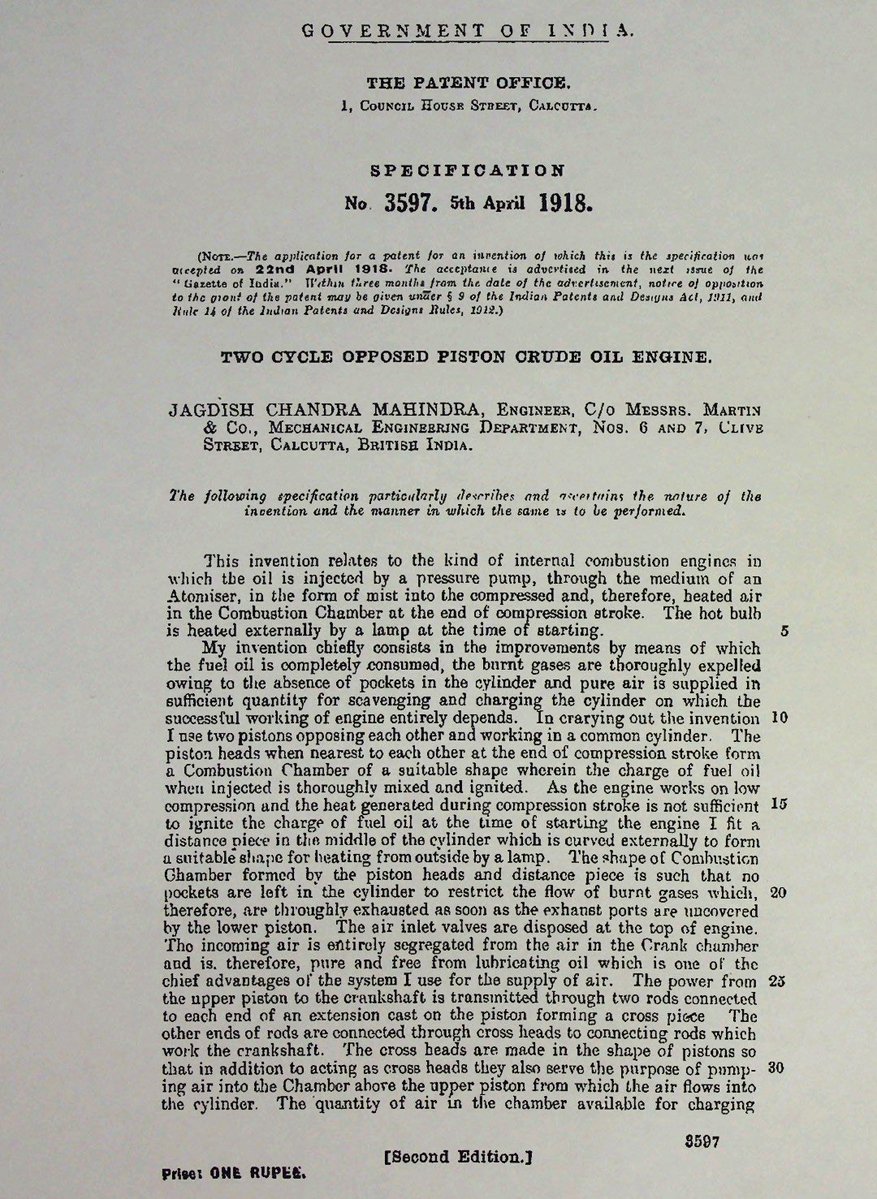
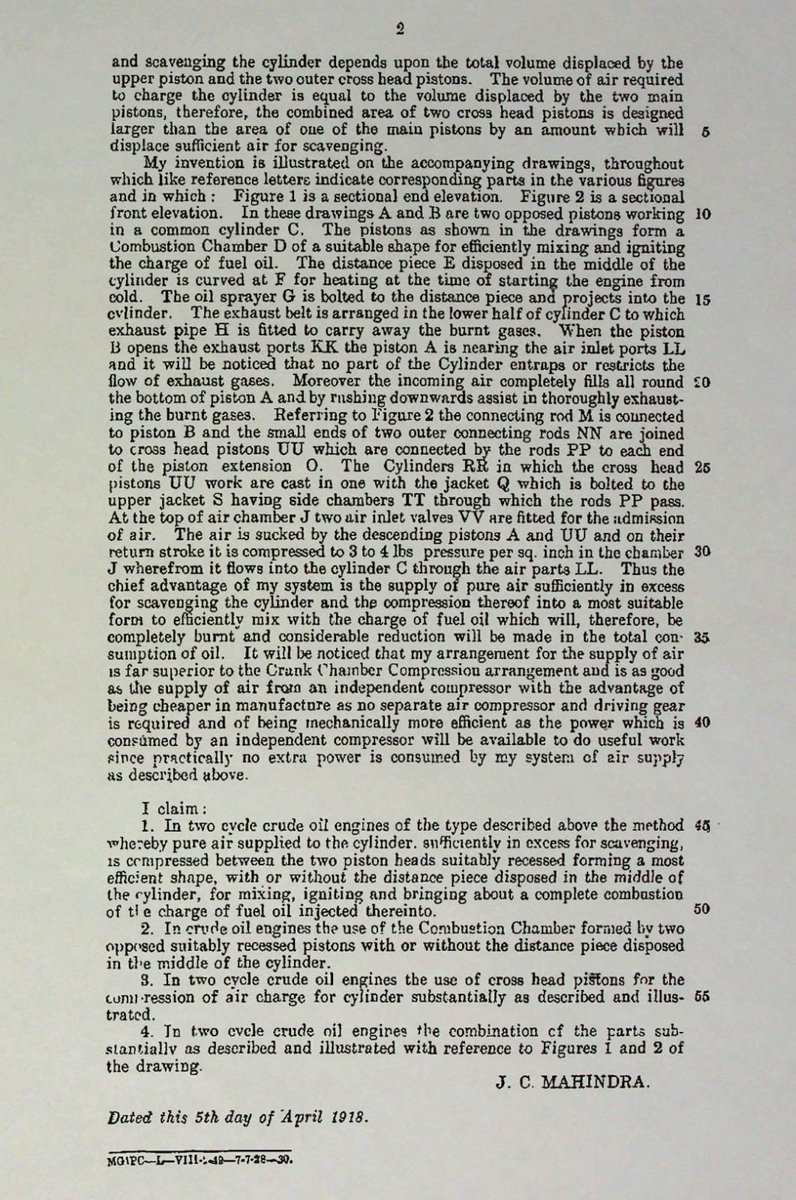
My grandfather, J.C. Mahindra, trained as an engineer at Veermata Jijabai Technological Institute, Mumbai, & the large part of his subsequent career was in the steel industry, including a stint working at Tata Steel.
During World War II, he went on to serve as India’s first Iron & Steel Controller, building relationships across global mills. Those connections later helped him and his brother, K.C. Mahindra, build a trading business that evolved into manufacturing, bringing in Willys Jeeps and International Harvester tractors to India.
Growing up, I would occasionally hear my father and uncle refer to J.C. as a “tinkerer”… someone who had even held a patent.
But it was always vague, never quite part of the Group’s folklore.
Perhaps that’s not surprising. For decades, we hadn’t systematically organised our archives and memorabilia.
Yesterday was World Intellectual Property Day.
Last week, Vaidehi Mayekar, Senior Manager at our company, who is helping organise the archives, sent me a mail in the context of the forthcoming World IP Day.
While going through all the random boxes of files & memorabilia, she had come across a document about a patent filed by J.C. in 1918… and assumed I would already know.
I didn’t.
And when I learned it was in internal combustion engine technology, I was genuinely stunned.
It may not have been a seminal or earth-shaking patent, but somehow, that part of his story had slipped through the cracks of family narratives.
At the very least, it ought to have been a strong part of the institutional ‘memory’ of a Group that makes automobiles.
Thank you Vaidehi , for giving me a renewed sense of pride & a fresh dose of motivation from my grandfather.
I hope it also gives engineers across the group the motivation to continue a legacy of innovation.
#MondayMotivation
Every time a German Messerschmitt pilot wanted to escape a Spitfire on his tail, he did the same thing.
He pushed the nose down.
In a dive, the German engine kept running — it used fuel injection. The British Spitfire's engine cut out. For one and a half seconds the Merlin went dead, the aircraft shuddered, and by the time it caught again the German was gone. Worse: if a German was behind a British pilot and the British pilot dove to escape, the German could follow and keep shooting while the British engine was silent.
Pilots were dying because of a carburetor.
The engineers at Farnborough knew about the problem. They were working on a long-term solution — a redesigned carburetor that would take years to perfect and manufacture.
A woman named Beatrice Shilling fixed it with a washer.
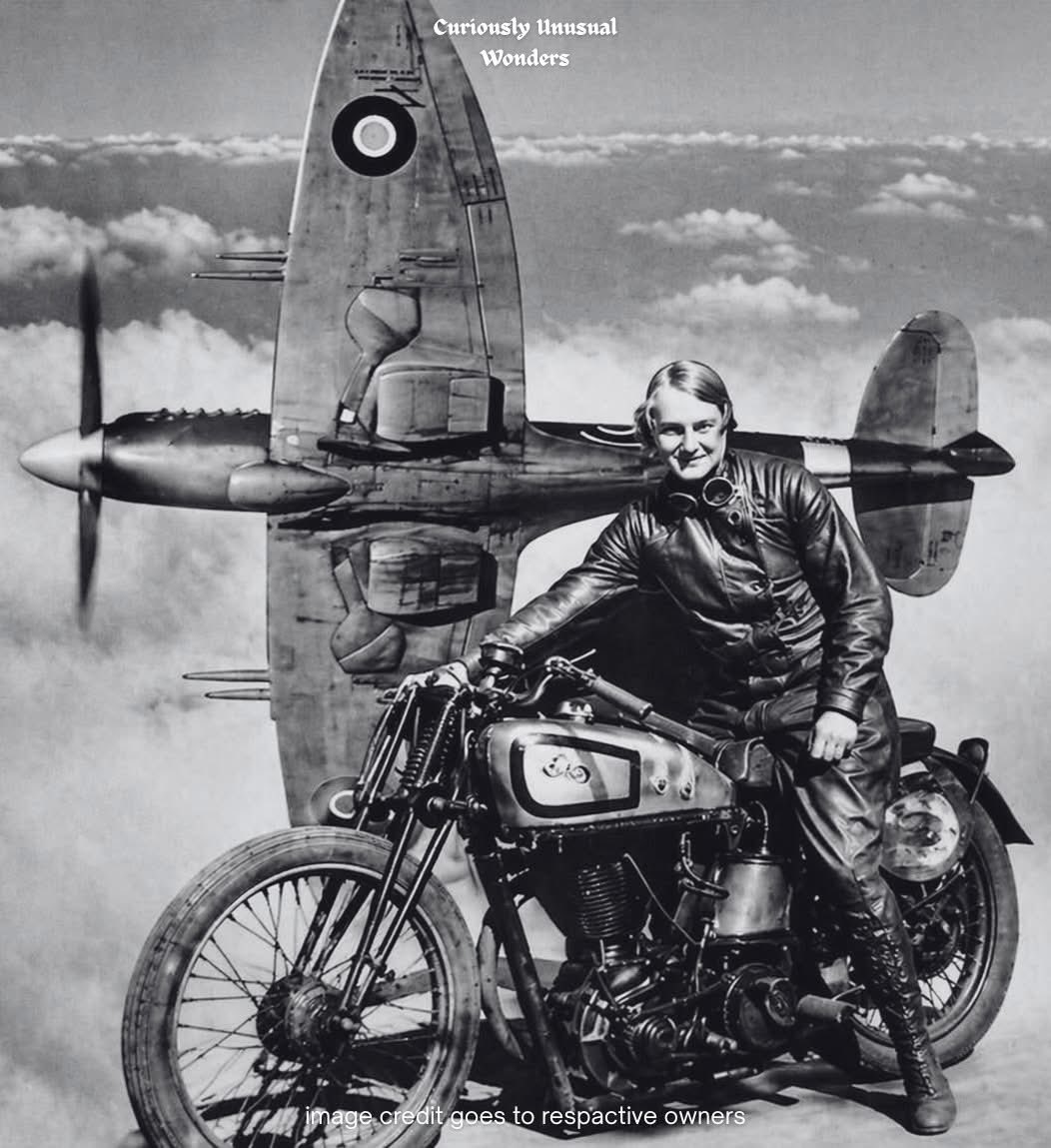
She was born in Hampshire in 1909 and was the kind of child who spent her pocket money on Meccano sets and tools. At fourteen she bought her first motorbike. Her mother, with the inspired instinct of someone who understood what her daughter actually was, found the Women's Engineering Society and arranged an apprenticeship at an electrical firm.
She went to Manchester University — one of the first two women ever to study engineering there — graduated with a degree in electrical engineering, stayed another year for a master's in mechanical engineering, and in 1936 joined the Royal Aircraft Establishment at Farnborough as a scientific officer.
By the late 1930s she was one of the best carburetor engineers in Britain. She was also one of only three women to hold the British Motorcycle Racing Club's Gold Star — awarded for lapping the Brooklands racing circuit at over 100 miles per hour on a motorcycle.
She had reportedly told her future husband, an engineer named George Naylor, that she wouldn't marry him until he earned his own Brooklands Gold Star first.
He earned it. They married in 1938.
The problem with the Merlin was specific and lethal. The SU carburetor used a float chamber to regulate fuel flow. Under negative g-forces — the forces experienced in a sudden dive — the fuel flooded to the top of the float chamber and starved the engine for 1.5 seconds. Just enough time for a German pilot to turn the tables entirely.
The RAF had known about this since the Battle of France. The formal solution — a redesigned pressure carburetor — was in development but wouldn't be ready for years.
Shilling was thirty-one years old, working in carburetor research, and she designed a fix in weeks.
A brass thimble with a precisely calibrated hole in the center — later simplified to a flat washer — fitted inline in the fuel line just before the carburetor. It restricted maximum fuel flow to just enough to prevent flooding without cutting off power. The key breakthrough: it could be fitted without taking the aircraft out of service. No downtime. No factory return.
The old guard at the RAE looked at it and called it a plumbing fix. They called her a plumber. The first batch of 5,000 units was made by a Birmingham firm that normally manufactured plumbing fixtures, which they found embarrassing.
The RAF pilots who flew Spitfires with Messerschmitts on their tails called it something else.
They called it Miss Shilling's Orifice. With deep affection.
By March 1941 she had organized a small team and was personally touring RAF fighter stations across England — traveling between bases on her old racing motorcycle — fitting the device to every Merlin engine they could reach. Squadron leaders all over the country were demanding installations. The word spread faster than the official channels could keep up with.
The Germans noticed. They couldn't explain why British fighter pilots had suddenly started following them into dives. They were baffled by the new aggression. They didn't know about the washer.
(More story replies)
When God has a plan…
From selling bhatura chole at Vivek Public School in 1989,
to opening Lawrence Garden Banquet from the back of my house in Amritsar in 1990.
In 1991, I chose culinary arts—
a decision that embarrassed almost everyone except my grandmother.
There were years of humiliation I rarely speak about.
Moments that nearly broke me.
In 2000, when my banquet was torn down, I almost gave up.
Instead, I moved to the United States and started over.
Cleaning homes.
Selling food on the streets of TriBeCa.
Sleeping at Grand Central.
Experiencing homelessness at NYC Rescue.
Sleepless nights.
Being called “Curry Boy” on the 7 train.
And still, I kept going.
From there…
8 Michelin stars.
Then losing myself again.
Then starting over—one last time as a promise to my sister—with Bungalow.
And now…
TIME100 Most Influential People in the World 2026.
I’m still trying to process it.
The journey continues.