Acquiring foundational site details usually means traveling to sites, finding utility access points, and tracking down disparate data sources. Google Earth is changing the way professionals work. https://t.co/Gk3eDMQ4IN
New AI-powered data layers in Google Earth pull from billions of Google Street View images to map infrastructure assets like fire hydrants, storm drains, and more. Plus, when combined with new building footprints and land parcels you have powerful, time-saving data a click away.
Inspecting utility access and site constraints from anywhere is now even easier with Google Earth.
These layers are now available for Professional & Professional Advanced customers on web and Android, with coverage expanding over the coming weeks.
The main reason more so-called "missing middle" housing doesn't get built:
In most states (including CA), there is little regulatory distinction between a 5 unit building and a 500 unit building.
Despite posing 1/100 of the risk, the 5 unit building is required to have the same sprinklers, same actively monitored fire panel, same elevator(s), etc.
But, obviously, the 5 unit building has many fewer units across which to amortize these costs, leading to higher cost per unit to construct and structurally lower operating margins.
If you want more "missing middle" housing, pressure building regulators to take a risk-based approach to regulation: The smaller the building, the fewer the regs.
@ArfTard@TaupeAvenger Heard that. The row house neighborhoods aren’t influenced by the height limit. I actually think downtown DC could use a bit more intensity. But row house DC is optimal density supporting walkable neighborhoods and transit while still giving everyone a (tiny)yard.
@patcarino I took her in to “simchas mall” when it opened. I wanted to show her my elevator from the basement through water street to the top of the project. She was so disappointed i bought a sweater from HM instead of bloomies. The end.
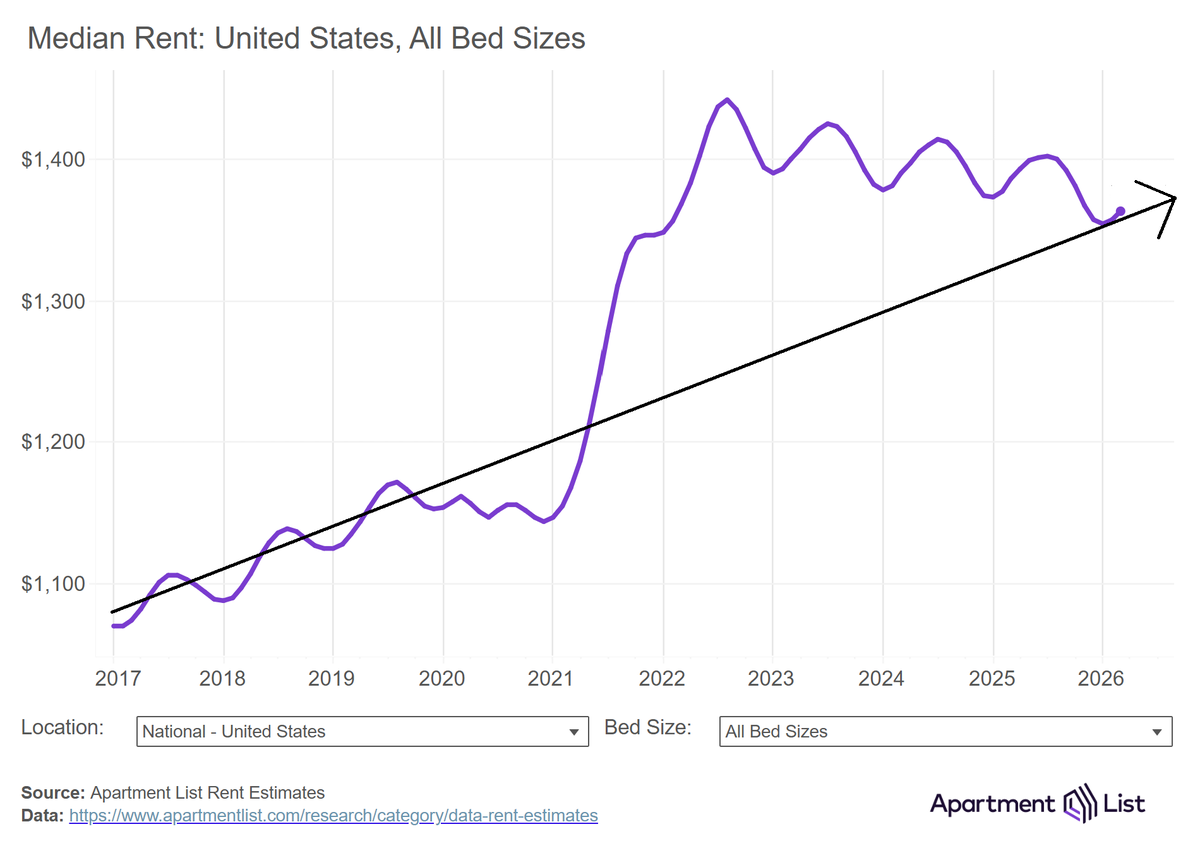
The normalization of apartment rents back to their pre-Covid trendline of ≈3% annual growth is an underreported story. The combo of stimulus, wealth effect, home officing, and desire to ditch roommate in 2021 created massive demand shock. It just took time to build new supply.