Finally, Serpens still has a few surprises 👀 We identify two protoplanetary disks with very large inner cavities (~90 au), including one with a strong asymmetry. What created these structures? We still don’t know.
Our new disk survey of the Serpens star-forming region is out! 🎉 We studied >300 disks to investigate how their evolution is affected by the local stellar environment.
With @NienkeMarel , Jonathan Williams and Alexa Anderson.
https://t.co/tIqzBbA5aX 🧵 (1/N)
Their lack of Gaia detections, strong 2D clustering, and low masses may indicate young, embedded systems whose disks experienced strong tidal truncation earlier in their evolution. (9/n)
In Ophiuchus, the low dust masses are mainly driven by sources without Gaia memberships, and this cannot be simply explained by the stellar mass dependence. (8/n)
Disks in Ophiuchus and Corona Australis appear unexpectedly low in dust masses for their young ages (Cazzoletti+2019; Williams+2019). However, when we only consider high-confidence members identified by Gaia, their dust masses are broadly consistent with their ages. (7/n)
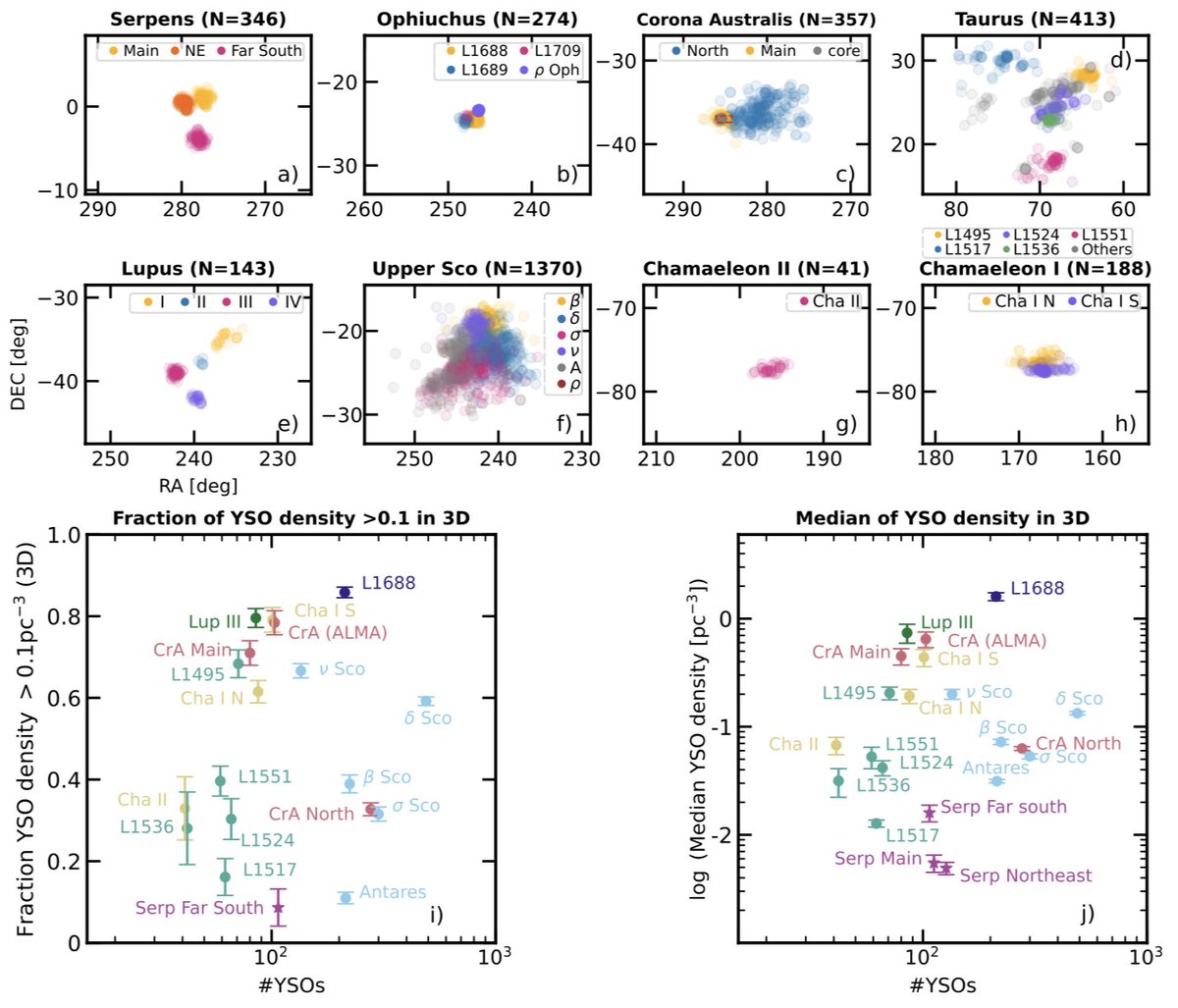
Beyond Serpens, we find that Ophiuchus is genuinely very dense, while the major region of Corona Australis is also relatively dense given its relatively old age (>5 Myr; Esplin & Luhman 2022). (6/n)
Serpens is extended along the line of sight, so converting from 2D to 3D substantially lowers its inferred density. Even accounting for missing members is unlikely to make Serpens dense enough for stellar encounters to strongly affect its disks. (5/n)
We revisited the stellar densities of nearby star-forming regions using Gaia distances for individual stars. This allows us to measure their 3D stellar densities, rather than the projected 2D surface densities. We find that Serpens is much less dense in 3D. (4/n)
But our survey, along with the earlier study led by Alexa Anderson, finds that the dust disk masses in Serpens are similar to those in Lupus and Taurus, two young regions with much lower stellar densities (Fig 6 in Anderson+2022). So, is Serpens really that dense? (3/n)
@NienkeMarel Serpens has long been considered denser than many nearby young star-forming regions (e.g. Megeath+2016, their Fig. 15). Such high stellar densities could lead to more frequent encounters between star–disk systems, potentially truncating disks and reducing their dust masses. (2/n)
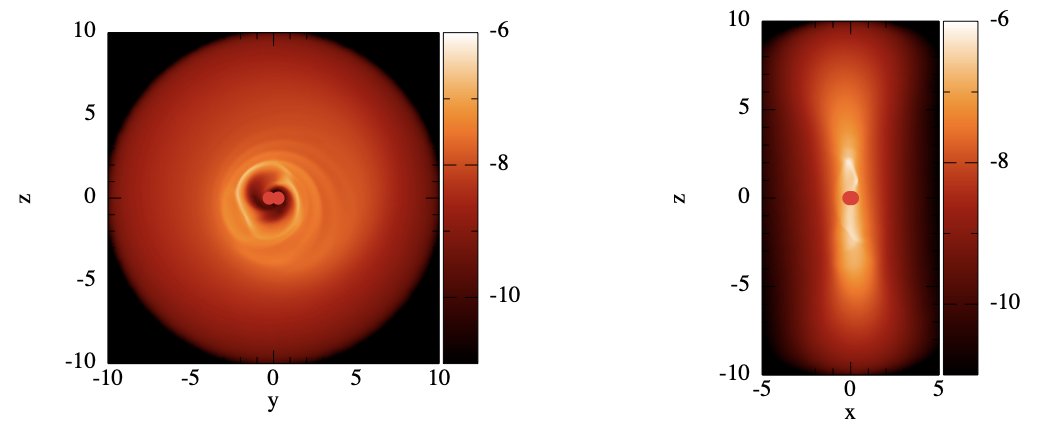
New paper! In work led by Cheng Chen, we show that polar aligned circumbinary disks (which, perhaps surprisingly, are known to be stable configurations for eccentric binaries) are quite efficient at driving binary inspiral.
https://t.co/SgraNiVe2F
Thomas Pfeil and I are organizing a workshop on Hydrodynamic and Dusty Turbulence in Protoplanetary Disks @FlatironInst in New York, Feb 23-35 (2026). Details, and a short form to express interest in attending, at the link below:
https://t.co/4Sq2aDrvCk
Our new paper, in collaboration with Richard @r_d_alexander , is out today 🥳! We propose a new mechanism for forming radially compact protoplanetary discs, which are common in ALMA star-forming region surveys. 🧵1/n
https://t.co/FQJEzHRNxO
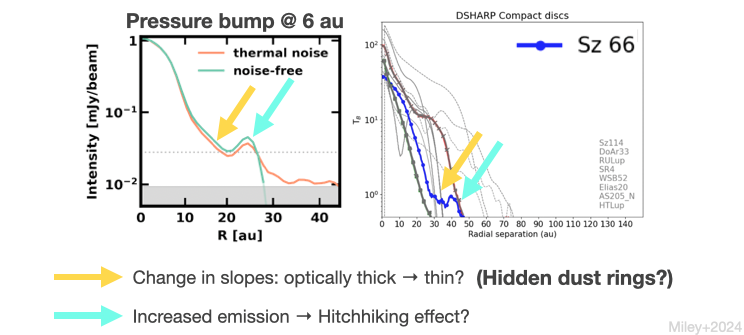
Synthetic observations from our models, are strikingly similar to real ones (e.g. Sz 66 in Miley+2024). Changes in radial intensity slopes may trace an unseen dust ring. The outermost increased emission may trace the “hitchhiking effect,” caused by sharp gas density drops.🧵3/n