Food for thought!
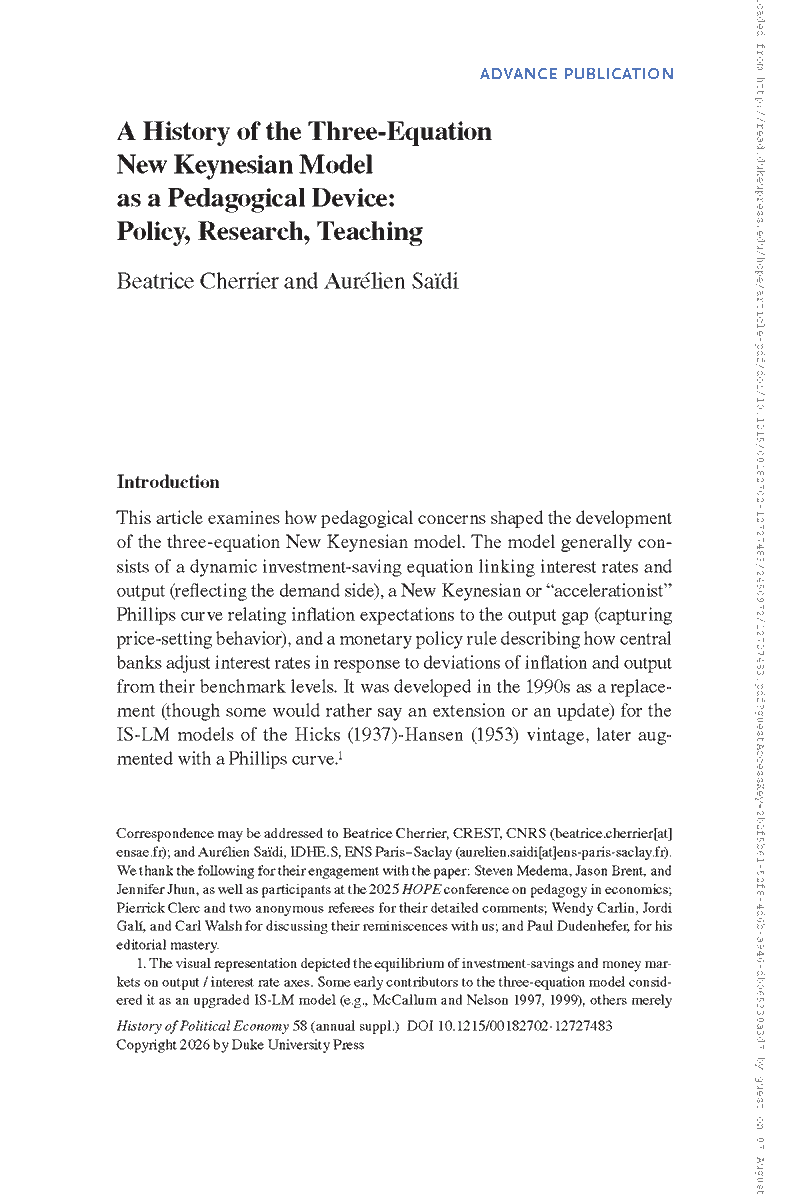
"A History of the Three-Equation New Keynesian Model as a Pedagogical Device: Policy, Research, Teaching" by Beatrice Cherrier and Aurélien Saïdi.
"This article examines how pedagogical concerns shaped the development of the three-equation New Keynesian model, which became the dominant framework for teaching and evaluating monetary policy from the 1990s onward. Contrary to the standard narrative, the model did not originate in classrooms or academic journals but in central bank workshops. We show that the many macroeconomists who proposed small models in the 1990s simultaneously targeted researchers, policymakers, and students, pursuing a common set of epistemic virtues: simplicity, realism, and consistency. They tried to accommodate recent advances in expectations modeling and price-setting modeling, to assess theoretically and empirically worldwide shifts in monetary policymaking, and to equip students with a sense of these mechanisms and dynamics. These virtues were negotiated differently across spheres, particularly in the transition from equation-based policy models to diagrammatic classroom representations, illuminating the porous boundary between education, research, and policymaking in modern macroeconomics."
https://t.co/VoxbdafuvM
Very valuable!
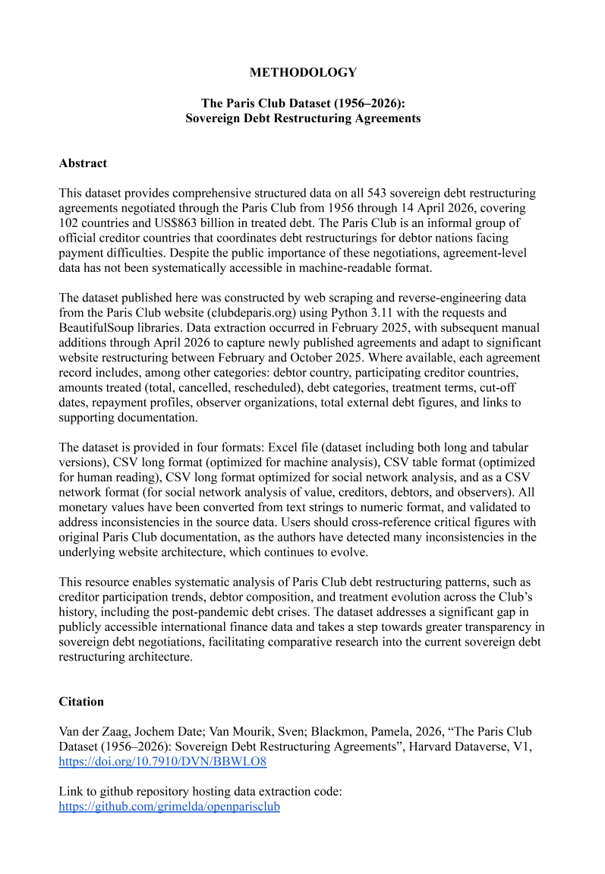
"The Paris Club Dataset (1956–2026): Sovereign Debt Restructuring Agreements" by van der Zaag, Jochem Date; van Mourik, Sven; Blackmon, Pamela.
"The Paris Club Dataset 1956–2026 provides structured, agreement‑level data on all known sovereign debt restructuring agreements negotiated through the Paris Club of official creditors between 1956 and April 2026, covering 543 agreements by 102 debtor countries and approximately USD $863 billion in treated debt. The dataset was constructed by systematically scraping and reverse‑engineering the Paris Club’s official website (https://t.co/b4PNya2Spk), followed by extensive manual cleaning, completion of missing agreements, and validation of monetary amounts and links in response to major website changes in 2025."
https://t.co/okkJeeBaTv
Highly relevant!
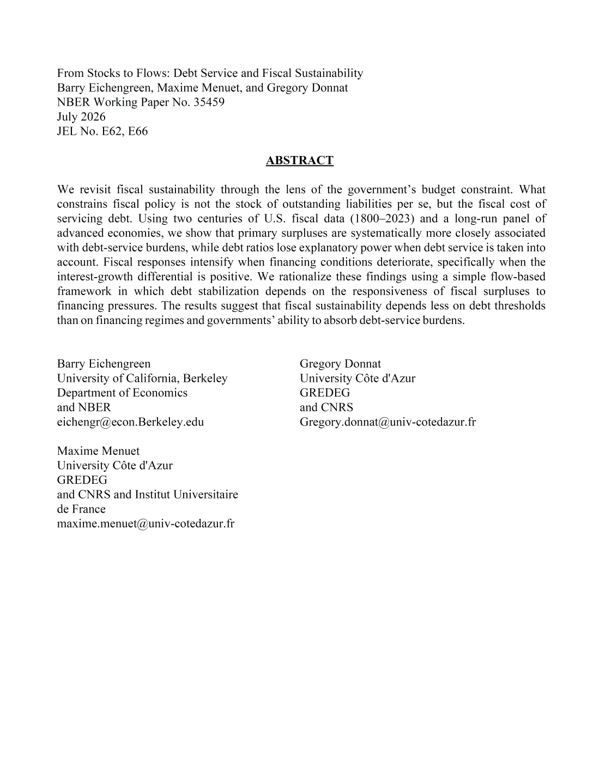
"From Stocks to Flows: Debt Service and Fiscal Sustainability" by Barry Eichengreen, Maxime Menuet, and Gregory Donnat.
"We revisit fiscal sustainability through the lens of the government’s budget constraint. What constrains fiscal policy is not the stock of outstanding liabilities per se, but the fiscal cost of servicing debt. Using two centuries of U.S. fiscal data (1800–2023) and a long-run panel of advanced economies, we show that primary surpluses are systematically more closely associated with debt-service burdens, while debt ratios lose explanatory power when debt service is taken into account. Fiscal responses intensify when financing conditions deteriorate, specifically when the interest-growth differential is positive. We rationalize these findings using a simple flow-based framework in which debt stabilization depends on the responsiveness of fiscal surpluses to financing pressures. The results suggest that fiscal sustainability depends less on debt thresholds than on financing regimes and governments’ ability to absorb debt-service burdens."
https://t.co/i2FsO6nc8b
In the spirit of no more forward guidance from the Fed, you will be happy to know that members of the Fed are speaking 14 times next including twice for Warsh speaking on Capitol Hill. We also get the Fed Beige book next week.
Thankfully, its the last week before Fed blackout
Super interesting!
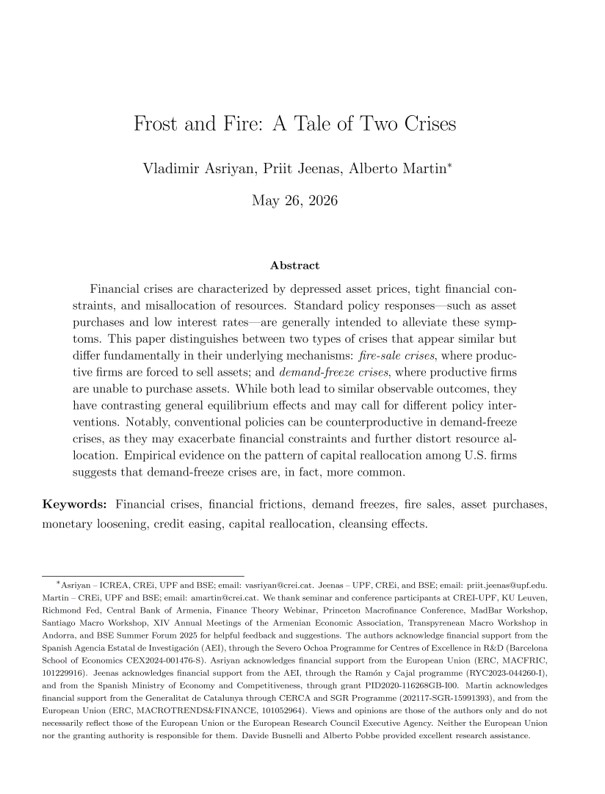
"Frost and Fire: A Tale of Two Crises" by Vladimir Asriyan, Priit Jeenas, and Alberto Martin.
"Financial crises are characterized by depressed asset prices, tight financial constraints, and misallocation of resources. Standard policy responses—such as asset purchases and low interest rates—are generally intended to alleviate these symptoms. This paper distinguishes between two types of crises that appear similar but differ fundamentally in their underlying mechanisms: fire-sale crises, where productive firms are forced to sell assets; and demand-freeze crises, where productive firms are unable to purchase assets. While both lead to similar observable outcomes, they have contrasting general equilibrium effects and may call for different policy interventions. Notably, conventional policies can be counterproductive in demand-freeze crises, as they may exacerbate financial constraints and further distort resource allocation. Empirical evidence on the pattern of capital reallocation among U.S. firms suggests that demand-freeze crises are, in fact, more common."
https://t.co/LWTJHpW7P3
That sagging feeling across assets is the drag from supply and it's just getting started.
As a reminder, financial asset prices in aggregate peaked on the 85bln Google equity issuance announcement.
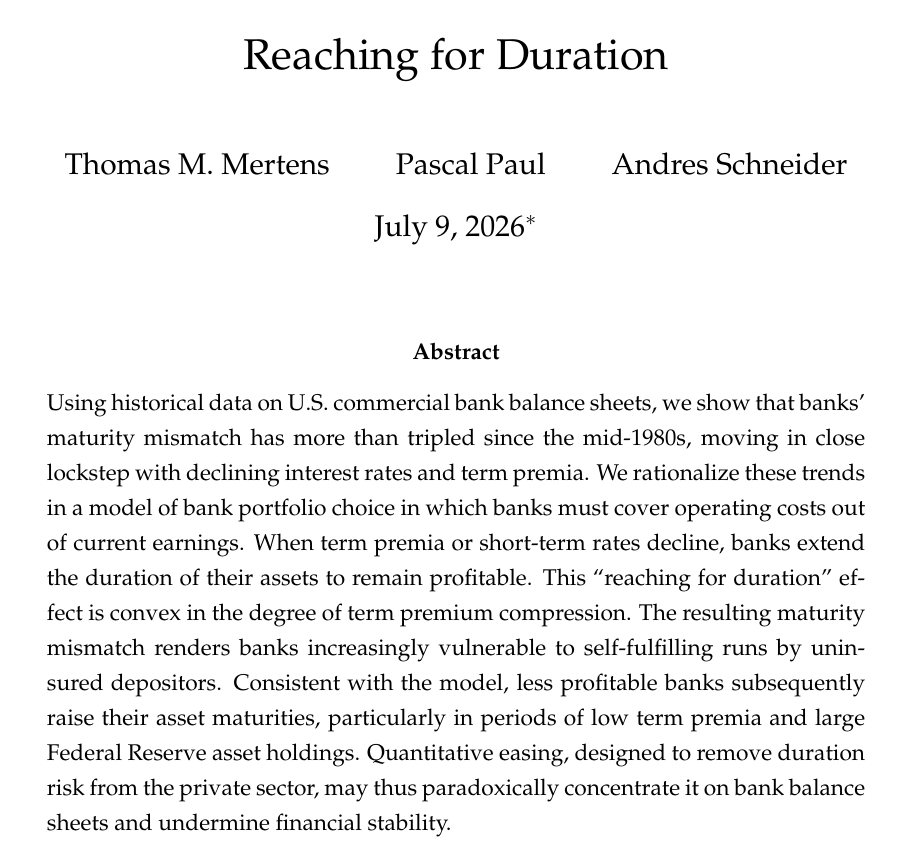
New paper: "Reaching for Duration" (with @ThomasMMertens & Andres Schneider).
Why do banks load up on long-term assets exactly when interest rates & term premia are low—and what does QE have to do with it?
A thread. 1/12
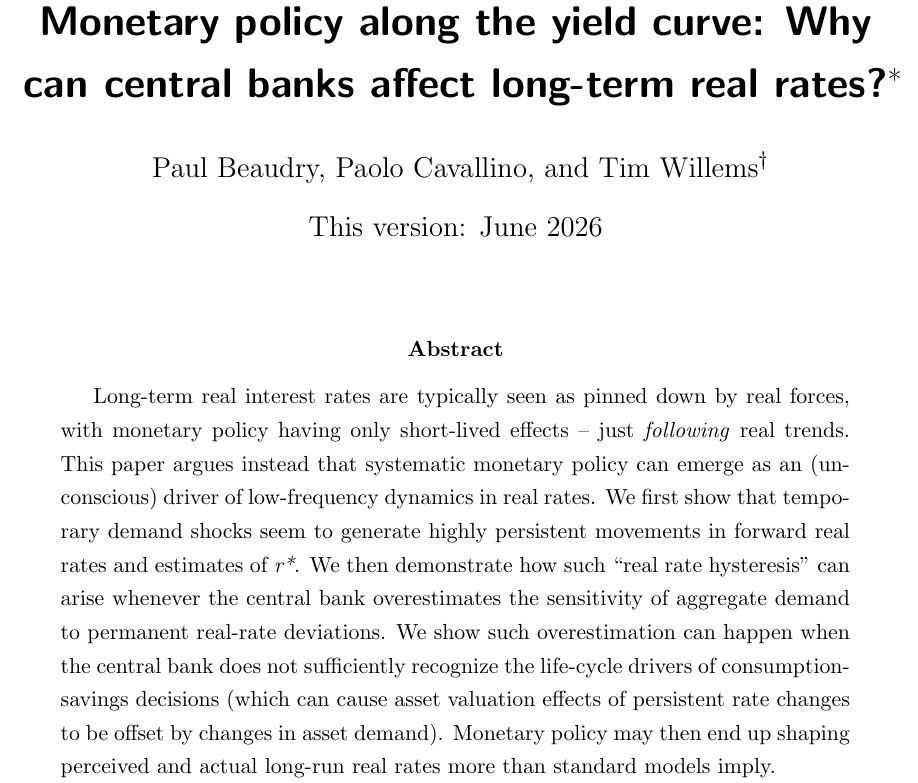
Excited to be presenting a revised version of "Monetary Policy Along the Yield Curve" in the Macro, Money and Financial Frictions session of the NBER Summer Institute next Weds, July 13 (14:40 EST).
FIFA warning: there will be a VAR (but results are robust to LP)
1/4
Interesting paper by UCL's Mariana Mazzucato in which she argues that in Europe, "for two decades, capital has been abundant and cheap, and corporate profits strong; yet investment, productivity, and wages have stalled."
https://t.co/X9WW3ELrNf
When term premiums go up, banks lend MORE. We formalize this in a dynamic bank portfolio model & test it using the 2013 Taper Tantrum. Finding: QE's term premium compression may dampen bank lending, working against monetary policy stimulus goals. https://t.co/LHv4obrSmR
Great news!
The Global Macro Database has been updated
"The 2026_06 update adds 39 new historical and country-level sources, bringing the database to 160 sources, extends automated error monitoring, resolves dozens of data-quality issues, and improves the Stata, R, and Python packages."
https://t.co/xBMXCjgnUW
Super interesting!
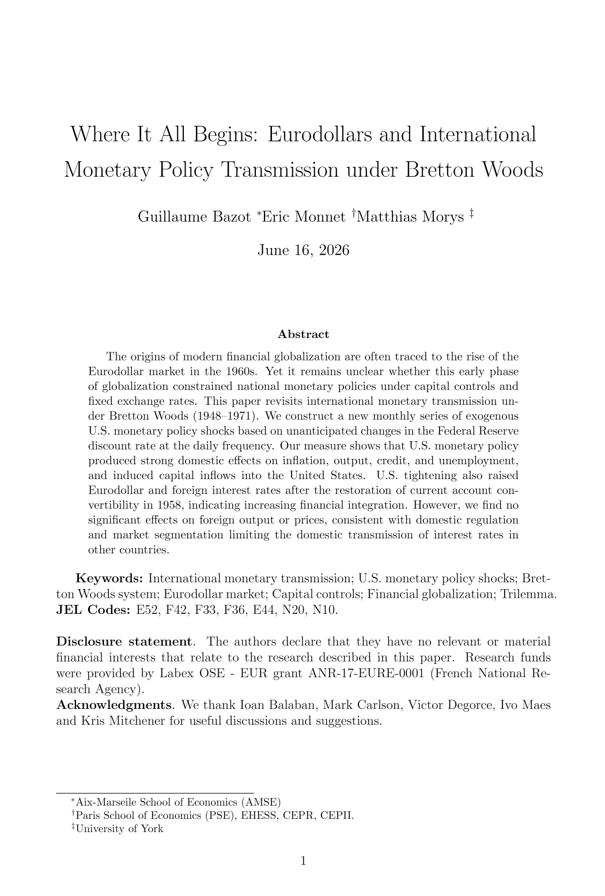
"Where It All Begins: Eurodollars and International Monetary Policy Transmission under Bretton Woods" by Guillaume Bazot, Eric Monnet, and Matthias Morys.
"The origins of modern financial globalization are often traced to the rise of the Eurodollar market in the 1960s. Yet it remains unclear whether this early phase of globalization constrained national monetary policies under capital controls and fixed exchange rates. This paper revisits international monetary transmission under Bretton Woods (1948–1971). We construct a new monthly series of exogenous U.S. monetary policy shocks based on unanticipated changes in the Federal Reserve discount rate at the daily frequency. Our measure shows that U.S. monetary policy produced strong domestic effects on inflation, output, credit, and unemployment, and induced capital inflows into the United States. U.S. tightening also raised Eurodollar and foreign interest rates after the restoration of current account convertibility in 1958, indicating increasing financial integration. However, we find no significant effects on foreign output or prices, consistent with domestic regulation and market segmentation limiting the domestic transmission of interest rates in other countries."
https://t.co/pYMgYpBEAO
@ZackEiseman This is basically Wicksell? High interest rates do not curtail investment—they redirect investments from other areas into those projects with the highest anticipated future rate of return, and current prices are an important signpost that guides such anticipations?
Great Books for Summer or Winter Reading!
"Monetary Economics and Policy: A Foundation for Modern Currency Systems" by Pierpaolo Benigno.
https://t.co/ZAXyl66fmf
"Over the past two decades, monetary policy has been deployed in unprecedented ways, as central banks attempted to mitigate the adverse consequences of the 2007–2008 financial crisis, the COVID-19 global lockdown, and recent inflationary surges. In Monetary Economics and Policy, Pierpaolo Benigno offers a new way to understand the potency and effectiveness of monetary policy, presenting a unified modeling framework to analyze policy challenges posed by both paper and digital currency systems. He investigates current theoretical and policy controversies, drawing connections with historical themes in monetary economics. Benigno’s novel framework also allows the study of monetary policy normalization through quantitative tightening toward what has become the “new normal.” He discusses the optimal provision of liquidity and the different roles of the government and financial intermediaries. Finally, he recounts historical controversies regarding the inflation-unemployment trade-off to understand the 2020s inflationary surge and delves into the causes and dynamics of hyperinflations, tracing them to the subtle, ambiguous linkages between monetary and fiscal policy and weak balance-sheet conditions for the central bank."
https://t.co/ZAXyl66fmf
Highly relevant!
"Wars, Threats, and the Sovereign Bond Market" by Jonathan Federle, Robin Greenwood, Josefin Meyer, Carmen Reinhart, and Christoph Trebesch.
"We study how wars and military threats affect financial markets. Leveraging more than 300,000 monthly price observations since 1822, we create an external currency bond index for more than 90 countries — the EXBI. Using the EXBI, we document large effects of wars on returns and borrowing costs. In a global external bond portfolio, a one-standard-deviation war shock lowers returns by five percentage points. At the country level, wars at home generate sharp losses and increase default risk. Military threats depress bond prices in threatened states, but not in threatening ones, highlighting their role as a channel for eoeconomic coercion."
https://t.co/DwfmF9hqpE