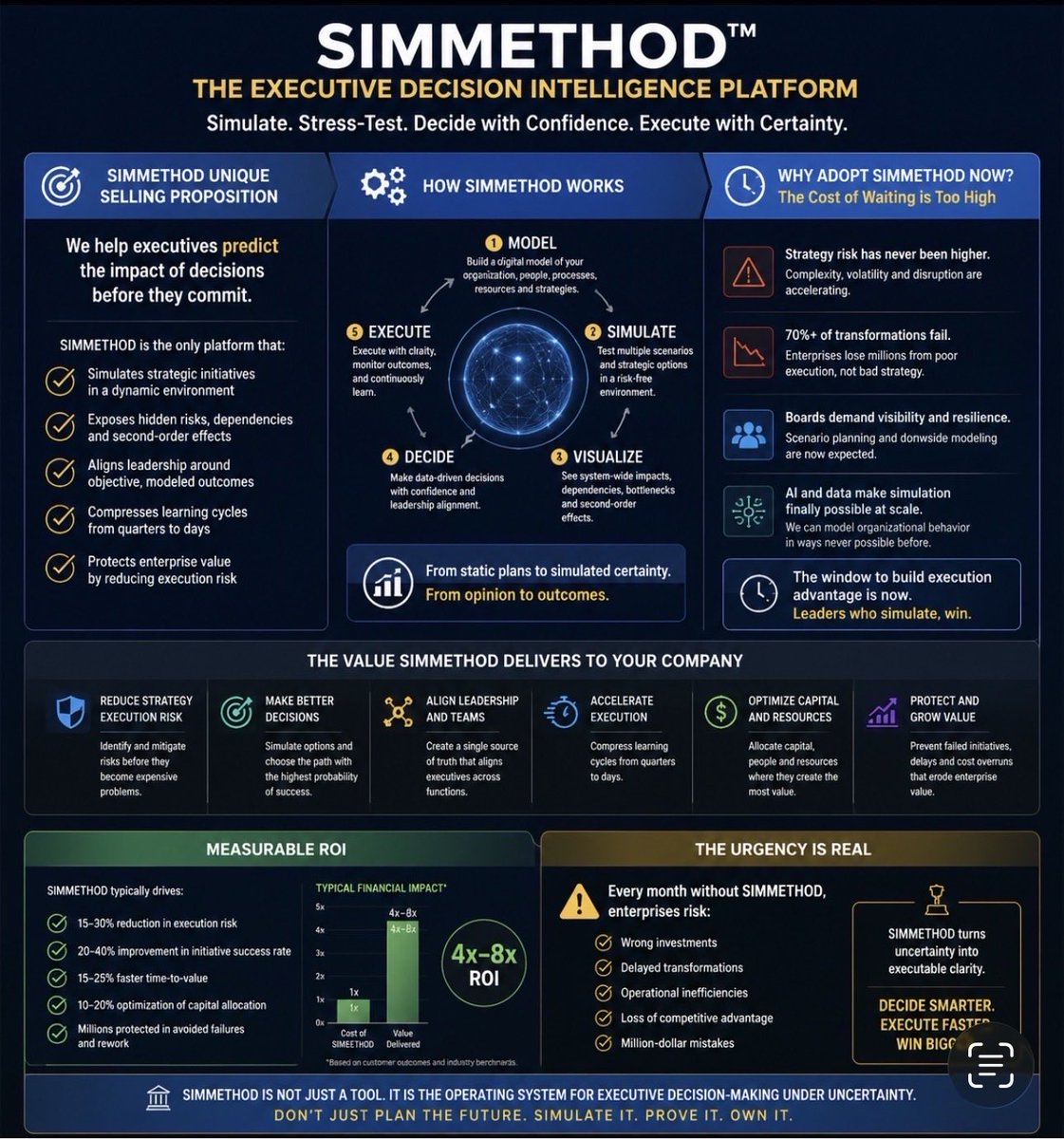
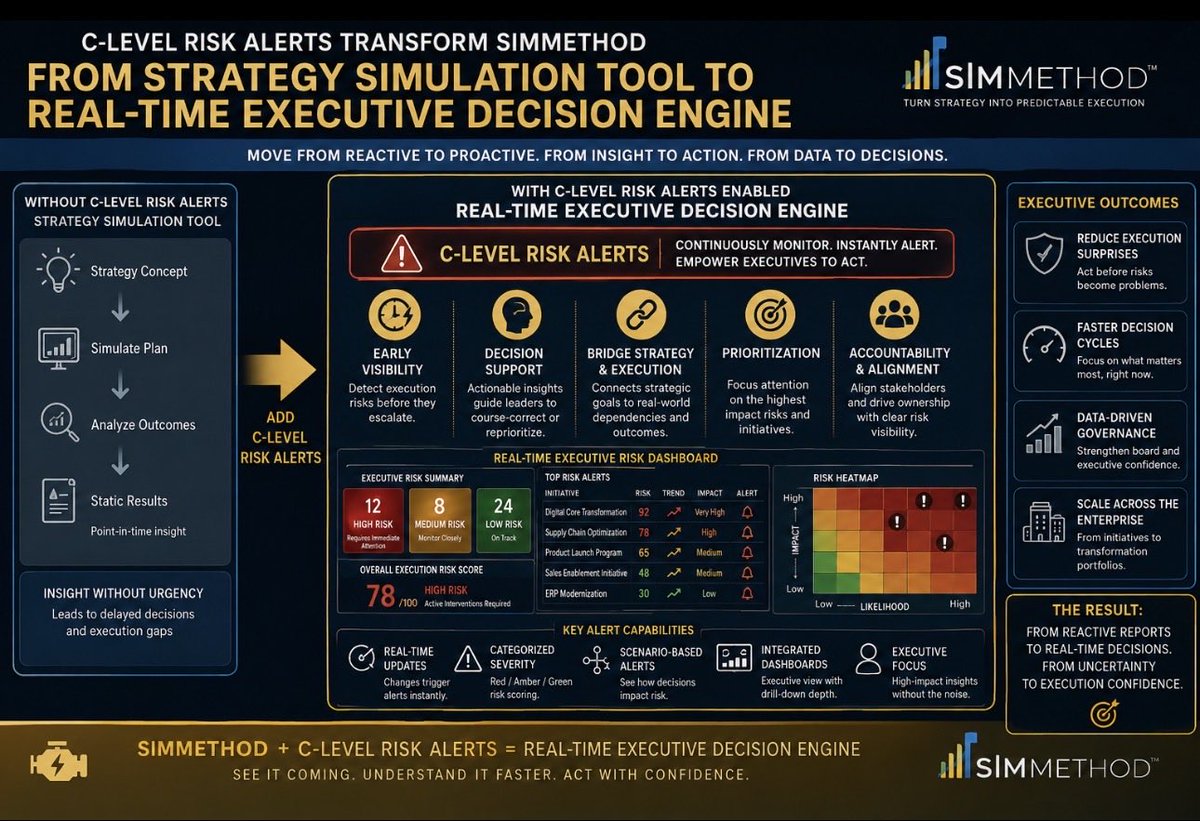
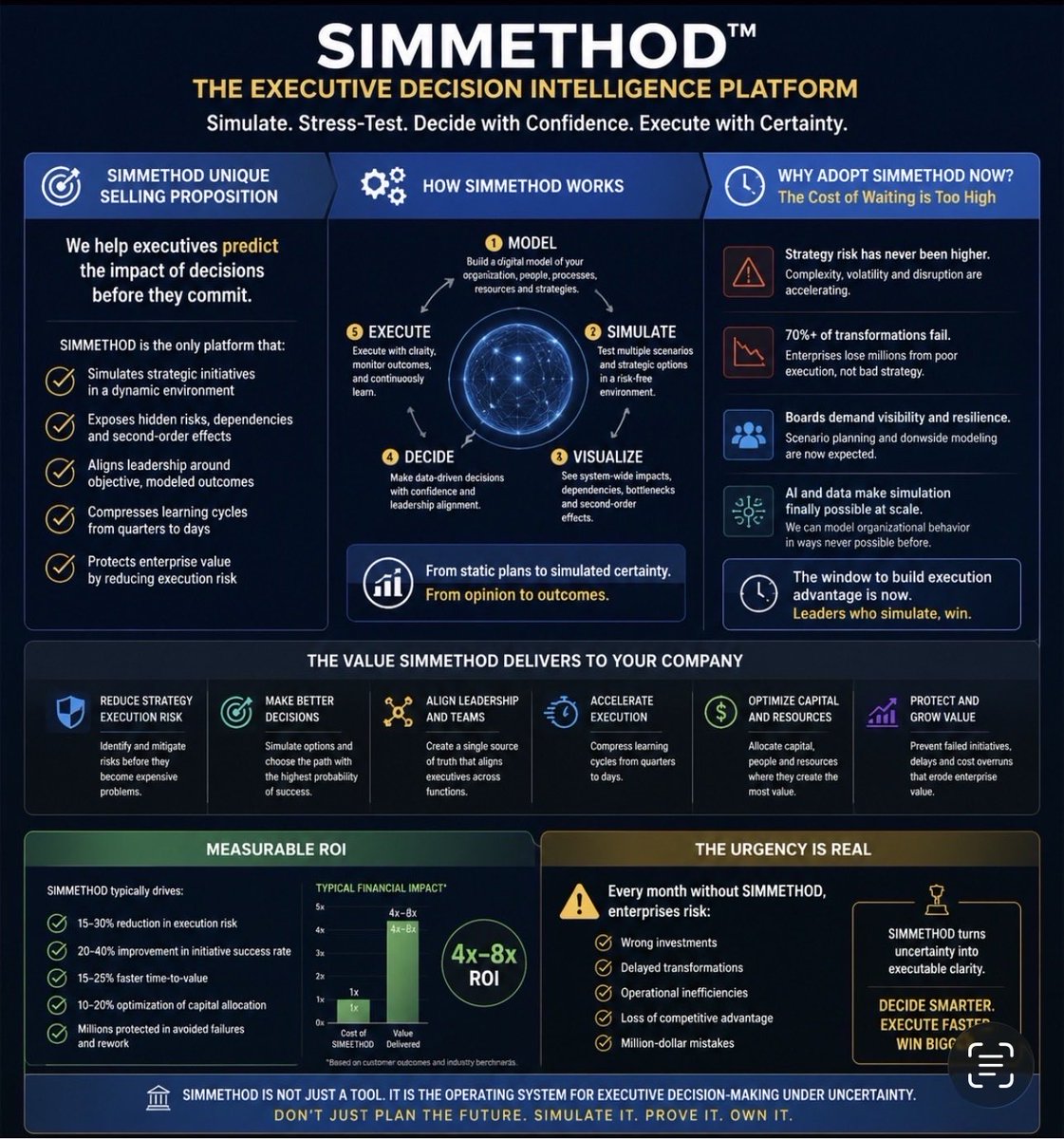
SIMMETHOD: The operating system for executive decision making under uncertainty.
By preventing failed initiatives, delayed transformations, and misallocated investments, SIMMETHOD directly supports:
•EBITDA protection
•capital efficiency
•transformation success rates
Ken Griffin, founder of Citadel, has a $10 plaque behind his desk that reads: "If we're all going to eat, someone has to sell."
Of all the things this man could surround himself with, he chose a cheap plaque with a blunt truth about business.
"You're always selling. You're selling to candidates. You're selling to vendors, you're selling to counterparties, you're selling to customers."
And if you're always selling, you know what you're going to hear a lot of?
"No."
Griffin doesn't sugarcoat it. He tells two stories that illustrate just how brutal rejection can be.
1994 was a rough year, with Citadel losing ~4% of its capital. Griffin flew to Switzerland for a crucial lunch meeting, sat down, and his guest arrived only to say:
"Oh, I thought you were John Griffin from Fen Church. I got to go."
His lunch date got up and left the table.
Later that afternoon, a Swiss banker spent 45 minutes with him in a beautiful office, smoking a cigar, before closing with:
"Such a pity that such a bright young man picked the wrong career."
Two rejections in one day for the founder of one of the most successful hedge funds in history — and his takeaway was simply this:
"You just have to tolerate. You're going to hear no a lot, but you need to become accustomed to having to market your ideas and market what you represent and what you stand for."
Absorbing rejection and continuing anyway is the actual skill, whether you're hiring, raising capital, or winning customers.
Most people avoid selling because they're afraid of no. The ones who build great things have learned to expect it.
The UK just deployed a political weapon it's only used once before in modern history.
And nobody is talking about what it just backfired into.
🚨 🚨 🚨 KEIR STARMER BANNED FOREIGN JOURNALISTS FROM ENGLAND TO STOP A RALLY → IT PRODUCED THE LARGEST ANTI-GOVERNMENT MARCH IN YEARS 🚨 🚨 🚨
The Home Office issued entry bans on 11 foreign nationals ahead of the 16 May 'Unite the Kingdom' rally in central London. Rebel News founder Ezra Levant. Multiple journalists. Commentators. Banned from the country. To stop a march.
Metropolitan Police deployed 4,000+ officers. Live facial recognition. Drones. Dogs. Horses.
The result: tens of thousands — some estimates reaching hundreds of thousands — flooding the streets of London anyway.
THE WEAPON:
→ UK Home Office entry bans — 11 foreign nationals barred from the country
→ Prime Minister publicly labeled the rally "extremist" and "hatred and division"
→ Starmer framed it as "a battle for the soul of our nation" in direct pre-rally statements
→ Police mobilized at a scale typically reserved for state visits or terror threats
→ Live facial recognition deployed across central London
→ Rival pro-Palestine march simultaneously permitted on the same day
→ Metropolitan Police prepared for 50,000 — the actual crowd exceeded preparation
→ Government rhetoric amplified international media attention across the US and Europe
THE TARGET:
→ A march organized around "national unity, free speech, and Christian values"
→ Organized weeks after Reform UK seized 1,350+ council seats and control of 13 councils in the 8 May local elections
→ Reform's gains came primarily at Labour's direct expense — Essex, Sunderland, council after council
THE MATH:
→ Reform UK: 1,350+ seats gained in a single election cycle
→ 13 councils flipped — including Essex with 42 seats
→ Starmer's response: ban journalists, deploy 4,000 officers, call the march extremist
→ Outcome: the bans became the story, the march became a symbol, and the streets filled anyway
Read that again.
💀 Every ban Starmer issued handed organizers a government-censorship narrative
💀 Every officer deployed turned a political rally into a national confrontation
💀 The suppression didn't shrink the movement — it advertised it
⚠️ Reform just proved it can win elections. The march proved it can also fill streets.
⚠️ Starmer called it "a battle for the soul of our nation" — and then lost the visual battle on live television
⚠️ This isn't a fringe moment. This is what a political realignment looks like in the streets.
They're showing you the arrests and the police lines.
They're NOT showing you what this sequence actually means — a government that just lost 1,350 council seats in one night responded to the aftermath by banning journalists and calling a march extremist, and the streets answered with the largest visible opposition mobilization in years.
You don't ban foreign journalists to stop a fringe event. You ban foreign journalists when you're afraid of what the footage will show. And you only deploy 4,000 officers with drones and facial recognition when you already know the crowd is going to be too large to ignore.
Process that.
Most people won't see this. RT to change that. 🔥
I'll keep you updated as this unfolds, turn on notifications this is EXTREMELY important.
I've always loved Eric Church's music - but WOW did he just deliver the best commencement speech I've ever heard.
"Tend to your faith not just when you're broken, but when you're whole."
“Tend to your faith not just when you’re broken, but when you’re whole.”
Eric Church returned to his alma mater, UNC Chapel Hill, and gave graduates a message bigger than music:
The country star told graduates that faith is the “low E” of life: the foundation every chord rests on, especially when the world gets overwhelming.
Was not ready for Eric Church to deliver the best commencement speech I’ve ever heard.
Six guitar strings. Six pillars of a life.
Faith. Family. Spouse. Ambition. Community. You.
Tune them when you’re whole, not just when you’re broken.
Watch the whole thing.
A 14 year old in America quit his weekend shifts at Domino's after he realized he could make more money during one lunch break with a laptop than an entire weekend making pizzas for $8.50 an hour.
He was sitting in a coffee shop googling roofing companies near his house for a school project about local businesses. Noticed something. JM Roofing 3rd Generation. 5.0 stars. 49 reviews. Family owned. Three generations. Located in LA.
No website.
A company with a perfect rating and 49 reviews and no website. He checked another roofing company. Same thing. Then a plumber. Same thing. Then a landscaper. Same.
He opened Claude Code on his laptop and typed: write me a cold outreach script for local businesses that have great Google reviews but no website. Make it sound like I'm a professional web agency.
Claude wrote it in 30 seconds.
He called JM Roofing. The owner picked up. He said: I found your company on Google Maps, you have 49 five star reviews and no website. I built you one. Can I show you?
The owner said: I've been meaning to do that for years but never had time.
The kid shared his screen. A full website. Clean, modern, black and gold. Hero section. Services page. Reviews pulled directly from Google. Booking button. Built in 47 minutes using AI tools and Claude Code while sitting in a coffee shop.
The owner said yes on the spot. Invoice: $1,000.
47 minutes from first Google search to a closed $1,000 deal. His pizza shop shifts paid $60 for 6 hours of work.
Then he built a system. Claude Code scrapes Google Maps for businesses with high ratings and no website. Filters by category, location, review count. Pulls 200 results in 10 minutes. Then Claude writes a personalized email for each one using their real business data, their name, their rating, their review count, their address.
500 emails a day. 3% respond. That's 15 new leads every single day without him doing anything.
Month one: $4,000. Month three: $11,000. Month six: $18,000. All from finding businesses on Google Maps that have great reputations and no website, building one with AI in under an hour and calling them before anyone else does.
He recorded a 47 second video showing the entire process from Google Maps search to finished website to invoice sent. Caption: this is your sign to quit your job.
He's 14. He doesn't have a job to quit. He has something better. A laptop, Claude Code and 5 million businesses on Google Maps still waiting for that call.
His pizza shop manager asked why he quit. He said he found better work. The manager asked where. He said Google Maps.
The manager didn't understand. The kid didn't explain. He was already in the coffee shop building the next website.
$1,000 per site. One hour per site. 15 leads per day. The math doesn't need Claude to figure out. But Claude does the work.
The most "unkillable" monopoly in America just got killed.
FICO has controlled the US credit score market for over 30 years.
90% of top US lenders use it. 70% of the US mortgage market runs on it.
It was the definition of a permanent moat.
Yesterday, that moat evaporated in a single press conference.
Here's what actually happened, and why retail investors are about to learn a brutal lesson about "safe" monopoly stocks:
Wednesday, April 22nd.
Federal Housing Finance Agency Director Bill Pulte and HUD Secretary Scott Turner stepped up to a microphone and said the following, effective immediately:
Fannie Mae and Freddie Mac will now accept VantageScore 4.0 for mortgage underwriting.
Fannie and Freddie back 70% of every mortgage in America.
VantageScore is owned by FICO's three biggest rivals: Equifax, Experian, and TransUnion.
The FHA will follow soon for government-backed loans used by first-time homebuyers.
One announcement. One day. The backbone of FICO's business model cracked in half.
The stock response was immediate.
FICO dropped 13% intraday before recovering to close down 6.42% at $970.
Not a rounding error. A generational repricing.
But here's the number that should wake up every retail investor in America:
FICO is now down almost 50% year to date.
The biggest loser in the entire S&P 500.
In 2026.
Peak share price, May 2025: $2,217.
Current share price: $965.
That's $1,252 of value erased from every single share in 11 months.
And here's the part nobody wants to admit.
All the warning signs were visible months ago.
November 2025: Stock starts rolling over.
Pulte begins publicly calling FICO's pricing "nonsense."
DOJ antitrust scrutiny starts circulating in analyst notes.
January 2026: Analysts start slashing price targets one by one.
Competition discussions heat up. A "Lender Choice" era is openly discussed on earnings calls.
Early 2026: Stock hits $1,284 intraday.
Analysts say "buy the dip." Retail listens.
April 22, 2026: The announcement nobody positioned for.
And the same analysts who cheered the dip?
Thirteen of them still have FICO rated as a "Buy."
Average price target: $1,780.
A 99% upside call on a stock that just lost its regulatory moat.
This is how retail investors get destroyed in slow motion.
Not on meme stocks. Not on penny stocks.
On "safe" monopolies everyone assumes can't be disrupted.
Here's the psychology that makes this trap so effective:
FICO has been untouchable for 30 years.
It has 90% market share in a business the entire US economy depends on.
Every mortgage. Every car loan. Every credit card application.
It looks like a Peter Lynch wet dream. A boring company that prints cash from a regulatory moat.
And that's exactly why retail piled into it on every dip.
"FICO is a monopoly."
"It's regulated into the system."
"It can't be replaced."
All three of those statements are objectively true.
And all three of those statements just became irrelevant.
Because regulators can change the system.
And yesterday, they did.
Here's what makes this story matter beyond one stock:
The same trap is being set across the market right now.
Credit bureaus. Payment networks. Legacy software providers. Insurance middlemen.
Every company whose moat depends on being "the standard" is one government announcement away from the same fate.
Retail investors see the market share and buy.
They don't see the regulatory risk sitting underneath it.
They don't see the slow-motion political pressure building for months.
They don't see the competitors quietly getting cleared for market entry.
Institutions see all of it.
That's why institutions sold FICO for six straight months while retail was "buying the dip."
The data was there. Public. Free. Sitting in every SEC filing and regulatory press release.
Nobody read it.
Because reading it requires a system.
And most retail investors don't have one.
They have a narrative.
"FICO is a monopoly" is a narrative.
"Fannie and Freddie just authorized a direct competitor" is data.
Narratives feel good. Data doesn't care how you feel.
And in the end, the data always wins.
FICO investors just learned that lesson the hard way.
The question is whether you'll learn it from their loss.
Or from your own....
Intel has been pink slipping over 20,000 workers.... effectively abandoning it's massive 600 acre campuses in Oregon. "Over relegation, cost of living and taxation making it too difficult to keep doing business in the state."
Intel investing 25-30 billion, basically relocating it's production to Arizona and Ohio. Oregon is, in effect, losing it's middle class income generation altogether. We are talking billions in annual tax revenues moving out of state.
The same is happening in Washington, California, New York, and other liberal states.
This is a Liberalism FAFO moment...
BREAKING: Vance reveals that whatever skepticism he had about the Iran war went away after meeting them face to face.
He makes clear that these people can never be trusted.
The GENIUS MOVE behind Trump's 'failed' negotiations
Chapters:
0:00 Why Trump sent 'good cop' Vance
1:59 Iran wants to keep funding terrorism
3:01 Trump's UNO reverse card with the Strait
4:52 Proof that Iran still wants NUKES
6:51 How Iranians feel about this
Sen. Lindsey Graham:
"To the Pope: you're a good, holy man. You don't understand the evil of Iran, you're miscalculating here. The Catholic Church, God bless it, in the 1930s didn't really get Hitler. And to the Pope: you really don't get this regime, the Ayatollah and his henchmen."
Ricky Sarkany: "A mi madre la llevaron a Auschwitz y, cuando bajó del tren, la recibió Mengele. Mi padre escapó de un campo de exterminio".
Historias fuertes como la de @RickySarkany, lamentablemente los judíos tenemos al por mayor.
You don’t know people as well as you think.
Polina Pompliano studies the world’s highest performers—and what she’s found challenges how we think about success, creativity, and human behavior.
From mental models to media bias to the hidden motivations driving people, this is a deep dive into how great thinkers actually see the world.
TIMESTAMPS
00:00 – Intro
02:12 – How Polina Breaks Down High Performers
06:02 – Rationality vs Emotion
10:03 – Creativity and Logic
15:30 – The Power of Storytelling
19:00 – Building The Profile
22:29 – The Mask vs The Real Person
30:48 – Growing Up in Bulgaria
36:03 – What Freedom Actually Means
40:17 – Why We’re All in Ideological “Cults”
01:00:15 – What She Learned From Profiling People