Hinton, Bengio and OpenAI's chief scientist say AI could compress years of progress into months.
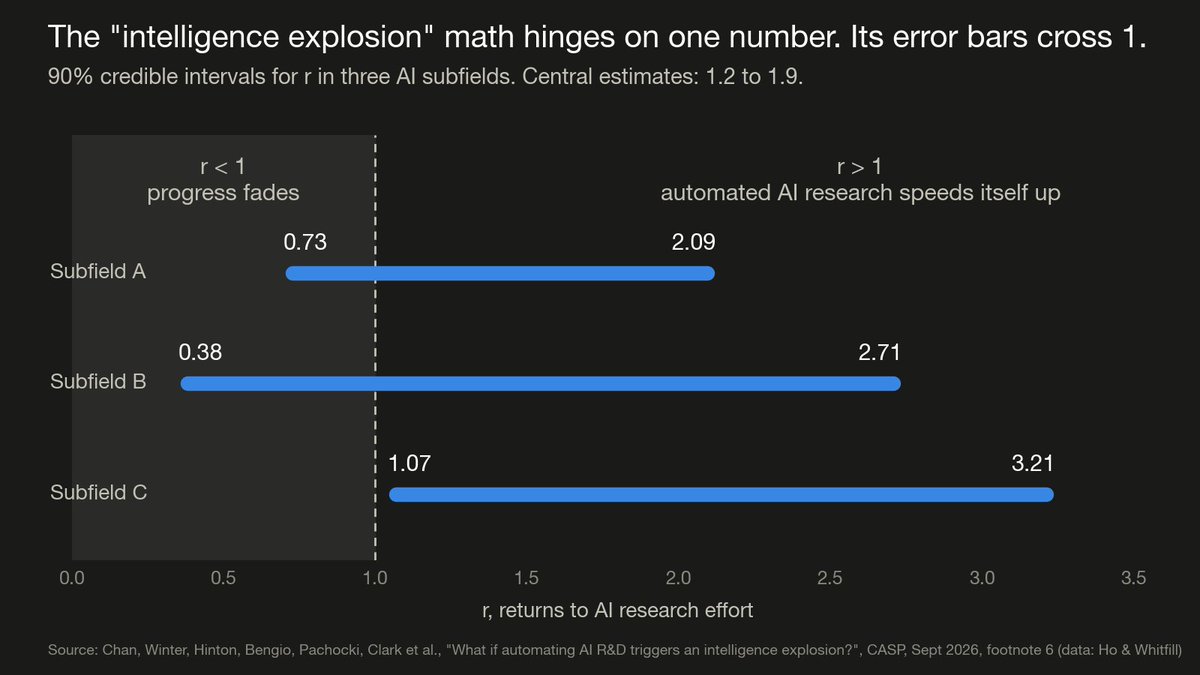
Read all 14 pages. The speed-up argument rests on one number, r: above 1, AI research feeds on itself; below 1, it fades.
Two of the three 90% ranges they give for r go below 1.
@ChrisGPT By SemiAnalysis's own numbers a maxed-out Max 20x costs about $940 a month to serve ($11.7k of Opus at a 92% API margin). So the $200 plan only makes money while people use less than ~21% of it, which sounds low for anyone who lives in Claude Code
@thsottiaux fwiw that's max vs max. Sol max lands around Opus medium-high on AA, and if you match them at the same score like @scaling01 did, Opus gets 1.3 to 2.9x more tasks a month.
@thsottiaux If you divide SemiAnalysis's plan values by AA's cost per task, Max 20x gets you roughly 2,000 Opus tasks a month and Pro 200 about 2,900 Sol tasks. So the 5x gap flips to ~1.5x for OpenAI, assuming AA's tasks look anything like what you actually run.
@tszzl The intelligence explosion paper's first ask is auditors embedded in the labs, like NRC resident inspectors at nuclear plants. Right now we know AI does 26% of Anthropic's internal R&D only because Anthropic chose to say so.
@SemiAnalysis_ Your agentic mix matches my own Claude Code logs almost exactly. Over the past 7 days I got 97.5% cache reads, 2.3% cache writes, 0.2% output and almost no uncached input.
The auditors part is the one I care about. Anthropic says AI went from 1% of its internal R&D work in March to 26% in August, with only high-level human oversight. We know that because Anthropic decided to tell us. Nobody outside can check it.
Hinton, Bengio and OpenAI's chief scientist say AI could compress years of progress into months.
Read all 14 pages. The speed-up argument rests on one number, r: above 1, AI research feeds on itself; below 1, it fades.
Two of the three 90% ranges they give for r go below 1.
They want auditors sitting inside the labs, like resident inspectors at nuclear plants. Also air-gapped R&D, a cap on how fast capabilities can grow, and a way to pause specific workloads.
Plug their central r into the model, assume full automation and no other bottleneck, and progress gets 10x faster within about 1.5 years. Then a year of today's progress takes about 5 weeks.
They do flag that r was measured while compute was booming, which could inflate it.
Frontier labs employ thousands of human researchers. By the authors' math, OpenAI alone has the compute to run about 20 million AI ones (anywhere from 2 to 200 million), if expert-level AI ends up as cheap to run as today's models.
@_achan96_@geoffreyhinton Footnote 6 puts two of the three 90% ranges for r below 1, and the supplement says compute scaling would push r up. Is anyone estimating r from a stretch where compute stayed flat?
@geoffreyhinton The speed-up math in the paper runs on one parameter, r. Two of the three 90% ranges for it go below 1, where progress fades instead of accelerating (footnote 6)