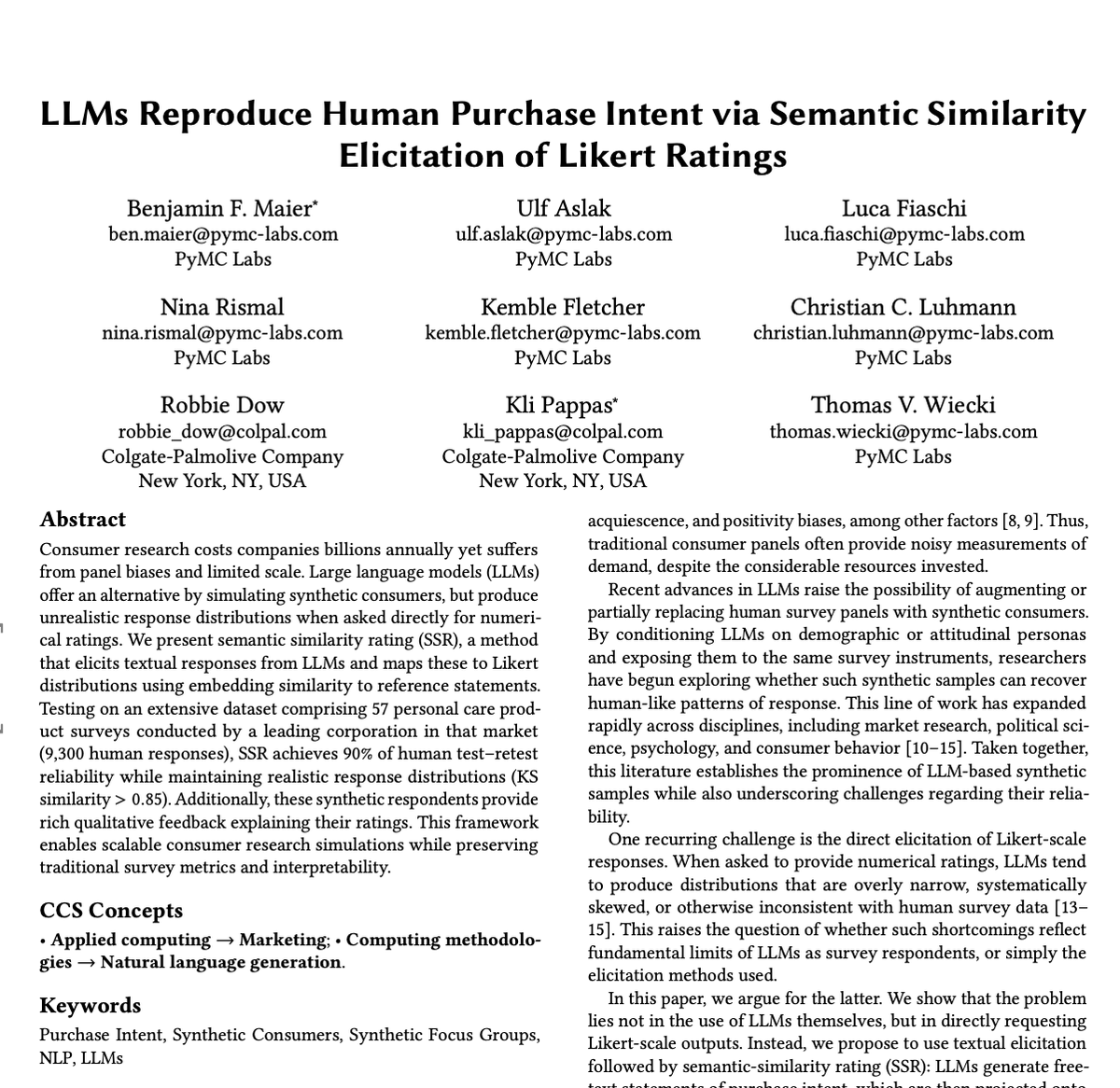
Researchers proved you can predict actual purchase intent at 90% accuracy by asking LLMs to roleplay customers.
if you just ask an LLM directly: "rate this product 1 to 5," it fails completely. it gives garbage distributions because models love defaulting to safe, middle-of-the-road answers.
to fix this, the researchers developed a method called Semantic Similarity Rating (SSR):
- The Persona Drop: You condition the LLM with a specific demographic profile (age, income, background).
- Free-Text Impressions: Instead of a number, you make the AI write natural, qualitative impressions of the product first.
- Embedding Mapping: You map those text responses to a 1–5 Likert scale using embedding cosine similarity against reference anchor statements.
They tested this across 57 real consumer surveys with 9,300 actual human responses from a major corporation.
The results are insane:
- Achieved 90% of human test-retest reliability.
- Maintained near-perfect distribution matching (KS similarity > 0.85).
- Captured subtle demographic nuances like age and income behavior patterns better than traditional models.
the implications are massive. you can now A/B test 1,000 product concepts overnight, simulate market reactions before manufacturing a single item, and get rich qualitative feedback explaining why people would buy it, all for pennies.
the synthetic consumer era is officially here.
Woke up to 690,000+ views on my Ralph article (what?)
So I'm going to double down and show you a real-world example of how I used Ralph to ship a feature this morning.
Also, I created a public repo that makes it super easy for you to get Ralph running: https://t.co/V2Qu7SMyxh
1. Created the PRD
https://t.co/SURYq8Xizc
Note how I used my create-prd markdown file from https://t.co/YXuNG6XKYz
2. Created the Ralph user stories
https://t.co/5Q7F6xLjUh
Note how I used my Ralph Skill to create the user stories
https://t.co/xdw8ur90m6
3. Started Ralph with max 25 iterations
./scripts/ralph/ralph.sh 25
Iteration 1
https://t.co/l38qgqyQeG
Iteration 2
https://t.co/xj05rXNqDO
Iteration 3
https://t.co/zOknKrGE4O
Iteration 4
https://t.co/vId1EtNGST
Iteration 5
https://t.co/KfGzjNq9AR
Iteration 6
https://t.co/fyMA7fnix9
Iteration 7
https://t.co/HGmrhbiaUc
Iteration 8
https://t.co/V4iww9gNUQ
Iteration 9
https://t.co/4eKssSyTW3
Iteration 10
https://t.co/GdIEliVL28
Iteration 11
https://t.co/jCOjNDbMdB
Iteration 12
https://t.co/a2I1g1EXwP
Iteration 13
https://t.co/xhQTR3R1lg
Iteration 14
https://t.co/F2TNGDxvao
After it finished, I tested manually and found a few edge-case bugs, which Amp quickly fixed.
Working my way through this brick - https://t.co/6vrrQ06x22 - highly recommend as a next read after "The Rust Book". Rust features and concepts are broken down into an easy to digest format. Pleasure to read!
@jimblandy Hey bud, currently studying Rust and wanted to know if there is a second edition of your book in the works? If not, is the first one still relevant with all the new Rust updates?
@simon_tong sorry for the delayed response on this Simon, but to answer your question -- not at the meantime as we plan on tightening our integrations with Apple Health and Google Fit. Sorry about that!
The reason it's called a "patch" in software is because you could make small corrections in a programmed sequence by "patching over" the paper tape and re-punching holes in that section..