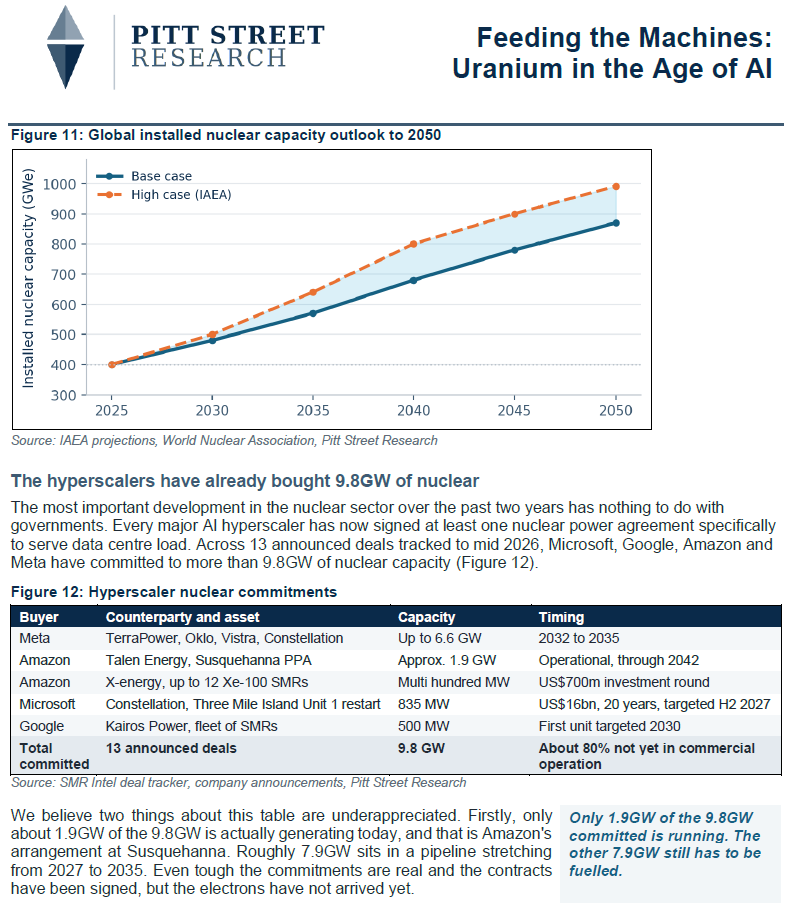
"We think the time is right to become materially more bullish on #Uranium miners. They are not a decarbonisation trade any more. They are the fuel supply chain for the largest infrastructure buildout in a generation, and the market has not finished repricing that."📈⚛️⛽️🤠🐂🌊🏄
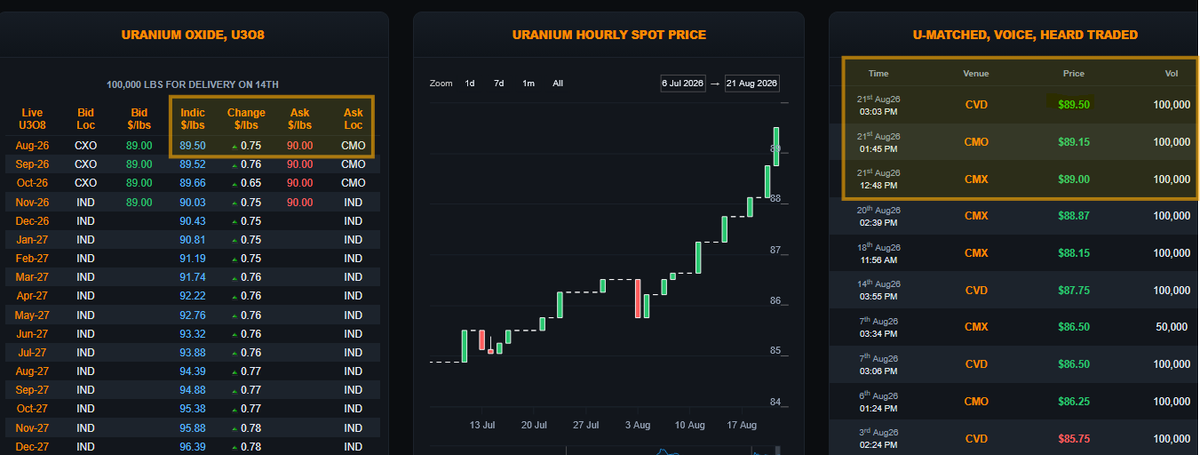
🤯Ka-boom!💣💥 Spot #Uranium has just blasted thru $91 with a sudden +$1.63 spike to $91.13/lb #U3O8 🔥🚀 its highest since 2 February🌋😎 with sellers now asking $92🧀🐭 as gap with $95.50 term price is rapidly closing🗜️ as this upleg gains serious momentum!📈🤠🐂 Surf's up!🌊🏄
Data centers constructed for hyperscalers to lease are off-balance sheet during construction. Hyperscalers, in partnership with private credit, create Special Purpose Vehicles (SPVs) to finance data center developments. These SPVs are considered "variable interest entities" (VIE) for accounting purposes because as the sole tenant of the data center, hyperscalers have more exposure to and influence on the SPV than their minority equity ownership and voting rights would suggest.
VIE structures became increasingly common and used to circumvent consolidation in the late '90s and early '00s, just before the dot com bubble burst and around the time of the massive fiber overbuild. In response, consolidation accounting was updated so that VIEs would be consolidated by the SPV's "primary beneficiary". For a hyperscaler to be considered the primary beneficiary of a lease SPV, it must have both (1) the power to direct the most economically significant activities and (2) the obligation to absorb the entity's losses or the right to receive the entity's economic benefits.
This was honestly the hardest pieces of work i’ve done, but also the most rewarding.
Looking at the final work, i’m genuinely proud of it.
This is essentially an X-ray of $GLO’s economics, breaking down the company in detail from every angle.
I learned an incredible amount! 🧠
$GLO #DFC ‼️⌛🇳🇪
Quote from the last Atomic Eagle CEO interview (from 14m 50s)
“First, the first point about like the likes of the US Development Finance Corporation we know are already looking very closely at the debt financing of the DASA uranium project owned by a Global Atomic.
When i met the DFC in January, also a future mineral forum, they expressed that the regulatory side of that transaction was not an impediment was merely the the export solution that they were trying to sort of work through with the company.”
Keep in mind that on June 20–21, 2026, the governments of #Niger and #Benin met in Cotonou and reached a broad understanding on the conditions required to reopen the border, laying the groundwork for a normalization of relations between the two countries.
So this is yet another data point coming from a completely different perspective than the usual sources (for whatever it may be worth) that further increases the probability of the Dasa financing ultimately being approved and closed, particularly after the project already cleared what was arguably the most difficult hurdle: DFC Credit Committee approval.
#uranium #globalatomic #U308
https://t.co/VDsOlLAszl
The uranium market is setting up for an interesting game of chicken.
Sprott’s John Ciampaglia says Western nuclear utilities still aren’t buying uranium aggressively. For now, many are basically replacing what they use.
That works today.
The problem starts closer to 2030.
New EIA data shows US utilities have much less of their future uranium needs covered by contracts by then. And nuclear fuel takes a long time to prepare, so they can’t simply show up at the last minute and buy it.
So why aren’t utilities more worried?
Because a bunch of new uranium mines are supposed to be producing by the time those uncovered needs start growing.
That’s a pretty big assumption.
As Ciampaglia points out, mines have a habit of being late, over budget or both.
Meanwhile, the biggest producers aren’t rushing to add supply either. They want long-term contracts at prices that justify expanding mines, restarting higher-cost production or building new projects.
So we have an unusual standoff:
Utilities are waiting for new mines.
Producers are waiting for contracts.
And the amount of uranium utilities still need to buy gets much larger around 2030.
There’s another important change happening.
Conversion and enrichment, the steps needed to turn mined uranium into reactor fuel, have been the bigger headache for utilities in recent years. Ciampaglia thinks those bottlenecks are slowly easing.
If that continues, utilities can turn their attention back to securing the actual uranium.
That may already be starting. He says utilities are beginning to “poke around” the market again.
The long-term uranium price is now in the mid-$90s/lb, but still well below the last cycle after adjusting for inflation.
And China and India are already buying heavily for future delivery.
The big question isn’t whether the world has uranium in the ground.
It’s whether enough new mines will actually be producing when utilities need those pounds.
Those are two very different things.
@sprott@capnek123
https://t.co/4rUwq5fBBM
I don’t give a damn about Atomic Eagle, but this is hugely important for #Niger ’s investability.
Add the Canadian oil refinery + the junta’s full support for $GLO , and a much more positive picture is emerging for lenders considering financing companies operating in the country.
I still think the reopening of the #Benin –Niger border is the final missing piece for an immediate #DFC green light, although it could still come earlier given the improving environment in the country.
Let’s see.
There’s a reason i’ve been so focused on $GLO 🇳🇪
After almost 5 months of work, my 2° report is nearly done and nothing was left to chance.
The expansion-case NPVs are striking🤯
No other #uranium stocks has this potential ⏩⌛
Free link to ppt: 👇🏼
https://t.co/mv8U5ixMaj
Atomic Eagle regains Madaouela in #Niger under a new 60/40 deal with the State. 🇳🇪
Another positive read-through for $GLO: Niger remains investable and wants #uranium projects developed. ⌛
France appears to be the real exception: understandably so.
🚨ICYMI #Uranium peeps!🎆😴 Cameco's Grant Isaac told U on the company's 31 July Q2 Results Conference Call precisely why we are on the cusp of a coming Uranium bull market for the history books!⚛️⛏️🐂🚀🌜 On the call Grant said:
"The uranium side of the market continues to move from strength to strength. Just in general, across the industry, I think what the most notable point to make is we are still not at replacement rate demand across the industry. We still don't have utilities coming forward and collectively buying at a volume that replaces what they consume under existing contracts! And yet we find ourselves back into a mid-90s long-term uranium price on its way to 3 digits likely. And that's in the absence of replacement rate demand. And as I remind folks, we've never been at this kind of uranium price [$97] on the front end of a uranium contracting cycle. We've only ever found ourselves at these prices on the back end."
He reminded us of 2 important factors:
1. Nuclear utilities normally sign a series of 4 different contracts to order reactor fuel🧾✍️⚛️🏭 starting with the fabrication of fuel assemblies filled with enriched uranium to be loaded into reactors 1⃣ then working backwards thru SWU for enrichment of UF6 2⃣ and Conversion of drummed U3O8 into UF6 3⃣ then finally, last of all, they sign contracts with miners to supply the required drums of mined U3O8 yellow cake 4⃣ the last link in the contracts chain.🛢️☢️🔗
⚠️ Prices for Conversion and enrichment SWU have already skyrocketed 200-300% to all-time highs, indicating that utilities have been squeezing the conversion & enrichment markets🗜️🛒 signing a large volume of new service contracts, but they haven't yet signed sufficient contracts for the mined U3O8 that must be converted & enriched!🚨
This is most evident by looking at long-term contracting volumes.📊 For the past 13 years, utilities on average globally have only been signing uranium supply contracts for little more than half the volume of uranium they have been consuming in reactors each year! Contracting has been far below what is referred to as "replacement rate" due to utilities being focused primarily on securing the most important contracts for fabrication, SWU and Conversion, putting off signing contracts for mined U3O8 until the last minute.😴 Hence, there is a massive wave of contracting volume yet to arrive at mined U3O8, the last domino to fall in the contracts chain.🌊🛢️☢️🛒
2. Grant also reminded investors on the call that the published long-term Uranium price has now reached a new all-time record high of $97/lb, higher than the $95 peak during the last 2006/2007 bull market, but replacement rate contracting by utilities hasn't even started yet! 😲
The coming "replacement rate" contracting cycle is going to start off at a higher long-term price than was ever achieved at the back-end months of the last uranium bull market!
Once fuel buyers jump back into signing a high volume of new U3O8 supply contracts, the Long-term and Spot prices will go far far higher from today's already elevated base prices!⏫���
In the first 3 years of the last Uranium bull market the long-term price rose from ~$25 in 2005 to a peak of $95 in 2007/2008, a near 4-fold price jump. Meanwhile, Spot U3O8 went from ~$20 to a peak of $136 in 2007, a near 7-fold price run!
Veteran uranium sector analysts & investors on the call understood exactly what Grant was saying to them.👍 Now U know why so many of us U sector veterans are so excited about what's yet to come when the long delayed full-on replacement rate contracting cycle gets underway!🚀🌜💰😀
But wait!✋ There's more... 😄
As Grant said, 'replacement rate' only deals with replacing the uranium fuel that is being consumed by today's operating reactors under existing contracts signed years ago!🌎⚛️⛽️
Additional demand coming from ~80 new reactors under construction today (which nominally load 3 years worth of uranium fuel at start-up), shuttered plants like Palisades, Three Mile Island, Duane Arnold and others worldwide being restarted, as well as the many reactors now unexpectedly receiving new multi-decade life extensions, is driving the required amount of fuel purchasing to a level far above today's replacement rate in order to secure the much higher quantities of fuel that will be required⬆️🛢️☢️🛒😊 which Bloomberg recently calculated to be a +44% increase of 163 Gigawatts😲 which will add around 80 Million lbs per year of new uranium demand by 2036!😲 VERY exciting times ahead for U!😃
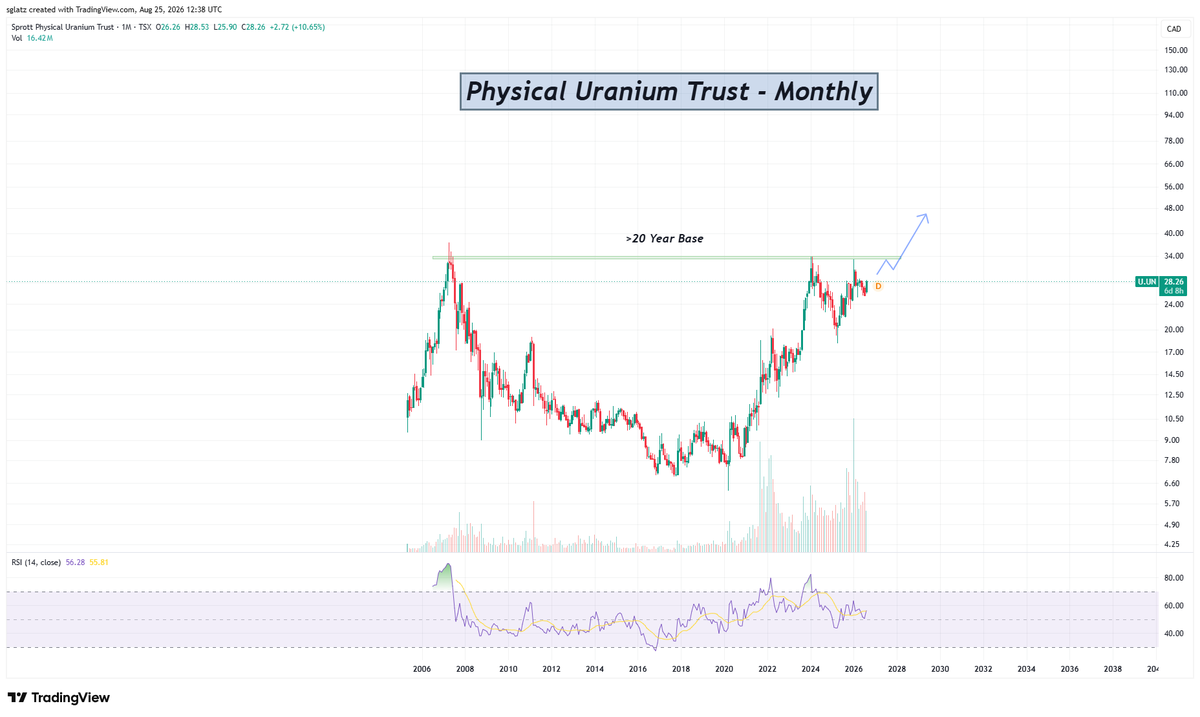
IMHO, with the Spot price surging back to highs not seen since February, firmly breaking out of a 6-month consolidation in a narrow trading range, NOW is the time to get positioned to ride the coming colossal wave!🌊🏄
Good luck to U all with your research & investments!☘️🌈💰It's your money... invest it wisely!🦉🤠🐂
⚡️Panic buying erupted in the Spot #Uranium market today⚛️🛢️☢️🛒😱 with 300,000 lbs purchased at higher & higher prices📈 spiking #Nuclear fuel brokers @UraniumMarket's Spot +78c to new 6-month high of $89.63⏫🌋😎 and @Numerco +75c to $89.50 with sellers asking $90🧀🐭🤠🐂🌊🏄
$KAP Management: “New realities are signaling that the era of ‘cheap’ uranium is fading away.”
When the lowest-cost major producer’s costs jump this much (+37% y/y), the incentive price for the whole industry rises.
$KAP
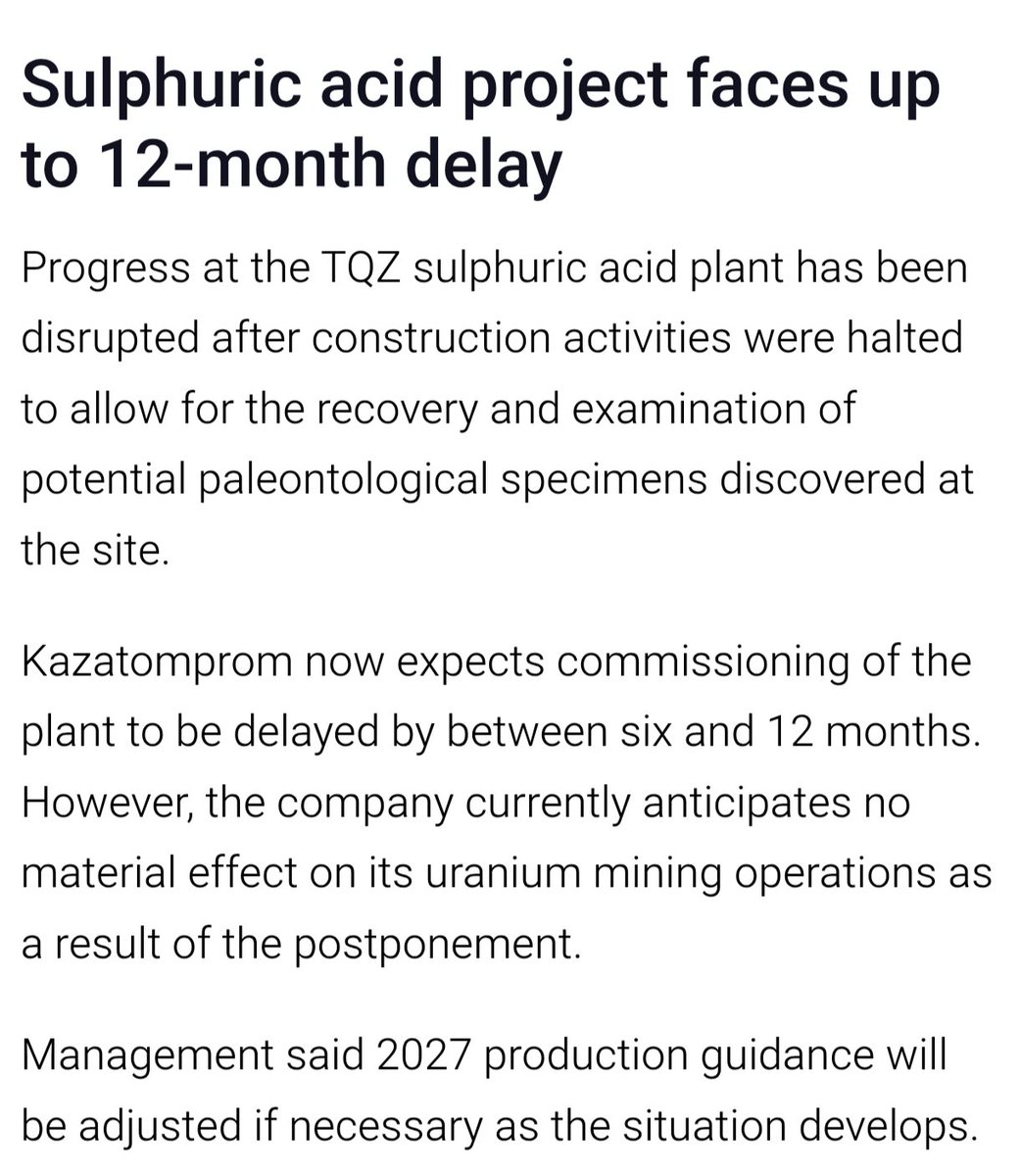
Sulfuric acid plant delayed by up to 12 months ⚠️
As always in the #uranium space, reality hits hard and crushes the rosy expectations.
Probably time to get back to my s-d model and see just how much more stretched the uranium deficit is right now 🤯
This could be the spark that ignites the next move higher in the spot price
Maybe we see some catch-up toward the long-term price around $95/lb 🤔
A rally driven by a real structural supply issue would be much healthier than bullshit headlines about data centers-ai ⌛
#uranium


![quakes99's tweet photo. 🚨ICYMI #Uranium peeps!🎆😴 Cameco's Grant Isaac told U on the company's 31 July Q2 Results Conference Call precisely why we are on the cusp of a coming Uranium bull market for the history books!⚛️⛏️🐂🚀🌜 On the call Grant said:
"The uranium side of the market continues to move from strength to strength. Just in general, across the industry, I think what the most notable point to make is we are still not at replacement rate demand across the industry. We still don't have utilities coming forward and collectively buying at a volume that replaces what they consume under existing contracts! And yet we find ourselves back into a mid-90s long-term uranium price on its way to 3 digits likely. And that's in the absence of replacement rate demand. And as I remind folks, we've never been at this kind of uranium price [$97] on the front end of a uranium contracting cycle. We've only ever found ourselves at these prices on the back end."
He reminded us of 2 important factors:
1. Nuclear utilities normally sign a series of 4 different contracts to order reactor fuel🧾✍️⚛️🏭 starting with the fabrication of fuel assemblies filled with enriched uranium to be loaded into reactors 1⃣ then working backwards thru SWU for enrichment of UF6 2⃣ and Conversion of drummed U3O8 into UF6 3⃣ then finally, last of all, they sign contracts with miners to supply the required drums of mined U3O8 yellow cake 4⃣ the last link in the contracts chain.🛢️☢️🔗
⚠️ Prices for Conversion and enrichment SWU have already skyrocketed 200-300% to all-time highs, indicating that utilities have been squeezing the conversion & enrichment markets🗜️🛒 signing a large volume of new service contracts, but they haven't yet signed sufficient contracts for the mined U3O8 that must be converted & enriched!🚨
This is most evident by looking at long-term contracting volumes.📊 For the past 13 years, utilities on average globally have only been signing uranium supply contracts for little more than half the volume of uranium they have been consuming in reactors each year! Contracting has been far below what is referred to as "replacement rate" due to utilities being focused primarily on securing the most important contracts for fabrication, SWU and Conversion, putting off signing contracts for mined U3O8 until the last minute.😴 Hence, there is a massive wave of contracting volume yet to arrive at mined U3O8, the last domino to fall in the contracts chain.🌊🛢️☢️🛒
2. Grant also reminded investors on the call that the published long-term Uranium price has now reached a new all-time record high of $97/lb, higher than the $95 peak during the last 2006/2007 bull market, but replacement rate contracting by utilities hasn't even started yet! 😲
The coming "replacement rate" contracting cycle is going to start off at a higher long-term price than was ever achieved at the back-end months of the last uranium bull market!
Once fuel buyers jump back into signing a high volume of new U3O8 supply contracts, the Long-term and Spot prices will go far far higher from today's already elevated base prices!⏫���
In the first 3 years of the last Uranium bull market the long-term price rose from ~$25 in 2005 to a peak of $95 in 2007/2008, a near 4-fold price jump. Meanwhile, Spot U3O8 went from ~$20 to a peak of $136 in 2007, a near 7-fold price run!
Veteran uranium sector analysts & investors on the call understood exactly what Grant was saying to them.👍 Now U know why so many of us U sector veterans are so excited about what's yet to come when the long delayed full-on replacement rate contracting cycle gets underway!🚀🌜💰😀
But wait!✋ There's more... 😄
As Grant said, 'replacement rate' only deals with replacing the uranium fuel that is being consumed by today's operating reactors under existing contracts signed years ago!🌎⚛️⛽️
Additional demand coming from ~80 new reactors under construction today (which nominally load 3 years worth of uranium fuel at start-up), shuttered plants like Palisades, Three Mile Island, Duane Arnold and others worldwide being restarted, as well as the many reactors now unexpectedly receiving new multi-decade life extensions, is driving the required amount of fuel purchasing to a level far above today's replacement rate in order to secure the much higher quantities of fuel that will be required⬆️🛢️☢️🛒😊 which Bloomberg recently calculated to be a +44% increase of 163 Gigawatts😲 which will add around 80 Million lbs per year of new uranium demand by 2036!😲 VERY exciting times ahead for U!😃
IMHO, with the Spot price surging back to highs not seen since February, firmly breaking out of a 6-month consolidation in a narrow trading range, NOW is the time to get positioned to ride the coming colossal wave!🌊🏄
Good luck to U all with your research & investments!☘️🌈💰It's your money... invest it wisely!🦉🤠🐂](https://pbs.twimg.com/media/HQV7boabgAA4rNR.png)
![quakes99's tweet photo. 🚨ICYMI #Uranium peeps!🎆😴 Cameco's Grant Isaac told U on the company's 31 July Q2 Results Conference Call precisely why we are on the cusp of a coming Uranium bull market for the history books!⚛️⛏️🐂🚀🌜 On the call Grant said:
"The uranium side of the market continues to move from strength to strength. Just in general, across the industry, I think what the most notable point to make is we are still not at replacement rate demand across the industry. We still don't have utilities coming forward and collectively buying at a volume that replaces what they consume under existing contracts! And yet we find ourselves back into a mid-90s long-term uranium price on its way to 3 digits likely. And that's in the absence of replacement rate demand. And as I remind folks, we've never been at this kind of uranium price [$97] on the front end of a uranium contracting cycle. We've only ever found ourselves at these prices on the back end."
He reminded us of 2 important factors:
1. Nuclear utilities normally sign a series of 4 different contracts to order reactor fuel🧾✍️⚛️🏭 starting with the fabrication of fuel assemblies filled with enriched uranium to be loaded into reactors 1⃣ then working backwards thru SWU for enrichment of UF6 2⃣ and Conversion of drummed U3O8 into UF6 3⃣ then finally, last of all, they sign contracts with miners to supply the required drums of mined U3O8 yellow cake 4⃣ the last link in the contracts chain.🛢️☢️🔗
⚠️ Prices for Conversion and enrichment SWU have already skyrocketed 200-300% to all-time highs, indicating that utilities have been squeezing the conversion & enrichment markets🗜️🛒 signing a large volume of new service contracts, but they haven't yet signed sufficient contracts for the mined U3O8 that must be converted & enriched!🚨
This is most evident by looking at long-term contracting volumes.📊 For the past 13 years, utilities on average globally have only been signing uranium supply contracts for little more than half the volume of uranium they have been consuming in reactors each year! Contracting has been far below what is referred to as "replacement rate" due to utilities being focused primarily on securing the most important contracts for fabrication, SWU and Conversion, putting off signing contracts for mined U3O8 until the last minute.😴 Hence, there is a massive wave of contracting volume yet to arrive at mined U3O8, the last domino to fall in the contracts chain.🌊🛢️☢️🛒
2. Grant also reminded investors on the call that the published long-term Uranium price has now reached a new all-time record high of $97/lb, higher than the $95 peak during the last 2006/2007 bull market, but replacement rate contracting by utilities hasn't even started yet! 😲
The coming "replacement rate" contracting cycle is going to start off at a higher long-term price than was ever achieved at the back-end months of the last uranium bull market!
Once fuel buyers jump back into signing a high volume of new U3O8 supply contracts, the Long-term and Spot prices will go far far higher from today's already elevated base prices!⏫���
In the first 3 years of the last Uranium bull market the long-term price rose from ~$25 in 2005 to a peak of $95 in 2007/2008, a near 4-fold price jump. Meanwhile, Spot U3O8 went from ~$20 to a peak of $136 in 2007, a near 7-fold price run!
Veteran uranium sector analysts & investors on the call understood exactly what Grant was saying to them.👍 Now U know why so many of us U sector veterans are so excited about what's yet to come when the long delayed full-on replacement rate contracting cycle gets underway!🚀🌜💰😀
But wait!✋ There's more... 😄
As Grant said, 'replacement rate' only deals with replacing the uranium fuel that is being consumed by today's operating reactors under existing contracts signed years ago!🌎⚛️⛽️
Additional demand coming from ~80 new reactors under construction today (which nominally load 3 years worth of uranium fuel at start-up), shuttered plants like Palisades, Three Mile Island, Duane Arnold and others worldwide being restarted, as well as the many reactors now unexpectedly receiving new multi-decade life extensions, is driving the required amount of fuel purchasing to a level far above today's replacement rate in order to secure the much higher quantities of fuel that will be required⬆️🛢️☢️🛒😊 which Bloomberg recently calculated to be a +44% increase of 163 Gigawatts😲 which will add around 80 Million lbs per year of new uranium demand by 2036!😲 VERY exciting times ahead for U!😃
IMHO, with the Spot price surging back to highs not seen since February, firmly breaking out of a 6-month consolidation in a narrow trading range, NOW is the time to get positioned to ride the coming colossal wave!🌊🏄
Good luck to U all with your research & investments!☘️🌈💰It's your money... invest it wisely!🦉🤠🐂](https://pbs.twimg.com/media/HQV7WudbUAAvSi8.png)
![quakes99's tweet photo. 🚨ICYMI #Uranium peeps!🎆😴 Cameco's Grant Isaac told U on the company's 31 July Q2 Results Conference Call precisely why we are on the cusp of a coming Uranium bull market for the history books!⚛️⛏️🐂🚀🌜 On the call Grant said:
"The uranium side of the market continues to move from strength to strength. Just in general, across the industry, I think what the most notable point to make is we are still not at replacement rate demand across the industry. We still don't have utilities coming forward and collectively buying at a volume that replaces what they consume under existing contracts! And yet we find ourselves back into a mid-90s long-term uranium price on its way to 3 digits likely. And that's in the absence of replacement rate demand. And as I remind folks, we've never been at this kind of uranium price [$97] on the front end of a uranium contracting cycle. We've only ever found ourselves at these prices on the back end."
He reminded us of 2 important factors:
1. Nuclear utilities normally sign a series of 4 different contracts to order reactor fuel🧾✍️⚛️🏭 starting with the fabrication of fuel assemblies filled with enriched uranium to be loaded into reactors 1⃣ then working backwards thru SWU for enrichment of UF6 2⃣ and Conversion of drummed U3O8 into UF6 3⃣ then finally, last of all, they sign contracts with miners to supply the required drums of mined U3O8 yellow cake 4⃣ the last link in the contracts chain.🛢️☢️🔗
⚠️ Prices for Conversion and enrichment SWU have already skyrocketed 200-300% to all-time highs, indicating that utilities have been squeezing the conversion & enrichment markets🗜️🛒 signing a large volume of new service contracts, but they haven't yet signed sufficient contracts for the mined U3O8 that must be converted & enriched!🚨
This is most evident by looking at long-term contracting volumes.📊 For the past 13 years, utilities on average globally have only been signing uranium supply contracts for little more than half the volume of uranium they have been consuming in reactors each year! Contracting has been far below what is referred to as "replacement rate" due to utilities being focused primarily on securing the most important contracts for fabrication, SWU and Conversion, putting off signing contracts for mined U3O8 until the last minute.😴 Hence, there is a massive wave of contracting volume yet to arrive at mined U3O8, the last domino to fall in the contracts chain.🌊🛢️☢️🛒
2. Grant also reminded investors on the call that the published long-term Uranium price has now reached a new all-time record high of $97/lb, higher than the $95 peak during the last 2006/2007 bull market, but replacement rate contracting by utilities hasn't even started yet! 😲
The coming "replacement rate" contracting cycle is going to start off at a higher long-term price than was ever achieved at the back-end months of the last uranium bull market!
Once fuel buyers jump back into signing a high volume of new U3O8 supply contracts, the Long-term and Spot prices will go far far higher from today's already elevated base prices!⏫���
In the first 3 years of the last Uranium bull market the long-term price rose from ~$25 in 2005 to a peak of $95 in 2007/2008, a near 4-fold price jump. Meanwhile, Spot U3O8 went from ~$20 to a peak of $136 in 2007, a near 7-fold price run!
Veteran uranium sector analysts & investors on the call understood exactly what Grant was saying to them.👍 Now U know why so many of us U sector veterans are so excited about what's yet to come when the long delayed full-on replacement rate contracting cycle gets underway!🚀🌜💰😀
But wait!✋ There's more... 😄
As Grant said, 'replacement rate' only deals with replacing the uranium fuel that is being consumed by today's operating reactors under existing contracts signed years ago!🌎⚛️⛽️
Additional demand coming from ~80 new reactors under construction today (which nominally load 3 years worth of uranium fuel at start-up), shuttered plants like Palisades, Three Mile Island, Duane Arnold and others worldwide being restarted, as well as the many reactors now unexpectedly receiving new multi-decade life extensions, is driving the required amount of fuel purchasing to a level far above today's replacement rate in order to secure the much higher quantities of fuel that will be required⬆️🛢️☢️🛒😊 which Bloomberg recently calculated to be a +44% increase of 163 Gigawatts😲 which will add around 80 Million lbs per year of new uranium demand by 2036!😲 VERY exciting times ahead for U!😃
IMHO, with the Spot price surging back to highs not seen since February, firmly breaking out of a 6-month consolidation in a narrow trading range, NOW is the time to get positioned to ride the coming colossal wave!🌊🏄
Good luck to U all with your research & investments!☘️🌈💰It's your money... invest it wisely!🦉🤠🐂](https://pbs.twimg.com/media/HQV7Qo5agAApHBl.png)





![quakes99's tweet photo. 🚨ICYMI #Uranium peeps!🎆😴 Cameco's Grant Isaac told U on the company's 31 July Q2 Results Conference Call precisely why we are on the cusp of a coming Uranium bull market for the history books!⚛️⛏️🐂🚀🌜 On the call Grant said:
"The uranium side of the market continues to move from strength to strength. Just in general, across the industry, I think what the most notable point to make is we are still not at replacement rate demand across the industry. We still don't have utilities coming forward and collectively buying at a volume that replaces what they consume under existing contracts! And yet we find ourselves back into a mid-90s long-term uranium price on its way to 3 digits likely. And that's in the absence of replacement rate demand. And as I remind folks, we've never been at this kind of uranium price [$97] on the front end of a uranium contracting cycle. We've only ever found ourselves at these prices on the back end."
He reminded us of 2 important factors:
1. Nuclear utilities normally sign a series of 4 different contracts to order reactor fuel🧾✍️⚛️🏭 starting with the fabrication of fuel assemblies filled with enriched uranium to be loaded into reactors 1⃣ then working backwards thru SWU for enrichment of UF6 2⃣ and Conversion of drummed U3O8 into UF6 3⃣ then finally, last of all, they sign contracts with miners to supply the required drums of mined U3O8 yellow cake 4⃣ the last link in the contracts chain.🛢️☢️🔗
⚠️ Prices for Conversion and enrichment SWU have already skyrocketed 200-300% to all-time highs, indicating that utilities have been squeezing the conversion & enrichment markets🗜️🛒 signing a large volume of new service contracts, but they haven't yet signed sufficient contracts for the mined U3O8 that must be converted & enriched!🚨
This is most evident by looking at long-term contracting volumes.📊 For the past 13 years, utilities on average globally have only been signing uranium supply contracts for little more than half the volume of uranium they have been consuming in reactors each year! Contracting has been far below what is referred to as "replacement rate" due to utilities being focused primarily on securing the most important contracts for fabrication, SWU and Conversion, putting off signing contracts for mined U3O8 until the last minute.😴 Hence, there is a massive wave of contracting volume yet to arrive at mined U3O8, the last domino to fall in the contracts chain.🌊🛢️☢️🛒
2. Grant also reminded investors on the call that the published long-term Uranium price has now reached a new all-time record high of $97/lb, higher than the $95 peak during the last 2006/2007 bull market, but replacement rate contracting by utilities hasn't even started yet! 😲
The coming "replacement rate" contracting cycle is going to start off at a higher long-term price than was ever achieved at the back-end months of the last uranium bull market!
Once fuel buyers jump back into signing a high volume of new U3O8 supply contracts, the Long-term and Spot prices will go far far higher from today's already elevated base prices!⏫���
In the first 3 years of the last Uranium bull market the long-term price rose from ~$25 in 2005 to a peak of $95 in 2007/2008, a near 4-fold price jump. Meanwhile, Spot U3O8 went from ~$20 to a peak of $136 in 2007, a near 7-fold price run!
Veteran uranium sector analysts & investors on the call understood exactly what Grant was saying to them.👍 Now U know why so many of us U sector veterans are so excited about what's yet to come when the long delayed full-on replacement rate contracting cycle gets underway!🚀🌜💰😀
But wait!✋ There's more... 😄
As Grant said, 'replacement rate' only deals with replacing the uranium fuel that is being consumed by today's operating reactors under existing contracts signed years ago!🌎⚛️⛽️
Additional demand coming from ~80 new reactors under construction today (which nominally load 3 years worth of uranium fuel at start-up), shuttered plants like Palisades, Three Mile Island, Duane Arnold and others worldwide being restarted, as well as the many reactors now unexpectedly receiving new multi-decade life extensions, is driving the required amount of fuel purchasing to a level far above today's replacement rate in order to secure the much higher quantities of fuel that will be required⬆️🛢️☢️🛒😊 which Bloomberg recently calculated to be a +44% increase of 163 Gigawatts😲 which will add around 80 Million lbs per year of new uranium demand by 2036!😲 VERY exciting times ahead for U!😃
IMHO, with the Spot price surging back to highs not seen since February, firmly breaking out of a 6-month consolidation in a narrow trading range, NOW is the time to get positioned to ride the coming colossal wave!🌊🏄
Good luck to U all with your research & investments!☘️🌈💰It's your money... invest it wisely!🦉🤠🐂](https://pbs.twimg.com/media/HQV7hXyaYAAmHUt.png)