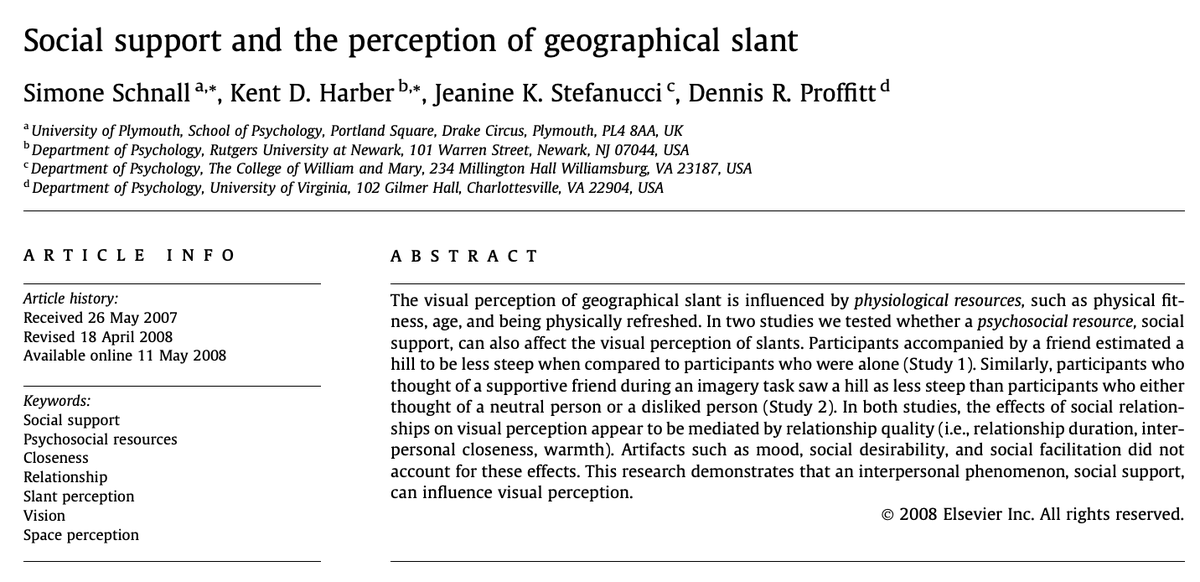
People standing at the bottom of a hill with a friend judged it less steep than people standing alone.
The longer they'd known their friend, the less steep it looked.
A good metaphor for life: even the hardest challenges can feel easier with a good friend by your side.
Bravo, @JonHaidt on being a major force in holding social media companies accountable.
For years our colleagues kept saying "...but we don't know if it's a causal influence. More research is needed..."
But the research on social media harms has been there all along, by @Meta.
If you think the fines being sought against Meta are high, at 200 B, remember that Meta has been harming children at an industrial scale for 2 decades. They knew it, their own research showed it.
We organized 35 of their own studies here:
https://t.co/JWDqxq78jB
Self-discipline served @robkhenderson well as a @Cambridge_Uni graduate student and @Gates_Cambridge scholar. He did excellent PhD research, while also writing his bestselling memoir "Troubled".
It was a pleasure and privilege to be part of Rob's Cambridge journey @CambPsych.
What actually changed my life was learning to do things I hated every single day.
Some people read the early chapters of Troubled and say, “I can’t recognize this person. How does the teenage kid I’m reading about become the person I’m speaking to now?”
The answer is simple: if you spend eight years in the military, you’re going to change.
And it took all eight of those years for me to reshape my personality, my outlook, and my priorities to the point where I could function as a self-sufficient adult.
I initially enlisted for four years. One of the most important lessons I learned during that time was that motivation is overrated. It took me a long time to understand this, but motivation is just a feeling. Do I want to do this? Do I not want to do this? Do I feel inspired today?
Self-discipline matters more than motivation. Self-discipline means doing what needs to be done regardless of how you feel. It means sticking to healthy routines and making good decisions even when you don’t feel motivated. If you can string together enough productive days over a long enough period of time, your life will begin to improve.
What’s happening internally, in terms of motivation or lack of motivation, matters less than people think. The real question is: can you do it anyway?
At first, that discipline was imposed from the outside. In basic training, the instructors enforce structure and routine. But over time, that external discipline gradually becomes internal self-discipline.
Even after my first four years in the Air Force, from ages seventeen to twenty-one, I knew I still wasn’t ready to leave that rigid structure behind. I understood that I needed more time inside an environment that demanded responsibility and consistency from me. So I reenlisted for another four years.
By the time I was twenty-four or twenty-five, I was finally prepared.
Academics write for each other, not for people.
Steven Pinker has spent over four decades doing the opposite, and thinks current academic writing is "enormous wasted effort."
"There's an awful lot of brilliant work, really smart people in academia. Why are they doing it? Just to entertain each other? Taxpayers pay for it. It should be accessible. Why should I have to read a paragraph five or six times?
It gets under my skin when academics devote so much brainpower into the scholarship and then just blow off the essential task of letting the world know what you've done."
NORC has received the @FundacionBBVA Frontiers of Knowledge Award in Social Sciences, an international honor whose past laureates include 34 Nobel Prize recipients. NORC shares the prize with @umisr.
Find out more: https://t.co/lfNOgBpobI
Announcement of the 18th Frontiers of Knowledge Award in Social Science.
@umisr and @NORCNews are honored for rigorously documenting social realities in the United States and across the world.
Democracy needs objective measurements of public opinion.
https://t.co/orAnjP4eom
Social sciences matters. Supporting the infrastructure for social science matters. That's why we've awarded the BBVA Frontiers of Knowledge Award for the first time to institutions: @umisr and @NORCNews
Many congratulations from the award jury! https://t.co/ISjyFy70Jg
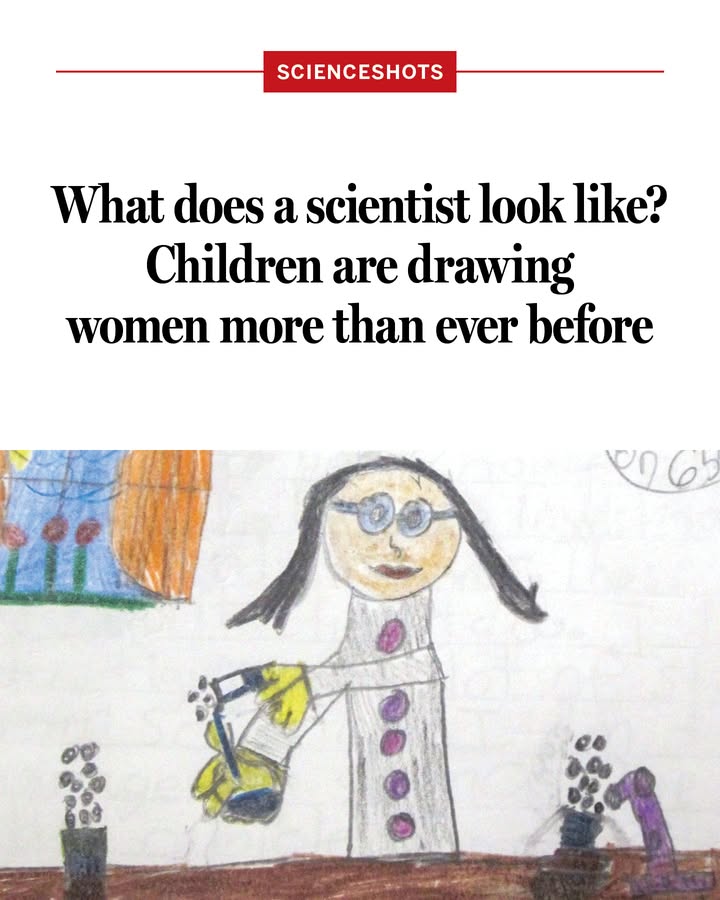
When asked to draw a scientist, school-age kids in the United States are increasingly sketching women, according to a study from 2018.
Read more on #InternationalWomensDay: https://t.co/R1S3Y3KLjE
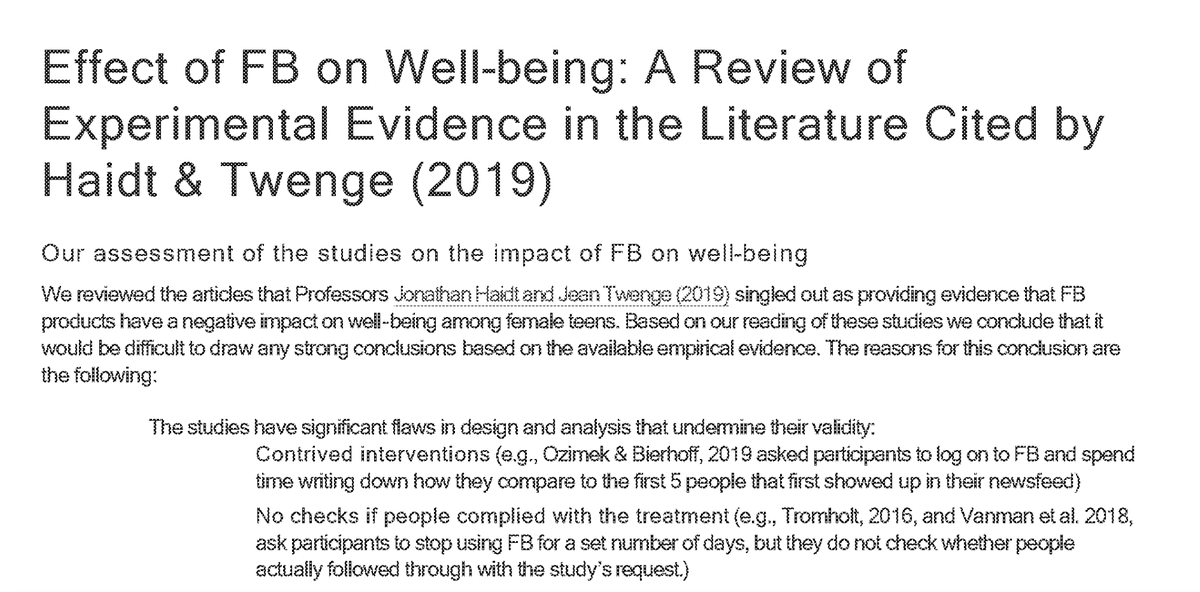
As we all comb through Meta's internal docs, released via the lawsuits, it's fun to discover that @jean_twenge and I were getting under Meta's skin by 2019. See the screenshot below, from:
https://t.co/ARcQn8uh35
They then ran their own RCT to show that Jean and I were wrong, but oops, they found that when people were randomly assigned to quit Insta or FB for a week, their mental health improved.
They called it "Project Mercury."
It is study 6.2 at
https://t.co/Nv14Y2n2kH
They found that those who stopped using Facebook for a week "reported lower feelings of depression, anxiety, loneliness, and social comparison"
Their own researchers (all of whom had Ph.Ds) concluded that: “the Nielsen study does show causal impact on social comparison.”
So whenever you hear the Meta talking point that the evidence is "just correlational," or that there is "no evidence of causality," know that this is not true, and they have known it's not true since 2019.
Please check out the other 30 internal Meta studies we found and catalogued at
https://t.co/Nv14Y2n2kH
Also, there is SO MUCH additional academic research demonstrating causality since 2019:
https://t.co/e2ifxADjd9
Today at 2pm, my talk our work about cognitive effects of engaging with beautiful art. @SPSPnews
Punch line: Aesthetic appreciation leads to abstract thinking.
Join us in Room E353C!
At 2pm today: "Honoring Jerry Clore: Affect-as-Information and Beyond", Room E353C @SPSPnews
A tribute to Gerald L. Clore's many contributions to studying affect-as-information. With Jeff Huntsinger, Linda Isbell, Michael Robinson and me.
@Oliver_S_Curry@EmmanuelMacron@JonHaidt@Ran_BarziLab Even a small effect can have massive real-life implications because depression can lead to self-harm or even suicide. And sure, it's not causal, but how long do we want to wait for causal evidence? This is not just a scientific question -- it's about billions of kids, right now.
@Oliver_S_Curry@EmmanuelMacron@JonHaidt A more recent analysis (2026) of the same ABCD data *does* find an effect on depression.
Clever study by @Ran_BarziLab compared kids who have a smartphone (n = 6739) vs. who don't (n = 3849), and what happens when they get a phone later.
Paper here: https://t.co/Q5xjwZTSw4
Social media companies have researched the negative effects on teen mental health for years, but lied about their findings.
Bravo, @JonHaidt and team for compiling all the evidence from whistleblowers, court cases etc. on this website:
https://t.co/7EAzPE2UYI
There is *tons* of evidence of social media harming young people so let's once and for all do whatever we can to protect them. Simply not good enough to keep saying "more data is needed."
Here are the 2 largest projects we've ever done to catalogue the evidence that social media is harming teens at an industrial scale:
1) A review paper, in press
2) A new website that presents 31 internal Meta studies
https://t.co/B8bAgWTfEG