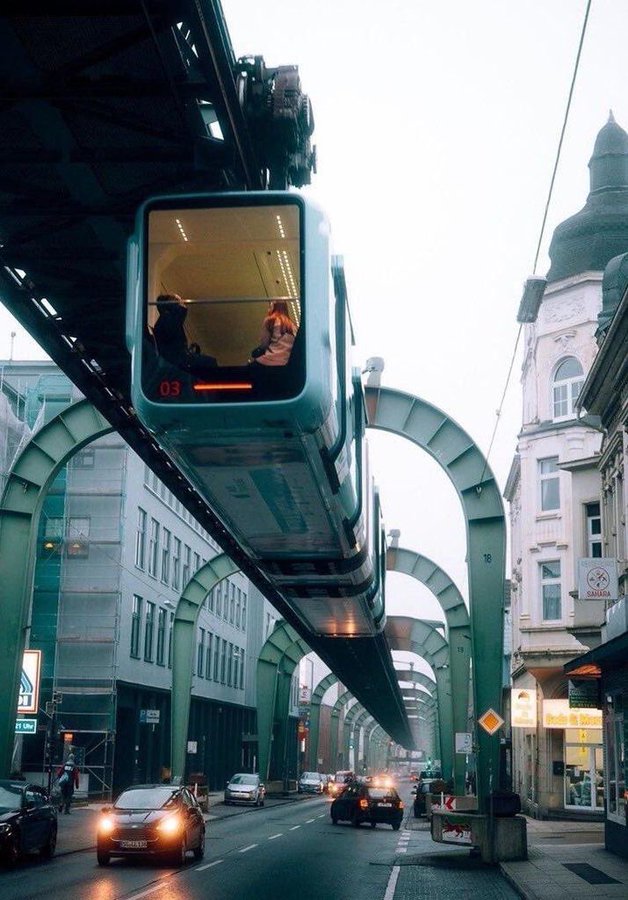
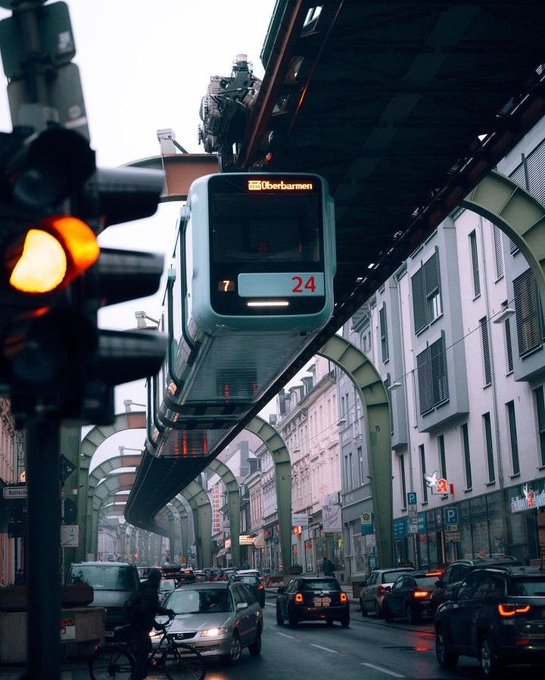
Our new @nberpubs paper extends Fogel’s social-savings approach to account for congestion and spatial externalities. These forces can change infrastructure priorities. Full explanation in the video below (sound on 🔊). ⬇️
Extending Fogel's 1964 social savings approach to incorporate traffic congestion and externalities and showing this affects where transportation investment has the greatest benefit, from @treballen, @SimonFuchs4, and @WoanFoongWong https://t.co/F1pEQWd0UC
New working paper: Maritime Vulnerabilities and Geopolitical Disruptions in Global Shipping
In a new paper with @SimonFuchs4 and @WoanFoongWong, we quantify maritime vulnerabilities around the world.
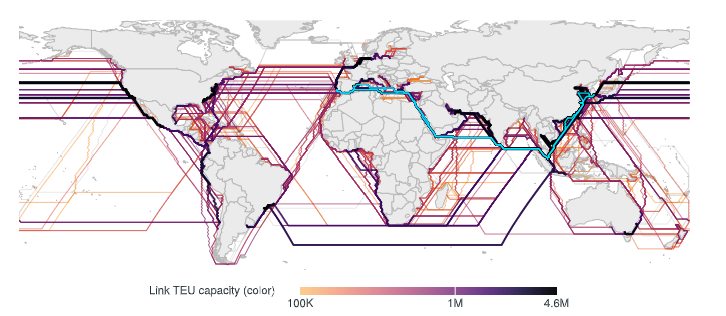
We combine novel data on shipping routes, vessel characteristics, and international trade to measure countries' exposure to maritime chokepoints, their ability to reroute, and their dependence on foreign vessels.
Motivated by this evidence, we develop a quantitative spatial model of global trade with endogenous shipping markets. The model allows us to quantify how disruptions affect shipping routes, freight rates, and economic welfare across countries.
We find that the busiest shipping routes are not necessarily the most vulnerable. What matters is how easily ships can reroute and how shipping markets adjust. Vulnerabilities differ substantially across countries, with U.S. exposure spread across distant chokepoints and China's more concentrated in East Asia.
Finally, we study two geopolitical scenarios: disruptions to maritime routes in East Asia and restrictions on Chinese-built or Chinese-operated ships. We quantify their economic consequences, including spillovers to third countries.
Paper: https://t.co/8gGdUT9oAU
Young spatial economists: apply for the August Lösch Prize 2027! Past winner Hans Koster will keynote our conference at HU Berlin, 18–19 June 2027. It should be great—even as a runner-up!
€5,000 prize · Deadline: 5 Feb 2027
Please repost!
Did we find a new dwarf planet?
@VRubinObs has revealed a new dwarf planet candidate that orbits our Sun beyond Pluto! And it may be among the largest and brightest objects discovered in this region of the Solar System: https://t.co/mPcVYVhvXZ
I keep seeing people run all sorts of documents through Pangram and get outraged when they come back as AI-positive. I feel like I’m starting to lose sight of what we’re trying to achieve here. Is the outrage always warranted? 1/
Trade JMCs: Each year, I compile a list of international-trade job-market papers. To make sure you're on my list (& save me some work), please reply with your info in the following format:
Firstname Surname (School) - JMP title - homepageURL
[Spatial JMCs: reply to other tweet]
⏳ 10 days left! Submit your working paper to the 19th @CentreFiw Research Conference “International Economics”
🗓 11–12 Feb 2027, @WU_econ , Vienna
🎤 Keynote: @FelixTintelnot (Duke)
💶 Two awards, €1,000 each
Deadline: 26 Oct 2026
Details: https://t.co/HF72qFFHLN
#CFP
@ubcVSE is hiring this year with a focus on International Trade/Spatial Economics and Macroeconomics/International Macroeconomics. Please apply!
See https://t.co/Vse7nGzh4z for more
This looks really promising. My current application with historical data requires quite a bit of fine tuning, but seemingly once finetuned competitive with google document ai. Here is a quick comparison on a problem that I'm currently working on. OCR is a really fun space.
Introducing Indra, a 1M parameter OCR model:
- 49 pages/s on CPU, 11x faster than PaddleOCR and 17x Tesseract
- Beats them on OmniParseBench text (41.3 vs 35.8 and 19.3)
- Full layout and line bounding boxes
How exposed are U.S. imports to disruptions at major shipping chokepoints?
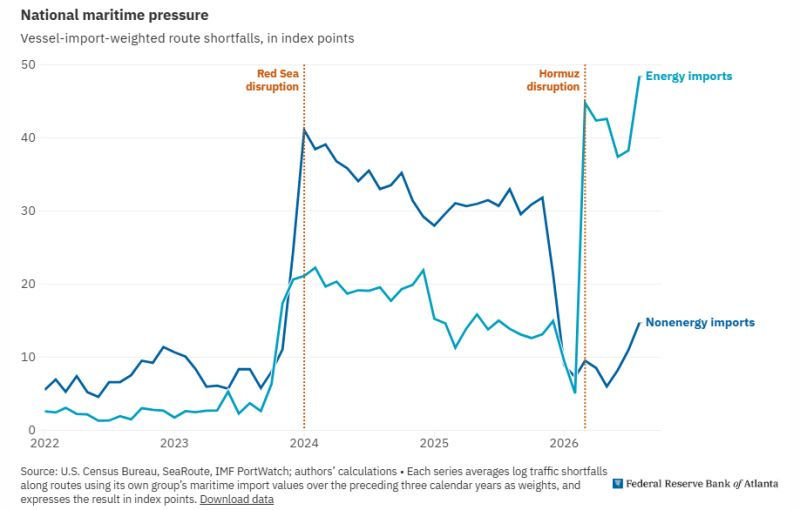
In a new @AtlantaFed's Policy Hub article with @SimonFuchs4, we construct an index to measure maritime pressures on U.S. imports using publicly available data.
The index combines vessel traffic through critical waterways with U.S. import data. It allows us to measure pressures over time and identify which products and U.S. ports are most exposed.
We find that maritime pressure peaked in January 2024, reaching five times its 2022–23 average, as disruptions in the Red Sea and restrictions at the Panama Canal occurred simultaneously.
These pressures vary considerably across products and regions. The Red Sea and Panama Canal disruptions affected a broad range of goods entering through East Coast ports. More recently, disruptions in the Strait of Hormuz generated pressures concentrated in energy imports and refining centers along the Gulf and West Coasts.
Our index provides a new tool to monitor U.S. exposure to disruptions in global shipping.
Article: https://t.co/1RMHBb1YC5
Nobel season! Little experiment - I’ve made a prediction game:
https://t.co/vO2cHghN47
Choose a team of economists for monday's announcement by spreading 100 credits across up to 10. You can change them until Sunday, Oct 11, at 8 p.m. Eastern. Just for fun and bragging rights!
Microfoundations for macro is a perfect summary of Bob Hall. The citation could also have discussed his seminal work in firm investment with Dale. Their work is the jumping-off point for my review, which I informally call the micro-to-macro manifesto: https://t.co/XNOYLK795F
Nobel season! Little experiment - I’ve made a prediction game:
https://t.co/vO2cHghN47
Choose a team of economists for monday's announcement by spreading 100 credits across up to 10. You can change them until Sunday, Oct 11, at 8 p.m. Eastern. Just for fun and bragging rights!
Nobel season! Little experiment - I’ve made a prediction game:
https://t.co/vO2cHghN47
Choose a team of economists for monday's announcement by spreading 100 credits across up to 10. You can change them until Sunday, Oct 11, at 8 p.m. Eastern. Just for fun and bragging rights!
And: Winning totals are spread across all players backing an economists encouraging you to not just pick the favorites! (Bit of strategic interaction here also)