To be honest, I'm not entirely sure about the reasons for the appearance of such gaps, but as far as I can tell, there are two possible explanations:
1) Periodic boundary conditions cut off lipids at the edges, so in effect there is a hydrophobic tail present at some location that simply isn't rendered.
2) Systems with lipid bilayers typically require very long equilibration under the NPT ensemble. Although I pre-equilibrated at 1 atm for approximately 20 ns, systems like this may require several times longer — around 100 ns or so. However, at the time I was limited in computational resources, and the system turned out to be quite large — over 2 million atoms, including water molecules.
This is a molecular dynamics visualization of TGF-β receptor 1, created in @Blender using #MolecularNodes. TGF-β pathway regulates many cellular processes including cancer formation. 1+ month of dedicated work from system prep to final render. #sciart#b3d#md#cancerdrugs
Thank you! Wow, that's a really great question! Molecular Nodes actually allows you to load molecular dynamics trajectories regardless of the method by which they were obtained — so if you have coordinate and topology files from umbrella sampling, metadynamics, or Gaussian accelerated MD with enhanced phase space sampling, you can visualize such trajectories in MN without any issues.
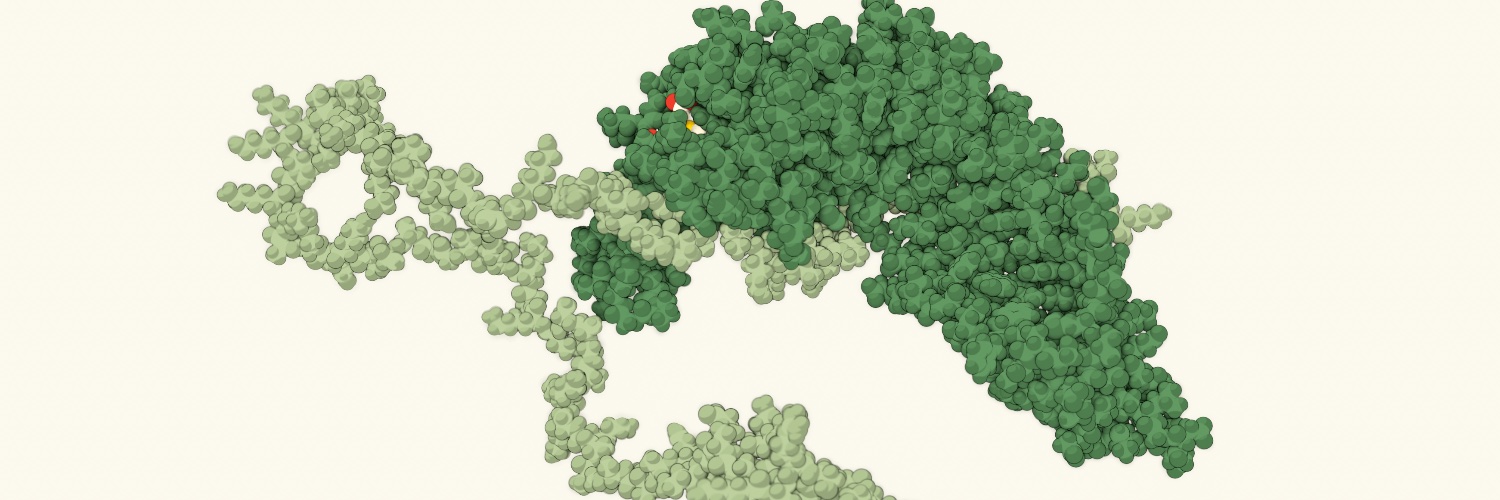
This is a molecular dynamics visualization of SETD7 and histone H1 complex, created in
@Blender using my favorite #MolecularNodes add-on by @bradyajohnston.
First time I tried to create a custom atom-cluttering sound effects as well as my own speech recording (sorry, English is not my first language).
Background music is generated by @suno
#sciart #b3d #md #blender3d
@bradyajohnston@Blender That genuinely made my day! I'm so glad you liked it. Thank you so much for Molecular Nodes! Of course, feel free to use it in your talk, I'd be honored!
This is a dynamic liposome visualization using MD trajectory data of individual lipids in @Blender using #MolecularNodes.
Blue - polar heads of phosphatidylcholine,
white - hydrophobic tails of oleic acid,
red - cholesterol molecules.
#sciart#b3d#blender3d
TIL, you can use a logarithmic depth buffer to render really tiny and large objects without using any scaling trickery.
Example: https://t.co/ACgDv0SZPa
#threejs#rendering#ComputerGraphics