Too busy with daily operations to build a website from scratch?
Here's a plug-and-play template built for your Home Service business, optimized to convert.
- trust signals that make homeowners pick up the phone
- before/after proof of work that sells itself
- clean, professional design ready to go live fast
Not a cookie-cutter theme. Not a $5k custom project. Just something in between.
https://t.co/mtoCK8XcUU
When businesses want to stand out, they often expand their services, broaden their reach, and add more to their offer.
But businesses that command higher prices often do the opposite: they specialize.
A roofing company that leads with "HOA roofing specialists" attracts a more specific type of buyer than one that markets itself to everyone, making its expertise easier to recognize and justify paying for.
A narrower offer creates a clearer brand, which can create more pricing power
The Good Enough App is live. Here's a quick demo of how it works.
I built it to combat my perfectionism of endless revising and over-optimizing.
It's a productivity app with a psychological angle:
- set a hard stop time (Parkinson's Law)
- define "good enough" before you start
- name your fear of stopping
- see if the fear came true the next day (most don't)
Try it for free. No password or setup needed, your email is your account.
Why do visitors leave a site they seemed interested in?
Often, the headline tells them what the business does but not why they should care. "We build websites for home service companies" describes the service, while "Book more jobs without increasing your ad spend" gives visitors a reason to keep reading.
Visitors rarely tell you the copy is weak. They just leave.
Your homepage has seconds to show visitors they're in the right place, and a generic headline wastes that opportunity
Local pages that don't rank often have the same structural problem: Google can't clearly identify the service and location each page targets.
Fix the architecture first:
- include the city and service in the title, H1, and opening paragraph
- keep your name, address, and phone number (NAP) consistent with your Google Business Profile
- write content relevant to customers seeking that service in that city
Clear structure gives Google a better understanding of each page before you invest in building authority
If you can't step away from your business for two weeks without things breaking, you've built dependency on yourself instead of leverage.
When every task runs through you, growth stalls because you haven't defined the outcomes clearly enough for someone else to own them.
Delegation doesn't fail at the hire. It fails at the handoff.
Handing off tasks while keeping every decision isn't delegation. It's distributed stress
Busy months and profitable months are not the same thing.
More clients can mean more work, more overhead, and less capacity to close the clients worth having.
The real filter isn't the proposal or closing call. It's the first conversation, where you decide whether a prospect is worth taking on or will become a client you struggle to manage profitably.
A discovery call that doesn't filter prospects becomes a calendar liability
The wrong move: swap tools every quarter, pour energy into setup, then restart because results haven't shown up yet.
The right move: stick with one system per function for at least 90 days, track inputs before judging outputs, and refine based on data rather than friction.
The feedback loop needs reps to form, which is impossible if you keep replacing the system.
Operators get results by staying with their tools long enough to learn what works
In 2027 operators that will win are the ones recognized before the get hired.
AI content is makes everyone look and sound the same. The differentiator is the human factor.
A plumbing company running ads with real employees on camera will always gain trust over the one running polished AI content. People hire who they trust, and trust starts with recognition.
Be genuine. Be scrappy. Just make sure your content is A+.
Getting ranked on Google and getting cited by AI are two different games.
Google rewards links and authority. AI rewards specificity and context.
When someone asks an AI who to hire for commercial flooring in Atlanta, it doesn't check your backlinks. It checks whether your content clearly answers the specifics(service, location, outcome).
Content written to solve a specific problem are the ones that gets cited.
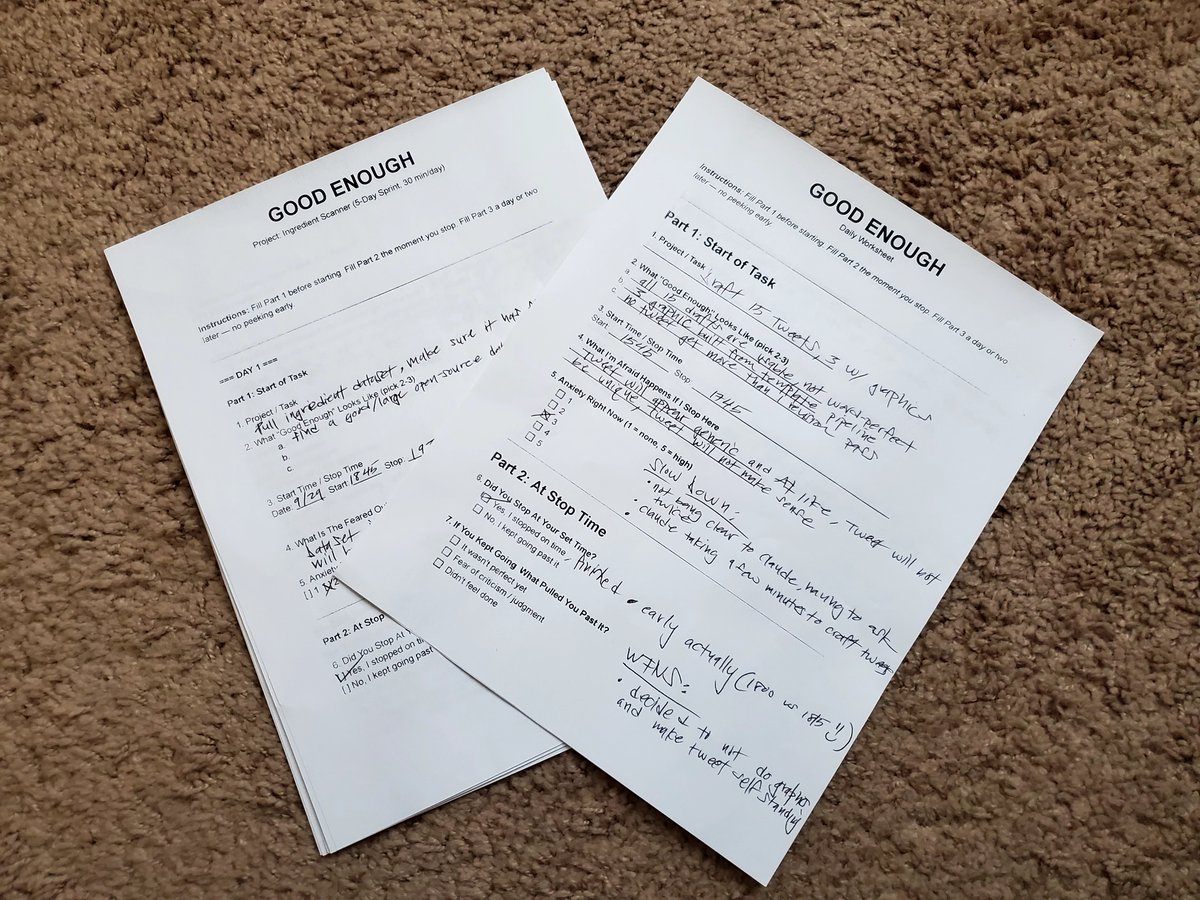
I've been a perfectionist most of my life.
It becomes a problem when it holds you back, makes you miss opportunities, or keeps you from taking action.
Over the past few weeks, I tested a worksheet call Good Enough.
Before each task, I wrote down what I feared would happen if I stopped on time. Afterward, I checked whether those fears came true, whether I stopped on time or not.
The results have been encouraging, so I'm building an app version, starting with an MVP.
Excited to share the build soon. 🛠️ 🙂
Your Google rating is not the only rating that matters anymore.
AI search pulls from directories, review sites, and list pages to decide who to recommend. A 5.0 on Google will not save you if you have a 4.0 scattered across 10 other directories.
Find 2-3 that’s dragging down and send your next 10 customers there.
This costs nothing and it's one of the easiest things you can control in how AI search sees your business.