With expertises in Speech Tech, Dr.Visarut Ahkuputra commercializes research in Thai Speech to real use. ASR AI Social Media Customer Service. #SG70#TU51#EE74
How Antennas Work in Real-World Systems 📡
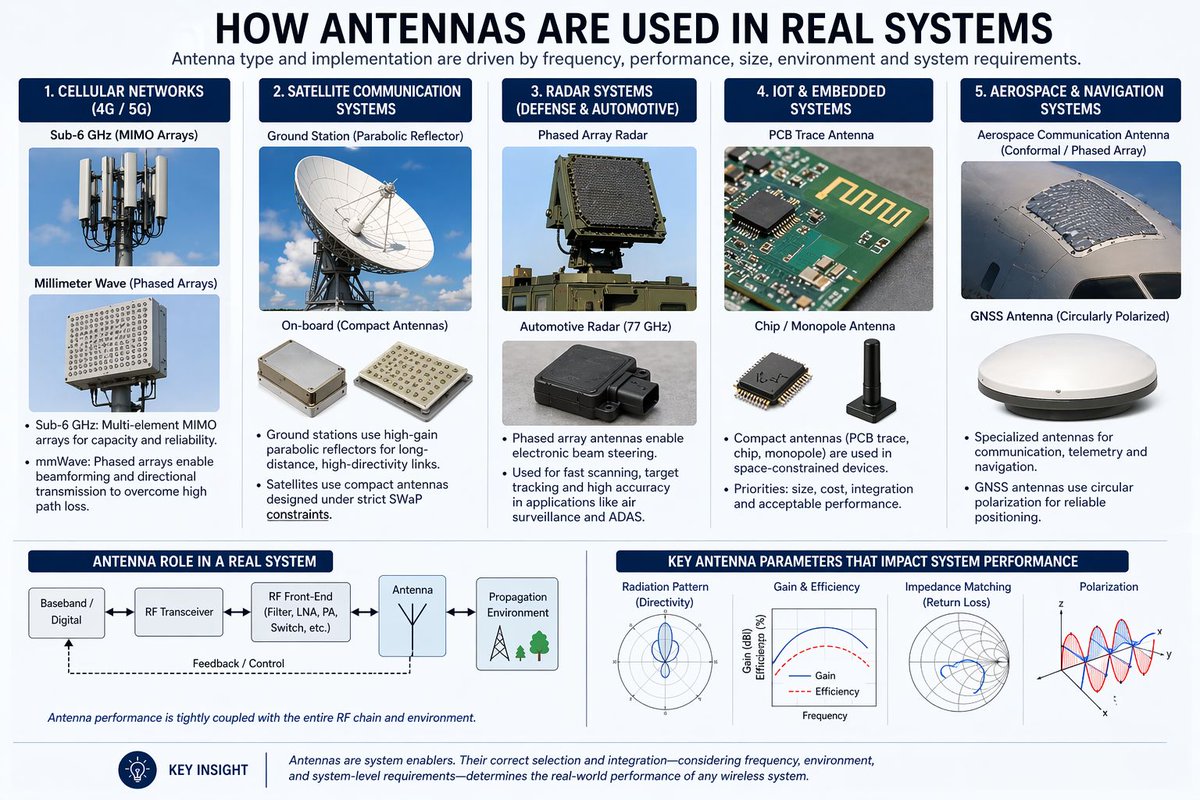
Antennas don’t exist in isolation. Their performance is deeply tied to RF front-end design, the propagation environment, and system-level goals. Here’s how that plays out across key applications:
📱 Cellular (4G/5G)
Sub-6 GHz systems rely on multi-element MIMO arrays for capacity and link reliability. At mmWave frequencies, phased arrays enable beamforming to overcome path loss and improve spatial reuse.
🛰️ Satellite Communications
Ground stations use high-gain parabolic reflectors for long-distance, high-directivity links. Onboard satellites demand compact antennas (arrays or reflectors) optimized under strict size, weight, and power (SWaP) limits.
🚗 Radar (Defense & Automotive)
Phased arrays enable electronic beam steering—no moving parts, fast scanning, precise tracking. Critical for air surveillance and automotive sensing where speed and accuracy matter.
🔌 IoT & Embedded Systems
PCB trace, chip, and monopole antennas dominate space-constrained devices. Trade-offs lean toward size, cost, and integration over raw efficiency or bandwidth.
✈️ Aerospace & Navigation
GNSS antennas use circular polarization and stable radiation patterns to maintain reliable positioning under dynamic, high-motion conditions.
Key takeaway: Antenna performance isn’t just about the radiator. Impedance matching, efficiency, polarization, and pattern shape the overall system outcome. Great antenna engineering = system-level optimization, not just a structure.
#AntennaDesign #RFEngineering #5G #IoT #Radar #Satcom