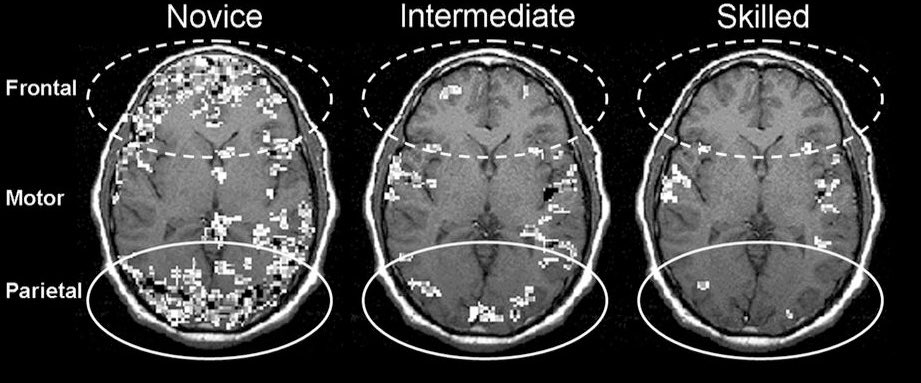
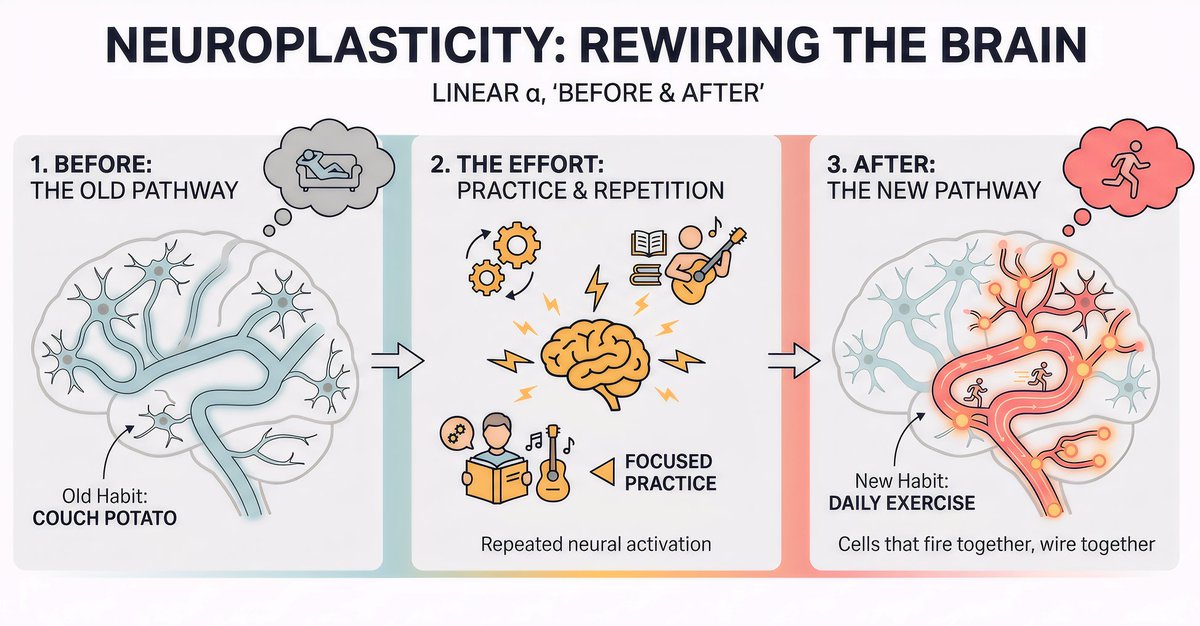
Repetition rewires the brain.
Repetition rewires the brain.
Repetition rewires the brain.
Repetition rewires the brain.
Repetition rewires the brain.
Repetition rewires the brain.
What you practice today is literally what your neural pathways become tomorrow. Choose your routines wisely.
A Stanford University experiment called ‘xenocortication’ lets human brain tissue develop inside a living mouse, offering a novel way to study the developing human brain and, potentially, how disease develops. It also raises new ethical questions about how far such experiments should go.
✍️ C. Aravinda, Veera Rajagopal
https://t.co/agKC1k1QCd
Managing Anxiety with Lifestyle
Anxiety is common. But our daily habits can influence how our brain and body respond to stress.
Here are 8 evidence-based lifestyle measures that can help reduce anxiety and improve mental well-being. 🧵
1/n
“राधाष्टमी के पावन अवसर पर श्री राधा रानी की असीम कृपा आप पर बनी रहे। आपके जीवन में प्रेम, भक्ति, शांति और आनंद का वास हो। राधे राधे!” 🌸🙏
जय जय श्री राधे! 🦚🌸💖
Utilizar videojuegos con medida puede ayudar a la memoria y mayor satisfacción con la vida.
La gente que juega videojuegos con frecuencia rinde en pruebas de atención, memoria y razonamiento como si tuviera casi 14 años menos siempre y cuando no sea demasiado.
Lo apoya un estudio de Japón: durante la escasez de consolas las sorteaban, y quienes las ganaron y jugaron un rato reportaron menos malestar y más satisfacción con la vida.
Jugar con medida puede ayudar al cerebro y al humor.
“I walk for 30–40 minutes every day.”
That is the most common answer when I ask people about exercise.
But when I ask, “Do you do strength training?” the answer is usually NO.
This is particularly important for people with insulin resistance, prediabetes and type 2 diabetes.
✅Aerobic exercise is excellent for metabolic health.
✅But strength training has its own unique benefits.
▶️Our muscles are major consumers of glucose. Strength training improves muscle mass, insulin sensitivity and the body's ability to handle glucose.
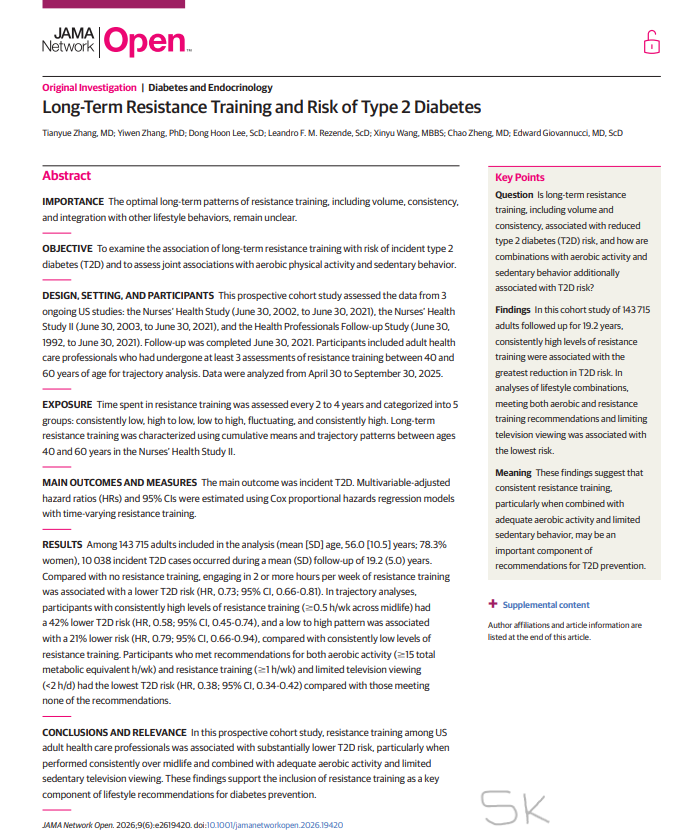
▶️Long-term studies have shown that regular strength training is associated with a significantly lower risk of developing type 2 diabetes.
🔹 Even relatively small amounts of strength training have been associated with lower diabetes risk.
🔹 Higher amounts of regular strength training appear to provide greater benefits.
🔹 The combination of aerobic exercise + strength training is better than either alone for reducing the risk of type 2 diabetes.
✅My simple prescription for better metabolic health:
🔸150+ minutes/week of aerobic activity
PLUS
🔸2-3 sessions/week of strength training
(aiming for approximately 60–120 minutes/week, depending on fitness and ability)
▶️You don't necessarily need a gym. Squats, lunges, step-ups, push-ups, resistance bands and weights can all help.
🔸Walking is good. But walking alone is not enough.
✅The best exercise programme is one that includes both aerobic exercise AND strength training.
Dr Sudhir Kumar @hyderabaddoctor