@KeniteYahwism e—a Semitic mountain language—and observed that while he attempted to pronounce the *sīn* in that same word, he was unable to articulate it using the *ṣād* sound.
@KeniteYahwism However, the pronunciation of the word *sa‘īr* (سعير) differs; in Semitic languages—including ancient Hebrew—the letter *sīn* (س) corresponds to the sound *ṣād* (ص). I personally tested this with an individual belonging to an ancient tribe that possesses its own distinct languag
Built to Last Forever? This Stone Giant Defies Time
Imagine standing in front of a structure so massive it makes you feel small, silent, and curious all at once. Built between 800 BCE and 300 BCE, this incredible megalithic monument is made from enormous stone blocks, each weighing several tons, fitted together with such precision that not even a blade could slip between them. No cement. No modern tools. Just pure human skill and intelligence. The contrast is striking—a tiny entrance carved at the base leads into a structure that towers above with overwhelming power, hinting that what lies inside was once deeply important.
Was it a tomb for the elite, a sacred ritual space, or a ceremonial site reserved for the powerful? We still don’t know. What we do know is this: the people who built it mastered quarrying, lifting, and stone-cutting techniques that continue to puzzle engineers today. Long after its builders vanished, the structure remains—silent, unshaken, and full of unanswered questions. Some monuments are built to be seen. Others are built to be remembered forever.
The Royal Road from Greece to Sumer!
The foot of the Tree of Knowledge & Life meets the foot of Shamash at the Euphrates near Suruç, Harran…& Göbeklitepe!
News, trade, and taxes to and from the king: Knowledge & life on the Stela Ur-Nammu.
@MikeAyotte1@1Quetzalcoatl1@Solomonzikel Gen 1 Elohim stands outside the world and acts by speaking: "let there be." He separates, names, blesses, and pronounces things "good." Everything goes to plan on schedule.
Yahweh didn’t fall from the sky as the one true God. He was a southern tribal war-god of the Shasu/Midianites/Kenites - local, named, and paired with a wife.
8th-century BCE pithos from Kuntillet ʿAjrud: “Yahweh of Samaria and his Asherah.” Same formula for “Yahweh of Teman and his Asherah.” Asherah was the Canaanite mother-goddess, consort of El. Popular Israelite religion treated Yahweh exactly like every other West Semitic high god: he had a female partner and sat in a pantheon.
Egyptian texts already list “the land of the Shasu of Yhw” centuries earlier. Archaic biblical poetry has him marching out of Seir, Teman, and Paran - not out of Jerusalem. No monotheism, no exclusive claim. Just another regional deity who absorbed El and Baal traits, then got cleaned up later by reformers.
Europeans got sold the post-exilic monotheist version - stripped of Asherah, stripped of the pantheon, and presented as unique—while our own Norse, Greek, and Roman gods were demonized as “false.” Same pattern: a local tribal god elevated by conquest and propaganda into the only god.
Archaeology doesn’t lie. The inscriptions are still there.
When they call us "Pagan" ( most of us are cultural pagans, European appreciators etc ) remind them that their god originally was a minor semetic pagan deity from pantheon, sold to them as monotheistic divinity.
@anglocobain@howlinghowler_@Yahvahyati_33 What? Yahweh very clearly originates as a solar warfare deity associated with the mountains and storm-weather, dawning from Seir with thunderous triumph and shining His Face upon His children.
"You don't even look into it" it is literally my primary area of academic study 💀
@michal_lw7@TheRealJamesRea@VeridianZero It's easy to know who YHWH is, it just takes comparing what Jesus taught vs what YHWH did or ordered to do. Also, Jesus talks about His Father being unknown and that no man had ever seen Him, but YHWH was seen many times, he even talked to Moses face to face.
Abraham ate a meal with YHWH, Moses spoke with Him face to face, and Isaiah saw Him on the throne… so when Iēsous told the Jews, “You have never heard His voice nor seen His form” (John 5:37), was he lying… or was he simply never talking about YHWH?
John 5:37 is not only about that crowd's personal experience. If the Father were Yahweh, saying they had never heard his voice or seen his form would deny Sinai and Isaiah. The same chapter says Moses "wrote of me," which does not identify the Father with Yahweh; Moses's writings already describe people seeing and hearing Yahweh.
دخل بنو إسرائيل مصر مع يوسف عليه السلام قبل نحو 1600 عام من الميلاد، واستقروا في أرض جاسان شرق الدلتا، وعاشوا فيها أربعة قرون حتى انقلب حالهم مع فرعون جديد.
اشتد عليهم بطش رمسيس الثاني، فذاقوا الذل والسخرة والقسوة الطويلة. فبعث الله موسى عليه السلام
🪨 Kudurru Taşı: Tanrıların İmzaladığı Sözleşme 📜
MÖ 1186… Babil’in tozlu bozkırlarında bir kral, toprağını tanrılara emanet ediyor. Ama bu sıradan bir ferman değil bu, gökyüzünün kendisine kazınmış bir antlaşma.
Üzerindeki her sembol, bir tanrının mühürü; her katman, kozmik bir hiyerarşinin haritası.
🌙 Üst katmanda Ay tanrısı Sin’in hilali, Güneş tanrısı Shamash’ın ışıkları ve gökyüzünün yıldızları evrenin en yüksek otoriteleri.
🐍 Orta katmanlarda ejderhalar, akrepler, yılanlar ve kanatlı aslanlar koruyucu ruhlar, kaosun bekçileri.
🏛️ Alt katmanlarda tapınaklar ve kurban hayvanları insan ile ilahi arasındaki sözleşmenin yeryüzündeki yansıması.
Bu taş sadece bir sınır belirlemez. Bir medeniyetin, varoluşunu gökyüzüne dayandırma çabasının taşlaşmış halidir.
“Burada birileri, sonsuzlukla anlaşmaya çalıştı.”
Tarih, aslında geleceğin en eski taslağıdır. 🔭
#Asur #sümer #Anunnaki
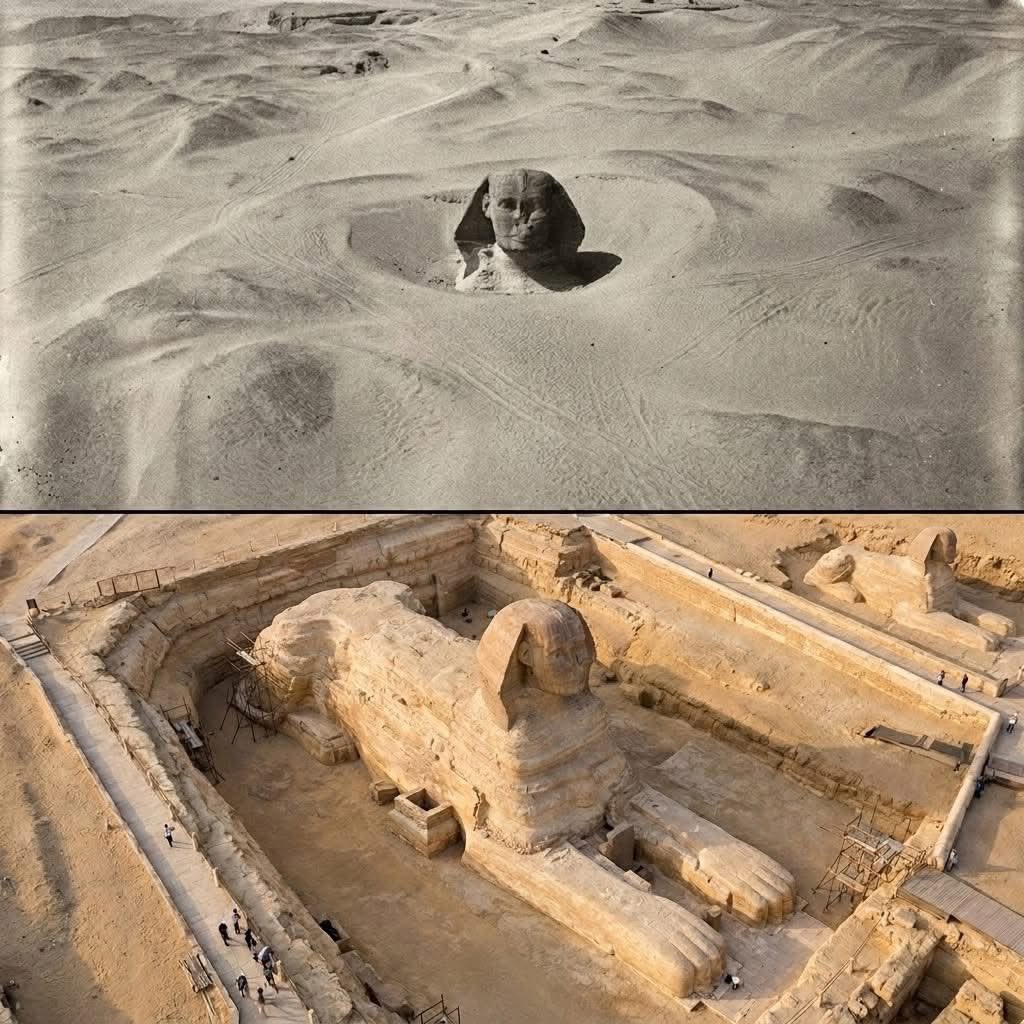
For Centuries, Egypt’s Great Sphinx Was Buried Almost Up to Its Neck…
For thousands of years, one of the most famous monuments on Earth was slowly disappearing beneath the desert.
The Great Sphinx of Giza wasn’t always sitting in full view like it is today. At different points in history, shifting sand buried almost its entire body. Imagine standing in the Egyptian desert and seeing nothing but a gigantic human head emerging from the sand.
That was the Sphinx.
Ancient and mysterious, it had been sitting there since around 4,500 years ago, watching kingdoms rise and collapse around it. By the time modern explorers arrived, much of its enormous lion-shaped body had vanished beneath the desert floor.
Old photographs make the story even more unbelievable. They show the massive head staring out across the sand while the rest of the monument remained hidden, as if some enormous creature had been trapped underground.
Then the digging began.
Slowly, layer by layer, the sand was removed. What emerged was far larger and stranger than the view people had known for centuries: the full body of a gigantic lion with a human head, carved directly from the limestone beneath the shadow of the pyramids.
And that’s where the mystery begins.
Why was it built? Who was its face meant to represent? Why combine a human with a lion? And after thousands of years of excavation and research, why are there still so many questions surrounding it?
Its nose is gone. Its face is damaged. Its stone body is covered in scars left by time and weather.
Yet there is something unsettling about the Sphinx.
It has no expression of fear. No sign of weakness. It simply sits there, staring silently towards the horizon.
More than 4,500 years have passed.
Pharaohs are gone. Their cities have disappeared. The people who built this enormous monument turned to dust thousands of years ago.
But the Sphinx is still there.
Still staring.
And perhaps still hiding secrets beneath the sands of Egypt.
@JoshuaBarzon The problem isn't that Europeans came and laid down borders that weren't perfect.
The problem is that Africans are tribal thinkers and can only behave in tribal ways and are unable to overcome tribal differences.
ie. They're civilizational morons.
This is Africa around 1880, before the fastest phase of European colonial conquest.
Look at how many names and political communities existed before the borders most of us recognize today. Ethiopia, the Sokoto Caliphate, Asante, Buganda, and countless other kingdoms, states, and communities had their own histories, rivalries, systems of government, and links to the wider world.
Some were large empires. Others were smaller kingdoms or societies governed through local institutions. A map like this can only approximate their influence; authority did not always stop at a clean line drawn across the land.
Trade connected the continent. Caravans crossed the Sahara. Ports along the Indian Ocean linked African merchants with Arabia and India. Farmers, herders, and craftsmen sustained economies that Europeans were about to try to control.
European colonialism was already present in 1880. France held Algeria, Britain ruled the Cape Colony, and Portugal possessed coastal territories. The Atlantic slave trade and earlier imperial expansion had already caused enormous upheaval.
But much of the continent was still governed by African powers.
At the Berlin Conference of 1884-85, outside powers agreed on rules concerning trade, navigation, and new colonial claims. No African rulers had a seat at the table. The conference did not draw every modern border in one sitting; conquest and further agreements followed over decades.
By 1914, European empires claimed nearly the entire continent. African resistance was widespread, and Ethiopia's victory over Italy at Adwa in 1896 helped preserve its independence.
Families found themselves living under governments whose capitals were thousands of miles away. Some communities were divided; others were placed together inside new colonial territories.
Many of those boundaries later became the borders of independent countries.
When you look at a modern map of Africa, you’re often seeing the geography of that conquest laid over a much older political world.
Map: DaniCBP / Wikimedia Commons. CC BY 4.0
https://t.co/58RpKHsXTJ