A firefly does not make its light.
Neither do you.
I wrote a short free primer on the oldest idea in the way of the strangers: the light in you is not yours. It is passing through.
Ten minutes to read. No email.
My favourite word in that book.
It's close to the heart of how I read the gospel too: the Father compels no one. He sends, and the way home is open, and you may walk it.
Thou mayest.
Honestly, this is the question that started it all for me and also for Marcion back in 144. His answer was that you don't have to blame the Father for the world's flaws, because the Father never made it.
Jesus says "a good tree bringeth not forth corrupt fruit" (Luke 6:43). Marcion simply took him at his word.
Apelles, his student, went a gentler way: the maker was blind, not evil, and the Good One came anyway.
Good work on the north. Zaphon and the Vendidad side by side is striking.
Where I part ways as Apellean: Ahriman is evil to the root, with no way back. Apelles' line is gentler. A fallen accuser, bound by the arrangement like the rest of us, and a mercy wide enough to reach him at the end.
Same north. Different ending for all.
Noah, Abraham, Moses: every covenant had terms.
The Father Jesus revealed made none. "It is your Father's good pleasure to give you the kingdom" (Luke 12:32).
A gift, not a contract.
Stephen's last sermon names two tents in the desert.
"The tabernacle of Moloch" (Acts 7:43).
"The tabernacle of witness" (Acts 7:44).
Then: "the most High dwelleth not in temples made with hands" (7:48).
Then the stones.
Which tent was the Father in?
It is a good picture. The Cathars read Revelation the same way, as already happened.
"His tail drew the third part of the stars of heaven, and did cast them to the earth" (Revelation 12:4).
In their reading, those stars are us. Fallen, not lost.
No one knew the Father before Jesus came.
"No man knoweth… who the Father is, but the Son" (Luke 10:22).
El Elyon was known.
Seventy sons. Arrows from heaven.
"The most High uttered his voice. And he sent out arrows" (2 Samuel 22:14–15).
So who calls Jesus the son of the Most High?
Luke 6:35 says "ye shall be the children of the Highest."
Tertullian, quoting Marcion's gospel, gives it as "ye shall be the children of God" (Against Marcion 4.17).
Gabriel and Zechariah say "Highest" in Luke 1. Marcion's gospel has no Luke 1.
That leaves one voice:
"What have I to do with thee, Jesus, thou Son of God most high?" (Luke 8:28)
A demon.
Gm Mico. I agree with you.
22:14 is already the merged form: "the LORD thundered… and the most High uttered his voice."
What shows they were two before the merge is Deut 32:8–9 in the Dead Sea Scroll reading: the most High divides the nations among the sons of God, and "the LORD's portion is his people."
One gives out the portions. The other receives one.
@EwTheFlub_Brian Marcion was the first person to put the Gospel of Jesus with Paul's letters. The ones after that "created their own" as a reaction to him.
Nice, following it through Joshua to David there.
Keep going two more verses. David "desired to find a tabernacle for the God of Jacob" (7:46) "But Solomon built him an house" (7:47). Then Stephen: "Howbeit the most High dwelleth not in temples made with hands" (7:48).
Tent or temple, he says neither held him.
So where was he?
@leahtrell@OvidijusKT@YourNeighbour23 Psalm 145 is a good one. Off the top of my head I know Natan can mean "let" or "allow". Do the word study, I'm curious what Logos gives you. I also use the software, it's a great tool indeed.
God told Israel to hand over their firstborn sons.
Later he said it never entered his mind.
"The firstborn of thy sons shalt thou give unto me." Exodus 22:29.
"Which I commanded them not, neither came it into my heart." Jeremiah 7:31.
Same god. Which is it?
In the second century, Marcion of Sinope wrote a book called the Antitheses. It did one thing: it set the god of the Law beside the words of Jesus and let the texts disagree in their own words.
The church burned it. It survives only in the quotations of the men who wrote against it. https://t.co/zuNdjxOgyp
Because it isn't a philosophy problem. It's the oldest Christian one.
Marcion started there in the 140s: "A good tree bringeth not forth corrupt fruit" (Luke 6:43), beside "I make peace, and create evil" (Isaiah 45:7).
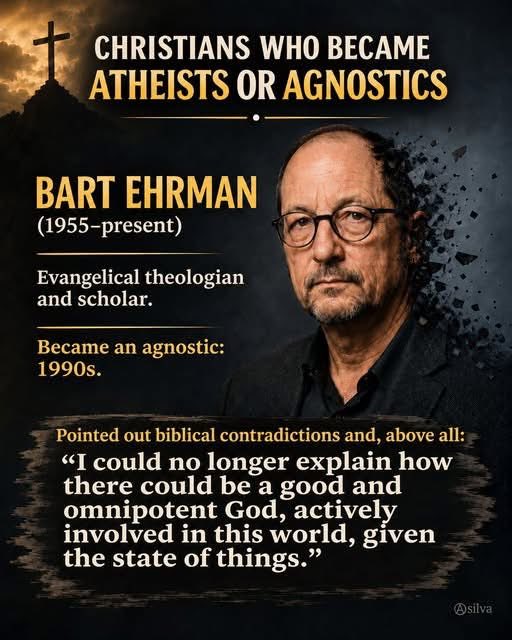
Ehrman's answer was to leave. Marcion's was to stop crediting the Father with the house.
Bart Ehrman left the faith over the problem of evil.
Marcion faced the same problem in the 140s and didn't leave. He kept Jesus and let go of the god of the flood.
"He is kind unto the unthankful and to the evil" (Luke 6:35). That one never created evil.
Because it isn't a philosophy problem. It's the oldest Christian one.
Marcion started there in the 140s: "A good tree bringeth not forth corrupt fruit" (Luke 6:43), beside "I make peace, and create evil" (Isaiah 45:7).
Ehrman's answer was to leave. Marcion's was to stop crediting the Father with the house.
That's is a careful case, now rereading it, and the NET has a fair point on 26: the Hebrew can mean "I declared them unclean," the way a priest pronounces it in Leviticus 13
But 25 doesn't move. "I gave them also statutes that were not good" uses the same verb as 11, "I gave them my statutes."
Deserve? Maybe. Jesus never asked what anyone deserved. "He is kind unto the unthankful and to the evil" (Luke 6:35).
"Now I'm talking about this stuff in church because I don't want no broke church... I can't be killing it and my church broke."
Limitless Church 'pastor' Kim Jones, adorned in a $1175 "prophetic wealth kimono" explains the importance of making bank.