What if …
the unintended consequence of this war is to damage the Gulf’s new economic model?
Photo: One of the earliest planning moments that marked the beginning of Abu Dhabi’s transformation from desert to global capital hub
Frankly, the claim ‘we didn’t anticipate that Iran would retaliate against Gulf countries after being struck’ does not sound convincing. It raises the question of whether this was a pre-emptive narrative anticipating such an outcome
Let's look at together
Over the past decade, Gulf economies have executed a clear shift:
* tourism, finance, luxury living, global events, from oil to services and capital hubs
The results were visible
* UAE (Dubai):+9,800 incoming millionaires (2025)
~$63B in wealth inflows
* Globally:142,000 millionaires relocated in 2025
*** One of the largest wealth migrations in modern history
At the same time, others lost ground
* UK:–16,500 millionaires, ~$90–100B in outflows
* Across Europe: France, Germany, Spain - net outflows
* Sweden, Norway - accelerating losses
* Europe is no longer a net wealth destination
* USA :–3,000-4,000 millionaires in outflows
This was not random
Gulf countries offered:
* zero income tax
* high quality of life
* security
* fast-track residency
* modern infrastructure
Result: capital relocation
But this model has a dependency
It relies on:
* continuous inflows of people
* stable tourism demand
* strong real estate markets
* uninterrupted capital mobility
Now consider the shock
* geopolitical tension
* travel disruptions
* rising uncertainty
* pressure on hospitality pricing
In some cases:
* aggressive discounting
* falling occupancy
* weakening pricing power
This raises a question !!!
If inflows slow:
* real estate valuations weaken
* tourism revenues decline
* liquidity tightens
And when domestic cash flows weaken:
* external assets may need to be adjusted
* overseas investments may come under pressure
So the question is not direct intent
But outcome:
Could this conflict end up weakening the very model that has been pulling global capital into the Gulf?
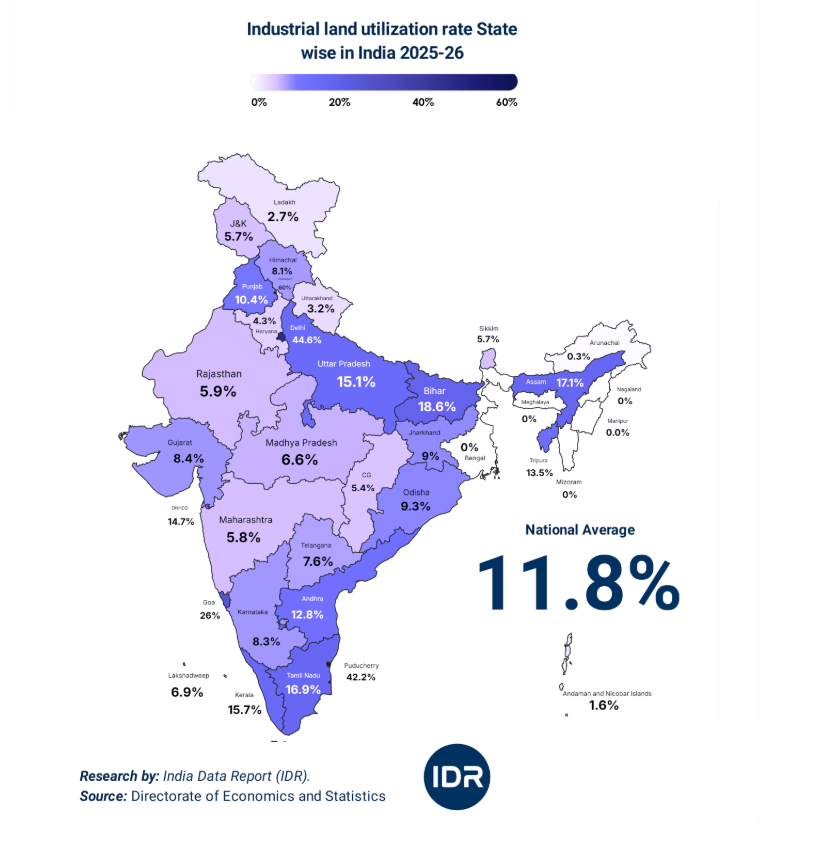
In my previous post, I highlighted underutilized industrial land in India.
I’ve now come across another interesting map on the same issue. This map adds another layer to the story
While there may be minor methodological differences between this dataset and the IMF data, the underlying reality looks similar:
* Industrial land utilization across states remains surprisingly low.
* The national average stands at just 11.8%.
* That’s striking for one of the fastest-growing major economies in the world.
* This opens up a slightly different insight beyond what I mentioned in the previous post.
Part of the explanation may lie in India’s federal structure.
In a competitive state system, local governments are under pressure:
If State A develops massive industrial parks and attracts investment, State B risks losing momentum.
That dynamic may encourage every state to announce industrial corridors, land banks, and parks, sometimes ahead of real demand.
There may also be political incentives at play.
Industrial parks make strong campaign promises.
Visible land allocation signals “development.”
But if capacity is created everywhere at once, underutilization becomes systemic.
And there is another dimension.
Industrial land often comes at the cost of agricultural land conversion.
If large tracts remain idle, the long-term effects may extend beyond manufacturing, potentially affecting agricultural balance and rural economics.
Maps's source: India Data Report
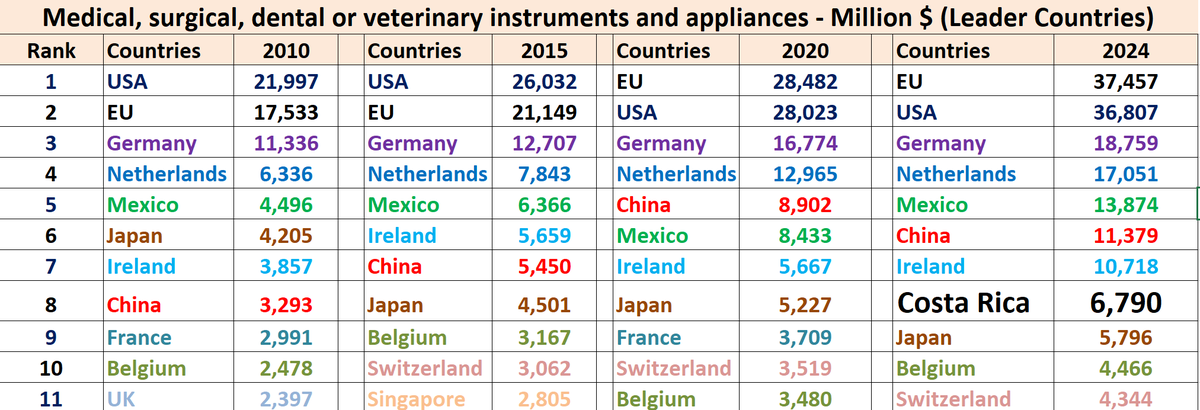
The chart in the post I quoted is actually more important than it appears at first glance !!!
Of course, this is a major transformation in itself. There is no doubt about that.
On the other hand, I believe this chart also tells another important story. This shift, while powerful, could trigger a serious negative cycle if conditions reverse , especially in a strong economy.
For example, China has planned its investments based on long-term export growth expectations. The state may have strategically supported certain sectors, absorbing part of their costs, and may still be doing so.
But what happens if exports suddenly decline, or continue outside the U.S. under less favorable conditions?
Could this create a chain reaction, and and potentially escalate into a crisis?
On the other side, what if exporters in countries currently benefiting from rising exports assume this trend is permanent? They too may eventually face a similar reversal.
In my view, one of the less visible, and potentially most disruptive, consequences of the #Trump #tariffs could be exactly this dynamic.
Thanks for the chart @Karl_Schamotta
The era of connected devices...
Are homes and offices ready for a fully connected world by 2030?
By 2030, connected home appliances are projected to become the norm rather than the exception. The question is no longer whether devices will be connecte, but whether infrastructure, buildings, and systems are ready for full integration.
::|:: Explosion in connected home appliances
The first chart shows a structural transformation in appliance connectivity.
Total connected home appliances rise steadily from the early 2010s to nearly 20 billion units by 2030.
The share of connected devices climbs from negligible levels in 2010 to a majority of all appliances by the late 2020s.
This indicates that connectivity is shifting from a premium feature to a standard embedded function.
::|:: Rapid growth in connectivity IC demand
The second chart highlights the #semiconductor dimension of this transition.
The connectivity IC market in home appliances grows from $4.2 billion in 2024 to $8.1 billion by 2030 !
This implies a CAGR of +11.6%, reflecting sustained demand rather than short-term spikes.
Wi-Fi remains the dominant connectivity technology, while Bluetooth and Zigbee/Thread support low-power and mesh-based device ecosystems.
The key takeaway is that the connected-device era is as much a semiconductor story as it is a consumer electronics story.
Strategic Implication
If nearly all appliances become connected by 2030, homes and offices must adapt:
* Network reliability
* Cybersecurity standards
* Interoperability across brands
* Energy management integration
*** The transition is not just about devices, it is about infrastructure readiness and digital architecture.
Source: @pwc by Glenn Burm
Nvidia’s $40,000 chip that sold out , and it’s already being replaced
In the video above, you’ll see a clip prepared for Nvidia’s H-series chips.
The Nvidia H100, introduced in 2022 and priced around $40,000, became the gold standard of the generative AI boom. It powered the first wave of large language models and set the benchmark for AI training.
But the story didn’t stop there.
From H100 to Grace Hopper and Blackwell !
* H100 >> 80GB memory
* GH200 Grace Hopper >> 624GB unified memory (CPU + GPU in one architecture)
* Blackwell B200 >> ~30x inference performance vs H100
* Rubin platform (2026) >> aims to cut AI costs by another 10x
* Each generation is not just faster, it fundamentally changes the scale at which AI can operate.
AI compute demand has exploded:
* 2022 >> ~1 zettaflop
* 2026 >> ~100 zettaflops
And the demand is still rising.
Is that the end of the story?
Not quite.
Training generative AI is massively expensive, both financially and computationally. Only a handful of chips globally can handle frontier-scale models.
So the real question is:
If a $40,000 chip becomes obsolete within a few years, how fast must the entire AI infrastructure evolve?
The hardware revolution is not slowing down, it’s accelerating.
Source: @wef
@VestelDestek 5 defa servis kaydı açılan ve 2 defa servis merkezine götürülen,eve gelindiğinde çalışmadığını gören servis çalışanlarına rağmen,ürünü halen daha servis merkezinde sorun göremedik yapılacak birşey yok diye bize geri göndren servis merkezinizi ve hizmeti alkışlıyorum
Bu gerçek mi ya? Osmaniye'de bina için yetkili çağırmışlar. Yetkili elindeki "ultra teknolojik" nalbur çekici ile, depremden her tatafı çatlamış patlamış binaya,vuruyor ve "sağlam bura" diyor.Kadıncağız "yine deprem olursa yıkılmaz mı?" diye soruyor. Cevap "onu Allah bilir"!
Nasuh Mahruki (@nasuhmahruki):
Asker ilk andan itibaren bütün koordinasyonu eline alacak şekilde sahaya çıksaydı, halkın yanında olabilseydi, halk çok daha fazla moral ve dayanma gücü bulurdu. TSK'nın artık böyle bir görevi yok. Bu görev alındı TSK'dan!
Sevgili Misvak ve Akit. Şu sıkıntıyı atlatalım sonra bol bol linç edersiniz beni, lütfen. Hatta geleyim yanınıza dövün beni valla ses etmeyeceğim. Şimdi sırası değil 🙏🏻 Gücünüzü bizi RT etmeye harcayın nolur. Hatta ofise gelin bi bilgisayar verelim size koordinasyona destek olun.