As the US and Iran slide back toward war, many are asking why the memorandum is collapsing so quickly.
👇In my latest for the @Guardian, I argue the deal is falling apart because it never resolved the central obstacle that has haunted US-Iran diplomacy for decades: credibility.
Tehran does not believe Washington can offer economic normalization that will endure after Iran has surrendered its principal sources of leverage.
After the 2015 nuclear deal collapsed and years of waiver-based relief proved so easily reversible, promises of future economic normalization have lost much of their credibility in Tehran.
That helps explain why Iran has become determined to maximize its leverage over the Strait of Hormuz.
Unlike promised sanctions relief, Hormuz is a source of economic and strategic leverage that Tehran itself can control.
From Iran's perspective, that offers a far more durable foundation for security than trading away key leverage in exchange for commitments that a future US administration can simply reverse.
If Washington continues to misunderstand that shift, it will keep producing agreements that neither side truly believes the other will honor.
Read the full piece here: https://t.co/j5V8nlK6nj
Iran has has a lot of time since 8 April to reconstitute its naval mining capabilities. That includes building rather crude improvised naval mines, adapting small boats for uncrewed mine laying, as well as comparatively more exotic aerial naval mine laying methods. Has it done so? We do not know, much as we do not know how many of Iran's prewar arsenal of naval mines remained by the ceasefire. Evidently some number of rocket-delivered naval mines survived.
Immediately following the breaking news of Secretary of the Army Dan Driscoll resigning, The Hill is now reporting that the Deputy Undersecretary of the Army is ALSO set to resign this week!
For all of the Trump Administration’s bluster of the Iranian leadership fracturing… it seems that the real regime change is happening in Washington.
Maybe coincidence, but a striking pattern in this war: senior US national security resignations/firings have several times preceded big escalations. Pentagon generals before the pilot/ground incursion, Navy Secretary before Project Freedom, Tulsi before renewed Hormuz fighting.
U.S. Army Secretary Dan Driscoll has just RESIGNED.
This move comes after months of internal disagreement with Pete Hegseth.
The significance and timing of such a resignation is not minor as the United States is currently in the midst of RAPIDLY escalating tensions with Iran, with President Trump indicating that more strikes will be authorized tonight.
At a time when much of the Trump Administration’s messaging strategy is built around portraying the Iranian leadership as rapidly fracturing…
It may just be the US leadership falling apart.
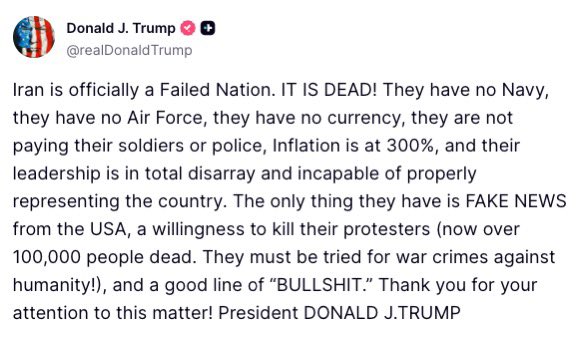
First it was 40,000 protesters in Iran. Then 52,000. Now 100,000. What's next — 200,000 by Tuesday?
The numbers are being manufactured in real-time to sell a war
This episode was significant beyond 2 launchers being hit. Delivering naval mines by missile or drone could make Iran’s ability to threaten Hormuz faster, more dispersed and harder to suppress. That may explain why the US moved so quickly against the launchers on Larak Island.
The rocket-launched standoff naval mining Fajr-5 variant offers Iran a niche capability for the Strait of Hormuz. There is also scope to use a strike drone like the Shahed-136 to deploy a 90 kg class naval mine of similar size/weight to what can be delivered by the Fajr-5. 1/
The combined 28-day average from the Strait of Hormuz, Oman, and Fujairah was 6.92 million barrels per day, TankerTrackers reports, with just under 4.5 million bpd passing through Hormuz itself.
That total does not include exports from Saudi Arabia’s west coast, which other trackers put at around 3 million bpd, down from roughly 5 million before Ansarallah’s blockade. It also excludes smaller bypass routes, including Ceyhan.
Before the war, total oil exports from the region averaged roughly 23 million bpd. Current flows are about 11–12 million barrels per day below that level.
Q: Have you ruled out using a nuclear weapon on Iran?
Trump: I would never say that but the answer is yes. There is no reason for it. What a stupid question. They’re totally defeated and now I should use a nuclear weapon on them? What a stupid question.
I spoke with @TheWorld’s @Shirinj about the Trump administration’s new economic pressure campaign against Iran, what it is trying to achieve, and why intensifying economic coercion could deepen rather than resolve the conflict. Listen here 👇
https://t.co/y1ANHTYMSt
Iran’s response to this US attack reinforces the deterrence equation it has sought to establish since the war. In response to what the US described as “limited and precise” strikes on Larak Island, Tehran says it hit US bases in Jordan and the UAE and downed an MQ-9, while reportedly continuing to target ships using Hormuz routes it rejects.
Trump is now threatening Iran again, saying “we’re going to hit them hard.”
So far, this episode reinforces the broader pattern of the war.
Washington has struggled to find military options that actually improve its position. When the US attacks, Iran seeks to hit back in a broader and more consequential way, confronting Trump with a choice between climbing further up the escalation ladder or absorbing Iran’s response.
That is the escalation trap Tehran has been trying to create for Trump.
At this juncture, Trump wants to avoid a wider conflict and keep things relatively stable heading into the midterms.
Iran, by contrast, has every incentive to deny him that stability and demonstrate that neither the status quo nor further US attacks aimed at weakening its leverage over Hormuz will come without mounting costs.
🚫CLAIM: Iran’s Islamic Revolutionary Guard Corps (IRGC) claimed in a recent statement that strikes by U.S. forces to prevent the IRGC from placing mines in the Strait of Hormuz were an “act of aggression.” This claim is absolutely FALSE.
✅FACT: U.S. forces took limited, precise action against IRGC minelaying forces posing an imminent threat in the Strait of Hormuz. In essence, Iran created the threat and the U.S. military eliminated it to protect civilian mariners, commercial shipping, and the free flow of global commerce.
Wouldn't usually pay attention to Pahlavi's wife as the family has lost the plot.
BUT the fact that Israel-aligned US neocons are suddenly trying to normalize the nuking of Iran suggests that there may be a concerted effort underway to convince Trump to do smth very stupid.
New from me in @guardian (👇). Trump is betting more pain will make Iran surrender. Tehran is betting it can outlast him while driving up the costs. Trump continues to gamble on escalation without a coherent strategy for what comes next.
https://t.co/JD0l7Os4cw
Past seven days daily average of crude oil exports via the SoH was 3.8 Mbpd. During the MoU period (which in effect only lasted for 25 days), it was 9.8 Mbpd.
In perhaps one of THE MOST embarrassing displays of TACO throughout the entire Iran War, Treasury Secretary Scott Bessent's threats to take action against a "major financial institution" turned out to be nothing but a TACO on the most epic of scale.
Reporting indicates that the US will be cutting off US Dollar and correspondent banking to the UAE's branch of Banque Misr, Egypt's second-largest bank.
Now that sounds sexy to say "Egypt's second-largest bank", but the United States didn't even SANCTION IT! It can still legally conduct business! The Trump Administration literally only cut of dollar clearing and correspondent banking access to a SINGLE BRANCH!
This is the clearest indication that the world can receive that there is no hope whatsoever in the United States winning the Iran War via Operation Economic Outcast.
Embarrassing.
TankerTrackers’ methodology directly challenges the administration’s higher Hormuz-flow claims.
Using AIS plus satellite imagery and backing out Oman and Fujairah exports, it estimates only 3.7 mmb/d actually moving through Hormuz over the past seven days.
That is the number that matters to the oil market—not gross vessel counts or barrels shuffled by ship-to-ship transfers inside the Gulf.
#Oil #Hormuz #Iran #TankerTrackers #EnergySecurity
Quoted in @StevenErlanger’s @nytimes analysis on the Iran war six months in. Washington has shown it can inflict enormous damage on Iran. What it hasn’t shown is that more pain produces surrender. That gap remains at the heart of the US approach.
https://t.co/xWq8vox1rD
Breaking news: The massive expenditure of U.S. munitions in the Middle East is worrying Asian allies and frustrating Pentagon officials overseeing the Indo-Pacific, who fear that the war with Iran could undermine U.S. readiness for a conflict with China. https://t.co/E4aHL7Dajn
BREAKING: The U.S. military faces a “beyond critical” shortage of Patriot missiles in Europe largely driven by the war with Iran, officials say. https://t.co/9Yws3BFHsy