CIVIL LAW ⚖️💫 Ejectment Involving Subterranean Portions and Structures Attached to Property 💛
Under Article 427 of the Civil Code, as applied in PLDT v. City Alliance (2019) and Barbers v. Cruz (2021), ownership of land extends not only to the surface but also to everything underneath and to the space above it up to a reasonable height, including structures attached to the property.
Accordingly, an action for ejectment may prosper even when the unlawful intrusion does not involve the surface of the land itself, but concerns the subterranean portion of the property or an encroachment upon structures forming part of the property, because such intrusion constitutes an impairment of the owner’s right to possess, use, and enjoy the property.
#Awesambar2026
#StrivewithHopeandGrit
#SuccessAchievedthroughMerit
CIVIL LAW 💛⚖️ Accion Publiciana
Under Aguillo v. Spilda Espinosa (2025), En Banc, accion publiciana is the plenary action for recovery of the better right to possess and may be filed even when the dispossession has lasted for one year or less, provided that the case does not involve the elements of forcible entry or unlawful detainer under Rule 70 of the Rules of Court.
The nature of the action is determined not merely by the allegation of ownership or the fact that ownership is mentioned in the complaint, but by the relief sought and the actual issue raised.
Hence, a complaint becomes accion reivindicatoria only when it seeks recovery of ownership or when the defendant places the plaintiff’s ownership in dispute.
#Awesambar2026
#StrivewithHopeandGrit
#SuccessAchievedthroughMerit
CIVIL LAW: Article 992 and Succession in the Direct Line — Aquino v. Aquino ⚖️ 💫
Under Article 992 of the Civil Code, as interpreted by the Supreme Court En Banc in Aquino v. Aquino (2021), the prohibition against succession between legitimate and illegitimate relatives does not apply to intestate succession in the direct line.
Thus, an illegitimate child may inherit from the legitimate parent of his or her biological or natural parent by right of representation, because Article 982 of the Civil Code does not distinguish between legitimate and illegitimate grandchildren.
However, Article 992 continues to apply to intestate succession in the collateral line.
#Awesambar2026 #StrivewithHopeandGrit #SuccessAchievedthroughMerit
CIVIL LAW ⚖️ Effect of Section 41, R.A. No. 11642 on Reserva Troncal 💫
Under Section 41 (R.A. No. 11642), the extension of legitimate filiation created by adoption may establish the relationship required for the application of reserva troncal under Article 891 of the Civil Code.
Thus, the adopter’s ascendants are considered ascendants of the adoptee, and the relatives of the adopter may qualify as relatives of the adoptee for purposes of succession.
Where the property is acquired by the adoptee (descendant prepositus) from an ascendant by gratuitous title, the adoptee dies without legitimate issue, and the property passes by operation of law to another ascendant, the property is reserved in favor of relatives of the descendant prepositus within the third degree who are also related by blood to the origin of the property.
#Awesambar2026 #StrivewithHopeandGrit #SuccessAchievedthroughMerit
CIVIL LAW; Fraud in Annulment of Marriage ⚖️
Under Article 46(2) of the Family Code, concealment of the wife's pregnancy by another man constitutes fraud only when the pregnancy exists at the time of the celebration of the marriage.
As clarified in Republic v. Villacorta (2021), the concealment of a previous pregnancy that had already terminated before the marriage does not constitute fraud for purposes of annulment, even if the husband later discovers that he is not the biological father of the child.
Thus, where the wife had already given birth before the marriage, the concealment of the child's paternity does not fall within the fraud contemplated under Article 46(2).
#Awesambar2026 #StrivewithHopeandGrit #SuccessAchievedthroughMerit
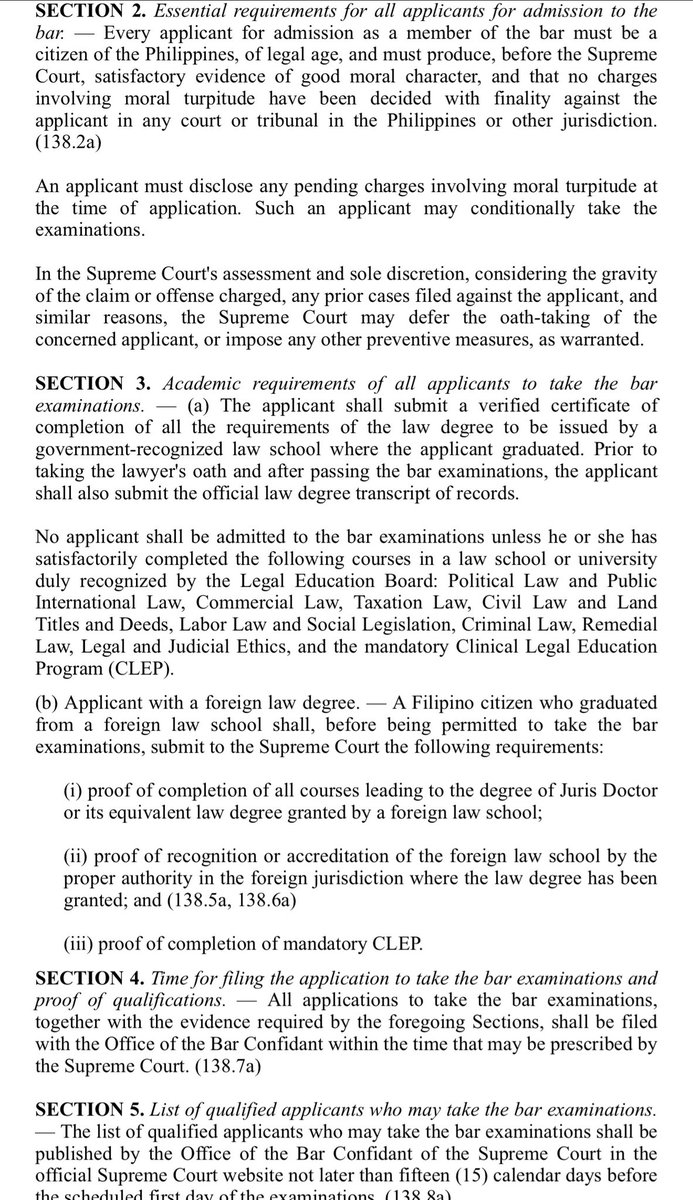
Publication of names of qualified bar applicants is mandatory per Sec. 5, Rule 148, ROC. This allows members of the public who know of reasons why a candidate is not qualified (as per Sec. 3) to file their opposition to the application.
COMMERCIAL LAW; Public Service Act (R.A. No. 11659)
Under Sec. 2(e) of R.A. No. 11659 (Public Service Act), critical infrastructure refers to any public service that owns, uses, or operates physical or virtual systems and assets so vital to the Philippines that their incapacity or destruction would have a detrimental impact on national security, including telecommunications and other vital services declared by the President.
#Awesambar2026
#StrivewithHopeandGrit
#SuccessAchievedthroughMerit
COMMERCIAL LAW; Electronic Commerce Act: Authentication of Electronic Data Messages and Electronic Documents ⚖️💛
Under Sec. 11 of R.A. No. 8792, electronic documents, electronic data messages, and electronic signatures shall be authenticated by demonstrating, substantiating, and validating the claimed identity of a user, device, or entity in an information or communication system.
Authentication may be established through:
1. Electronic Signature — by proving that a letter, character, number, or symbol in electronic form attached to or logically associated with an electronic data message or electronic document was used with the intention of authenticating or approving the document;
2. Security Procedure — by proving that an appropriate security procedure was adopted to:Verify the originator of the electronic data message or document; or
Detect error or alteration in the communication, content, or storage of the electronic document or data message.
Moreover, the Supreme Court may adopt additional authentication procedures, including electronic notarization systems and certificates of authentication for printed or hard copies of electronic documents.
The person introducing an electronic data message or electronic document in a legal proceeding has the burden of proving its authenticity.
In the absence of contrary evidence, the integrity of the information and communication system may be established by showing that:
1. The system operated in a manner that did not affect the integrity of the electronic data message;
The electronic data message or document was recorded or stored by an adverse party; or
2. The electronic data message or document was recorded or stored in the usual and ordinary course of business by a non-party who did not act under the control of the party using the record.
#Awesambar2026 #StrivewithHopeandGrit #SuccessAchievedthroughMerit
📢 The Office of the Bar Confidant has published the list of applicants who may take the #Bar2026 Examinations, pursuant to Rule 138, Section 5 of the Rules of Court, as amended.
To view the full list, scan the QR code or click the link: https://t.co/o1dTDfxjfr
#AweSAMbar2026
#StrivewithHopeandGrit #SuccessAchievedthroughMerit
#SupremeCourtPH
CHAIR'S CASE 💛⚖️ Commercial Law; Remedies for Trademark Infringement and Unfair Competition 💫
Under Section 156.4 of R.A. No. 8293 (Intellectual Property Code), the owner of a registered mark may demand an injunction against any person who infringes the trademark upon proper showing of entitlement thereto.
Thus, the court may order the infringing party to cease and desist from using the registered mark to fully protect the trademark owner’s rights.
Further, under Emzee Foods, Inc. v. Elafroods, Inc. (2021, J. Gaerlan), exemplary damages may be imposed when the accountable party deliberately engages in unfair competition, particularly when such party intentionally copies another’s marks and passes off its goods as those of another to deceive the public and take advantage of another’s goodwill.
#Awesambar2026 #StrivewithHopeandGrit #SuccessAchievedthroughMerit
COMMERCIAL LAW ⚖️ Financial Rehabilitation and Insolvency Act (FRIA) 💫 2022 BAR EXAM
Under Section 4(h) of Republic Act No. 10142, , an insolvent refers to a debtor who is generally unable to pay its or his liabilities as they fall due in the ordinary course of business or has liabilities that are greater than its or his assets.
Technical insolvency exists when the assets of the debtor are greater than its liabilities, but the debtor is generally unable to pay obligations as they fall due.
Actual insolvency exists when the liabilities of the debtor are greater than its assets.
#Awesambar2026 #StrivewithHopeandGrit #SuccessAchievedthroughMerit
CIVIL LAW; CHAIR'S CASE 📍Repeal and Nullification of Laws: Under Pimentel III v. Matula, there are two kinds of repeal:
Express repeal, when a statute expressly declares that a specific law or provision is repealed or amended; and
Implied repeal, when the provisions of the new and old laws are irreconcilably inconsistent, or when the new law covers the whole subject of the old law and is clearly intended as a substitute.
#Awesambar2026
#StrivewithHopeandGrit
#SuccessAchievedthroughMerit
COMMERCIAL LAW: 2022 BAR EXAM 📍
Under Secs. 6 and 7 of R.A. No. 8792 (Electronic Commerce Act), an electronic data message shall not be denied legal effect, validity, or enforceability solely because it is in electronic form.
An electronic document shall likewise be the functional equivalent of a written document for evidentiary purposes.
Moreover, under the E-Commerce Act, an offer, acceptance, and other elements required for contract formation may be expressed, demonstrated, and proved through electronic data messages or electronic documents, and no contract shall be denied validity or enforceability solely because it is in electronic form.
#Awesambar2026
#StrivewithHopeandGrit
#SuccessAchievedthroughMerit
COMMERCIAL LAW: Cram Down Effect in Rehabilitation Proceedings
Under BPI v. Sarabia Manor Hotel Corp. (2013), the cram-down principle allows rehabilitation courts to approve a Rehabilitation Plan despite the objections of creditors when:
1. Rehabilitation is feasible; and
2. The creditors’ opposition is manifestly unreasonable.
The exercise of cram-down power may result in the modification or impairment of contractual obligations because such modification is necessary to achieve the long-term viability of the debtor.
#Awesambar2026 #StrivewithHopeandGrit #SuccessAchievedthroughMerit
COMMERCIAL LAW: IP; Protection of Well-Known Marks Against Unrelated Goods or Services ⚖️💛
In determining whether a mark is well-known, the relevant sector of the public, the mark’s duration and extent of use, market share, distinctiveness, reputation, registration, commercial value, and successful protection of rights may be considered. (Rule 102, Trademark Rules; 246 Corp. v. Daway, 2003)
#Awesambar2026 #StrivewithHopeandGrit #SuccessAchievedthroughMerit