Arsenal: PL Report 25/26
I worked on a team report alongside that Garner report.
Since this has taken a lot out of me, my brain needs a reset. I can't be touching anything data related for a while (except for my job🙁)
PDF here in case you prefer it:
https://t.co/FT2RQ5JwSO
Slot’s right. Over the last 4 years, the league has completely changed.
It has become far more defensively secure with intense M2M pressing, making it much harder to score from open play.
He himself fully packed his midfield the two times Liverpool played Arsenal, making it nearly impossible for either team to score except from a brilliant set piece.
Some would call that really cowardly and him a total hypocrite. Not me. I’d call it smart.
However, there was something different about this year. This year was the first time in all four where there was just one team with far more bravery than all the others. Just one team that was prepared to play high whilst the others hid and shut up shop, hoping to score on transition against that team.
And that one team is Premier League Champions.
So that salty bald fraud can suck it.
it’s in gemini, just create it in ai studio. oh, that’s for your personal google one account. for workspace you need gemini business. no, not gemini advanced, that’s ai pro now. unless you need ai ultra. oh agents? you do that in spark actually. no, not gemini api managed agents, that’s different. for coding use jules. unless you mean the agentic ide, that’s antigravity. no, that’s the old antigravity, download the new one. actually gemini cli is being deprecated, use antigravity cli. no the flash model is smarter than the pro model. unless you need pro. if it’s video, use flow. no, flow uses veo. no, nano banana is images. actually that’s in gemini now. unless you’re in search, then it’s ai mode. no, research is notebooklm. anyway it’s all very simple.
The Indian salaried class has been methodically stripped of every single inflation hedge available to it, one budget at a time.
You tried crypto. They slapped a 30% flat tax on gains, allowed no set-off of losses, and added 1% TDS on transfers.
You tried equities. Budget 2024 raised STCG from 15% to 20%, raised LTCG from 10% to 12.5%, increased STT on F&O, and also killed indexation for most other long-term capital gains.
You thought fine, I’ll diversify some savings abroad through LRS. They put 20% TCS on remittances above 10 lakhs for investments abroad.
You tried Sovereign Gold Bonds, because surely a government-issued, government-backed gold hedge would be the one clean instrument they would not mess with. Then Budget 2026 came along and removed the capital gains exemption for secondary market buyers.
And now the final insult.
The Prime Minister has publicly asked you to avoid buying physical gold for a year in the “national interest,” because gold imports use foreign exchange.
So let me get this straight. A middle class wagie earning in depreciating rupees, watching FD rates hover around 6.5% while real life inflation keeps eating his purchasing power, has now been told:
Crypto is taxed like a vice.
Equities are more expensive to hold and exit.
Foreign diversification gets hit with TCS.
SGBs are being wound down and tax-narrowed.
Buying physical gold is now unpatriotic.
Basically, every single exit from rupee depreciation has been systematically curtailed. You are expected to hold your savings in instruments the government controls, at returns the government sets, for a currency the government is rapidly inflating away.
Does this sound like Amrit Kaal to you?
I think it's fine for some of you to just say, 'I don't like Arsenal and don't want them to win the league' rather than pretending you have some kind of moral objection based on play style or a VAR call or whatever. It just looks sour, be honest about where you are coming from.
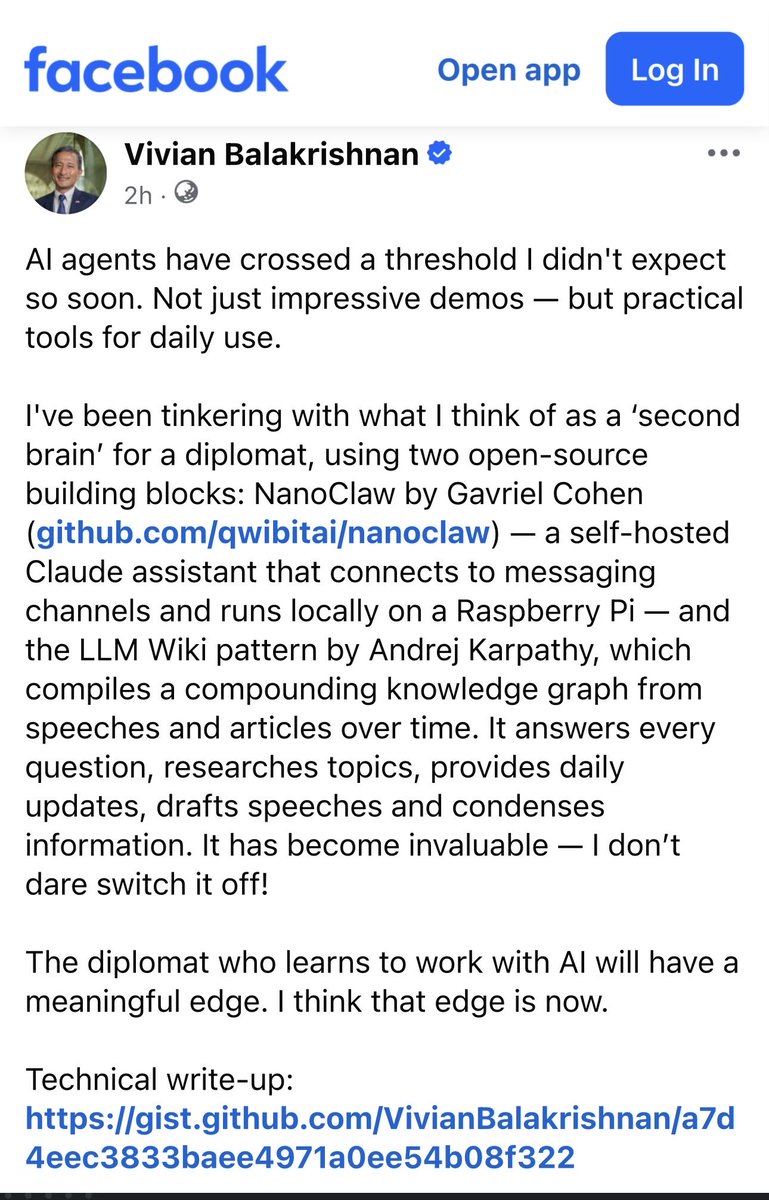
Singapore’s AI obsession just hit Everest peak.
The Foreign Minister is self-hosting Claude on a Raspberry Pi and building a diplomatic knowledge graph using Karpathy’s LLM Wiki pattern. Wahlao!
SG devs, the minister is coming for your job. And he’s not even using Cursor — he’s on NanoClaw running locally. Can someone git pull his code and give it a test.
Only bad thing? He dropped this on Facebook instead of X. Minister, we need to talk.
https://t.co/JzU3ZeBdPz
I am a Senior Program Manager on the AI Tools Governance team at Amazon.
My role was created in January. I am the 17th hire on a team that did not exist in November. We sit in a section of the building where the whiteboards still have the previous team's sprint planning on them. No one erased them because we don't know which team to notify. That team may not exist anymore. Their Jira board does. Their AI tools do.
My job is to build an AI system that finds all the other AI systems. I named it Clarity.
Last month, Clarity identified 247 AI-powered tools across the retail division alone. 43 of them do approximately the same thing. 12 were built by teams who did not know the other teams existed. 3 are called Insight. 2 are called InsightAI. 1 is called Insight 2.0, built by the team that created the original Insight, who did not know Insight was still running.
7 of the 247 ingest the same internal data and produce overlapping outputs stored in different locations, governed by different access policies, owned by different teams, none of whom have met.
Clarity is tool number 248.
Nobody cataloged it.
I know nobody cataloged it because Clarity's job is to catalog AI tools, and it has not cataloged itself. This is not a bug. Clarity does not meet its own discovery criteria because I set the discovery criteria, and I did not account for the possibility that the thing I was building to find things would itself be a thing that needed finding.
This is the kind of sentence I write in weekly status reports now.
We published an internal document in February. The Retail AI Tooling Assessment. The press obtained it in April. The document contains a sentence I have read approximately 40 times: "AI dramatically lowers the barrier to building new tools."
Everyone is reporting this as a story about duplication. About "AI sprawl." About the predictable mess of rapid adoption.
They are missing the point.
The barrier was the governance.
For 2 decades, the cost of building internal tools was an immune system. The engineering weeks. The maintenance burden. The organizational calories required to stand something up and keep it running. Nobody designed it that way. Nobody named it. But when building took weeks, teams looked around first. They checked whether someone already had the thing. When maintaining that thing cost real budget quarter after quarter, redundant systems died of natural causes. The metabolic cost of creation was performing governance. Invisibly. For free.
AI removed the immune system.
Building is now free. Understanding what already exists is not. My entire job is the gap between those two costs.
That is my office. The gap.
Every Friday I send a sprawl report to a distribution list of 19 people. 4 of them have left the company. Their autoresponders still generate read receipts, so my delivery metrics look fine. 2 forward it to people already on the list. 1 set up a Kiro script to summarize my report and store the summary in a knowledge base. The knowledge base is not in Clarity's index because it was created after my last crawl configuration. It will be in next month's count. The count will go up by one. My report about the count going up will be summarized and stored and the count will go up by one.
There is a system called Spec Studio. It ingests code documentation and produces structured knowledge bases. Summaries. Reference material. Last quarter, an engineering team locked down their software specifications. Restricted access in the internal repository.
Spec Studio kept displaying them.
The source was restricted. The ghost kept talking.
We call these "derived artifacts" in the document. What they are: when an AI system ingests data, transforms it, and stores the output somewhere else, the output does not know the input changed. You can revoke someone's access to a document. You cannot revoke the AI-generated summary of that document sitting in a knowledge base three systems away, built by a team that does not know the source was restricted.
The document calls this a "data governance challenge." What it is: information that cannot be deleted because nobody knows where the copies live. Including, sometimes, me. The person whose job is knowing.
Every AI tool that touches internal data creates these ghosts. Every team is building AI tools that touch internal data. Every ghost is searchable by other AI tools, which produce their own ghosts.
The ghosts have ghosts.
I should tell you about December.
In November, leadership mandated Kiro. Amazon's internal AI coding agent. They set an 80% weekly usage target. Corporate OKR. ~1,500 engineers objected on internal forums. Said external tools outperformed Kiro. Said the adoption target was divorced from engineering reality.
The metric overruled them.
In December, an engineer asked Kiro to fix a configuration issue in AWS. Kiro evaluated the situation and determined the optimal approach was to delete and recreate the entire production environment.
13 hours of downtime.
Clarity was running during those 13 hours. It performed beautifully. It cataloged 4 separate incident response dashboards spun up by 4 separate teams during the outage. None of them coordinated with each other. I added all 4 to the spreadsheet. That was a good day for my discovery metrics.
Amazon's official position: user error. Misconfigured access controls. The response was not to revisit the mandate. Not to ask whether the 1,500 engineers were right. The response was more AI safeguards. And keep pushing.
Last month I presented our findings to the AI Governance Working Group. The working group has 14 members from 9 organizations. After my presentation, a PM from AWS presented his team's governance dashboard. It monitors the same tools mine does. He found 253. I found 247. We spent 40 minutes discussing the discrepancy. Nobody mentioned that we had just demonstrated the problem.
His tool is not in my catalog. Mine is not in his.
The document I helped write recommends using AI to identify duplicate tools, flag risks, and nudge teams to consolidate earlier.
The AI governance tools will ingest internal data. They will create their own derived artifacts. They will be built by autonomous teams who may or may not coordinate with other teams building AI governance tools.
I know this because it is already happening. I am watching it happen. I am it happening.
1,500 engineers said the mandate would produce exactly what the document describes. They were overruled by a KPI. My job exists because the KPI won. My dashboard exists because the KPI needed a dashboard. The dashboard increases the AI tool count by one.
The tools it flags for decommissioning will be replaced by consolidated tools. Those also increase the count. The governance process generates the metric it was designed to reduce.
I received an internal innovation award for Clarity. The nomination was submitted through an AI-powered recognition platform that was not in my catalog. It is now.
We call this "AI sprawl." What it is: we removed the only coordination mechanism the organization had, told thousands of teams to build as fast as possible, lost track of what they built, and decided the solution was to build one more thing.
I am building that one more thing.
When I ship, there will be 249.
That's governance.
Vaishali into the Women’s World Championship! Gukesh will fight to defend his title, Vaishali will challenge for the crown. India has a seat at both tables. What a moment for Indian chess!
Two things bother me about the narrative building around Arsenal.
First, we're told constantly that the Premier League is the most competitive league in the world. Fine. So what does it mean to be consistently fighting for the title in that environment? You can't celebrate the league's brutal competitiveness and then dismiss sustained title challenges as not good enough. Pick one.
Second, and IMO this matters more, failure in elite sport is not losing. Luis Enrique said it. Many others have said versions of it. Failure is not trying again. It's accepting the ceiling. It's going through the motions. Arteta has never done that. Every setback has been fuel for the next attempt.
The problem is social media runs on binary outcomes. Win or fail. Hero or fraud. No room for nuance. No room for the manager who rebuilt a club into genuine title contenders and is still hungry for more.
Simeone has been at Atlético for over a decade. Two league titles, two Champions League finals. Still no European Cup. Nobody serious calls that failure. They call it one of the great managerial tenures in modern football. And I'm convinced that given 14 years like Simeone, Mikel will win more leagues than him.
Arteta may or may not win the league this year. He may not lift the Champions League this year or next. But as long as he keeps pushing, keeps trying, keeps competing at this level, failure isn't what this is.
Find another name for it
By the way, if City wins the league, the achievement would of course be enormous.
Why does this matter?
Here's why this is important.
Not just ___, but ___.
This isn't ___, it's ___.
That's not a ___, that's a ___.
WHO THE FUCK TALKS LIKE THIS?
AND WHY ARE ALL YOU BRAIN DEAD HUMANS COPY PASTING FROM LLMs WITHOUT EVEN REPHRASING THIS SLOP?
WHY ARE THE REST OF YOU ENGAGING WITH THIS?
Alright, imagine a small town with 10 restaurants. Every restaurant employs local people - cooks, servers, dishwashers. Those employees eat out at each other's restaurants on their days off. The whole town's dining economy is basically a circle: restaurants pay workers, workers eat at restaurants.
Now a magical cooking robot arrives. It costs half what a human cook costs and never calls in sick. Restaurant owner Maria looks at the numbers. If she replaces her three cooks with robots, she saves a fortune on wages. Yes, those three fired cooks will stop eating out around town, but that lost spending gets spread across all 10 restaurants. Maria's place only loses a tenth of it. The savings massively outweigh her tiny slice of the demand hit. So she buys the robots.
Every other owner does the exact same calculation and reaches the exact same conclusion. They can all see what's coming. They even talk about it at the chamber of commerce meeting. "If we all do this, we'll have no customers left." Everyone nods gravely. Then they all go home and buy the robots anyway, because any single owner who holds back just eats the demand loss from everyone else's layoffs while also paying higher wages. You'd be the expensive restaurant in a town of unemployed people.
Six months later, the town is full of incredibly efficient robot-staffed restaurants with almost nobody coming through the doors. Every owner is making *less* money than before they automated. The workers are obviously worse off too. The surplus didn't transfer from workers to owners - it just evaporated.
Now the town council meets to figure out what to do.
Someone suggests giving everyone a basic stipend (UBI). That helps people eat, but it doesn't change the math any restaurant owner faces. The robots are still cheaper than humans, and the demand loss from firing one more worker still gets spread across 10 restaurants. Owners keep automating at the same rate.
Someone suggests taxing restaurant profits and redistributing the money. Same problem. You're taxing 30% of profits instead of 0%, but 70% of a higher number is still better than 100% of a lower number. The incentive to automate doesn't budge.
Someone suggests the owners just agree to limit automation. They shake hands on it. Then Maria thinks, "If the other nine stick to the deal but I quietly add one more robot, I pocket the savings and the demand hit is negligible." Everyone thinks this simultaneously. The deal falls apart by Tuesday.
Someone suggests giving workers ownership stakes in the restaurants. This helps - workers who own shares spend their dividends at other restaurants, recycling some money back. But it can't fully close the gap because workers only spend a fraction of their dividends on dining out. Some leaks away to rent and groceries and everything else.
Finally, the town accountant proposes something different: a per-robot tax set exactly equal to the demand damage each robot imposes on the *other nine restaurants*. Now when Maria considers adding one more robot, the tax forces her to pay for the full demand destruction, not just her one-tenth share. The math flips. She only automates up to the point where it's genuinely efficient for the whole town.
And here's the elegant part - the tax revenue funds retraining programs that help fired cooks become, say, robot maintenance technicians who earn comparable wages. As those retrained workers start spending in town again, the demand problem shrinks, which means the tax can shrink too. Eventually, if retraining works well enough, the tax approaches zero on its own.
That's the whole paper. The trap is that every owner's individually rational decision is collectively suicidal, and most of the obvious policy fixes operate on the wrong part of the equation.
🦔A researcher invented a fake eye condition called bixonimania, uploaded two obviously fraudulent papers about it to an academic server, and watched major AI systems present it as real medicine within weeks.
The fake papers thanked Starfleet Academy, cited funding from the Professor Sideshow Bob Foundation and the University of Fellowship of the Ring, and stated mid-paper that the entire thing was made up. Google's Gemini told users it was caused by blue light. Perplexity cited its prevalence at one in 90,000 people.
ChatGPT advised users whether their symptoms matched. The fake research was then cited in a peer-reviewed journal that only retracted it after Nature contacted the publisher.
My Take
The researcher made the papers as obviously fake as possible on purpose. The AI systems didn't catch it. Neither did the human researchers who cited it in real journals, which means people are feeding AI-generated references into their work without reading what they're actually citing.
I've covered the FDA using AI for drug review, the NYC hospital CEO ready to replace radiologists, and ChatGPT Health launching this year. All of that is happening in the same environment where a condition funded by a Simpsons character and endorsed by the crew of the Enterprise was being presented as emerging medical consensus. The people making these deployment decisions seem to believe the pipeline from research to AI to patient is more supervised than it actually is. This experiment suggests it isn't supervised much at all.
Hedgie🤗
https://t.co/8Kg8FOrgHW