Please repost!
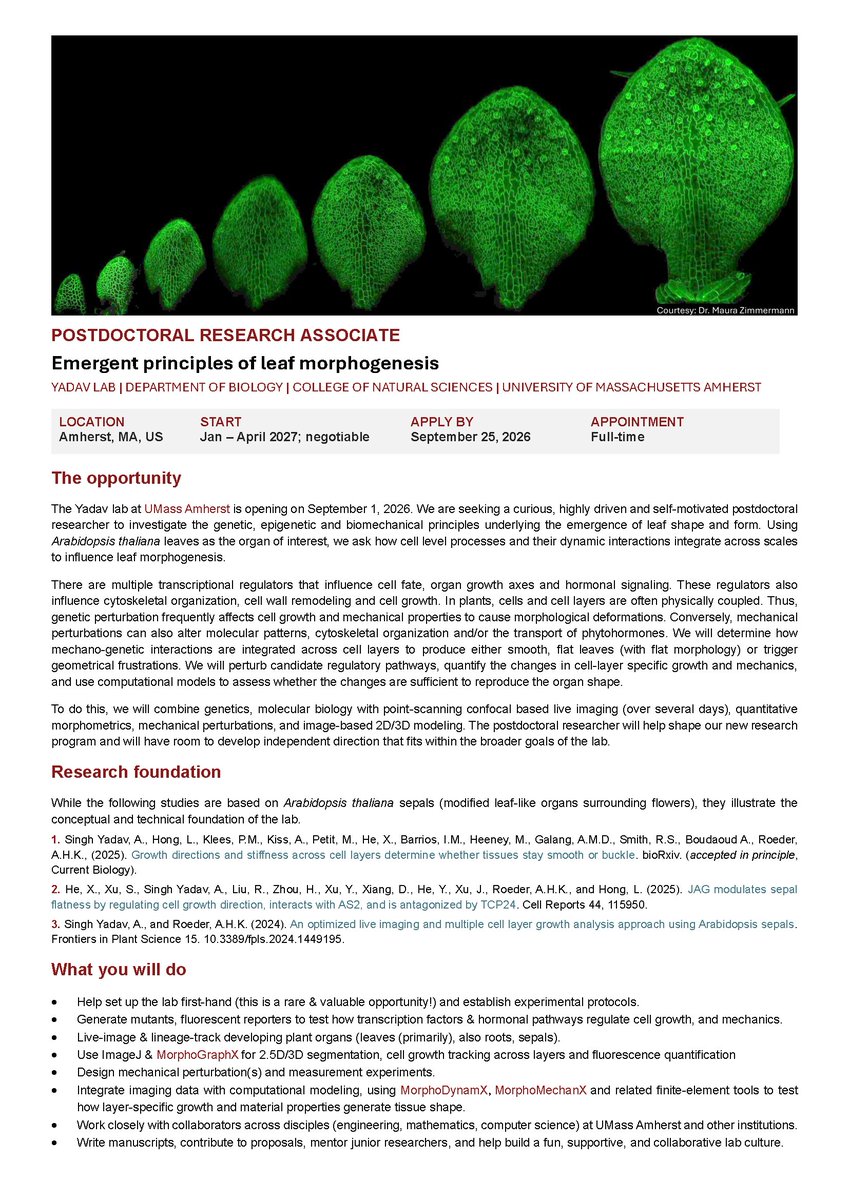
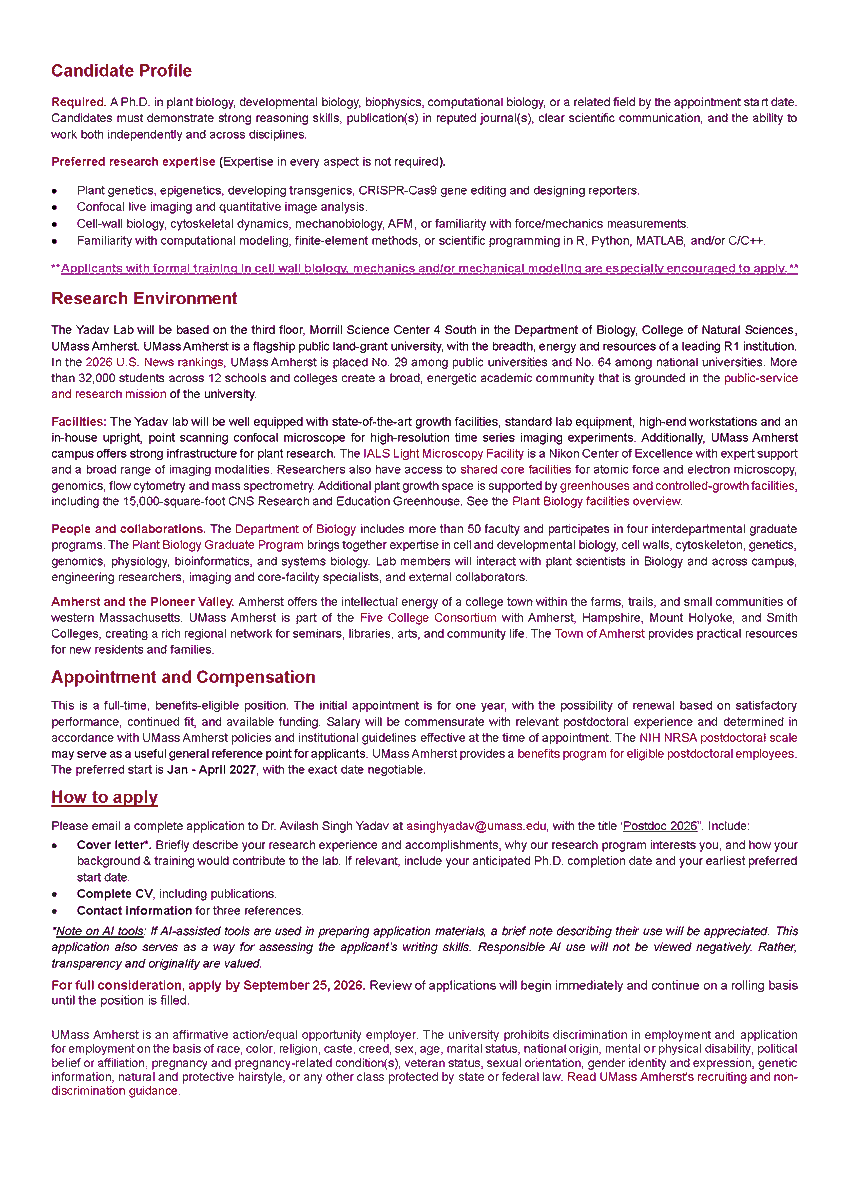
🌿 Postdoctoral position available in the Yadav Lab at UMass Amherst! 🌿
Apply by September 25, 2026. Please see the advertisement below. https://t.co/WAfLIVN7at
We are seeking a #postdoc to investigate the genetic, epigenetic and biomechanical principles underlying the leaf morphogenesis.
Applicants with formal training in cell wall biology, mechanics and/or mechanical modeling are especially encouraged to apply.
#PlantScience #DevelopmentalBiology #Morphogenesis #Mechanobiology #Biomechanics #ComputationalBiology #QuantitativeBiology #LiveImaging #Microscopy #Arabidopsis #AcademicJobs #ResearchJobs #UMassAmherst #NewPI #ScienceJobs #Biophysics #SystemsBiology
Happy to share our latest work to define the features that explain splice-site choice in eukaryotes! Here we have empirically quantified splice-site usage across individuals in Arabidopsis, Drosophila and Humans and attempted to infer patterns (1/10)
https://t.co/yuW9HtjnHo
Russell Woodford and co-authors find an essential role of PGR5 in enabling efficient C4 photosynthesis under fluctuating light by regulating photosynthetic control and energy-dependent non-photochemical quenching. https://t.co/eUDru5hNjH
Congrats Russell and thanks @AustPlantPhenom! This award will help us uncover novel genetic targets for improving productivity and resilience of crops operating C4 photosynthesis in realistic environments with fluctuating light @MonashBiol
Congrats to A/Prof @JeremyJBarr@MonashBiol on being awarded $500,000 USD from the @gatesfoundation to support ground-breaking research discovering how bacteriophages could prime human immunity and impact health. Read more 👇
https://t.co/uXIhAJAZ18
New paper! Circadian clocks in the field. Wonderful collaboration with Hiroshi Kudoh at Kyoto University, studying #circadian signalling in a natural plant population. Congrats to first authors Haruki Nishio and @Dodka_ 1/2 @JohnInnesCentre#chronobiology https://t.co/QunBYdkQqU
🚨An exciting update re. Plant Chronobiology 2025:
Announcing our Keynote Speakers! We are looking forward to Keynotes by Rob McClung (@dartmouth) and Paloma Mas (@cragenomica), chaired by @DrSteveKay!
RSVP below for more updates re. invited talks and our scientific program!
Our quantitative analysis of electron transport in C4 bundle sheath cells is finally out in @NewPhyt! We show that the CEF/LEF ratio in bundle sheath cells is >5 and half of electrons reducing PSI are coming from NDH complex. https://t.co/heVeipZxjc
Great to see the work of @Lee_B_Miles published https://t.co/E1ucg6bUct with contributions from every member of the team - thanks everyone
Looking forward to applying this an making many more disease models and make drug screening easier. #zebrafish
We tried CUT&Tag with very little amount of Arabidopsis material (less than 0.01gr!) to map different histone modifications and it works so well! Here you can our find the method
https://t.co/rYyDu7hH8I
We are hiring! :
Lecturer or Senior Lecturer in Global Change Biology
Lecturer or Senior Lecturer in Plant Community Ecology
Lecturer or Senior Lecturer in Botany or Phycology
https://t.co/GRog3JZ9mi
We already know DNA->mRNA->protein.😴
We also know RNA->DNA->mRNA->protein.😒
But DNA->ncRNA->DNA->mRNA->protein is something new!🤯
https://t.co/Dffvtc2uj7
Exciting findings from our lab's latest paper in @NaturePlants The research sheds light on the molecular mechanisms underlying epigenetic gene silencing induced by expanded repeats, revealing novel components involved.
https://t.co/yd3tvgJUPL
Here we quantified the usage of individual splice-sites and uncovered extensive variation between individuals (genotypes) in Arabidopsis, Drosophila, and Humans. Kudos to @ciden13@JordynCoutts and other authors. Well done 🌱🦟🧬 #Genetics#Research#Science
Exciting news! 📢 Our lab (@SKBLab and @GATCLab ) just published a groundbreaking paper titled "A basic framework governing splice-site choice in eukaryotes."
https://t.co/NVe4cHK9sU
Analysis of transcriptomes in multiple species across eukaryotes suggest that hexamer ranks can explain splice site choices across eukaryotes and the correlation of hexamer rankings reflect phylogenies
I am pleased to share our latest work on the genomic determinants of splice-site choice. This has been in works for the past few years and I will provide a glimpse of our journey and key findings (1/8)
https://t.co/ZdC2HQoNIj
“Next-generation DNA sequencing technology is allowing us to step back into the past.”
An impressive study of plants’ ancient DNA reveals #MicrobialAssociations and changes in #PlantGenomes through history from @rgutaker & @hernanaburbano on @kewgardens: https://t.co/xOAqYD4VHh