We’ve helped launch 70 portfolio startups so far and here’s how I gut-check good ideas from bad one.
Earned secrets. People who’ve actually done the work know counter-intuitive, contrarian things about their space. These non-obvious things are a trust signal to their customers that they really know what they’re talking about.
Obvious ideas are generally terrible.
Great ideas seem ridiculous until they become obvious.
If you’re a domain expert (minimum 5 years in your space) with a startup idea and don’t know where to start, shoot me a message or reach out to me at https://t.co/YSWlgipFDF
@WhatsApp my account of 15 years was randomly banned today with no information on why and no way to escalate a review. I lost 15 years of conversations with loved ones, some of whom are no longer alive. This is a disgrace.
@OpenAI just launched AgentKit.
Most people are thinking of it as a no-code Agentic AI builder - something like n8n.
And while that’s true, it ignores something critical: @ChatGPT's existing customer base.
When you combine AgentKit with the millions of workflows already running through @ChatGPT , it’s not just a new tool - it’s the foundation of a new economic model for startups.
For the last decade, technical leverage was the moat.
Founders who could code, automate, and ship faster had the edge - and that justified early capital.
You needed time, talent, and tech just to compete.
AgentKit flips that.
It turns technical leverage into design leverage.
The question isn’t “can you build it?” anymore - it’s “do you deeply understand a problem worth automating?”
That’s a higher bar for thought, but a much lower one for execution.
And that shift changes three fundamentals about early-stage building:
1️⃣ The MVP is no longer a milestone - it’s the starting line.
If anyone can build a workflow in eight minutes, differentiation comes from insight, not speed.
2️⃣ Capital efficiency becomes the norm.
When orchestration, iteration, and deployment cost almost nothing, raising $1M to prove demand feels bloated.
3️⃣ The founder profile evolves.
The next credible founders won’t be technical wizards - they’ll be domain polymaths who understand systems, incentives, and users better than anyone else.
AgentKit is less a dev tool and more AWS for cognition - it abstracts the hard part so more people can compete on the smart part.
For venture capital, that means a shift: from funding execution to funding judgment.
Because when everyone can build, what you choose to build becomes the differentiator.
This might be the first time in decades where both software and capital advantage erode at once - and that’ll open up paths for domain expert builders to create ultra-niche, high-value businesses.
#AgentKit #AIStartups #VentureCapital #OpenAI #FounderEconomy
@OpenAI didn’t democratize AI with Agent Builder - it just created a $4B consulting market.
Everyone’s saying: “Now anyone can build AI agents!”
But let’s be clear - Agent Builder isn’t a magic button. It’s a developer tool, not a plug-and-play solution.
It helps you prototype faster, but not deploy better.
And that’s the billion-dollar gap most people are missing.
Even the best-built agents only succeed 57% of the time in production.
Because what kills projects isn’t building - it’s:
-Integration hell (custom APIs, auth, error handling)
-Reliability issues (edge cases, data drift, compliance)
-Missing domain expertise (finance ≠ healthcare ≠ manufacturing)
That’s where the money is.
4 services that’ll dominate this wave:
1. Production hardening ($75K–$150K)
2. Custom integrations ($50K–$200K)
3. Multi-agent workflows ($150K–$500K)
4. Managed ops ($5K–$50K/mo)
Agent Builder won’t replace experts - it’ll multiply demand for them.
Just like AWS didn’t replace infra engineers and Zapier didn’t replace devs.
The easier it is to start, the more people get stuck.
And the more stuck they get, the more they’ll need people who can finish.
The gold rush isn’t in building agents.
It’s in making them work in production.
A tiny VR startup built something @Meta couldn’t - so @Meta paid $400M for it.
The company? Within
The product? A VR fitness app called Supernatural
The Problem They Saw
-VR headsets were selling, but people weren’t using them every day
-Hardware adoption was outpacing real, sticky use cases
-Fitness in VR had been mostly gimmicky - nothing felt habit-forming
What Made Supernatural Different?
Instead of just another VR workout app, they built an experience people kept coming back to:
1. Real Coaches in Immersive Worlds - live-action trainers guiding you through stunning virtual landscapes
2. Premium Licensed Music & High Production Value - made workouts feel like a studio-class experience
3. Fresh Daily Content - kept it engaging and habit-forming
4. Performance Tracking & Heart-Rate Sync - gave users measurable progress
5. Smart Subscription Model ($19/mo) - signaled ongoing value and funded better content
6. Perfect Timing - launched during the home-fitness surge and maximized Oculus/Quest reach
The Payoff
-Grew to 110,000+ paying users
-Caught Meta’s eye and sold for $400M
By focusing on habit-building, premium UX, and fresh content, Supernatural turned what could’ve been a gimmick into one of VR’s biggest wins.
What’s the one underutilized use case in your industry no one’s built for yet?
Drop your thoughts - I’d love to explore with you👇
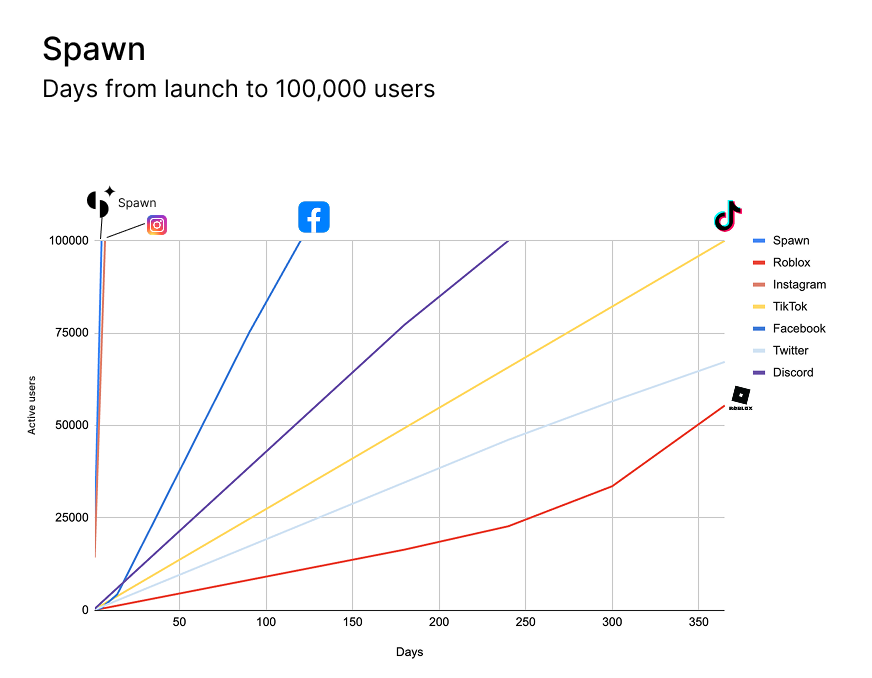
Spawn hit 100K users in 5 days.
Instagram needed 7.
Most founders blame slow growth on marketing.
Truth is - it’s often the format that’s broken.
Spawn flipped the script.
Instead of scrolling feeds, it made live games the social currency.
Not something you watch. Something you do with friends.
Here’s what unlocked the breakout:
-Clean core: the product is the game - no extra layers
-Built-in distribution: every game session is an invite loop
-Delight factor: real-time play + AI-powered creation = instant wow
The payoff:
-100K+ users in just 5 days
-Beat Instagram’s legendary 7-day record
-Backed by top VCs betting on games as the next social network
Takeaway for founders:
Your first product doesn’t need a massive feature set — it needs a clean, addictive core loop that naturally drives users to bring in others.
Spawn didn’t “add virality” later; the game was the viral mechanic. That’s the bar.
If you’re at the idea stage, don’t ask: “What features can I add?”
Ask: “What’s the one thing my product does so well that users can’t help but pull others in?”
Get that right, and growth becomes a byproduct of usage - not a separate marketing problem.
The future of social networking may not be photos or videos.
It’s play. 🎮
👉 What do you think - will “play” overtake photos and videos as the next social language?
From 0 to NVIDIA
DeepMap went from stealth startup to $450M+ valuation and acquisition in 5 years.
Why?
Because autonomous vehicles don’t just need maps.
They need machine-readable, centimeter-accurate maps.
Not built for humans.
Built by machines, for machines.
The old playbook?
-Build traditional maps for drivers.
-Pinpoint locations to within meters.
-Hope for safety with vague geodata.
DeepMap’s breakthrough:
-HD Mapping-as-a-Service: 3D maps with lane-level geometry.
-Real-time Localization: Vehicles knew exactly where they were.
-Crowdsourced Intelligence: Sensor-agnostic, cloud-based mapping at global scale.
The results?
-$92M raised from A16Z, Accel, NVIDIA, Goldman Sachs
-Used by Ford, Honda, SAIC, Mercedes-Benz
-Acquired by NVIDIA in 2021 to power their DRIVE platform.
For early-stage founders:
1.Solve a non-negotiable problem.
DeepMap didn't build a "nice-to-have"-they built the one thing AVs couldn't ship without. Ask yourself: What breaks if your product doesn’t exist?
https://t.co/384yJyqljQ for your best-fit customer-not your first one.
Their first users weren’t just testers-they were tier-1 automakers. Build your v1 for the right user, not the most available one.
Your v1 doesn’t need to be big. It just needs to be critical.
#startups #founderstory #deeptech #autonomousvehicles #productstrategy
100+ rejections. No tech background. $26B company.
That’s Melanie Perkins’ story building @canva . And for early-stage founders, there’s so much to learn from it.
She didn’t start by building “@canva.” She started by solving one painful problem - making yearbooks easier to design. That became Fusion Books, and eventually snowballed into the Canva we know.
Here are 5 takeaways for early-stage founders (especially non-technical ones):
1. Start with a problem that’s worth solving.
Melanie noticed students struggling with Photoshop. That pain point turned into her wedge.
2. Rejection isn’t failure - it's feedback.
She heard 100+ “no’s” before her first “yes.” Each one sharpened the pitch and clarified the vision.
3. Don’t wait for a technical co-founder.
She didn’t code. But she focused on product, recruited the right people, and stayed relentless. The right team followed.
4. Distribution is half the battle.
Learning to kitesurf just to be where investors were? Wild - but smart. Relationships move faster than ads.
5. MVP is a wedge, not a wall.
Fusion Books wasn’t @canva . But it got her in the game, let her learn, and validated the need for a better design platform.
At BYLDD , we’ve seen this too. The goal isn’t to build a perfect product - it’s to build something customers will pay for, fast.
Launch → learn → iterate → grow. That’s the loop.
#startups #founderjourney #productdevelopment #canva #mvp #byldd #earlystagefounders #buildlean
Outsourcing product development can either accelerate your startup-or sink it.
Most early-stage founders (especially non-technical ones) fall into one of two traps:
1. Overbuild and burn $50K+ on features no one needs
2. Under-build and hand a vague spec to a freelancer and hope for the best
Neither works.
Done right, outsourcing isn’t just about saving time or money
It’s about focusing your limited energy on the highest-leverage work:
- Talking to users
- Refining positioning &
- Iterating quickly
Here are 5 lessons I’ve learned working with early-stage teams:
1. Build the test, not the dream
Your v1 is just a hypothesis. Its job is to validate demand, not fulfill your full vision.
2. Scope like a surgeon
If a feature doesn’t help you sell or learn-cut it.
3. Communicate context, not just tasks
Your dev team should know why a feature matters, not just what it is.
4. Avoid the “yes-man” vendor
You want a partner who challenges assumptions, not one who agrees to everything.
5. Don’t neglect IP and handoff
Set this up right from day one-repos, contracts, and ownership.
I wrote more about this here:
👉 https://t.co/a60WF0UM6B
Curious-if you’ve outsourced product development before, what worked for you and what didn’t?
#startups #productdevelopment #MVP #earlystage #founderlessons #outsourcing
From $0 to $32 Billion in 5 years!
Wiz went from an ambitious idea to one of the fastest-growing cybersecurity startups in the world - and there’s a lot founders can learn from how they built.
Instead of chasing perfection early on, Wiz focused on speed to market.
They launched with a product that was good enough to solve a painful problem and iterated quickly with customer feedback.
That focus allowed them to:
- Validate demand fast
- Win enterprise trust
- Scale revenue without wasting cycles on “nice-to-have” features
For early-stage founders, the lesson is simple but powerful:
1. Ship fast → Don’t wait for perfect; get something usable in customers’ hands.
2. Stay close to users → Real feedback beats assumptions every time.
3. Prioritize trust → In markets like security (but really in all markets), credibility compounds into growth.
Wiz is proof that execution > ideas.
A great team + relentless focus on customer pain points can turn even a crowded market into a breakout opportunity.
👉 What’s one thing you’re over-engineering right now that you could cut to get to market faster?
@OpenAI went from $0 to a $300B+ valuation in just 10 years
How did a tiny nonprofit turn into the most powerful AI company in the world?
Reason: they nailed 4 basic things
1. Purpose > Profit:
They started with one mission: “make AI benefit everyone.” This attracted the best researchers in the world, before money ever came in.
2. Openness → Control:
They began open-sourcing to build credibility. But as models got powerful, they pivoted to controlled releases balancing hype with safety.
3. Speed of Execution:
GPT-2 was cautious. GPT-3, GPT-4, and ChatGPT? Launched fast, iterated faster. That’s how ChatGPT hit 100M users in 2 months and now serves 700M+ weekly users.
4. Partnerships that Scale:
Microsoft gave them compute + distribution. SoftBank is now pushing $40B. Without these, @OpenAI couldn’t have scaled to $300B this quickly.
💡 The result:
@OpenAI isn’t just an AI company.
It’s a masterclass in how to build under uncertainty, pivot when needed, and scale at lightning speed.
Which move do you think mattered most:
Mission, Openness, Speed, or Partnerships?
#OpenAI #AI #Startups #Growth #LeadershipTips
@OpenAI just revealed what people actually use @ChatGPTapp for
…and every single bar in this chart is a billion-dollar startup waiting to be built.
Here’s what the data shows - and what founders can do with it:
1. Tutoring & Teaching (10.2%)
What the data says: People aren’t just looking for answers - they want to learn. This is the single largest category of use.
Founder takeaway:
Build AI tutors that adapt to each user’s learning style, track their progress, and nudge them consistently. Think of a tool that is always available, never judges, and remembers where the user left off - perfect for lifelong learning, career upskilling, or K-12 education.
2. How-To Advice (8.5%)
What the data says: Users are asking “how do I…” across every niche - job prep, meal planning, DIY, business setup.
Founder takeaway:
Each “how-to” is a wedge into a niche vertical. Build AI agents that don’t just give instructions, but walk users through the process - maybe even automate steps. Example: a Shopify setup copilot that writes product descriptions, configures shipping, and launches ads.
3. Writing & Editing (18% combined)
What the data says: Nearly 1 in 5 conversations are about writing or improving text - from email drafting to text critique.
Founder takeaway:
Embed AI into workflows where writing happens: sales CRMs, HR platforms, legal review tools, PR dashboards. Make it collaborative - not just a blank chat box, but a context-aware editor that understands company tone and purpose.
4. Health, Fitness & Self-Care (5.7%)
What the data says: People trust AI with questions about their health, body, and habits - despite this being a sensitive area.
Founder takeaway:
Build AI products that combine personalisation + accountability. Example: a fitness AI that not only generates workouts but adapts them based on past adherence, checks in daily, and escalates to a human coach when needed. This space can win big if trust is handled carefully.
5. Product Recommendations (2.1%)
What the data says: People are already asking AI what to buy - from gadgets to books.
Founder takeaway:
This is an intent-rich query. Build an AI shopping layer that combines product discovery, reviews, price comparison, and affiliate links - the “SEO of the future.” Early movers can own high-value verticals (fashion, travel, SaaS, B2B tools).
6. Translation (4.5%)
What the data says: Users don’t just want translation - they want tone, slang, culture, nuance.
Founder takeaway: Build AI that translates intent, not just text. A tool that helps businesses localize marketing campaigns or individuals communicate naturally across cultures could disrupt entire localization agencies.
7. Programming Help (4.2%)
What the data says: Developers use AI as a coding assistant - but general copilots aren’t enough.
Founder takeaway: Build vertical copilots for specific stacks, tools, or workflows. A copilot that knows Shopify Liquid inside-out or helps with Unreal Engine scripting can become the default tool for that ecosystem.
Big Picture for Founders:
This data is a map of demand. Each bar represents behavior people are already paying for - tutoring, coaching, editing, recommending.
Your job is to:
- Pick a wedge where you have insight or unfair advantage
- Go deep, not broad - solve that workflow better than anyone
- Layer trust + personalization so users come back daily
The next billion-dollar companies won’t just use AI - they’ll own one of these behaviors.
💭 If you had to pick just one of these wedges to build a company around, which would you choose - and why?
#AI #Startups #SaaS #Product #GenerativeAI #ChatGPT
@amasad Learning to code is the most effective way of figuring out how to break down problems. There is no alternative that gives you close to the same benefit as consistent, challenging coding work.
Building a booking platform for one of our portfolio companies to automatically call vendors, qualify them based on an evaluation matrix and present data with a recommendation to a human. Saving weeks or work with AI. Application extends to recruitment, sales, events and more.