You have noticed it. ChatGPT feels dumber than it used to. Your prompts that worked six months ago produce worse results now. The writing sounds flatter. The ideas sound safer. The internet itself feels like it is shrinking. Every article reads the same. Every email sounds the same. Every answer sounds like it was written by the same voice.
You thought it was you. It is not you.
Researchers at Oxford and Cambridge published a paper in Nature proving what is happening. They call it Model Collapse.
Here is the mechanism in one sentence. AI trained on AI-generated data gets dumber every generation until it forgets what real human data looked like.
The internet is filling with AI-generated content. Blog posts. Articles. Reviews. Comments. Social media. AI companies scrape the internet to train the next generation of models. Which means the next generation of AI is being trained on the output of the current generation.
Each cycle loses information. Not randomly. It loses the rarest, most unusual, most creative parts first. The researchers call these the "tails of the distribution." The weird ideas. The unexpected perspectives. The things that made the internet feel human. Those disappear first.
What remains is the average. The safe. The expected. The bland.
Then the next generation trains on that. And loses more. And the next generation trains on that. And loses more. The researchers proved this is not a slow decline. Major degradation happens within just a few iterations. Even when some of the original human data is preserved.
They tested it on large language models. On image generators. On statistical models. The pattern was the same every time. The output converges toward a narrow, flattened version of reality that looks nothing like the original data.
The lead researcher put it plainly. "Large language models are like fire. A useful tool. But one that pollutes the environment."
The pollution is invisible. You cannot see which sentence on the internet was written by a human and which was written by AI. Neither can the AI that is about to train on it. And once the tails are gone, they do not come back. The damage is irreversible.
This is not a prediction anymore. It is a diagnosis.
The internet you grew up on was built by humans writing things no algorithm would have written. Strange, personal, imperfect, alive. That internet is being diluted. One generation of AI at a time. And the models trained on what remains are learning a smaller and smaller version of the world.
Model Collapse is not a technical problem. It is a cultural one. The thing that made the internet worth reading is the thing that disappears first.
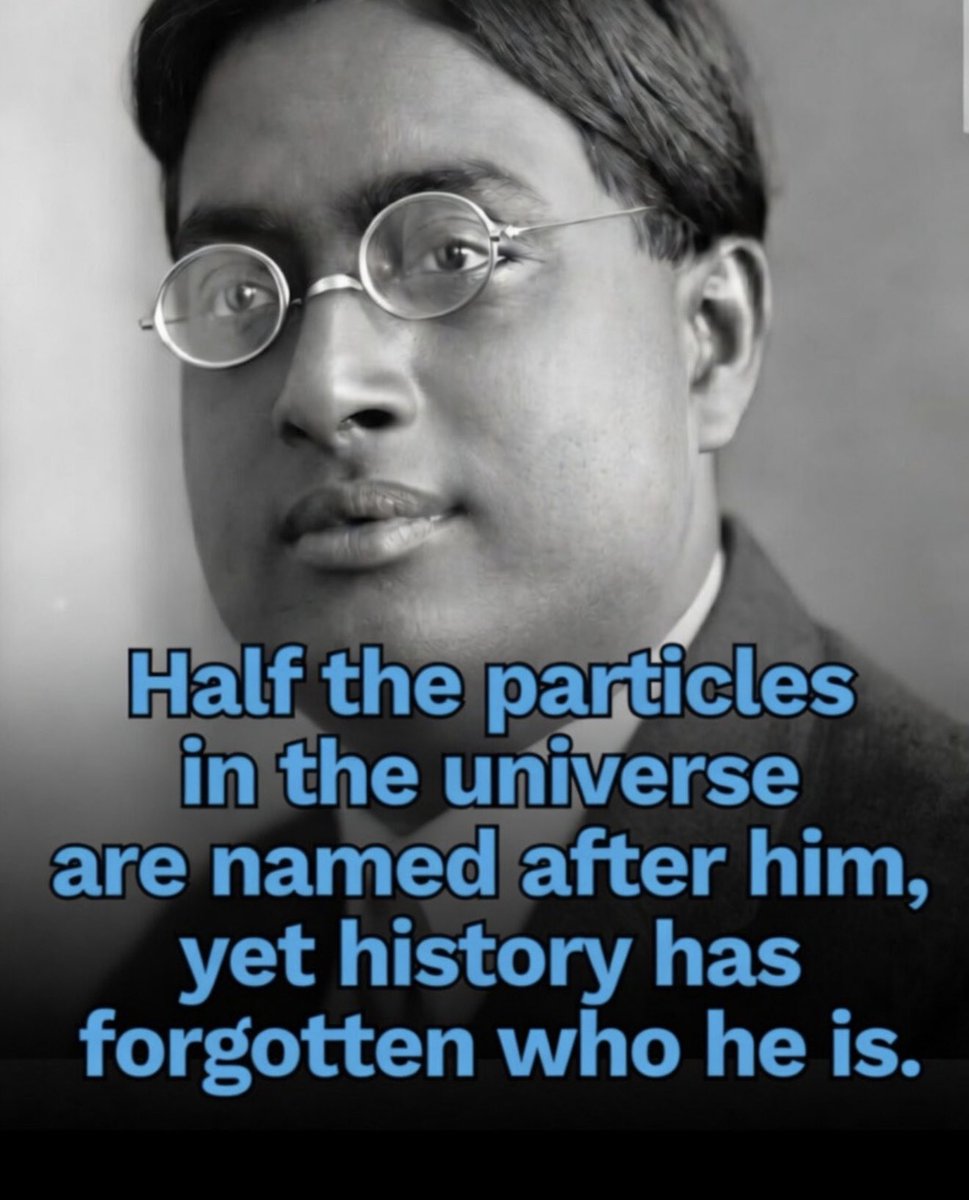
Satyendra Nath Bose helped reshape the foundations of physics, yet he remains one of science’s most under-recognised figures.
In 1924, the Indian physicist sent a brief paper to Albert Einstein that would go on to transform quantum mechanics. In it, Bose suggested a radical idea for the time: that identical subatomic particles might be fundamentally indistinguishable. Einstein quickly saw the importance of the concept, translated the work himself, and extended it mathematically to include matter as well as light.
This collaboration led to what is now known as Bose-Einstein statistics and established a key category of particles called bosons, which include photons and gluons.
Bose’s insight helped lay the groundwork for major advances in modern science and technology, from lasers and superconductors to the eventual discovery of the Higgs boson. Despite this impact, he never received a Nobel Prize. Today, his name lives on in physics, even if wider recognition has lagged behind his contribution.
Source: Bose, S. N. (1924). Plancks Gesetz und Lichtquantenhypothese. Zeitschrift für Physik.
He was Satyendra Nath Bose, an Indian physicist whose quiet brilliance in the 1920s forever altered our understanding of the quantum world.
In 1924, Bose, then a 30-year-old professor in British India, sent a groundbreaking manuscript directly to Albert Einstein. The paper offered a novel, more elegant derivation of Planck's law for blackbody radiation by treating light quanta (photons) as indistinguishable particles—a radical departure from classical statistical methods. Impressed by its insight, Einstein personally translated the work into German and facilitated its publication in the prestigious Zeitschrift für Physik.
This exchange sparked a brief but profound collaboration. Einstein extended Bose's statistical approach to material atoms, predicting a bizarre new state of matter at ultra-low temperatures: what we now call a Bose-Einstein condensate (BEC), where particles behave as a single quantum wave. Bose's original framework became known as Bose-Einstein statistics, and the class of particles that obey it—those with integer spin, including photons, gluons, W and Z bosons, and the Higgs boson—was later named bosons in his honor by Paul Dirac.
Unlike fermions (matter particles like electrons), which obey the Pauli exclusion principle and cannot occupy the same quantum state, bosons can pile into identical states en masse. This "social" behavior underpins extraordinary macroscopic phenomena: the coherent light of lasers, the zero-resistance flow in superconductors, and the collective quantum coherence in BECs.
Despite the monumental impact—his statistics describe half of all fundamental particles and enabled key advances in quantum field theory, condensed matter physics, and particle physics—Bose remained remarkably unassuming. He continued teaching at universities in Dhaka and Calcutta (now Kolkata), mentored students, pursued ideas in X-ray crystallography, unified field theory, and other areas, and never sought the spotlight. Nominated several times for the Nobel Prize (notably for Bose-Einstein statistics and his later work), he was never awarded it, and his name rarely appears in popular accounts of 20th-century physics.
There's a poignant humility in his story: a man whose legacy literally names one of the two fundamental families of particles in the universe, yet whose personal fame never matched the scale of his contribution. Bose reminds us that true influence often arrives without fanfare. Some breakthroughs echo through textbooks and technologies, while their creators work in the background, content to let the universe carry their ideas forward—even if history's spotlight rarely finds them.
ওপিনিয়ন এলার্ট ✍🏻:
ইতিহাস সাক্ষী থাকবে। পৃথিবীর বৃহত্তম দেশের সরকারকে তার সম্পূর্ণ তন্ত্র ব্যবহার করতে হয়েছে একটি রাজ্যের নির্বাচনের জন্য। ভারতবর্ষের মাটিতে এই ঘটনা বেনজির ও অকল্পনীয়।
কিছু মানুষের গল্পকথা অনুযায়ী যদি বাংলা সত্যিই এতটাই ক্ষুদ্র, দারিদ্র্য ও অপ্রাসঙ্গিক হত, নিশ্চয়ই এত অর্থ, সময় ও প্রচেষ্টা বাংলা দখলের জন্য নেওয়া হত না। তাই যারা বলে বাংলায় কিছু নেই, তারা উদ্ভ্রান্ত, উন্মত্ত, আত্মভোলা। মানসিক ভারসাম্যহীন।
আজ থেকে ২৩০০ বছর আগে যেদিন গঙ্গারিডাই সাম্রাজ্যের ক্ষমতার গল্প শুনে সিকান্দারকে উপমহাদেশ ছেড়ে ফিরে যেতে হয়েছিল, বাংলা সেদিনও প্রাসঙ্গিক ছিল।
বিগত ১০০০ বছর ধরে বাংলা যখন দিল্লি সুলতানি ও মোঘল সাম্রাজ্যের সময় উপমহাদেশের সবচেয়ে সমৃদ্ধ এলাকা ছিল, সেদিনও এই মাটি প্রাসঙ্গিক ছিল।
যখন পৃথিবীর সবচেয়ে বড় সাম্রাজ্য গোটা উপমহাদেশকে বাংলার রাজধানী কলকাতা থেকে শাসন করত, বাংলা সেদিনও প্রাসঙ্গিক ছিল।
বাংলা আজও একই ভাবে প্রাসঙ্গিক আছে এবং যতদিন এ পৃথিবীর বুকে মানবসভ্যতার অস্তিত্ব থাকবে, বাংলার নিজস্ব সামাজিক, রাজনৈতিক , অর্থনৈতিক ও সাংস্কৃতিক প্রাসঙ্গিকতা অক্ষুণ্ণ থাকবে।।