Meeting of High-Level Committee on 5-Day Banking was held in Mumbai on 12 November.
No solid decision taken on 5-Day Banking. Read meeting highlights 👇
https://t.co/ZOd5FcXrW7
Appeal to all Public Banks Executives
Please release 70 –100% PLI for all Bank Clerks and Scale 1 - 3 Officers too and release notification for #5DaysBanking effective from 1st Oct'26. Else, Join Our Protest and Bank Strikes.
Thank You 🙏
Banks power India 5 days a week in the demand? No. Bankers ask for 5 Days Banking, with the agreed 40-minute daily adjustment. The proposal has been pending with the Government since the March 2024 settlement. How long must the workforce wait for a settled issue?
#5DayBankingNow #FBOIOA
@DFS_India@aiboc_in@UFBUIndia@nilesh_pawar15@rupamsmail
Bankers waiting for #5daysbanking update from the High-Level Committee: 🥹
The Committee👇
Aaj bas chai pi hai, 5-day week ke liye ek aur meeting rakhenge.🤡
Endless meetings, zero execution! #UFBU
Employees in Kanpur have started gathering and are raising their voices today towards their demand of #5DaysBanking.
@DFS_India@FinMinIndia should announce 5 Days as promised long back.
#BankStrike
ढाई साल से स्टेकहोल्डर्स के साथ डांडिया खेल रहे थे क्या, जो अब उनसे डायलॉग करने की सूझ रही है? क्या ही गजब की मास्टरी कर रखी है तुमलोगों ने छीछालेदर और लिपाई पुताई में !! अभी भी एक तारीख पर नहीं आये तुमलोग की कब तक #5DaysBanking पर अंतिम निर्णय हो जाएगा। वही पुरानी लफ्फेबाजी और घुमावदार बातें। #No_More_Ullu_Banaowing
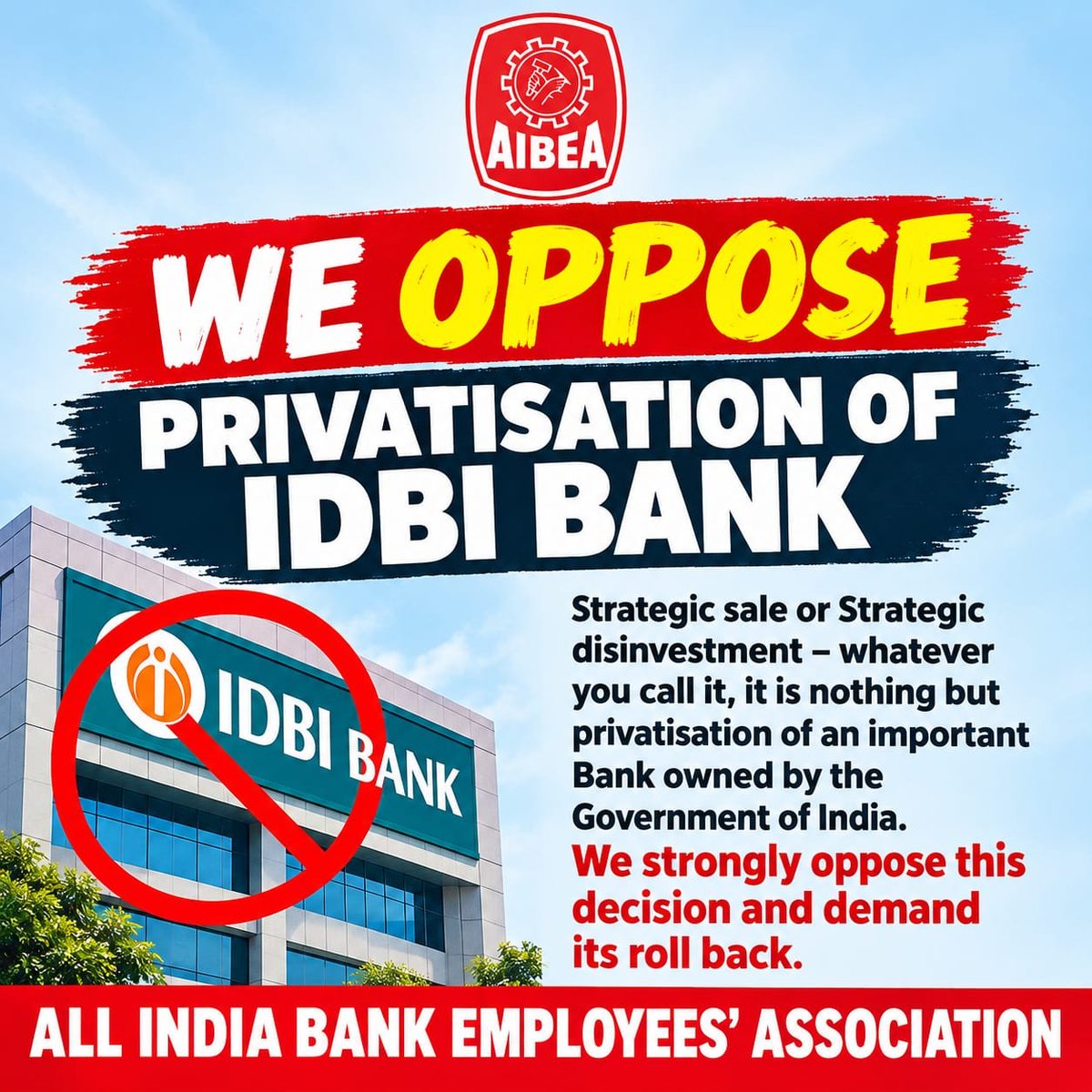
THE IDBI BANK PRIVATISATION NEEDS ANSWERS
The ₹52,878-crore sale of a controlling 60.72% stake in IDBI Bank to Fairfax is being presented as a landmark FDI transaction.
But the reported internal government documents raise a far more important question-
When the bidder couldn't meet the government's valuation, did the government change the valuation framework to accommodate the bidder?
The sequence.
▪️ The first-round reserve price was fixed at ₹94.42 per share.
▪️ Fairfax's initial bid was reportedly ₹75 nearly ₹20 below the reserve price.
▪️ The initial bids were therefore not approved.
So far, exactly what one would expect from a process designed to protect the value of a public asset.
But what happened next is what deserves scrutiny.
Instead of ending the process and starting afresh with wider competition, bidders were invited to submit new "best offers".
And, according to BusinessWorld's reporting based on internal documents, the valuation framework itself was reconsidered after officials already knew the earlier bids.
▪️ The earlier ₹94.42 reserve price was discarded.
▪️ Fresh valuations produced a dramatically lower benchmark of ₹75.99.
▪️ Fairfax offered ₹81.
Suddenly, an offer that was ₹13.42 below the original reserve price became acceptable because it was ₹5.01 above the new benchmark.
◾According to reports on the internal documents
▪️ IDBI's volatile market price was excluded from the final valuation framework.
▪️ The comparison was restricted to public-sector banks rather than higher-valued private-sector peers.
▪️ Fairfax reportedly made clear that ₹81 was its final offer and that it could withdraw if asked to improve it.
▪️ The government reportedly agreed to indemnification relating to disputed income-tax demands of IDBI Bank , raising the obvious question of how much potential liability ultimately remains with the public exchequer ?
But perhaps the most bizarre part is the reported justification for departing from the original reserve-price framework.
The internal process reportedly drew support from provisions governing disposal of government physical assets and even cited the Railway Stores Code governing auctions, under which below-reserve bids for stores/scrap may be accepted in specified circumstances.
Think about that.
A controlling stake in a major Indian bank was being privatised and officials reportedly reached for rules used in auction of government assets and railway stores to justify accepting a different pricing approach.
There is another revealing element.
The internal note reportedly cited the government's need to complete the transaction against the backdrop of fiscal pressures, weak FDI inflows and pressure on the currency from the global energy situation.
◾That raises an uncomfortable question
Was maximising value for the public the overriding objective or had completing the sale itself become the overriding objective?
The government says two independent valuers subsequently arrived at an average fair value of ₹75.99 and that Fairfax's ₹81 offer exceeded both individual valuations.
◾But that does not answer the procedural question-
▪️Why was the original ₹94.42 reserve price abandoned only after the bids below it had already been revealed?
▪️And why was restarting the process and seeking wider competition apparently considered less desirable than redesigning the valuation framework around the existing bidders?
This is public wealth.
LIC's stake is ultimately backed by policyholders' money.
The government's stake belongs to the people.
◾The government should therefore publish-
▪️ The complete Committee/Core Group minutes, both rounds of valuation reports, the reasons for abandoning ₹94.42
▪️The instructions given to the valuers, the tax-indemnity terms and the full record explaining why fresh competitive bidding was rejected
Privatisation itself is a policy choice.But changing the yardstick after seeing the bids is a matter of public accountability
A two-day hunger strike is announced on November 2 and 3 in response to the Cabinet's approval for selling stake to Canada's Fairfax.
https://t.co/SCXH0yorQN
@FinMinIndia Hi, @FinMinIndia
Questions isn't on transparency process, but need of selling Govt owned Banks to foreign players when they already making good profits and revenue for govt too.
Better merge with existing PSBs. Plz cancel Deal. #SaveIDBI