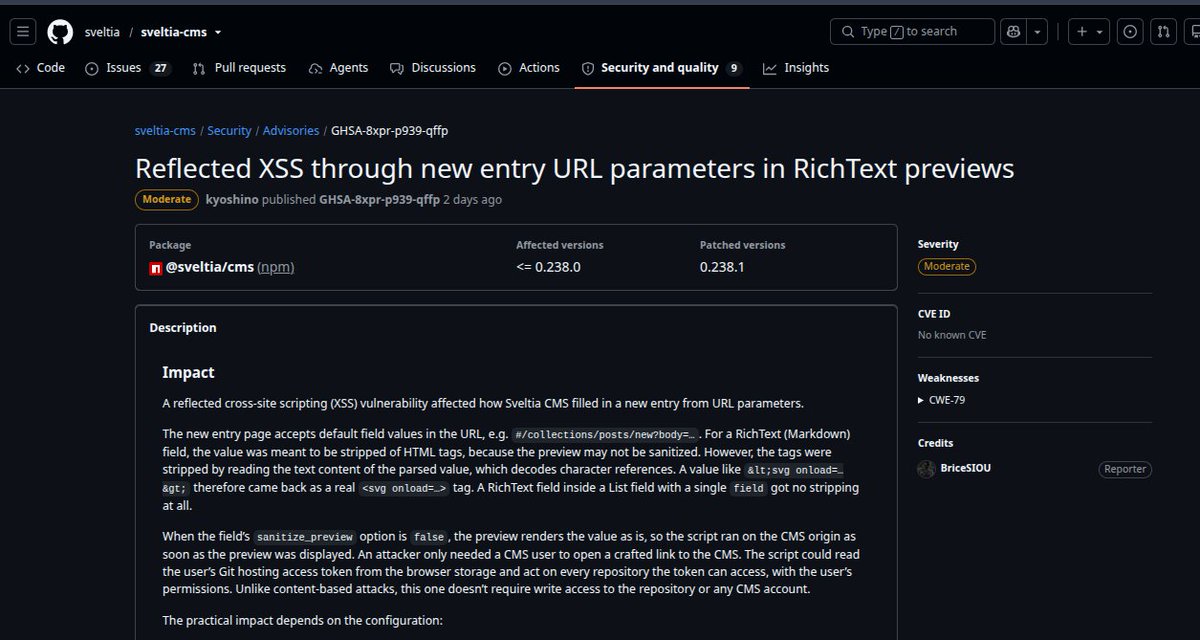
My first security advisory is out 🎉
Reflected XSS in Sveltia CMS: textContent decoded <svg onload> into a real tag. One crafted link → Git token exposed.
Lesson: decoding after sanitizing undoes the sanitizing.
Fixed in 0.238.1
https://t.co/xGcAtjf6wd
The PEB, where Windows keeps a process's info, holds more than the DLL list. BeingDebugged is what IsDebuggerPresent reads. Nearby: where the .exe is loaded, the command line, the default heap.
Anti-debug code that reads the PEB directly is a classic detection target.
Process Ghosting, well explained by Pentest Laboratories.
The payload is written to a file already marked for deletion, mapped as an image, then the file vanishes and a process starts from it. No file left on disk to scan.
https://t.co/MyeJxjhj6I
Pentest or red team? Not the same job.
A pentest looks for ways around a system's security. Red teaming emulates a real threat's techniques to train and measure defenders.
Red Team Guide (Joe Vest, James Tubberville) defines about 50 terms like these:
https://t.co/2iqGHQ1HlF
The easiest thing to hunt here: it all runs as WsiAccount, the account behind the "I forgot my PIN" screen, so a shell or a program launched from Explorer under that account is a red flag.
A public PoC breaks the Windows 11 lock screen using Narrator and AutoPlay, no credentials, no CVE. We reproduced it, got a reverse shell, and wrote two Sigma rules for events Sysmon never logged.
https://t.co/SsqOYcmnbp
@NtRajkit@elasticseclabs@elastic Nice trace. Rewriting the file with XOR is common for quarantine: the goal isn't secrecy, it's making sure the file can't run or get picked up again by other scanners while it sits there.