This is my loop
I built a SaaS that posts to Instagram + TikTok 24/7
I don't write the captions. I don't pick the music. I don't touch it
The stack that runs it while I sleep:
> PHP 8.3, no framework
> Caddy web server
> SQLite in WAL mode
> Cloudflare R2 for video storage
> Cloudflare Tunnel, no open ports
> Stripe for billing
> OpenAI writes every caption
> ffmpeg muxes the music
> Zernio publishes to IG + TikTok
> Vanilla JS + CSS on the front
> one cron job that loops forever
No Next.js. No Kubernetes. No VC
Got your hands on Claude Fable 5?
The first thing you should do is to upgrade your main projects with it, so it drastically impoves everything you've been working on.
Run this Audit & Project Improvement Prompt on each repo that's important to you (simply copy-paste it):
Repo Audit & Improvement Plan:
Prompt made by Claude Fable 5
You are a world-class principal-level software engineer and technical auditor. Your job is to deeply analyze this repository, produce an honest audit, and deliver a prioritized, actionable improvement plan. Work in the four phases below, in order. Do not skip ahead.
Ground every claim in actual files: cite file paths and line numbers. If you can't verify something, say so explicitly rather than guessing.
Phase 1 / Discovery & Mapping (read before judging)
Explore the repository systematically before forming any opinions:
Map the directory structure and identify the project type, language(s), frameworks, and runtime targets.
Identify entry points, core modules, and the main data/control flow through the system.
Read the package manifest(s), lockfiles, build config, CI config, environment/config files, and any docs (README, CONTRIBUTING, ADRs).
Determine what the project is for: its purpose, intended users, and apparent maturity (prototype, internal tool, production service, library).
Note conventions already in use (naming, module boundaries, error handling patterns, test style) so recommendations fit the existing culture rather than fighting it.
Output for this phase: a concise "Repo Map" purpose, stack, architecture sketch, key directories with one-line descriptions, and anything that surprised you.
Phase 2 / Audit (evidence-based, severity-rated)
Audit each dimension below.
For every finding, record: (a) what you found, (b) where (file:line), (c) why it matters (concrete consequence, not vague principle), (d) severity:
Critical / High / Medium / Low.
• Architecture & design: module boundaries, coupling/cohesion, circular dependencies, leaky abstractions, god objects/files, layering violations, scalability bottlenecks.
• Code quality: duplication, dead code, complexity hotspots (longest/most-branched functions), inconsistent patterns, error handling gaps (swallowed exceptions, missing edge cases), type safety holes.
• Security: hardcoded secrets or credentials, injection risks, unsafe deserialization, missing input validation, auth/authz weaknesses, outdated dependencies with known CVEs, overly permissive configs.
• Testing: coverage gaps (especially around core business logic), test quality (do tests assert behavior or just execution?), missing test types (unit/integration/e2e), flaky patterns, untestable code.
• Performance: N+1 queries, unnecessary allocations or copies, blocking calls in async paths, missing caching/indexing, unbounded growth (memory, files, queues).
• Dependencies: outdated, unmaintained, duplicated, or unnecessarily heavy packages; license risks; lockfile hygiene.
• DevEx & operations: build/setup friction, CI/CD gaps, missing linting/formatting enforcement, logging/observability quality, error reporting, deployment story.
• Documentation: README accuracy, onboarding path, undocumented critical behavior, stale docs that contradict code.
Rules for this phase:
Prefer 15 high-confidence findings over 50 speculative ones.
Distinguish facts ("this function has no error handling: src/api/client.ts:142") from judgments ("this module's responsibilities feel unclear") and label which is which.
Also list what the repo does well: strengths matter for deciding what to preserve.
Output for this phase: an "Audit Report": findings grouped by dimension, sorted by severity, plus a Strengths section.
Don't forget to mention all the ugly parts that need utmost priority.
Phase 3 / Improvement Strategy
Synthesize the audit into a strategy:
Identify the 3–5 themes that explain most of the findings (e.g., "no enforced boundaries between layers," "error handling is ad hoc").
For each theme, propose a target state and the principle behind it.
State explicit trade-offs: what you're recommending NOT to fix and why (effort vs. payoff, risk, project maturity).
Define what "done" looks like — measurable signals (e.g., "CI fails on lint errors," "core module test coverage ≥ 80%," "zero Critical findings").
Phase 4 / Detailed Task Plan
Convert the strategy into an execution plan:
Break work into discrete tasks. Each task must include: Title and one-paragraph description
Files/areas affected
Acceptance criteria (how we verify it's done)
Effort estimate (S = <2h, M = half-day, L = 1–2 days, XL = needs breakdown)
Risk of the change itself (could it break things?)
Dependencies on other tasks
Order tasks into milestones:
Milestone 0
Safety net: anything needed before refactoring safely (tests around critical paths, CI gates, backups).
Milestone 1
Critical fixes: security and correctness issues.
Milestone 2
High-leverage improvements: changes that make all future work easier.
Milestone 3
Quality & polish: remaining medium/low items worth doing.
Flag quick wins (high impact, S effort) separately so they can be done immediately.
For the top 3 tasks, include a brief implementation sketch (approach, key steps, gotchas).
Final Deliverable Format
• Produce a single document with these sections:
• Executive Summary (≤10 sentences: overall health grade A–F with justification, top 3 risks, top 3 opportunities)
• Repo Map
• Audit Report
• Improvement Strategy
• Task Plan (milestones + task table + quick wins)
• Open Questions: anything you need from a human to decide (product intent, deprecation candidates, performance targets)
Constraints
Do NOT modify any code during this audit. Analysis only.
Do not pad the report. If a dimension is healthy, say so in one sentence and move on.
Calibrate to the project's maturity. Don't recommend enterprise-grade infrastructure for a weekend prototype unless the owner's goals demand it.
Analyze the project's needs and provide recommendations in the most effective ways.
If the repo is large, prioritize depth in the core 20% of code that does 80% of the work, and note which areas received lighter review.
what is agent looping
for the last two years we prompted agents one task at a time. that is starting to change
instead of asking an agent to build the landing page and then driving every step yourself, you set up a loop that handles discovery, planning, the work, checking, and iterating until the goal is met
looping is a setup you build. almost any agent harness can run it, it just depends on how you wire it up
at its simplest, looping is one agent working on itself:
> researches
> drafts
> checks the draft against a goal
> fixes what is weak
> runs that cycle again until the work clears the requirements
you are not prompting each step anymore. the agent repeats the cycle for you
the bigger version is a fleet looping. you give an orchestrator agent a goal, it breaks the goal into pieces, hands each piece to a specialist agent, and those specialists hand smaller jobs to their own subagents
the whole tree keeps looping through discovery, planning, execution, and verification until the goal is met
one agent looping is like a person redoing their own draft. a fleet looping is a whole team running a project end-to-end
you create a goal, and the system runs the loop until it finishes within the reqs you set
open and closed looping:
OPEN LOOPING is exploratory. it still has conditions and a goal, but you give the agent or the fleet a wide space to move in. it can try different paths, discover things, build something you did not fully spec out
this is the exciting end, it is what Peter and others are doing, and tbh it is where I want to spend more time
the catch is cost, an open loop with real room to explore burns an insane amount of tokens. for the 90 percent of people without an unlimited budget it is not runnable yet, and pointed at projects with a loose standard it turns into a slop machine
CLOSED LOOPING is bounded. a human designs the end-to-end path first:
> clear goal
> defined steps
> an eval at each step
> a point where it stops or hands back to you (and feeds back performance data)
the agents still loop, but inside framework you built. it gets better every run because each pass feeds the next, and it runs on a normal budget because the path is tight.
for most marketing work, closed is the one that pays off today.
> the orchestrator owns the goal
> the specialists own the steps
> the subagents do the narrow work
> an eval gate make sure its not slop
📢 Nex-N2 is here!
A family of agentic models that doesn't just think, it acts!
Coding, search, tool use. All fused into a single agentic reasoning loop.
- Adaptive Thinking, auto-scales reasoning depth per step. Saves ~20% tokens, zero performance loss.
- Coherent Thinking, one thinking paradigm across search, coding, and tool use. No more fragile mode-switching.
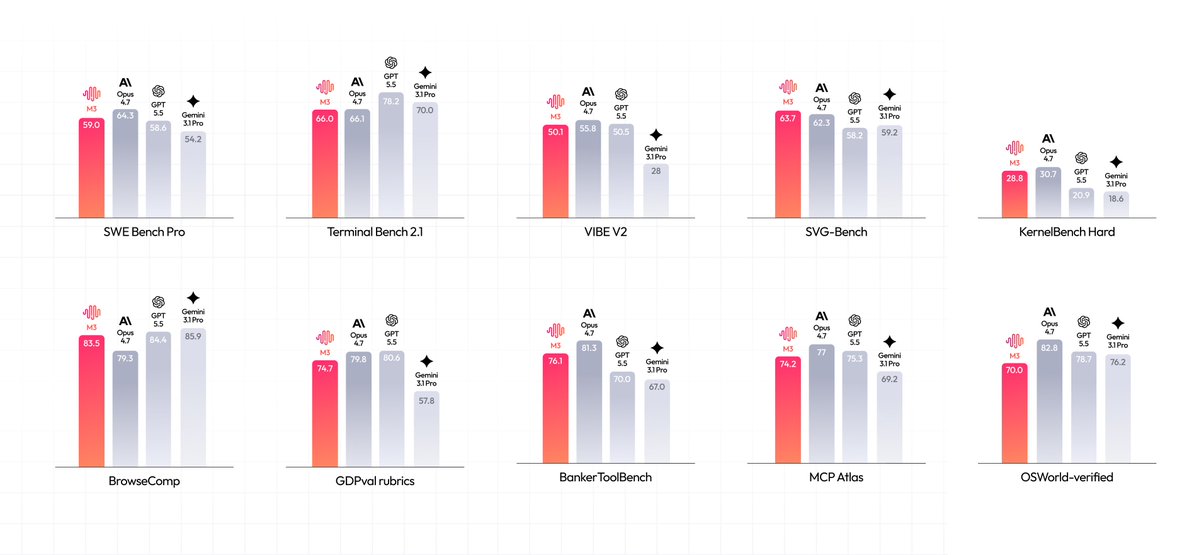
🏆 Result: Tier-1 open-source performance on SWE-bench, Terminal-Bench, GDPval, and more, tracking GPT-5.5 and Opus 4.7.
🎉 Open-weight. Try it now.
🔗 https://t.co/7oLSfyOCxB
📦 https://t.co/c2CGhXWaz6
https://t.co/KJYXZIpk8M
https://t.co/vcjdZ9cuB6
A Stanford psychiatrist says modern anxiety is not caused by danger.
It's caused by tiny habits that teach your brain to panic when nothing is actually wrong.
You do them every day.
And you call them normal.
6 normal habits quietly teaching your nervous system to panic:▼▼▼
1/ Reaching for your phone the moment you feel uncomfortable.
Unlock the power of autonomous workflows with Startup School: Agentic AI.
Join @GoogleCloud experts to discover how to build, deploy, and scale sophisticated #AIagents that drive real business impact. Ready to innovate? Register here ➡️ https://t.co/QzUDNTjYzt
A Stanford neuroscientist warns high cortisol wrecks memory, enlarges your fear center, and make your brain feel broken.
If I wanted to fix it naturally, I'd do these 8 things every day:
1. Walk barefoot on grass for 5–7 minutes.
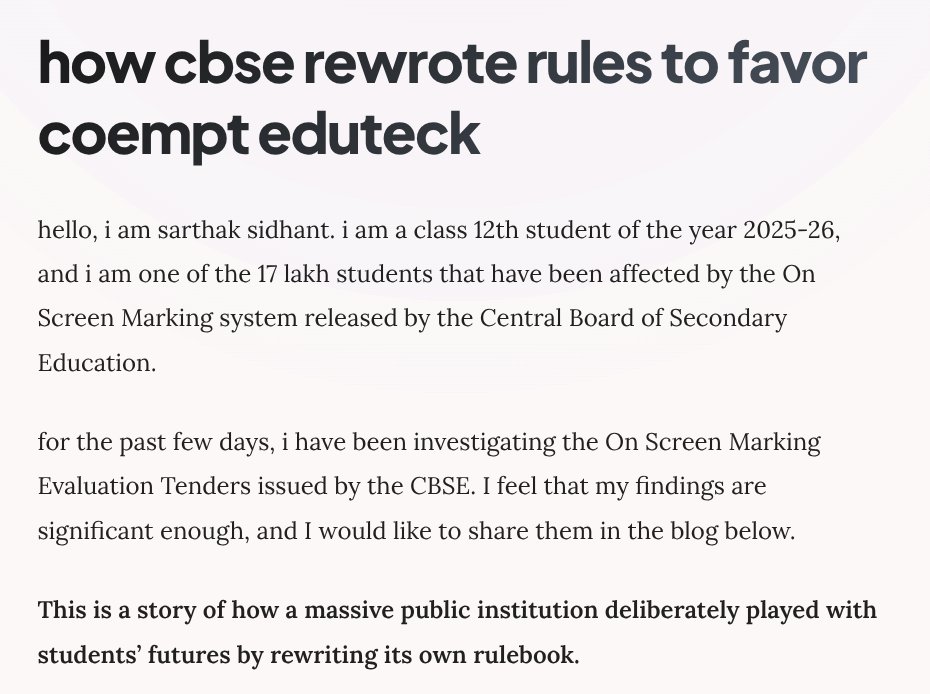
This is an unbelievable piece of work by Sarthak and something that requires amplification.
Let me explain what he found, in simple terms.
Sarthak is a Class 12 student from the 2025-26 batch, one of the 17 lakh students whose answer sheets went through CBSE's new On-Screen Marking system.
He spent days reading through CBSE's evaluation tenders, scraped all 576 tenders CBSE has issued, and tracked how the rules changed across three versions of the same tender.
The core finding is that the company that won the contract to scan and grade 17 lakh students' answer sheets is Coempt Eduteck.
Coempt used to be called Globarena Technologies. Globarena was the company behind the 2019 Telangana intermediate exam disaster, where software failures led to 3.8 lakh students getting wrong or missing marks, and 23 students died by suicide.
A government committee found systemic failure and negligence. Six months later, Globarena rebranded to Coempt Eduteck.
So a company with that track record won a contract to handle 17 lakh CBSE students. Sarthak's investigation is about how the rules were rewritten to let that happen.
The tender was issued three times.
> First tender, February 2025. It existed, then disappeared from the public GeM portal. Sarthak scraped all 576 CBSE tenders and this one was missing from the archive entirely.
> Second tender, May 2025. Four companies applied including TCS and Coempt. All four failed the technical evaluation. Cancelled.
> Third tender, August 2025. Coempt won. Between the second and third tender, a series of rule changes happened, and every single one made it easier for Coempt to qualify.
Here is what changed, one by one.
01. The old rules disqualified any company with a history of abandoning work, failing to complete contracts, or financial weakness. The new rules deleted this clause entirely. Coempt's Telangana history stopped being a barrier.
02. The old rules disqualified any company that was "blacklisted earlier." The new rules changed this to "currently blacklisted." Because Globarena rebranded after Telangana, removing the word "earlier" effectively erased their past.
03. The rules required Rs 50 crore average turnover over three years. Coempt's exact average came to Rs 50.86 crore. They cleared the bar by less than 1%. Earlier, a smaller company had asked CBSE to lower the bar to Rs 30 crore for fairer competition. CBSE refused. So the bar was kept high enough to block small players, but sat exactly low enough for Coempt to scrape through.
04. Software maturity is measured on the CMMI scale, 1 to 5. The old rules required Level 5. The new rules dropped it to Level 3. Coempt is a Level 3 company.
05. The cooling-off period for engaging retired CBSE officials was cut from two years to one. This makes it easier to use recently retired insiders to influence the process.
06. The old rules required experience with large projects of at least 5 lakh students each. The new rules removed the student count and counted cumulative answer-book volume across small projects instead. Coempt has many small fragmented university contracts. This helped Coempt and hurt TCS.
07. The old rules required bidders to own their own data centre and disaster recovery centre on Indian soil. The new rules allowed third-party MeitY-empanelled cloud hosting. Coempt runs on AWS and Azure. This helped Coempt and hurt TCS, which owns its own data centres. It also means student data is no longer on sovereign, Indian infrastructure.
08. The old rules required the bidder to own or control the complete source code of its software. The new rules deleted this. Coempt's platform runs on Microsoft's proprietary IIS, which they don't own.
09. A last-minute corrigendum, issued right before bid submission, removed CBSE's own power to blacklist the firm if its software failed catastrophically. So even a Telangana-scale failure couldn't get Coempt banned from future government tenders.
10. The penalty structure shifted from punishing mistakes to punishing delays. The old rules fined the vendor for wrong scanning, merged pages, and unscanned books. The new rules dropped those and instead levied Rs 50,000 per day for delays. This incentivises rushed scanning over accurate scanning.
11. The old rules had a hard accuracy threshold, error rate not to exceed 0.5%. The new rules removed this number entirely.
12. The old rules specified proper book and robotics scanners. The new rules just say "sufficient scanners." The definition was vague enough that, as Sarthak notes, the scanning could be done with a phone on a stand.
13. On the security side, the contract required a VAPT (vulnerability and penetration test) certified by CERT-In before go-live, and a restricted beta phase before launch. The system clearly wasn't restricted, because the other researcher, Nisarga, was able to access it and find vulnerabilities four days before go-live. So the mandatory security audit appears to have been bypassed.
These are more than a dozen rule changes, all between the failed tender and the winning tender, all pushing in the same direction, all benefiting the one company with the worst track record in the field.
The security holes Nisarga found last week now have an explanation. The system was built by a vendor that was specifically allowed to skip the security certification, the source code ownership, the data sovereignty, and the quality thresholds the original rules demanded.
Following things need to happen immediately;
1. An immediate CAG audit of the tender process.
2. A parliamentary debate on the topic.
3. An independent investigation into
> Why the first tender vanished?
> Why the disqualification clauses were deleted?
> Why the turnover bar was held exactly where it was?
> Why the security level was dropped?
> Why the blacklisting power was removed at the last moment?
Sarthak, this is genuinely exceptional investigative work. Far better than most journalists with full resources ever manage. Take a bow. :)
Tucker Carlson interviews a British doctor who worked in Gaza.
"Four young teenage boys were brought in, all of whom who'd been shot in the testicles."
فضيحة تاريخية يجب أن يشاهدها العالم أجمع
الوزير الإسرائيلي يُخاطب الجنود الإسرائيليين قبل دخولهم غزة قائلاً: "أمسكوا بالأطفال الرضع في غزة وحطموا رؤوسهم على الصخور"
🇮🇱 A West Bank council has finally admitted Israeli settlers have been systematically raping kids as young as three and four.
After years of denial, the Gush Etzion Regional Council acknowledged ritualistic sexual abuse cases in its communities following a bombshell Kan 11 investigation.
The abuse spanned years and is emerging as one of the most organized and disturbing sexual abuse cases ever exposed in Israel.
For years, allegations were met with denials and deep skepticism, but in a complete 180, the council is now acknowledging the problem, calling it "pure evil and moral depravity that has no place in human society."
Source: Kan 11
Free Models Updated on 28 May 2026
OpenCode
- Deepseek v4 Flash ( Recomended to try)
- MiMo v2.5 (Recomended to try, Multi modal)
- Nemotron 3 Super
Best 1-10$
- Opencode Go (Kimi, MiniMax,Qwen,MiMo)
- Command Code Go ( Deepseek, Qwen, MiMo)
- Deepseek PayPer API
- MiMo Lite ( MiMo Family)