Yes, that was the fix that most DBMSes applied for fsyncgate
But most still don’t use Direct I/O when they replay the WAL on reboot.
So they risk externalizing non-durable data as durable (because they still read from the incoherent kernel page cache).
cf. “Can Applications Recover from fsync Failure?” which looked into this in 2020, two years after these fixes, and found that PG, SQLite et al were still vulnerable.
Niklas (@dergoegge) outlines an approach and a solution, bedrock, for this problem of determinism.
He focuses on the challenge of emulating time and pausing a VM at an exact instruction count, something CPUs aren't designed to do.
https://t.co/w9vjZhx6QZ
Three ways to drive testing from a Quint spec, depending on how much control your runtime gives you:
→ Model-Based Testing: replay traces from the model
→ Hybrid: model proposes the next action based on results from runtime
→ Trace Validation: capture from production, check it against the model
A peek at @bugarela's BugBash by @AntithesisHQ 2026 talk. Full video soon!
i like to think of settings like a pressure valve
every time you add one its because you avoided making a real product decision
if youre not careful your product becomes a graveyard of avoided decisions
lets just add a setting often means we dont want to pick a default
it might feel diplomatic in the moment
everyone gets what they want in the end
except for the user
they end up with a minefield of toggles they dont understand
good products make strong choices
they say: this is how it works by default because we believe this is the best way
settings should exist for real variability
not to protect us from disagreements
when you look at an app with 200 settings youre not seeing power
youre seeing a decade of unresolved arguments
and its costing clarity for you and your customers
im not anti settings
im anti cowardice
if the only reason a toggle exists is: we didnt want to take a stance
it probably shouldnt exist
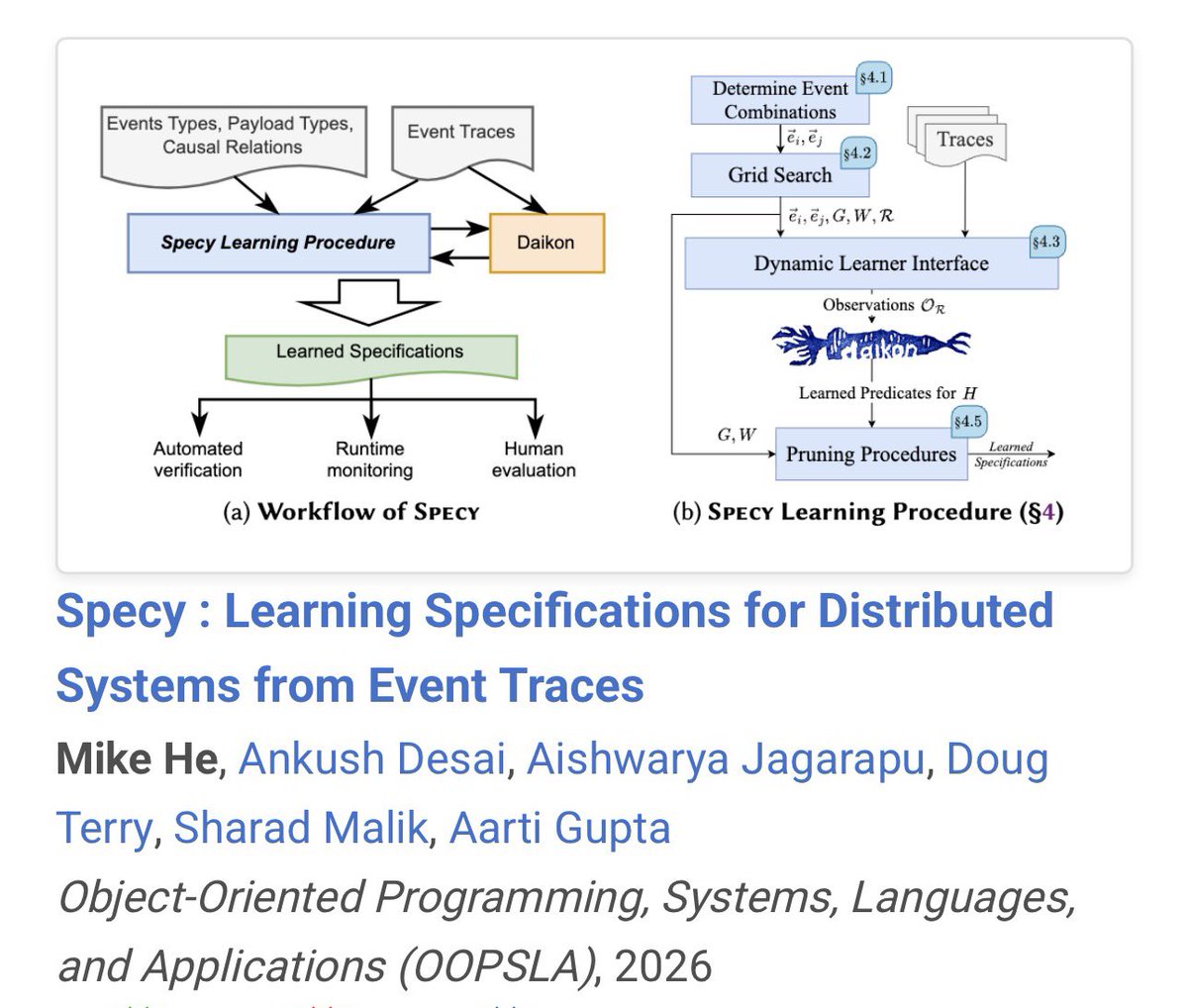
"Specy addresses this challenge by automatically
learning specifications from observable event traces generated by message exchanges in distributed systems." 🤯. I'm a huge fan of P. I can't wait to play with this.
TL;DR: we identified a pattern of FOL formula over message events (exchanged between servers) that can express various safety properties of distributed systems, and we combine static&dynamic learning to effectively discover them.
Check out our pre-print: https://t.co/hxqQQ00tFG
Happy to announce that our paper “Specy: Learning Specifications for Distributed Systems from Event Traces” has been accepted at OOPSLA’26. This is a joint effort with Ankush (@ankushpd) and the P team! It’s not possible without all the great collaborators!
"Scale isn't just performance or distribution, it's survivability." - @TigerBeetledev's @jorandirkgreef. At Monster Scale Summit, find out what keeps most transaction processing systems from scaling and how to survive billions of transactions. https://t.co/Bd1UcNHk4I
#ScyllaDB