Same people, same peninsula, same starting line. North Korea chose socialism, South Korea chose free markets. One doubled in 53 years, the other multiplied by 137. This isn’t “nuance“, this isn’t “the wrong kind of socialism.” This is the experiment running in real time, with the control group next door.
Socialist central planning fails not because of bad leaders, but because it goes against human nature. It lacks the incentives free people have to invent, trade, and compound. Controlled people wait for permission and starve on schedule.
The chart doesn’t care about slogans. This is well-documented history. Why do so many in the West still follow this failed ideology?
This is absolutely INSANE. What?!
Mamdani vs Khomanei
This is how the Islamic Regime took over Iran by lying about these “promises” as a cover for what they were really doing.
And… wow.
Mamdani.. almost word for word.
https://t.co/d7BnQAW1jU Because wind and solar are not capable of producing baseload power, a second completely redundant grid is required which will provide baseload power, driving up the overall price of power.
It didn't matter how many wind turbines and solar panels were built and installed across remote corners of the western world.
They were never capable of delivering the baseload power that is essential to modern society. They did not have the dense energy to support heavy industry or manufacturing, or produce steel or power transport. They did not deliver baseload power—the bedrock of a modern, industrial electronic world.
Fossil fuels made the Industrial Revolution possible, lifting the world out of millennia of poverty and famine.
The result is a vast, visible structural overbuild: at least 1.3 million large-scale turbines of reinforced steel, concrete, rare metals, and composite resins, alongside billions of solar panels composed of silicon, glass, aluminium, copper and silver. These arrays are a symbol of failed ideology.
The concept of energy harnessed from wind and sunlight only ever worked at micro-scales—for boutique lifestyle choices in an off-grid cabin, but disastrous when scaled up to power modern industrial civilisation. The mammoth arrays corrode, degrade and stop working within a decade or two, turning landfill sites into graveyards for this ideology.
Furthermore, wind and solar present a glaring paradox: they cannot be mined, manufactured, transported or installed without the heavy grunt of diesel power and heavy industry. The raw materials required for this world-war-style effort place catastrophic demand on global metal reserves, driving up costs while relying entirely on the very hydrocarbon energy they seek to replace.
Intermittent power is fundamentally incompatible with existing global electricity grids. Managing it requires building a completely redundant second grid at an estimated cost of $21 trillion. This still is only a fraction of the colossal scale of this global spending spree, subsidised by meek, obedient, and some say traitorous, Western governments.
Despite four decades of this overbuild, costing trillions every year - hydrocarbon fuels still provide the world with roughly 86% of its primary energy.
https://t.co/3vhFvn0EEk Oceans cover 72% of the planet at an average depth of 2.3 miles and are over 1,000 times denser than air. Oceans also hold more than 90% of the planet’s accumulated heat energy and store 50 to 60 times more carbon than the atmosphere.
The oceans are the ancient rulers of the Earth, and they need neither crown nor throne to prove it.
Stretching across 72% of the planet's surface to an average depth of 2.3 miles, ocean waters are 1,000 times denser than air. They hold roughly 93% of the planet’s accumulated heat energy and store 50 to 60 times more carbon than the atmosphere.
According to Henry’s Law, gas exchange between air and sea continuously seeks equilibrium. Because the world's oceans are so immense, even a tiny shift in their thermal state or deep circulation moves vast quantities of energy and carbon.
The atmosphere is shackled to this ongoing love affair with the deep sea—a dynamic that operates on multi-century timescales and follows the unyielding laws of thermodynamics.
The prevailing climate narrative frequently treats the atmosphere as a closed, isolated loop, conveniently ignoring the colossal engine pulsing beneath.
While human emissions have increased atmospheric carbon dioxide concentrations—forcing the ocean to act as a net carbon sink—the sheer scale of the sea means it will ultimately write the equations of long-term stability.
If over 90% of Earth's accumulated heat energy resides in the oceans, then this is where the answers lie. The economic quest to fine-tune global climate has turned a blind eye to these great waters, where we have the least historical data and zero operational control.
To claim we can manage Earth's climate strictly by tweaking atmospheric gases—while treating the oceans as background noise—overlooks the fundamental physics of planetary inertia.
The oceans remain the timeless Ghost in the Machine.
Most Americans don’t understand what socialism is.
It’s not universal healthcare.
It’s not affordable housing.
It’s not what Nordic countries do.
Confusion is making socialism appeal to those who never lived it.
People who have, reject it.
Did you know? 🤔
🌡️ 38 (76% of) U.S. states set their “all-time” high temperature records before 1955.
🌡️ 46 (92% of) U.S. states set their “all-time” high temperature records at least 30 years ago.
If you didn’t, now you do! 🤘😎👍
https://t.co/z8d8bbBOCG Commercial greenhouse operators routinely enrich the CO2 in their greenhouses to 1,000 – 1,200 ppm, resulting in increased crop yields of 30% to 100%.
Portraying CO₂ as a threat to climate and health is being used to justify tens of trillions in redirected capital, heavy regulation and centralised control.
This is pure globalism at work. Who else would be behind it? The financial incentives driving this agenda ignore a basic biological truth. Commercial greenhouse operators routinely enrich their air to 1,000–1,200 ppm — nearly triple atmospheric levels — because it directly fuels photosynthesis, boosting crop yields by 30% to over 100%. If it were a pollutant, they'd be killing their profits. Instead, they are reducing more robust plant food.
This same principle is taking place globally. At around 426 ppm, rising atmospheric CO₂ is driving measurable global greening and boosting crop productivity, as confirmed by NASA satellite observations and NBER analysis.
Higher CO₂ also improves plant water-use efficiency, allowing vegetation to thrive in previously arid or desert regions, such as the Sahara, which has lost 700,000 square kilometres of desert sands to new leaf growth. These real-world results overwhelm the harsh computer models every time.
The globalist narrative treats CO₂ as a toxin; the real data shows it as a biological godsend.
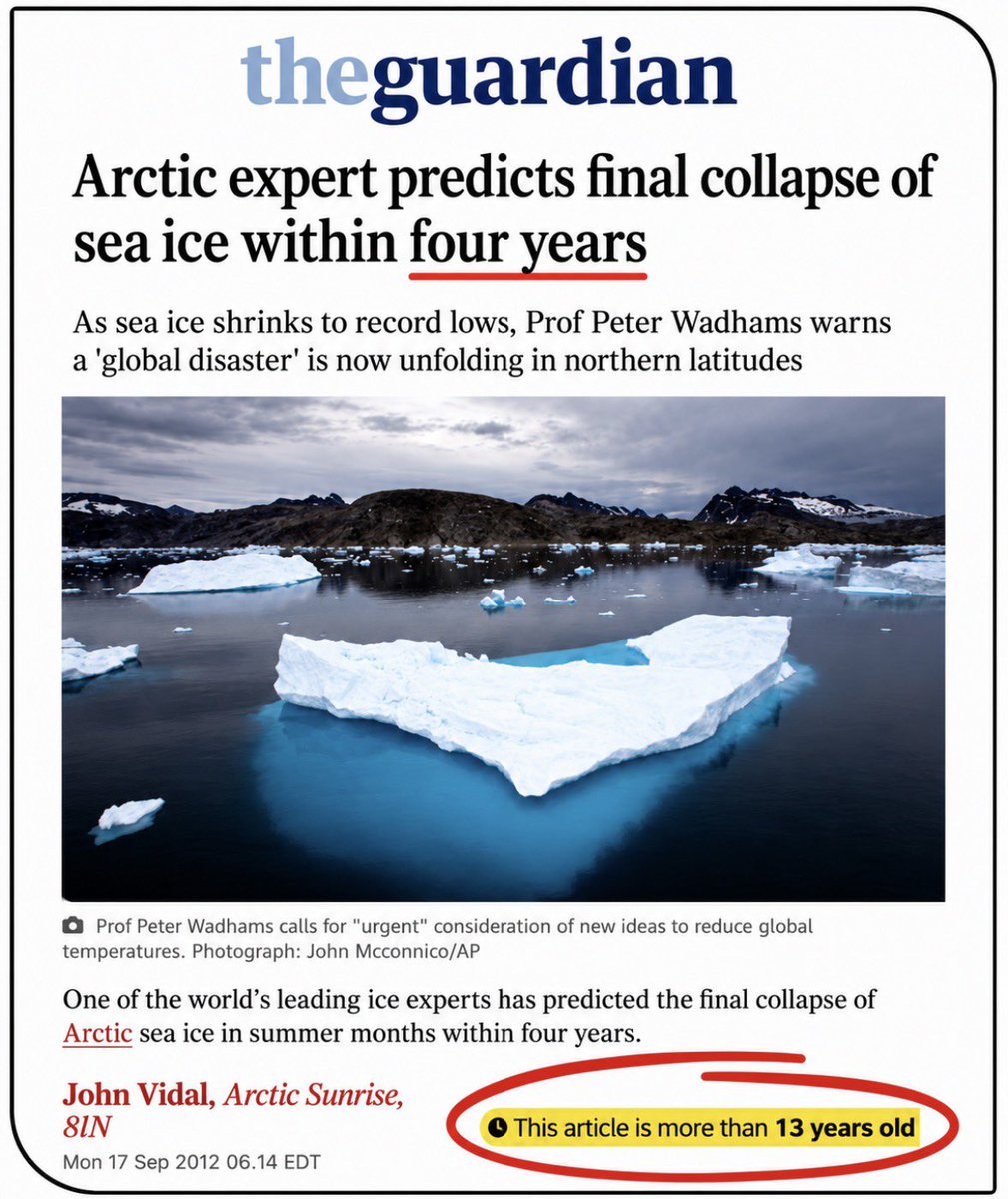
https://t.co/6QbhWObcTL BREAKING NEWS! An Arctic expert predicts the final collapse of sea ice within four years! …Oh, wait, this was from 2012. Never Mind.
https://t.co/cdOXkWsA1Z The earth is currently in a cooling phase and has been 5°C-10°C hotter than it is now. The phase we’re in now is one of the coldest periods in history and has lasted for 34 million years.
Earth's current global baseline temperature does not add up to a planetary emergency.
Humanity has evolved and still lives in an Ice Age; Earth's long-term climate has almost always been 5°C-10°C hotter than today. How can we be facing a climate crisis?
It has been vastly hotter in the past than today's modest 14-15°C range. We are living in an unbroken ice-age ecosystem, which has lasted for 34 million years. We are currently experiencing one of the coldest periods in geological history.
Historical studies show that long-term global temperatures were between 20°C and 25°C. Earth has been in this warmer greenhouse state for roughly 70–80% of the last half-billion years, devoid of polar ice sheets.
The global average temperature of 15°C may be the modern baseline (specifically closer to 14°C or 14.5°C), calculated via global weather stations and satellite anomalies to track current trends. But it is still far colder today than the world's long-term average climate.
Nor is CO₂ the hot button switch from glacial periods to warm interglacials and back—it is orbital mechanics pulling the trigger. Paleoclimate data shows that CO₂ forms a positive feedback loop. But studies do not attribute ice ages - or the glacial or interglacial cycles - to CO₂ levels.
Human civilisation has arisen almost entirely within the current warm interglacial period (the Holocene). The pacing of these glacial-interglacial cycles over the last 2.58 million years is indisputably driven by variations in Earth's orbit, known as the Milankovitch cycles—eccentricity, axial tilt (obliquity), and wobble (precession).
Earth is still within the Late Cenozoic Ice Age, which began 34 million years ago, sparked by the separation of Antarctica from South America and Australia, creating the Antarctic Circumpolar Current. This thermally isolated Antarctica, leading to its oceanic isolation and glaciation.
Humanity has evolved - and still lives entirely within - the Late Cenozoic Ice Age; while world temperatures have been 5°C-10°C hotter for 541 million years.
Why are these fundamental geological realities completely omitted from the modern agenda?
https://t.co/hB3cQkPW52 All the towns and cities on earth are 3% of the earth’s landmass. Oceans cover 72% of the earth and have an average depth of 2.3 miles. The oceans contain approximately 86% of the earth’s carbon reservoir and 91% of all retained heat energy. By comparison, the atmosphere contains 1% to 2% of the earth’s carbon reservoir and retained heat energy. So…what is driving climate change? My money’s on the oceans.
One only has to look at the sheer scale of the planet to see the flaws in the climate agenda.
Combined, every town and city on Earth occupies a mere 3% of the world's landmass. The true driving forces for regional climates rest in the oceans and major landforms - the planet's genuine engine rooms. Oceans cover 72% of the globe to an average depth of 2.3 miles. They contain roughly 86% of the global carbon reservoir and 91% of all retained heat energy; by comparison, our thin atmosphere holds a meager 1 to 2% of each.
Ancient ocean currents give balance to the world's weather, carrying tropical warmth to northern regions in cycles that drive migration, cloud formation and global storms. Landforms guide ocean currents across deep geological time, as tectonic changes to continental land masses reshape the entire world.
The legacy of ignoring this planetary scale of the environment can be seen today in our defaced countryside and industrialised coastal retreats. Sweeping vistas are being vandalised by massive arrays of wind and solar structures, causing immeasurable localised environmental carnage.
It has created a perpetual, asset-swapping loop of renewal and replacement at a staggering, endless cost to national economies, while hollowing out traditional industries and aggressively mining the earth for rare metals like copper and silver.
The back-end of this 'clean' energy loop is an impending hazardous waste crisis. With global solar capacity now officially surpassing 2 Terawatts (TW)—representing between 7 and 8 billion solar panel equivalents—the world is utterly unprepared for the onslaught of disposal.
The International Renewable Energy Agency projects up to 78 million metric tons of solar e-waste by 2050. Because there is little financial incentive for complex recycling, up to 90% of decommissioned panels currently go straight into the ground. When left to fracture in landfills, heavy metals like lead and cadmium can leach into surrounding soil and groundwater.
This will remain the most visible legacy from the Twenty-First Century.
https://t.co/9ndweYvoAF Part of Secretary Kennedy's response to an article in the NY Times: "Your article exemplifies the biased reporting we have come to expect from you and
@nytimes. It was unfair, inimical, and inaccurate. All one needs to refute your argument is to glance at my publicly available calendar and to review my unprecedented list of accomplishments on a wide range of issues, all of which I drove. You evidently never undertook these foundational due diligences. Why let facts obscure a good story?"
Sheryl. Your article exemplifies the biased reporting we have come to expect from you and @nytimes. It was unfair, inimical, and inaccurate. All one needs to refute your argument is to glance at my publicly available calendar and to review my unprecedented list of accomplishments on a wide range of issues, all of which I drove. You evidently never undertook these foundational due diligences. Why let facts obscure a good story?
You fault me for missing a couple of monthly counselor meetings. However, I meet one-on-one with my counselors every day to decide policy and strategy. We schedule the monthly meetings to give the divisions a chance to keep each other informed about HHS-wide policies with which I’m already intimately familiar. Had you read my calendar, you would have seen that I have back-to-back meetings all day, every day, with both career and political staff, with my counselors and with outside stakeholders, interspersed with press conferences and other policy announcements.
I am knowledgeable and active on every issue in every division of my department, and I always make the final decisions. I meet with the principals at FDA, NIH, CDC, and my senior counselor every morning, something, I’m told, is unprecedented in HHS history. I try to get out of the office between 4:30 and 6:00 PM, so that I can spend three hours, in quiet, responding to emails. I normally work until 11 PM every night, mostly on phone calls to staff.
In order to prove your preconceived case for my disengagement, you quote anonymous employees, some of whom I fired or who quit to avoid being fired. You also deceptively quote HHS employees without identifying whether they were among those I fired, thereby depriving your readers of the opportunity to make an independent judgment about their credibility.
I came into this job to change the culture of a broken agency that has presided over the worst decline in public health in American history. Of course I fired people—lots of them! It's an easy task for even the laziest journalist, to comb that flotsam and jetsam for malevolence toward the Trump administration. And of course, this species of journalist will always be able to find disgruntled individuals among the 70,000 employees of the Department from whom to cherry pick "facts" to flesh out a preordained hit piece. All that is required for this brand of journalism is the ethical elasticity that you seem to have in spades. You had a preconceived thesis, and you set out to prove it. This is a widely accepted technique in journalism today, but I grew up in an era when it would not have been tolerated by the New York Times.
Ultimately, God puts us all on this earth to search for existential truths. I've tried to instill this mission at HHS by implementing gold standard research to end the regime of politicized science that COVID exposed to the American public. There was a time that journalists were proud to be the fearless and uncompromising champions of truth. Standards have devolved, and journalism is dead. The Times now employs propagandists. Your capitulation to partisanship further compounds your journalistic challenges; since we all are aware of your predictable bias, we at HHS are unwilling to talk to you about the topics that are important. The fact that you have minimal access to decision makers leaves you covering trivia and relying on your own capacity for invention.
Btw. When I took this job, the building was empty. About 90% of the employees were not coming to work. I changed that, but your newspaper never covers my reforms. Nor did you cover the fact that my predecessor almost never showed up for work here during his four years in office. When we came in, there were still artifacts from the first Trump administration in many of our office drawers because no one showed up for work during the Biden years. Just as Rochelle Walensky spent her entire term as CDC Director in Cambridge, Xavier Becerra reportedly spent most of his term as HHS Secretary in California. (I live in California, but I’ve only been there once in fifteen months).
His only notable accomplishments here were losing 300,000 children, referred to HHS for custody and care, to human traffickers and drug runners, encouraging transgender surgeries, and disabling the entire program-integrity apparatus, allowing hundreds of billions of dollars of theft from my agency. I have set out to find the children Becerra lost. He is now the front-runner for the governor of California. These are not invented stories; they are genuine scandals that the Times will never cover, presumably, because the malefactors are Democrats.
Finally, you criticize me for spending time with the Indian tribes in Alaska. I consider that part of my job. I run the Indian Health Services, and I’ve had unprecedented success in transforming IHS from a backwater to a top priority for this department. I’ve made more trips to Indian country and to Indian health clinics and hospitals than any HHS secretary in history, and I’ve brought Indians into high positions on the sixth floor for the first time in agency history. This is another success story that the Times will never cover.
https://t.co/K1uBmYG27k "The global warming agenda is an ideology, driven in part by a misleading, fear-laced 2006 documentary by former US vice president, Al Gore. 'An Inconvenient Truth' has not stood the test of time, yet its purpose was achieved: to blame human society for an environmental collapse that hasn't happened."
Earth is not facing urgent climate-related damage, despite claims embedded in the United Nations' 40-year grand plan.
The real damage can be measured in global instability and widespread economic and industrial decline. The estimated price tag for this UN agenda is a staggering $275 trillion by 2050 (based on a 2022 McKinsey Global report). This involves constructing a completely new global grid, blanketing landscapes with stadium-sized wind and solar arrays.
The global warming agenda is an ideology, driven in part by a misleading, fear-laced 2006 documentary by former US vice president, Al Gore. 'An Inconvenient Truth' has not stood the test of time, yet its purpose was achieved: to blame human society for an environmental collapse that hasn't happened. The movie gained widespread exposure, injecting deep cultural guilt into the drive to build today's worsening glut of turbines and solar arrays.
In effect, it replaces dense and dependable hydrocarbon energy with mechanical gadgetry - systems that have proven to be intermittent and unreliable and subject to 20-to-25-year replacement cycles.
The idea that human society is single-handedly overheating the world has its own dedicated core of followers. But no Western country sought the genuine backing of its citizenry via democratic consultation for this shift.
The UN has led a relentless, top-down economic campaign, denouncing any doubts as 'science denial'.
My resolution to stop senators' pay during government shutdowns cleared a key procedural vote today, moving it one step closer to final passage.
Fair-minded Americans know senators should feel the pain of a shutdown with the American people.