Rachel Reeves has told Labour MPs that tomorrow’s budget would be constructed to deliver three cuts - to the cost of living, to NHS waiting lists and to the government’s £2.6 trillion of debt.
None of this is going to happen in the kind of simple way most of us would understand.
First, there will be no big new allocation of public money to hospitals. Instead the Chancellor will say that she has chosen to raise taxes to fill a £30bn fiscal hole, rather then via a reduction in public expenditure. Waiting lists will be cut only in the sense they might have risen if she had chosen a return to austerity.
You decide whether that’s a reason to crack open the Champagne.
As for her promised cuts to the cost of living, her tax increases - around £30bn of them - can’t help but do the reverse of that and are likely to increase the cost of living.
Few can escape the cost-of-living increase of tax rises, partly because a big chunk of the tax revenue being raised, perhaps £8bn, will come from freezing income tax thresholds and partly because pretty much any tax increase lifts the cost base of the economy, and can be loaded into the prices we all pay.
However the burden will fall heaviest on those who own substantial assets - through her proposed new levy on proprietors of homes worth £2m or more - and on higher (though not high) earners, via an increase in national insurance contributions by employees and employers who make pension contributions through so-called salary sacrifice schemes.
Not everyone will be hurt. There will be extra help for families on low incomes, through the abolition of the two-child limit on universal credit and thanks to a shift of green-transition costs from energy bills to general government spending.
Finally there is literally zero chance of Reeves reducing the £2.6 trillion quantum of government debt. What she hopes to do instead is stabilise debt as a share of national income, which would see nominal debt increasing only as fast as the economy grows.
What she should have said - and this in fact is the big test of her budget - is she hopes the cost of borrowing for the government will fall, that gilt prices will rise, after she adds around £10bn to her fiscal headroom, her cushion to protect the public finances from future shocks.
Some on the left and right of politics see her choice to raise taxes for the express purpose of appeasing bond investors as the tyranny of markets. By contrast, Reeves sees it as survival - because with the government needing to borrow around £540bn in new and refinanced debt just in the next two years, every 1% fall in the interest she pays saves her more than £5bn a year.
So the least democratic and most important verdict on her budget will come from hedge funds and other institutional investors.
Their judgement about whether to buy or sell UK government debt will not hinge not just on how much Reeves says she is raising in taxes.
Their confidence in her will be determined by whether they think those tax rises are real and whether they are front-loaded or back-loaded.
The more revenue she writes into her plans from combating avoidance and closing a so-called tax gap, and the more she says taxes will rise in three years rather than this year, the less credible she and her budget will be.
Her reputation and survival as chancellor will hinge on whether she is the iron she claims, or is in fact plasticine.
On Wednesday I will set out how we will cut NHS waiting lists, cut national debt and cut the cost of living.
This will be a Budget for you and your family.
https://t.co/3YRXhvVQrN
The Governing Council decided to keep interest rates unchanged at today’s press conference.
Inflation is currently at around our 2% medium-term target and the inflation outlook is broadly unchanged, said President @Lagarde.
Ahead of her unveiling of the new EU budget tomorrow, Ursula von der Leyen has delivered a series of last-minute concessions in a bid to quell the threat of internal revolt against her, according to a document seen by POLITICO.
https://t.co/x9xnVHNrc1
Reeves to say cuts to City red tape will bring trickle-down benefits to households.
Don't do it.
Most post- 2008 regulations repealed. Regulators now required to promote growth of City. Capital requirements diluted.
Will end in tears.
https://t.co/ouHXi15K3N
On the 20th anniversary of 7/7 we remember all those who cruelly lost their lives, were injured, the families of those affected, and pay tribute to the courage and bravery shown by the London transport staff, firefighters, police officers, and all emergency responders that day.
This video brought tears to my eyes. I'm incredibly grateful to all my colleagues—academics, alumni, staff, and students—who worked together to put it together. Extremely thoughtful of you, and hugely appreciated.
(For information on the campaign: https://t.co/T9kIeKIWmc )
#cambridge @Cambridge_Uni@QueensCam #cambridgechancellor #cambridgechancellor2025
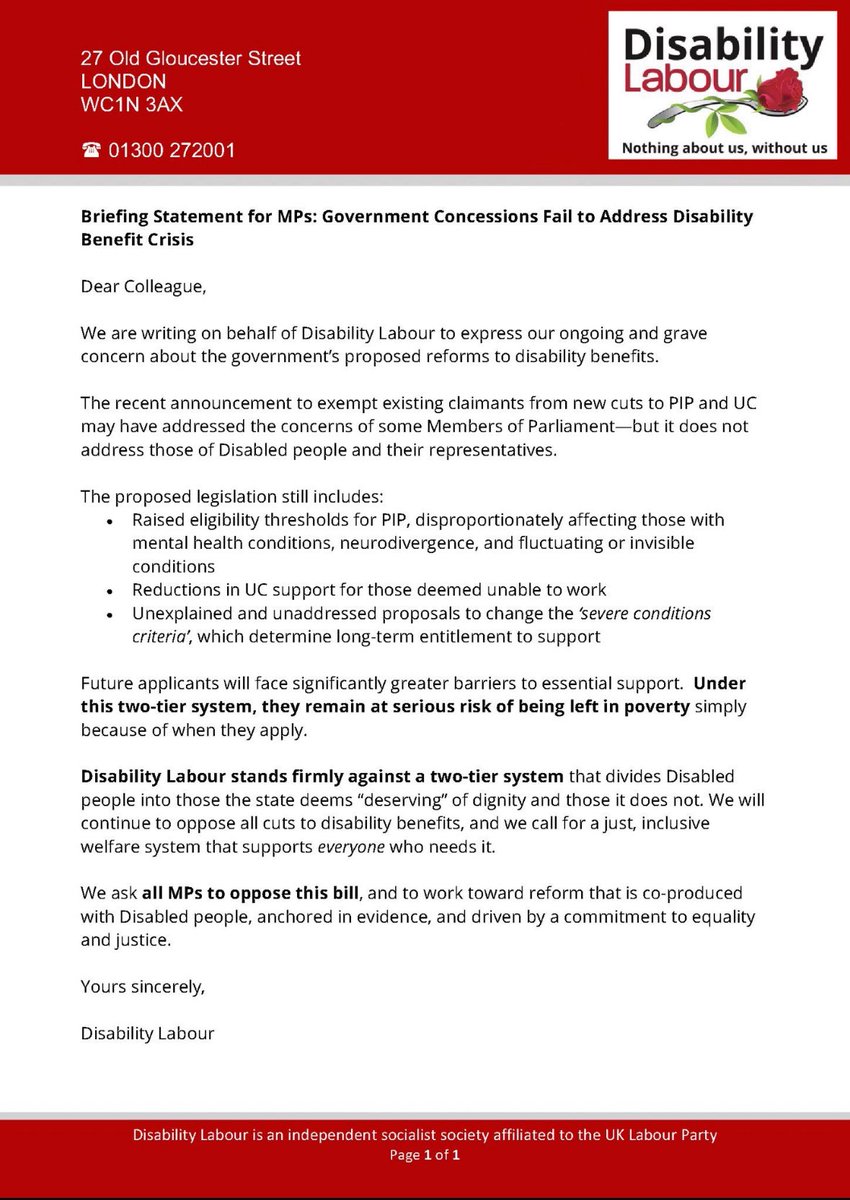
Labour’s official disabled person’s affiliate organisation has issued this statement calling on Labour MP’s to vote against the welfare Bill.
This vote is a simple choice.
Do you believe disabled people should be put in poverty, or not?
I’m voting against these cuts.
The UK shaped the ECHR post-WWII to protect rights, but some Brexit politicians now target it for withdrawal, so the European Movement UK urges staying in to safeguard freedoms, sign our petition now.
https://t.co/lqjyZNmr87
NEW
In Observer iv with @TomBaldwin66 PM admits his August rose garden speech on economic “pain” was a mistake which “squeezed the hope out”… we forgot people wanted something to look forward to as well.”
Consumer confidence recovery did go into reverse around same time
The foreign secretary David Lammy just said in the Commons that he was unable to say whether the UK would be obliged under NATO’s article 5 to intervene in the conflict with Iran were Iran to attack the US, because this would breach the provision of the ministerial code which says he cannot disclose what legal advice he may or may not have received from the Attorney General. So I think we can safely assume that legal advice has been sought whether the UK would be obliged in those circumstances to stand with the US in a military sense
No surprise that Trump’s bunker-buster bombing of Iran’s Fordow has happened at a weekend, when markets closed. Investors have 24 hours to assess the scale and distribution of collateral damage, with the oil price the primary driver of all other market movements, and deep unease about contagion to currency, debt and shares. Much now depends on how Iran retaliates, including whether it chooses to close the Straits of Hormuz to oil and liquified gas shipping
🚨 BREAKING: Israel’s actions in Gaza may have violated the terms of the country’s agreement with the EU, the bloc’s diplomatic corps found.
🔗 https://t.co/rEeqBLAOZq
HMRC failed to collect £46.8bn tax in 2023-24.
40% relates to small businesses.
Total doesn't include taxes lost due to wealthy stashing wealth offshore, profit shifting by companies.
HMRC was starved of resources. Skilled labour lost, real wage cuts.
https://t.co/tM6mupVLpK
Corporate Welfare
UK chancellor told a oil company the industry would receive a “quid pro quo” in return for higher taxes on its windfall profits.
Carbon capture, usage and storage subsidies were a payoff for higher tax on oil firms.
Govt cut benefits.
https://t.co/vI9VLi98Rw