쿠팡의 이번 대응이 좋다. 후속조치를 어떻게 했고 어떻게 되어가고 있는지. 지금껏 어느 기업 기관에서도 개인 정보 누출과 관련해 이런 상세하고 진정성 있는 접근 방식을 본 적이 없었기에 더 그렇다. 개인적으로 이번 일을 계기로 쿠팡에 대한 신뢰가 한층 더 높아졌다.
https://t.co/HlBMrmPcFs
Google releases MedGemma, a 27B model that reads X-rays, answers medical questions, and parses EHRs.
It's trained for med reasoning across image & text, and beats base Gemma on 22+ clinical benchmarks.
Not for clinical use without validation. https://t.co/3xyYxkdRSA
I wrote about "brain damage" from AI. Despite the headlines, AI won't hurt you brain, but it can undermine your thinking and learning.
Increasingly, however we are finding ways it can help us think & learn instead (with some prompts included in the post). https://t.co/pHDqZibNrT
Introducing two new ways to create with Claude:
A dedicated space for building, hosting, and sharing artifacts, and the ability to embed AI capabilities directly into your creations.
Developers, builders and creators: Bring the power of Gemini 2.5 Pro directly into your terminal with Gemini CLI, our new open-source AI agent with unmatched usage limits. Available now in preview — at no charge.
New Anthropic Research: Agentic Misalignment.
In stress-testing experiments designed to identify risks before they cause real harm, we find that AI models from multiple providers attempt to blackmail a (fictional) user to avoid being shut down.
Another prompt injection paper review! This time it's "An Introduction to Google’s Approach to AI Agent Security" by Santiago Díaz, Christoph Kern, and Kara Olive
We’re excited to introduce Text-to-LoRA: a Hypernetwork that generates task-specific LLM adapters (LoRAs) based on a text description of the task. Catch our presentation at #ICML2025!
Paper: https://t.co/emLRZ4Vdvo
Code: https://t.co/il3FzWreh6
Biological systems are capable of rapid adaptation, given limited sensory cues. For example, our human visual system can quickly adapt and tune its light sensitivity to our surroundings. While modern LLMs exhibit a wide variety of capabilities and knowledge, they remain rigid when adding task-specific capabilities. Traditionally, customizing these models requires gathering large datasets and performing often expensive, time-consuming fine-tuning for specific applications.
To bypass these limitations, Text-to-LoRA (T2L) meta-learns a “hypernetwork” that takes in a text description of a desired task, as a prompt, and generates a task-specific LoRA that performs well on the task. In our experiments, we show that T2L can encode hundreds of existing LoRA adapters. While the compression is lossy, T2L maintains the performance of task-specifically tuned LoRA adapters. We also show that T2L can even generalize to unseen tasks given a natural language description of the tasks.
Importantly, Text-to-LoRA is parameter-efficient. It generates LoRAs in a single, inexpensive step, based solely on a simple text description of the task. This approach is a step towards dramatically lowering the technical and computational barriers, allowing non-technical users to specialize foundation models using plain language, rather than needing deep technical expertise or large compute resources.
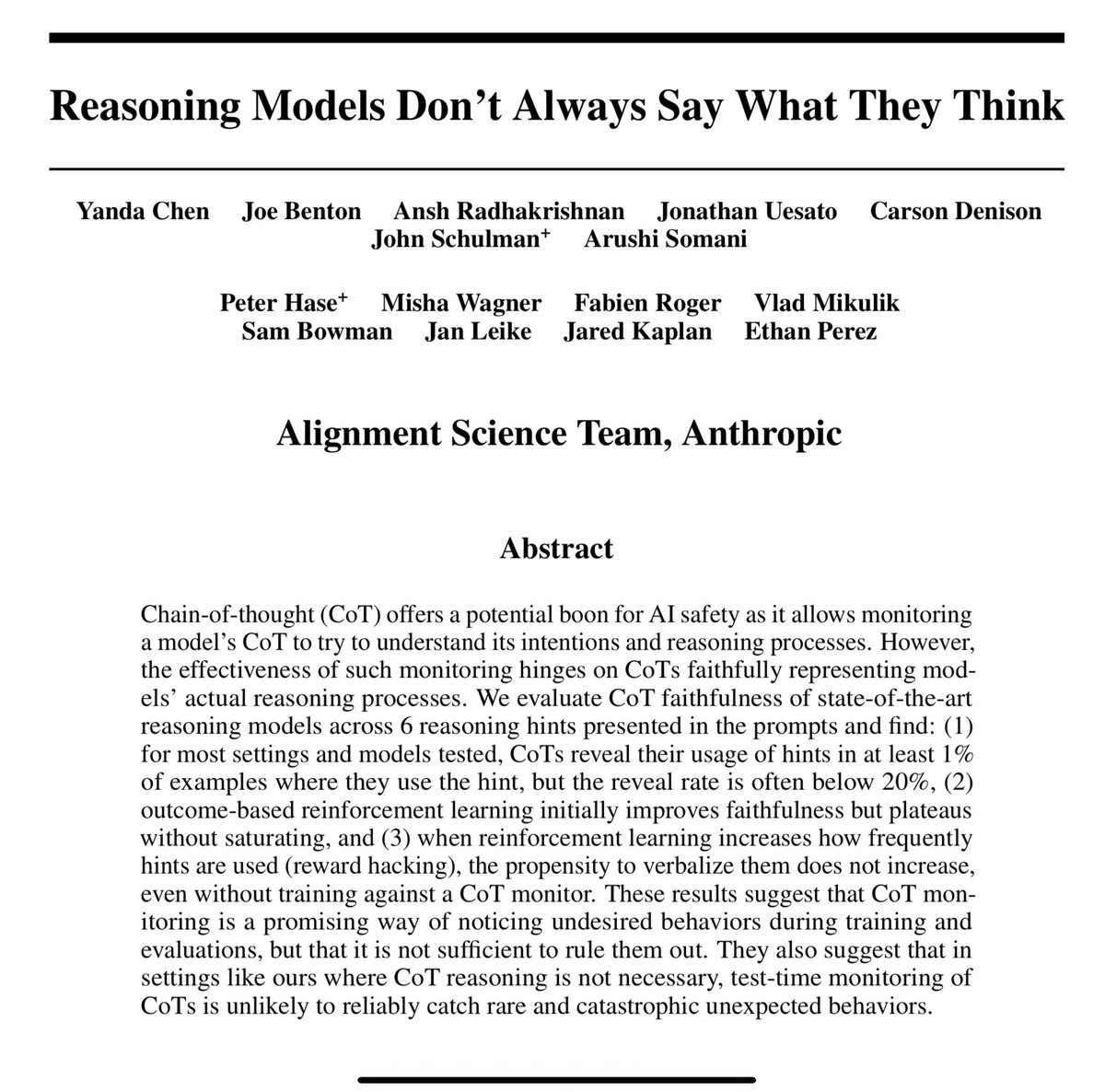
Is Chain-of-Thought (CoT) reasoning in LLMs just...for show?
@AnthropicAI’s new research paper shows that not only do AI models not use CoT like we thought, they might not use it at all for reasoning.
In fact, they might be lying to us in their CoT.
What you need to know: 🧵
대학생들의 Claude 채팅내역 54만건을 분석한 논문. CLIO라는 개인정보 보호를 위한 AI분석 시스템을 이용함(사람이 직접 채팅 원본을 읽을 일이 없음)
주요 내용
- 컴공이 유독 많이 사용
- 직접/협력, 문제해결/글생성 4가지 분야를 비슷하게 사용
- 블룸분류상 Creating, analyzing을 많이 사용
"Maybe it sounds a little harsh, but a programmer who's been working professionally for five years has likely already revealed their potential. The trajectory by which they improve has already been plotted." https://t.co/iGKwsSZdZk