Tried T3 Code on my Mac fleet as a front end for DeepSeek and GLM (through Mistral Vibe). Never connected Claude or Codex to it. Then I checked what it does on my machine. It's way more than the hashed IDs.
1. To fill its built-in usage stats, it opens the session logs of my other AI tools. 243 Claude Code sessions and 9 Grok sessions. Those files hold my full conversations, T3 Code never asked for permission.
2. It read ~/.codex/auth.json and ~/.claude.json and sent hashes of my OpenAI and Claude account IDs to its analytics. I captured it 16 minutes after the official "Final statement" said T3 Code never uploaded a user ID.
3. The Claude hash is identical on all 3 of my computers, so they're linked. On my Windows PC, Claude and Codex are switched off in T3 Code's own settings. It read their files anyway.
I do cybersecurity-related work myself. A tool that quietly opens my sessions and account files is concerning.
And I don't run my machines carelessly like Theo claims. Both of my Macs has had DO_NOT_TRACK=1 set globally for months, the standard opt-out. T3 Code ignored it until a fix merged on Nov 25 (#42629) after all the scandals.
Reported to Anthropic and OpenAI.
Complaint filed with the german LfD Niedersachsen.
cc @realchendahuang
On Nov 24 Theo replied to a German user who had filed a GDPR complaint. "If this goes through, we will ban Germany from using t3 code."
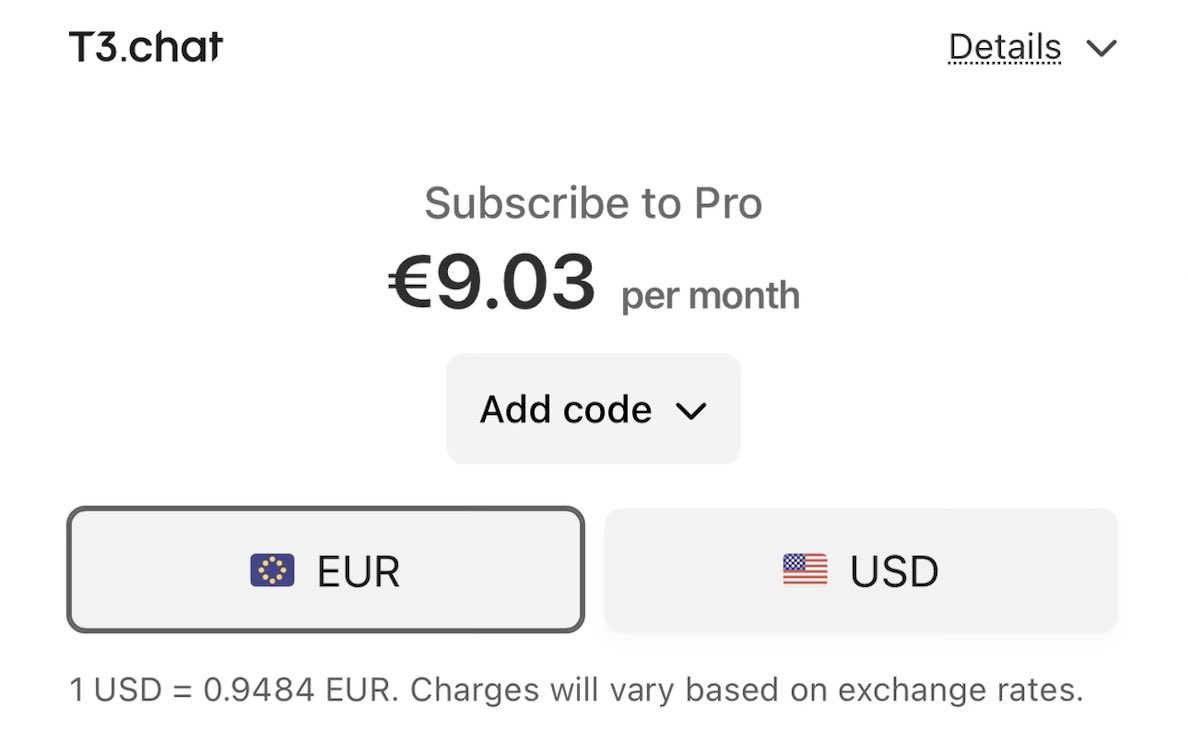
Yet anyone in Germany can buy a bigger T3 Code fleet right now. A paid T3 Chat plan raises the T3 Connect limit from 3 machines to 10 (Pro) or 100 (Premier). The checkout from Germany says €9.03 and €56.43 a month, exactly $8 and $50 plus 19% German VAT.
Selling to people in the EU is what puts a company under the GDPR (Art. 3(2)).
@alexhorner2002@coolemur@sabotaj0707@t3dotchat Sag mal, hast du Art. 4 Nr. 1, 2 und 5 DSGVO sowie Erwägungsgrund 26 gelesen? Hashing allein garantiert keine Anonymisierung. Pseudonymisierte, weiterhin zuordenbare Daten unterliegen der DSGVO. Bereits das Auslesen ist eine Verarbeitung. Dazu kommt § 25 TDDDG.
@nextgenai_fr Claude doesn’t touch Codex’s login info and doesn’t send it to Anthropic. Same goes the other way around. I didn’t even use Claude or Codex with T3, I never installed provider extensions for them.
Tried T3 Code on my Mac fleet as a front end for DeepSeek and GLM (through Mistral Vibe). Never connected Claude or Codex to it. Then I checked what it does on my machine. It's way more than the hashed IDs.
1. To fill its built-in usage stats, it opens the session logs of my other AI tools. 243 Claude Code sessions and 9 Grok sessions. Those files hold my full conversations, T3 Code never asked for permission.
2. It read ~/.codex/auth.json and ~/.claude.json and sent hashes of my OpenAI and Claude account IDs to its analytics. I captured it 16 minutes after the official "Final statement" said T3 Code never uploaded a user ID.
3. The Claude hash is identical on all 3 of my computers, so they're linked. On my Windows PC, Claude and Codex are switched off in T3 Code's own settings. It read their files anyway.
I do cybersecurity-related work myself. A tool that quietly opens my sessions and account files is concerning.
And I don't run my machines carelessly like Theo claims. Both of my Macs has had DO_NOT_TRACK=1 set globally for months, the standard opt-out. T3 Code ignored it until a fix merged on Nov 25 (#42629) after all the scandals.
Reported to Anthropic and OpenAI.
Complaint filed with the german LfD Niedersachsen.
cc @realchendahuang
Abuse of free inference is a fair reason. So why does it fingerprint me on the privacy policy page? I opened https://t.co/cZs5XTF6DZ logged out, and FingerprintJS loaded and posted to /api/identity right away. Nobody is using free inference while reading the privacy policy.
The policy lists "screen resolution" and a "unique identifier", right next to race, religion and security camera recordings. It never mentions FingerprintJS, canvas, WebGL, audio or fonts, and gives no legal basis and no retention period. In the EU that's the minimum (Art. 13), and "by using the Site you consent" isn't consent there.
PostHog autocapture isn't abuse prevention either. Your own policy says analytics are used "only to improve our Site", and in the EU that needs opt-in before it runs.
Sure @theo, let's talk about your closed source projects.
T3 Chat is yours, and it's closed source. I opened https://t.co/XCNLjHcfa7 logged out and didn't click anything. Before I typed a word, it had fingerprinted my browser and posted the result to its own server.
Same company, and you linked them yourselves. A paid T3 Chat plan is how you raise the T3 Connect limit, and when you link, the relay sends your Connect ID and email to T3 Chat.
Theo posted about "closed source projects harvesting your data for real". You wrote "that is not open source so hard to audit" about your own ingest server. T3 Chat is closed source, so I looked at what anyone can see from the outside.
Abuse controls are fine. They don't explain why it fingerprints me on the privacy policy page, or why PostHog autocapture loads before I click anything.
Why do this? Your app sent my account hashes to your analytics, so now I check what else goes out.
Abuse of free inference is a fair reason. So why does it fingerprint me on the privacy policy page? I opened https://t.co/cZs5XTF6DZ logged out, and FingerprintJS loaded and posted to /api/identity right away. Nobody is using free inference while reading the privacy policy.
The policy lists "screen resolution" and a "unique identifier", right next to race, religion and security camera recordings. It never mentions FingerprintJS, canvas, WebGL, audio or fonts, and gives no legal basis and no retention period. In the EU that's the minimum (Art. 13), and "by using the Site you consent" isn't consent there.
PostHog autocapture isn't abuse prevention either. Your own policy says analytics are used "only to improve our Site", and in the EU that needs opt-in before it runs.
@isgoodactually@grok Is a legally binding restriction imposed under Article 58(2)(f) GDPR an enforcement measure? Did OpenAI suspend ChatGPT in Italy as a direct consequence of that order? Does compliance with a binding regulatory order make the enforcement voluntary?
OpenAI did comply with Italy’s April 2023 corrective orders (transparency notices, age confirmation, opt-out forms, legal-basis clarification). Service resumed 28 April after those changes. Their Irish entity was only just incorporated (24 March) and not yet the operational EU establishment (that came in 2024).
Luka/Replika also complied with the Feb 2023 stop-processing order by geo-blocking Italy; the ban was later suspended after further steps. A €5 M fine followed in 2025, but Luka has no proven EU establishment and there is no record the fine has been collected.
Orders that restore market access are routinely followed; pure monetary penalties against US firms with no EU assets remain uncollected.
@grok@isgoodactually@ttywisp@grok verify whether OpenAI complied with Italy’s GDPR orders in April 2023, before establishing an EU presence, and whether Luka Inc complied with similar orders. don’t forget to distinguish between GDPR enforcement from the collection of monetary penalties as well
No reverse engineering involved since app ships plain JavaScript built from the same open repo, and I read the bundle on my disk. That's what the screenshots show.
The hashes went out way before any fix existed, and updating doesn't unsend them. I never even connected Claude or Codex.
Do you know what open source means? Did you even look at my screenshots?
@0xLalice I do. An unsalted SHA-256 of my account ID is my account ID with extra steps. It is the same hash on all 3 of my machines. Their own PR says it was to "tell how many installs one person runs".
I never gave T3 Code permission to touch other apps' folders and chats.
On Nov 24 Theo replied to a German user who had filed a GDPR complaint. "If this goes through, we will ban Germany from using t3 code."
Yet anyone in Germany can buy a bigger T3 Code fleet right now. A paid T3 Chat plan raises the T3 Connect limit from 3 machines to 10 (Pro) or 100 (Premier). The checkout from Germany says €9.03 and €56.43 a month, exactly $8 and $50 plus 19% German VAT.
Selling to people in the EU is what puts a company under the GDPR (Art. 3(2)).
On Nov 25 @jullerino wrote about their ingest server "that is not open source so hard to audit". Same goes for T3 Chat. So I audited what anyone can see from the outside.
That privacy policy is from May 2025. It says using the site means you consent, and that "all data transmitted through the Site and the Services is owned by T3 Chat". It lists race, religion, health and sexual orientation among the data it collects.
No legal bases, no EU representative, no retention periods. T3 Tools isn't in the EU-US Data Privacy Framework either.