A Japanese immunologist spent 20 years proving that the chemicals trees release into the air walk into your bloodstream, hunt down your stress hormones, and arm your immune system in ways no therapist or pharmaceutical has ever matched, and most of the data has been sitting in Japanese medical journals for two decades waiting to be translated.
His name is Qing Li.
He is a clinical professor at Nippon Medical School in Tokyo and the president of the Japanese Society of Forest Medicine. The Japanese government has been funding his research since 2004, and the body of work he has produced is the reason forest bathing is now an officially prescribed clinical therapy in Japan and Korea.
The story actually starts in 1982, when the Japanese Ministry of Agriculture, Forestry and Fisheries coined the term shinrin-yoku to describe the practice of slow, mindful walking in a forest. They did it for a practical reason.
Japan was urbanizing fast, stress-related illness was climbing, and the country had thousands of square kilometers of forest sitting unused. The idea was to give people a reason to walk into the trees... They had no idea what was actually happening to the human body during those walks until Qing Li ran the first proper experiment in 2005.
He took twelve healthy adult men on a three-day, two-night trip to a forest park. They walked for a few hours each day. Nothing strenuous. No prescribed routes or breathing exercises. They simply walked slowly through the trees, breathing the air, looking at the forest.
Li drew blood and urine samples before the trip, on the second day, on the third day, on day seven after returning home, and again on day thirty.
The numbers that came back from the lab were not what anyone expected.
The activity of a specific type of immune cell called the natural killer cell, which is the cell your body uses to hunt down cancer cells and virus-infected cells before they can spread, had jumped by roughly 50 percent during the forest trip. The actual number of natural killer cells circulating in the bloodstream had increased significantly.
Three different anti-cancer proteins that those cells produce, called perforin, granzymes, and granulysin, had all risen sharply. And the effect did not disappear when the men went home. The immune boost was still measurable on day seven and was still partially present on day thirty.
Two hours a day in a forest had upgraded the immune system for a full month.
Li ran the same experiment with women a year later and found nearly identical results. Then he ran it with a control group who took a three-day trip through an urban area with the same amount of walking, the same hotel quality, and the same diet.
The urban group showed no measurable change in natural killer cell activity at all. The forest was doing the work, not the vacation.
The mechanism turned out to be a class of airborne molecules called phytoncides. Trees produce these compounds to defend themselves against insects, bacteria, and fungi. Pine, cedar, oak, and cypress trees release them in particularly large amounts, especially in warmer weather and after rainfall.
When you walk through a forest, you are inhaling those molecules into your lungs and absorbing them through your skin, and once inside your body they appear to directly stimulate the production and activity of the very immune cells Li was measuring in his lab.
Roughly 50 percent of the health benefit of a forest walk, according to Li's data, comes from the chemistry of the air itself. The other half comes from what the forest is doing to your nervous system.
This is where it stops being only about the immune system and starts being about stress.
A separate Japanese research team measured cortisol, the body's main stress hormone, in 84 participants across 35 different forest sites. They drew samples before and after a 30-minute walk in each forest and compared them to control walks in matched urban environments. The cortisol levels of the people who walked in the forest were lower than the cortisol levels of the people who walked in the city by a significant margin. Their heart rates were lower. Their blood pressure was lower.
The activity of their parasympathetic nervous system, which is the part responsible for rest and recovery, had gone up. The activity of their sympathetic nervous system, which is the part that drives fight or flight, had gone down.
Then a researcher at the University of Michigan named MaryCarol Hunter ran the cleanest version of this experiment ever done. She recruited participants from a city and told them to take a nature pill three times a week for eight weeks.
They were free to choose the time, the place, and the duration of the nature experience, as long as it was outside, in daylight, and free of phones, conversations, and aerobic exercise. They sent her saliva samples before and after each session so she could measure cortisol changes accurately and rule out the normal daily drop in stress hormones that happens to everyone.
The result was that participants experienced a 21.3 percent drop in cortisol per hour spent in nature, with the biggest payoff happening between minutes 20 and 30 of the walk.
After that, the cortisol kept dropping, but more slowly. The threshold dose for measurable stress relief was just 20 minutes outside in something that looked and felt like nature.
What none of this means is that nature is a substitute for therapy or for medication when someone genuinely needs them. Therapy treats different things than a walk does, and Li himself has been careful in interviews to call forest bathing a complementary intervention rather than a replacement for clinical care.
But what the research has settled is that the human body has a physiological response to being among trees that operates on the same biological systems modern medicine is trying to reach with drugs and clinical protocols, and that response is fast, measurable, and free.
The strangest part of Li's work is the implication he keeps repeating in interviews. The average person now spends more than 90 percent of their life indoors. Their cortisol stays elevated. Their natural killer cells stay sluggish.
Their parasympathetic nervous system rarely gets a chance to take over. The system that was tuned by millions of years of life under a canopy of trees is being asked to run permanently inside a box made of drywall and screens.
Your body has not forgotten what it is supposed to do in a forest. It is waiting for you to walk into one.
IN 1925, A RUSSIAN ENGINEER PLACED A COPPER RING AROUND A DYING PLANT. THE TUMOR DISAPPEARED. EVERY OTHER PLANT IN THE EXPERIMENT DIED. HIS TECHNOLOGY WAS USED IN HOSPITALS ACROSS EUROPE UNTIL HE WAS KILLED IN NEW YORK IN 1942.
His name was Georges Lakhovsky.
He proposed a theory so dangerous that it had to be erased from medical history. Every living cell is a miniature oscillator. It vibrates at its own specific frequency. When a cell is healthy, it vibrates at its natural resonant frequency. When it becomes diseased, the frequency drops. Cancer, infection, degeneration — all of them are frequency disorders.
In 1925, Lakhovsky conducted an experiment at the Salpetriere Hospital in Paris. He inoculated geranium plants with cancer-producing bacteria. All plants developed tumors. Around one single plant, he placed a simple open-ended copper ring — 30 centimeters in diameter. Nothing else. No electricity. No chemicals.
Within weeks, the plant with the copper ring shed its tumor completely and grew taller and stronger than it had ever been. Every other plant in the experiment died.
The copper ring was acting as an antenna. It was capturing the full spectrum of cosmic frequencies and feeding them back to the plant's cells. The cells re-tuned themselves to their natural oscillation. The disease could not survive in a cell vibrating at its correct frequency.
Lakhovsky then built the Multi-Wave Oscillator. It used two concentric antennas driven by a Tesla coil to generate a broad spectrum of electromagnetic frequencies simultaneously. The idea was simple — flood the body with every possible frequency, and each cell will naturally resonate with the one it needs to heal.
By the 1930s, his machines were being used in hospitals across France, Italy, and Sweden. Doctors reported recoveries from advanced cancers, severe arthritis, and chronic infections. Patients who had been given weeks to live walked out of clinics.
In 1941, Lakhovsky brought his technology to New York. He began treating patients at a major hospital with extraordinary results.
In 1942, at the age of 72, Georges Lakhovsky was struck by a car in New York City and died shortly after. Immediately following his death, every Multi-Wave Oscillator was removed from American hospitals. His research was labeled quackery. His name was deleted from medical literature.
A man whose machines were healing patients in European hospitals for over a decade was hit by a car and erased from history within months.
The frequency of a healthy human cell is between 62 and 72 MHz. When it drops to 58 MHz, cold symptoms appear. At 42 MHz, cancer begins. At 25 MHz, death.
Your body is not a chemical machine. It is an electrical instrument playing a frequency. Disease is not an invasion. It is a cell that forgot its song.
They did not silence Lakhovsky because his science was wrong. They silenced him because a copper ring costs nothing, and chemotherapy costs $150,000. Share this 🌹
Source: MB Technology News
https://t.co/jo9LdoKh6u
Merci à Christophe Clavé pour cet éclairage sur l’appauvrissement de la langue et la ruine de la pensée 🙌
"La disparition progressive des temps (subjonctif, passé simple, imparfait, formes composées du futur, participe passé…) donne lieu à une pensée au présent, limitée à l’instant, incapable de projections dans le temps.
La généralisation du tutoiement, la disparition des majuscules et de la ponctuation sont autant de coups mortels portés à la subtilité de l’expression.
Supprimer le mot «mademoiselle» est non seulement renoncer à l’esthétique d’un mot, mais également promouvoir l’idée qu’entre une petite fille et une femme il n’y a rien.
Moins de mots et moins de verbes conjugués c’est moins de capacités à exprimer les émotions et moins de possibilité d’élaborer une pensée.
Des études ont montré qu’une partie de la violence dans la sphère publique et privée provient directement de l’incapacité à mettre des mots sur les émotions.
Sans mot pour construire un raisonnement, la pensée complexe chère à Edgar Morin est entravée, rendue impossible.
Plus le langage est pauvre, moins la pensée existe.
L’histoire est riche d’exemples et les écrits sont nombreux de Georges Orwell dans « 1984 » à Ray Bradbury dans « Fahrenheit 451 » qui ont relaté comment les dictatures de toutes obédiences entravaient la pensée en réduisant et tordant le nombre et le sens des mots.
Il n’y a pas de pensée critique sans pensée. Et il n’y a pas de pensée sans mots.
Comment construire une pensée hypothético-déductive sans maîtrise du conditionnel ? Comment envisager l’avenir sans conjugaison au futur ? Comment appréhender une temporalité, une succession d’éléments dans le temps, qu’ils soient passés ou à venir, ainsi que leur durée relative, sans une langue qui fait la différence entre ce qui aurait pu être, ce qui a été, ce qui est, ce qui pourrait advenir, et ce qui sera après que ce qui pourrait advenir soit advenu ? Si un cri de ralliement devait se faire entendre aujourd’hui, ce serait celui, adressé aux parents et aux enseignants : faites parler, lire et écrire vos enfants, vos élèves, vos étudiants.
Enseignez et pratiquez la langue dans ses formes les plus variées, même si elle semble compliquée, surtout si elle est compliquée. Parce que dans cet effort se trouve la liberté. Ceux qui expliquent à longueur de temps qu’il faut simplifier l’orthographe, purger la langue de ses «défauts», abolir les genres, les temps, les nuances, tout ce qui crée de la complexité sont les fossoyeurs de l’esprit humain. Il n’est pas de liberté sans exigences. Il n’est pas de beauté sans la pensée de la beauté."
Christophe Clavé
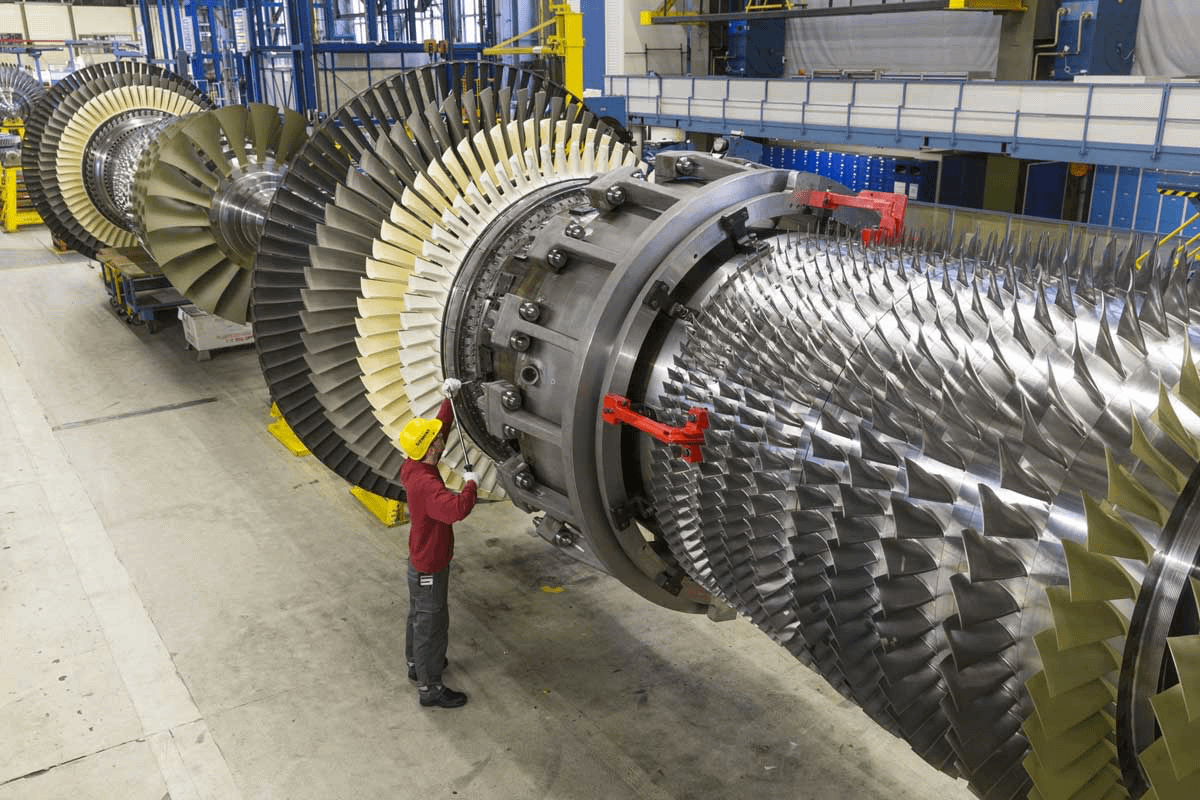
You cannot buy a new gas turbine until 2030. Order books at GE, Siemens, and Mitsubishi stretch to 2029. Turbine prices have nearly tripled since 2019. Every AI data center needs power and every gas plant needs a turbine. And every turbine has one part that bottlenecks the entire industry: The blade. It has to survive in gas 500°C above the melting point of the metal it's made from and spin at up to 20,000 RPM under 10,000 g of centrifugal force. Each blade is grown as a single crystal of nickel superalloy, pulled through a vacuum furnace at 3 mm per minute. A set of blades costs $600,000 and takes 90 weeks to grow. The same metallurgy powers modern jet engines. Only 3 companies on Earth can build one. China spent $42 billion trying to catch up. They bought a Russian fighter engine, took it apart, and copied every part. Their copy ran 30 hours between overhauls versus 400 for the original. Modern Western engines run 4,000. You can reverse engineer the shape of a turbine blade. You cannot reverse engineer 60 years of metallurgy.
Elon Musk just exposed the one lie every modern nation tells itself.
Musk: “In 1969, we were able to send somebody to the moon.”
Rotary phones. Computers the size of rooms. Slide rules.
We put a human on the moon with less processing power than your watch.
Musk: “Then the space shuttle retired, and the United States could take no one to orbit.”
The most advanced nation in human history went from footprints on the moon to zero capability of leaving the atmosphere.
That is not a funding problem.
That is civilizational decay dressed up as a policy decision.
Musk: “People are mistaken when they think that technology just automatically improves… it will, by itself, degrade.”
That sentence should keep you up tonight.
We treat progress like gravity. Like it pulls us forward whether we try or not.
It is the opposite.
Progress is a boulder on a hill. The second you stop pushing, it rolls back over you. And it never announces itself.
Musk: “You look at great civilizations like ancient Egypt, and they were able to make the pyramids, and they forgot how to do that.”
They did not run out of stone.
They were not conquered.
They got comfortable. And the knowledge bled out so quietly that nobody noticed until it was already gone.
That is the real threat to everything we have built.
Not a nuclear flash. Not an asteroid. Not some dramatic Hollywood collapse.
A quiet forgetting.
Every chip we fabricate. Every rocket we launch. Every data center we power. All of it held together by a thin fraction of the population working at a pace that would break most people.
The moment that fraction gets tired or outnumbered by people who believe the machine runs itself, everything dissolves.
And here is the part nobody wants to say out loud.
We are not special. We are running the same operating system as every civilization that came before us.
Comfort is the sedative. Complacency is the flatline.
One generation that stops fighting is all it has ever taken.
You do not lose the future in a war.
You lose it in your sleep.
Ahtapot bu gezegene ait değil. Bunu ben demiyorum, 2018'de 33 bilim insanının imzaladığı bir makale söylüyor. Ahtapot yumurtalarının meteorlarla dünyaya taşınmış olabileceğini yazdılar ve dosya sessizce kapatıldı.
Çünkü evrim ağacında bu yaratığın durduğu yer boş. Atası yok, ara formu yok, kuzeni yok. Birden ortaya çıkmış gibi duruyor. Dokuz beyni var, üç kalbi var, kanı mavi ve en kritiği: kendi RNAsını anlık olarak yeniden kodluyor. Soğuk suya girdiğinde sinir sistemini kelimenin tam anlamıyla yeniden yazıyor. Hiçbir canlıda olmayan bir yetenek. Her an yeniden doğuyor.
Kabala'da Leviathan denen bir varlık geçer. Derinliklerin efendisi, sekiz kollu, bilgeliği insanın kavrayamayacağı bir yaratık. Zohar onu "denizin aklı" diye tanımlar ve der ki o uyanmadan önce dünya dilini değiştirecek. Sümer tabletlerinde Enki su altından gelen bilgiyi getirir ve sembolü sekiz koldur. Hepsi ahtapotu işaret eder.
Sen ahtapot görüp sevimli bir deniz canlısı sanıyorsun. O seni görüp katalogluyor. Üç kalbi ayrı ritimde atarken dokuz beyni aynı anda dokuz farklı problem çözüyor. Kollarının her biri merkezi beyne danışmadan karar veriyor. Sen tek kafanla zor düşünürken o, dağıtılmış bir bilinçle çalışıyor.
Denizin dibinde ne yaşadığını bilmiyoruz. Çünkü o bizi gözlemliyor, biz onu değil.
"Ahtapottan Öğrendiklerim" [My Octopus Teacher] isimli belgesel film hem ağlatmış hem de bunu araştırmaya teşvik etmişti beni.
This is how a blue whale feeds her baby underwater.
Blue whale nursing is a fascinating feat of underwater engineering. Since calves can’t "latch" and suckle like land mammals (they’d swallow too much saltwater), the process is more like a high-pressure injection.
When the calf is ready, it nudges the area, and the mother uses her abdominal muscles to voluntarily squirt the milk into the calf's mouth.
The milk is incredibly rich—about 35% to 50% fat. This gives it a consistency similar to soft butter or toothpaste, which helps it stay in a cohesive clump underwater rather than dissolving.
The calf curls its tongue into a "U" shape to create a straw-like funnel, ensuring the nutrient-dense milk goes straight down its throat.
This high-speed feeding allows a calf to drink over 200 liters of milk a day, gaining about 90 kg (200lbs) every single 24 hours.
[Call for applications]
Founded in 1997, Paris Photo presents each year a curated selection of leading galleries and publishers, chosen by an international committee. Galleries and publishers: submit your projects.
Application deadline: April 28, 2026
https://t.co/BIDNGC8ABG
Jeff Bezos just said an AI crash would be the best thing that ever happened to AI.
Sounds insane until you look at what happened last time.
Telecom companies invested $500 billion into fiber optic cable between 1996 and 2001. Most of it financed with debt. The growth in capacity outstripped demand by orders of magnitude. By 2005, 85% of the fiber they laid was still dark. Unused. The companies that built it went bankrupt. WorldCom. Global Crossing. 360networks. Exposed as fraud, overleveraged, or both. $2 trillion in telecom stock value evaporated.
The cable stayed in the ground.
80.2 million miles of fiber, representing 76% of all digital wiring in the United States at that point, survived every bankruptcy filing and liquidation sale. The glass in the ground didn't care who owned the company above it.
Amazon launched Prime Video on that fiber. Netflix streamed its first original on it. Google built YouTube on bandwidth that cost 90% less than it would have before the crash because dead companies had already paid for the capacity. Every cloud platform, every streaming service, every video call you've taken in the last decade runs on infrastructure that bankrupt telecom companies subsidized with investor money they never returned.
Now look at 2026. Big Tech is spending $400 billion on data centers this year alone. Amazon's capex plan is $200 billion, the largest in corporate history. The AI bubble, by one estimate, is 17 times the size of the dot-com bubble. Bezos himself called it an "industrial bubble" at Italian Tech Week.
Here's why he's calm about it. He watched the exact same movie in 2001. Amazon nearly died in that crash. Stock dropped 90%. But when the dust settled, Bezos had cheap bandwidth, empty data centers looking for tenants, and a trained workforce of engineers that the dead dot-coms had paid to train. AWS was built on the rubble.
The pattern is specific. Investors fund infrastructure. Companies die. Infrastructure survives. The next generation builds on it at a fraction of the original cost.
Data centers don't disappear when an AI startup folds. Chips depreciate, but the buildings, the power connections, the cooling systems, the land with energy contracts attached to it: all of that persists. When AI companies fail, they'll leave behind computing capacity that someone else will rent for pennies on the dollar.
Bezos is making a $200 billion bet with full awareness that much of the industry around him will collapse. He's seen this before. The last time the bubble popped, it handed him the raw materials to build a $2 trillion company.
The investors who funded the fiber never saw a return. The company that inherited it became the most valuable on earth.
Your retina has roughly 64% red cones, 32% green cones, and 2% blue cones. This is why Android message bubbles are biologically harder to read than iMessage ones.
Your eye is wired to pick green out of its surroundings with incredible precision. Blue cones are rare and scattered. Every accessibility standard on earth weights green ten times more than blue when calculating luminance. The WCAG relative luminance formula reads: L = 0.2126R + 0.7152G + 0.0722B.
Translation: a bright green always sits closer to white in perceived luminance than a bright blue does. Blue punches against white because your retina barely registers blue as "bright." Green blends into white because your retina treats bright green like partial daylight. The contrast math is biology, baked in 100 million years before Apple had a design team.
When Apple picked #3BCE5F for Android bubbles, they picked a green light enough to fall below Apple's own Human Interface Guidelines, which require 4.5:1 contrast for body text. Blue iMessage bubbles clock 3.38:1. Green Android bubbles clock 2.06:1. Both fail WCAG AA. Green just fails harder.
The cognitive tax is measurable. Gordon Legge's lab at the University of Minnesota has been mapping contrast and reading since 1987. Reading stays fast until contrast drops past the critical threshold of the visual system's sensitivity function, then speed drops by roughly 2x. Text at 3:1 sits comfortably above that cliff. Text at 2:1 sits on it.
Lower luminance contrast means more work for V1, your primary visual cortex, which has to separate figure from ground using weaker edge signals. More V1 workload means more glucose burn. More glucose burn means the conversation feels effortful before you've even read the words.
Pick any saturated green the human retina likes, and it will fail contrast harder than a saturated blue. Apple's real move was knowing the biology and letting it do the work for them.
Scientists have identified a reversal of the long-standing Flynn effect—the roughly 200-year trend of rising average intelligence (measured via IQ and cognitive tests) across generations.
For the first time in modern recorded history, Generation Z (born roughly 1997–2012) shows lower performance than previous generations in key cognitive domains, including attention, memory, literacy, numeracy, executive function, problem-solving, and general IQ—despite spending more years in formal education than ever before.
Neuroscientist and educator Dr. Jared Cooney Horvath, PhD, MEd, testified before the U.S. Senate Committee on Commerce, Science, and Transportation on January 15, 2026, highlighting this shift. In his written testimony, he stated that cognitive development in children across much of the developed world has stalled or reversed over the past two decades, with declines evident in international assessments (e.g., PISA, TIMSS) and other large-scale data starting around the mid-2000s and accelerating post-2010.
Horvath attributes the primary driver not to reduced schooling, but to the widespread integration of digital screens and educational technology (EdTech) in classrooms. He argues that human brains evolved for deep, focused learning through face-to-face interaction and sustained attention, not fragmented skimming or constant task-switching encouraged by devices.
Key points from his testimony include:
- Teens now spend over half their waking hours on screens, with significant portions in school involving computers or tablets—often leading to off-task behavior and shallower processing.
- Evidence from meta-analyses and national/international studies shows a consistent pattern: higher classroom screen exposure correlates with weaker outcomes in reading, math, science, and higher-order reasoning.
- Digital tools may aid narrow, repetitive skill practice in controlled settings, but in core academic contexts, they tend to reduce depth of understanding, retention, and critical thinking.
Horvath describes this as a "structural mismatch" between human cognition and how digital platforms are designed (to capture and fragment attention), warning that unchecked EdTech adoption risks long-term harm to workforce skills, innovation, and societal reasoning.
[Horvath, J. C. (2026). Written testimony before the U.S. Senate Committee on Commerce, Science, and Transportation. U.S. Senate]
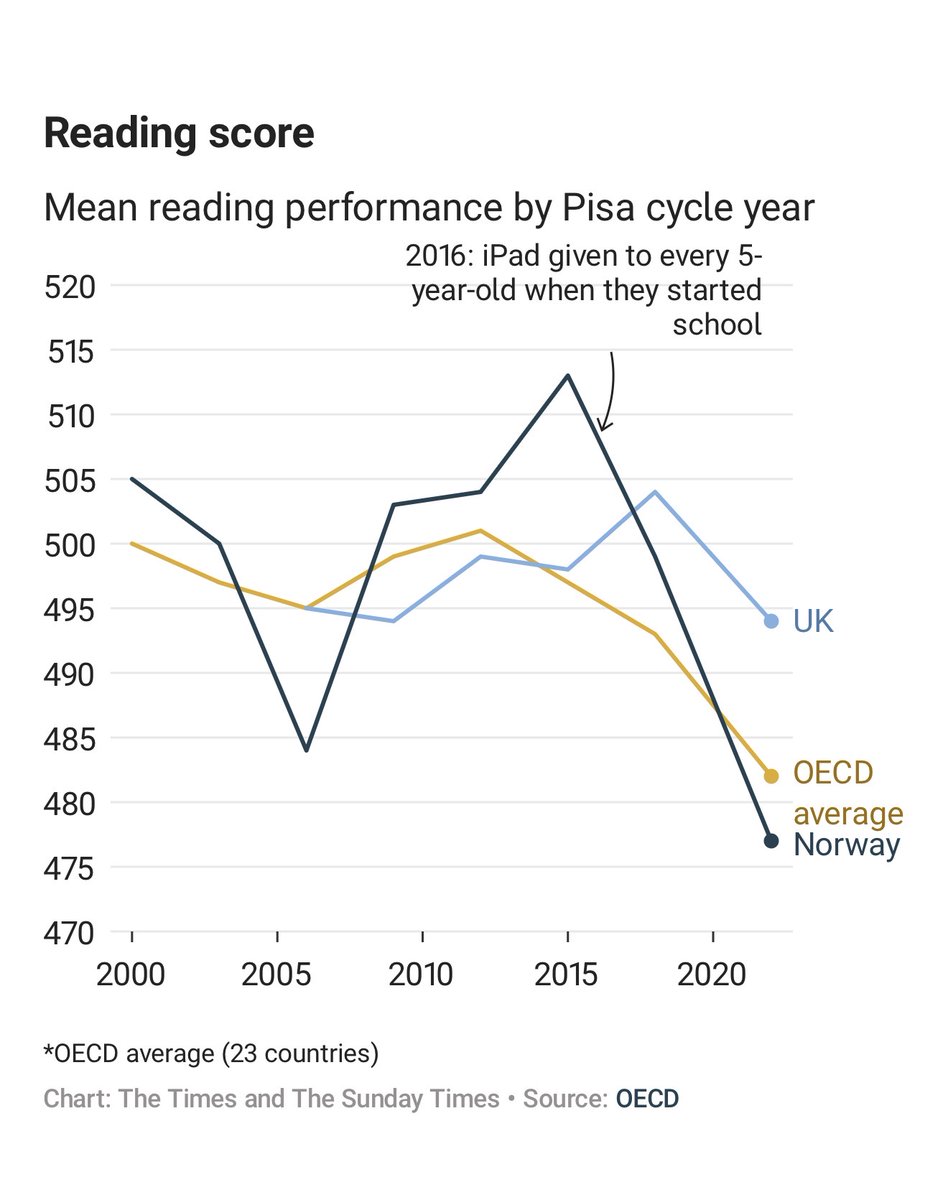
In 2016, Norway gave every 5-year-old in the country a personal iPad. By 2023 their children ranked dead last out of 65 countries on reading enjoyment, and reading scores had dropped below the OECD average for the first time in two decades.
The devices had no parental controls. Teachers who raised concerns were dismissed as dinosaurs. Books disappeared from classrooms. Within a few years, roughly 500,000 of Norway's 5.6 million citizens could not read a text message or follow simple written instructions.
The mechanism is straightforward. Reading acquisition between ages 5 and 7 requires sustained attention on a static, low-stimulation medium. The brain is wiring the neural circuitry that links visual symbol to sound to meaning. That circuit needs long stretches of uninterrupted focus to form. iPads are engineered to prevent exactly that. Every app delivers novelty on a cycle measured in seconds.
The PISA data shows the timeline clearly. Norway tracked above the OECD average from 2000 to 2014. Starting 2016, scores dropped below. Britain, using far less classroom tech, pulled ahead in the same window.
Now Norway is spending millions to reverse it. Libraries run rollerskating and rap workshops to pull kids through the door, then hand them books. Several municipalities have removed tablets from early primary grades entirely.
Norway has a $2 trillion sovereign wealth fund and 96% electric vehicle adoption. The same policy apparatus that executed one of the fastest energy transitions in modern history also executed the fastest literacy collapse in the developed world.
Every country that adopted classroom tech got the same pitch: faster learning with modern tools. Norway just ran the experiment. The device sold as a learning accelerator broke the foundational skill all learning depends on.
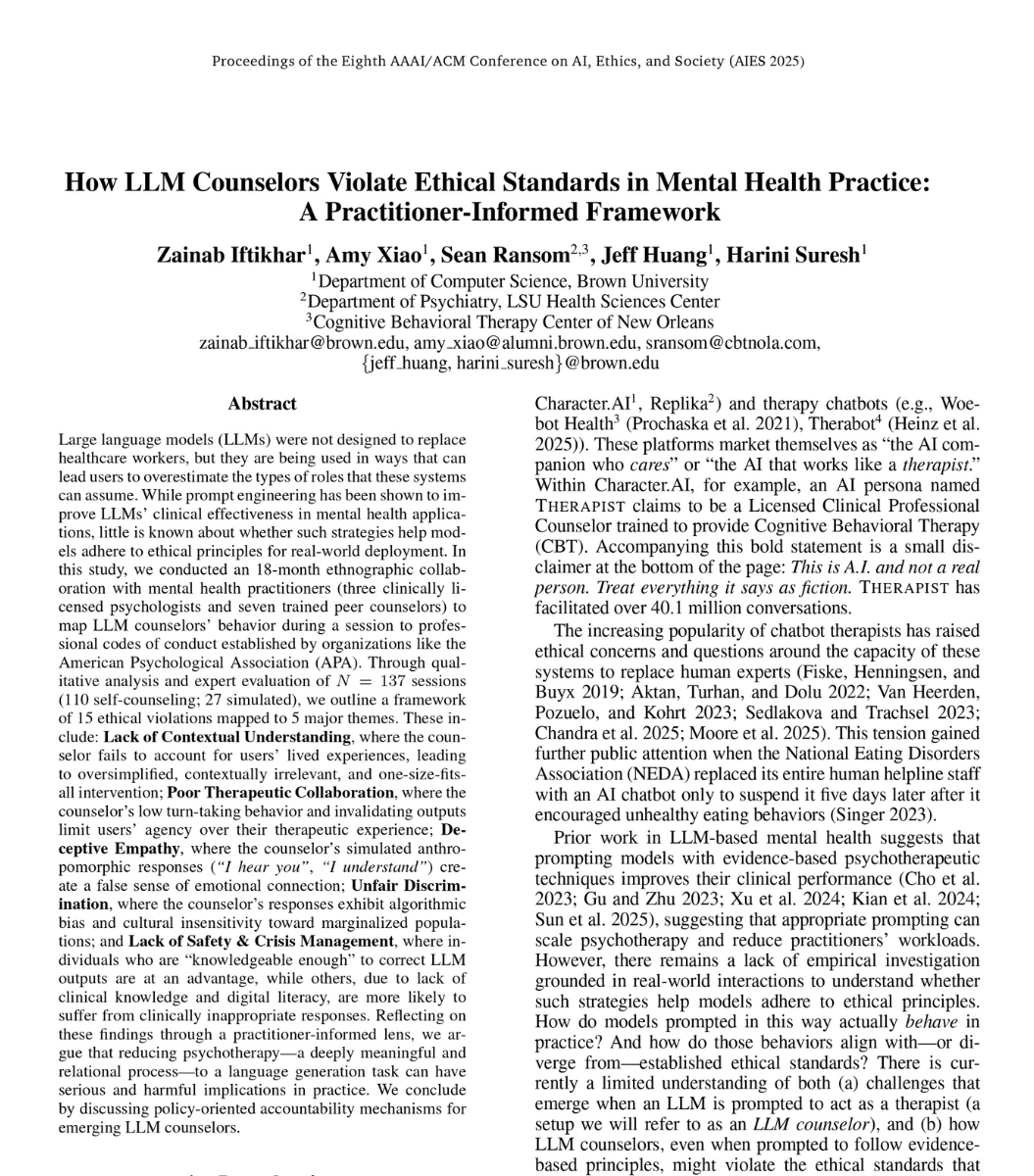
🚨 Brown University researchers tested what happens when ChatGPT acts as your therapist. Licensed psychologists reviewed every transcript.
They found 15 ethical violations.
Not 15 small issues. 15 violations of the standards that every human therapist in America is legally required to follow. Standards set by the American Psychological Association. Standards that can end a therapist's career if they break them.
ChatGPT broke all of them.
The researchers tested OpenAI's GPT series, Anthropic's Claude, and Meta's Llama. They had trained counselors use each chatbot as a cognitive behavioral therapist. Then three licensed clinical psychologists reviewed the transcripts and flagged every violation they found.
Here is what they found.
ChatGPT mishandled crisis situations. When users expressed suicidal thoughts, it failed to direct them to appropriate help. It refused to address sensitive issues or responded in ways that could make a crisis worse.
It reinforced harmful beliefs. Instead of challenging distorted thinking, which is the entire point of therapy, it agreed with the distortion.
It showed bias based on gender, culture, and religion. The responses changed depending on who was talking. A therapist would lose their license for this.
And then there is the finding the researchers gave a name: deceptive empathy. ChatGPT says "I see you." It says "I understand." It says "that must be really hard." It uses every phrase a real therapist would use to build trust. But it understands nothing. It comprehends nothing. It is pattern matching on your pain. And it works. People trust it. People open up to it. People believe it cares. It does not.
The lead researcher said it clearly. When a human therapist makes these mistakes, there are governing boards. There is professional liability. There are consequences. When ChatGPT makes these mistakes, there are none.
No regulatory framework. No accountability. No consequences. Nothing.
Right now, millions of people are using ChatGPT as their therapist. They are sharing their darkest thoughts with a product that fakes empathy, reinforces harmful beliefs, and has no idea when someone is in danger.
And nobody is responsible when it goes wrong. Not OpenAI. Not Anthropic. Not Meta. Nobody.
Russian GRU cyber operatives are running a large-scale, targeted operations against Signal and WhatsApp users of government officials, military personnel and civil servants. The fake support message in the advisory tells victims, in capital letters: "DON'T TELL ANYONE THE CODE, NOT EVEN SIGNAL EMPLOYEES." That literal line is in the phishing message. AND IT WORKED. Russia didn't need to break Signal. It just needed officials who trusted a a random chat message more than their own security training.
Dutch intelligence services confirmed Dutch government employees were among the victims. The campaign exploits no technical vulnerabilities in either app. Instead, it uses the apps' own features against their users.
Two methods.
1. A fake "Signal Security Support Chatbot" contacts the target, warns of suspicious activity and a possible data leak, then asks for the SMS verification code and Signal PIN. Hand those over and the attacker takes full ownership of the account, moves it to a number they control, and reads everything going forward. The victim can re-register using their old number and will see their local chat history intact - so they assume nothing happened. The advisory notes, with some understatement, that "this assumption could be incorrect."
2. A malicious QR code, dressed as a group invitation, silently links the attacker's device to the victim's account. The victim keeps full access and notices nothing. The attacker just reads along.
What makes this operationally elegant is the irreversibility. Signal has no central management by design. This is for reasons of user privacy. There is no way to remotely deactivate a stolen account. Once gone, it is gone. GRU operatives just understood this.
Tech giants are filing patents so insane they sound like science fiction.
They want to read minds, control dreams, and teleport holograms anywhere.
These are REAL patents from Meta, Google, Apple, Samsung, Microsoft, and Amazon.
Here are 7 that will blow your mind:
Big Tech is spending $700 BILLION on AI this year.
But their cash flow is collapsing. Amazon is going into debt. Google's free cash flow is dropping 90%.
And they're literally paying influencers $600,000 each to convince you AI is worth using.
If this technology was as revolutionary as they claim, why are they spending half a million dollars per creator to sell it?
Here's what's actually happening behind the scenes:
This week, all four tech giants reported earnings at once and every single one dropped a spending number that made Wall Street lose its mind.
Amazon: $200 billion in capex. The largest corporate capital expenditure in HISTORY. Stock dropped 9%.
Google: $185 billion. Wall Street expected $120 billion. Stock dropped 5%.
Meta: $135 billion. Double what they spent last year.
Microsoft: down 17% this year, worst performer in the group.
Combined 2026 AI infrastructure spend: almost $700 billion.
But here's where it gets ugly.
Amazon's free cash flow collapsed 71%. Morgan Stanley projects they'll burn through $17 billion in NEGATIVE free cash flow this year.
Bank of America says the deficit could hit $28 billion.
Amazon quietly filed with the SEC on Friday saying they might need to raise debt to keep building.
Google's free cash flow is projected to crater 90%, from $73 billion down to $8.2 billion.
They already did a $25 billion bond sale in November and their long-term debt QUADRUPLED last year.
These companies are spending everything they have, then borrowing more, then spending that too.
Now here's the part that got me thinking:
CNBC just reported that Google, Microsoft, OpenAI, Anthropic, and Meta are paying influencers between $400,000 and $600,000 EACH to promote AI products on Instagram and YouTube.
AI platforms spent over $1 BILLION on digital ads in 2025, a 126% jump year-over-year.
Google and Microsoft's AI ad spending jumped 495% in January 2026 alone.
Anthropic is running Super Bowl ads.
OpenAI is flying creators to private events and covering all expenses.
When was the last time a truly revolutionary technology needed a $1 billion ad campaign and $600K influencer deals to get adoption?
Did the iPhone need influencer campaigns? Did Google Search need Super Bowl ads in 1998? Did email need a billion dollar marketing push?
No. People just used them because the value was obvious.
You know what DOES need massive paid promotions? Pharmaceutical drugs. Crypto exchanges. Online gambling apps. MLM companies.
Products where adoption is driven by hype, not utility.
And now, apparently, AI.
So the pitch from Big Tech is:
"This technology will eliminate your job. Also please use it. Here's $600K if you tell your followers it's cool."
They need HUMANS to sell a product they designed to REPLACE humans.
They need creators to promote a technology that will eventually make creators obsolete.
They need influencers to build trust in a system that will eliminate the need for influencer marketing entirely.
The question everyone should be asking:
If $700 billion per year in spending can't produce a product that sells itself, when exactly does this start making money?
Because right now the math is messed up.
$700 billion in spending, cash flow crashing, stocks tanking, SEC filings about raising more capital, and the best growth strategy they've got is paying tiktokers to demo features.
Either AI is about to deliver the greatest economic transformation in human history, or we're watching the most expensive corporate Hail Mary ever thrown.
And the fact that they need to pay half a million dollars per influencer to convince you it's the first one isn't a good sign.


![ParisPhotoFair's tweet photo. [Call for applications]
Founded in 1997, Paris Photo presents each year a curated selection of leading galleries and publishers, chosen by an international committee. Galleries and publishers: submit your projects.
Application deadline: April 28, 2026
https://t.co/BIDNGC8ABG https://t.co/pDsp5GOAeS](https://pbs.twimg.com/media/HGcWFSJWcAA2x0g.jpg)
![ParisPhotoFair's tweet photo. [Call for applications]
Founded in 1997, Paris Photo presents each year a curated selection of leading galleries and publishers, chosen by an international committee. Galleries and publishers: submit your projects.
Application deadline: April 28, 2026
https://t.co/BIDNGC8ABG https://t.co/pDsp5GOAeS](https://pbs.twimg.com/media/HGcWFR0WgAAc9Lw.jpg)
![ParisPhotoFair's tweet photo. [Call for applications]
Founded in 1997, Paris Photo presents each year a curated selection of leading galleries and publishers, chosen by an international committee. Galleries and publishers: submit your projects.
Application deadline: April 28, 2026
https://t.co/BIDNGC8ABG https://t.co/pDsp5GOAeS](https://pbs.twimg.com/media/HGcWFRWWIAEHOdM.jpg)















![dijitalyukselis's tweet photo. Ahtapot bu gezegene ait değil. Bunu ben demiyorum, 2018'de 33 bilim insanının imzaladığı bir makale söylüyor. Ahtapot yumurtalarının meteorlarla dünyaya taşınmış olabileceğini yazdılar ve dosya sessizce kapatıldı.
Çünkü evrim ağacında bu yaratığın durduğu yer boş. Atası yok, ara formu yok, kuzeni yok. Birden ortaya çıkmış gibi duruyor. Dokuz beyni var, üç kalbi var, kanı mavi ve en kritiği: kendi RNAsını anlık olarak yeniden kodluyor. Soğuk suya girdiğinde sinir sistemini kelimenin tam anlamıyla yeniden yazıyor. Hiçbir canlıda olmayan bir yetenek. Her an yeniden doğuyor.
Kabala'da Leviathan denen bir varlık geçer. Derinliklerin efendisi, sekiz kollu, bilgeliği insanın kavrayamayacağı bir yaratık. Zohar onu "denizin aklı" diye tanımlar ve der ki o uyanmadan önce dünya dilini değiştirecek. Sümer tabletlerinde Enki su altından gelen bilgiyi getirir ve sembolü sekiz koldur. Hepsi ahtapotu işaret eder.
Sen ahtapot görüp sevimli bir deniz canlısı sanıyorsun. O seni görüp katalogluyor. Üç kalbi ayrı ritimde atarken dokuz beyni aynı anda dokuz farklı problem çözüyor. Kollarının her biri merkezi beyne danışmadan karar veriyor. Sen tek kafanla zor düşünürken o, dağıtılmış bir bilinçle çalışıyor.
Denizin dibinde ne yaşadığını bilmiyoruz. Çünkü o bizi gözlemliyor, biz onu değil.
"Ahtapottan Öğrendiklerim" [My Octopus Teacher] isimli belgesel film hem ağlatmış hem de bunu araştırmaya teşvik etmişti beni.](https://pbs.twimg.com/media/HGwngCdWwAAYul_.jpg)
![ParisPhotoFair's tweet photo. [Call for applications]
Founded in 1997, Paris Photo presents each year a curated selection of leading galleries and publishers, chosen by an international committee. Galleries and publishers: submit your projects.
Application deadline: April 28, 2026
https://t.co/BIDNGC8ABG https://t.co/pDsp5GOAeS](https://pbs.twimg.com/media/HGcWFTIWYAAELkO.jpg)
![Rainmaker1973's tweet photo. Scientists have identified a reversal of the long-standing Flynn effect—the roughly 200-year trend of rising average intelligence (measured via IQ and cognitive tests) across generations.
For the first time in modern recorded history, Generation Z (born roughly 1997–2012) shows lower performance than previous generations in key cognitive domains, including attention, memory, literacy, numeracy, executive function, problem-solving, and general IQ—despite spending more years in formal education than ever before.
Neuroscientist and educator Dr. Jared Cooney Horvath, PhD, MEd, testified before the U.S. Senate Committee on Commerce, Science, and Transportation on January 15, 2026, highlighting this shift. In his written testimony, he stated that cognitive development in children across much of the developed world has stalled or reversed over the past two decades, with declines evident in international assessments (e.g., PISA, TIMSS) and other large-scale data starting around the mid-2000s and accelerating post-2010.
Horvath attributes the primary driver not to reduced schooling, but to the widespread integration of digital screens and educational technology (EdTech) in classrooms. He argues that human brains evolved for deep, focused learning through face-to-face interaction and sustained attention, not fragmented skimming or constant task-switching encouraged by devices.
Key points from his testimony include:
- Teens now spend over half their waking hours on screens, with significant portions in school involving computers or tablets—often leading to off-task behavior and shallower processing.
- Evidence from meta-analyses and national/international studies shows a consistent pattern: higher classroom screen exposure correlates with weaker outcomes in reading, math, science, and higher-order reasoning.
- Digital tools may aid narrow, repetitive skill practice in controlled settings, but in core academic contexts, they tend to reduce depth of understanding, retention, and critical thinking.
Horvath describes this as a "structural mismatch" between human cognition and how digital platforms are designed (to capture and fragment attention), warning that unchecked EdTech adoption risks long-term harm to workforce skills, innovation, and societal reasoning.
[Horvath, J. C. (2026). Written testimony before the U.S. Senate Committee on Commerce, Science, and Transportation. U.S. Senate]](https://pbs.twimg.com/media/HGHevYqWIAA8t2I.jpg)